Kirjojen hintavertailu. Mukana 12 396 935 kirjaa ja 12 kauppaa.

Kirjahaku

Etsi kirjoja tekijän nimen, kirjan nimen tai ISBN:n perusteella.

33 kirjaa tekijältä Thomas Graham

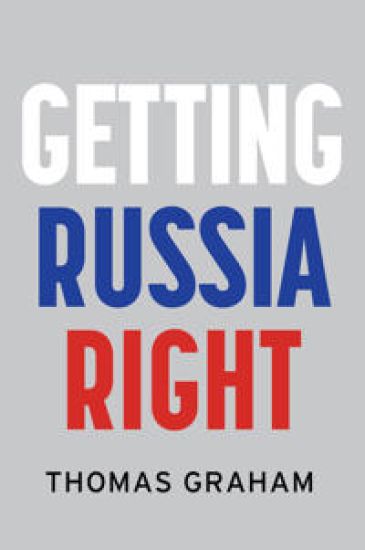
Getting Russia Right

Getting Russia Right

Thomas Graham

JOHN WILEY AND SONS LTD
2025
nidottu
As US-Russian relations scrape the depths of cold-war antagonism, the promise of partnership that beguiled American administrations during the first post-Soviet decades increasingly appears to have been false from the start. Why did American leaders persist in pursuing it? Was there another path that would have produced more constructive relations or better prepared Washington to face the challenge Russia poses today? With a practitioner's eye honed during decades of work on Russian affairs, Thomas Graham deftly traces the evolution of opposing ideas of national purpose that created an inherent tension in relations. Getting Russia Right identifies the blind spots that prevented Washington from seeing Russia as it really is and crafting a policy to advance American interests without provoking an aggressive Russian response. Distilling the Putin factor to reveal the contours of the Russia challenge facing the United States whenever he departs the scene, Graham lays out a compelling way to deal with it so that the United States can continue to advance its interests in a rapidly changing world.Also available as an audiobook.

Flagler's St. Augustine Hotels

Flagler's St. Augustine Hotels

Thomas Graham

Pineapple Press Inc.,U.S.
2004
pokkari
Near the end of the nineteenth century, Standard Oil millionaire Henry Morrison Flagler ventured to St. Augustine, Florida, America's Oldest City, and transformed it into an exotic travel destination for the social elite. He raised magnificent, fanciful Spanish Renaissance hotel palaces on what had been orange grove and salt marsh. Then he connected his creation with the outside world by building a modern railroad system. Flagler's hotels stand as monuments to innovation in architecture and engineering. They were the first large buildings in the United States constructed of poured concrete, and they pioneered use of novel amenities like electric lights, steam heat, and elevators. They are still a vital part of modern St. Augustine. The Ponce de Leon, Flaglers preeminent hotel, now houses Flagler College; the Alcazar now holds the City Hall and the Lightner Museum. Only the Casa Monica (previously called the Cordova) is presently a hotel.
Let's go for a walk

Let's go for a walk

Thomas Graham

Bobby Graham Publishers
2025
pokkari
When Thomas unexpectedly suffered a stroke, he faced loss of mobility to his right-sided limbs. Let's go for a walk is his account of the rehabilitation process to restore his mobility and return to active, independent living.Through a programme of intensive physiotherapy, Thomas worked to regain his physical movement, rebuild his strength, and enhance his stamina. He wrote poetry to support his psychological wellbeing and embraced nature-based activities-sit spotting, forest bathing, walking and gardening-for spiritual sustenance to nurture a greater appreciation for life.His journey of navigating a medical emergency with resilience and positive intent, supported by close family and friends, offers encouragement and hope to stroke survivors, trauma sufferers, and those entrusted with their care.Front cover artwork: 'My MAN(dala)' by Slobodanka Graham
Sapphire: Looking Toward the End of the Cold War
Known to a very few, highly placed individuals in the US government as Sapphire, Linda Blaine is a senior undercover intelligence agent. Though she is known to hostile governments-as well as some US allies-by several different aliases, her real name is not associated with Sapphire's more extraordinary exploits.Linda Blaine/Sapphire/Sophia Lermontov-one and the same person-faced down the Soviet Politburo at the time of the Cuban Missile Crisis. But late in the Cold War, the Soviets bring in a new leadership in an attempt to change the balance of terror. At great personal risk, Linda/Sapphire must once again contend with officials at the highest level of the Soviet government to defeat them in their attempt to create a crisis. Their aim is to destroy American security and wreck the US as a major state, possibly leading to a third world war, which would involve the active use of nuclear weapons. Sapphire again brings her legendary courage and resourcefulness to her continued defense of America.
Elements Of Chemistry, Including The Applications Of The Science In The Arts (Volume I)
The book, Elements Of Chemistry, Including The Applications Of The Science In The Arts (Volume I), has been considered by academicians and scholars of great significance and value to literature. This forms a part of the knowledge base for future generations. So that the book is never forgotten we have represented this book in a print format as the same form as it was originally first published. Hence any marks or annotations seen are left intentionally to preserve its true nature.
Cornerstones of Security

Cornerstones of Security

Thomas Graham; Damien J. LaVera

University of Washington Press
2003
sidottu
This anthology presents the complete text of thirty-four treaties that have effectively contained the spread of nuclear, biological, and conventional weapons during the Cold War and beyond. The treaties are placed in historical context by individual commentaries from noted authorities Thomas Graham Jr. and Damien J. LaVera, which provide unique insights on each treaty's negotiation and implementation.During the 1990s, numerous arms control agreements were concluded under U.N. or U.S. leadership. In 1995, one hundred sixty-five nations agreed to indefinitely extend the Nuclear Nonproliferation Treaty. Many nations ratified important chemical and biological weapons conventions, a pact to reduce conventional forces in Europe, and agreements to limit testing of weapons of mass destruction. More recent treaties seeking to restrain small arms trafficking and ban land mines are also highlighted and analyzed.Graham concludes with lessons learned from the collective negotiation and verification history of these treaties, ongoing efforts to limit weaponry, and general observations on the status and effectiveness of these agreements. There is no comparable resource available for diplomats, international lawyers, and arms control specialists.
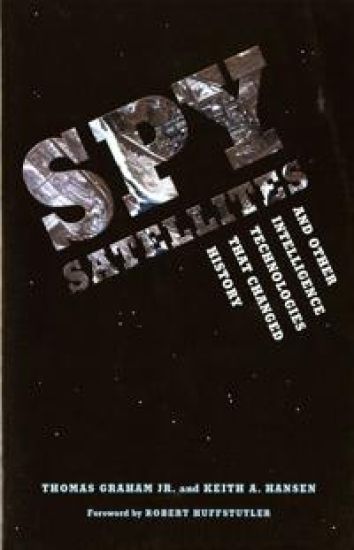
Spy Satellites and Other Intelligence Technologies that Changed History

Spy Satellites and Other Intelligence Technologies that Changed History

Thomas Graham; Keith A. Hansen; Robert Huffstutler

University of Washington Press
2007
pokkari
Much has been said and written about the failure of U.S. intelligence to prevent the terrorist attacks on September 11, 2001, and its overestimation of Iraq's weapons of mass destruction under Saddam Hussein. This book focuses instead on the central role that intelligence-collection systems play in promoting arms control and disarmament.Ambassador Thomas Graham Jr. and Keith Hansen bring more than fifty combined years of experience to this discussion of the capabilities of technical systems, which are primarily based in space. Their history of the rapid advancement of surveillance technology is a window into a dramatic reconceptualization of Cold War strategies and policy planning. Graham and Hansen focus on the intelligence successes against Soviet strategic nuclear forces and the quality of the intelligence that has made possible accurate assessments of WMD programs in North Korea, Iran, and Libya. Their important insights shed a much-needed light on the process of verifying how the world harnesses the proliferation of nuclear arms and the continual drive for advancements in technology.
Unending Crisis

Unending Crisis

Thomas Graham; Hans Blix

University of Washington Press
2012
pokkari
In Unending Crisis, Thomas Graham Jr. examines the second Bush administration's misguided management of foreign policy, the legacy of which has been seven major--and almost irresolvable--national security crises involving North Korea, Iran, Afghanistan, Pakistan, Iraq, the Arab-Israeli conflict in Palestine, and nuclear proliferation. Unending Crisis considers these issues individually and together, emphasizing their interrelationship and delineating the role that the neoconservative agenda played in redefining the way America is perceived in the world today.
Unending Crisis

Unending Crisis

Thomas Graham; Hans Blix

University of Washington Press
2015
sidottu
In Unending Crisis, Thomas Graham Jr. examines the second Bush administration's misguided management of foreign policy, the legacy of which has been seven major--and almost irresolvable--national security crises involving North Korea, Iran, Afghanistan, Pakistan, Iraq, the Arab-Israeli conflict in Palestine, and nuclear proliferation. Unending Crisis considers these issues individually and together, emphasizing their interrelationship and delineating the role that the neoconservative agenda played in redefining the way America is perceived in the world today.
Spy Satellites and Other Intelligence Technologies that Changed History

Spy Satellites and Other Intelligence Technologies that Changed History

Thomas Graham; Keith A. Hansen; Robert Huffstutler

University of Washington Press
2015
sidottu
Much has been said and written about the failure of U.S. intelligence to prevent the terrorist attacks on September 11, 2001, and its overestimation of Iraq's weapons of mass destruction under Saddam Hussein. This book focuses instead on the central role that intelligence-collection systems play in promoting arms control and disarmament.Ambassador Thomas Graham Jr. and Keith Hansen bring more than fifty combined years of experience to this discussion of the capabilities of technical systems, which are primarily based in space. Their history of the rapid advancement of surveillance technology is a window into a dramatic reconceptualization of Cold War strategies and policy planning. Graham and Hansen focus on the intelligence successes against Soviet strategic nuclear forces and the quality of the intelligence that has made possible accurate assessments of WMD programs in North Korea, Iran, and Libya. Their important insights shed a much-needed light on the process of verifying how the world harnesses the proliferation of nuclear arms and the continual drive for advancements in technology.