Kirjojen hintavertailu. Mukana 12 390 323 kirjaa ja 12 kauppaa.

Kirjahaku

Etsi kirjoja tekijän nimen, kirjan nimen tai ISBN:n perusteella.

32 kirjaa tekijältä Timothy B. Smith

The Golden Age of Battlefield Preservation

The Golden Age of Battlefield Preservation

Timothy B. Smith

University of Tennessee Press
2008
sidottu
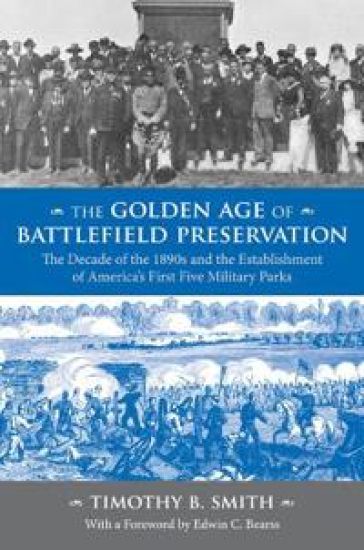
The 1890s, argues Timothy B. Smith in his new book, represented the climax of battlefield preservation in America. But what makes this decade so important? This decade was the perfect time for the establishment of these national parks. Five Civil War battlegrounds—at Gettysburg, Chickamauga and Chattanooga, Shiloh, Antietam, and Vicksburg—were commemorated as national sites during this time. Just past the bitterness and racial tensions of Reconstruction and prior to the explosive growth brought on by the Second Industrial Revolution, the time was right for the war's veterans from both sides to come together, in a spirit of reconciliation and brotherhood, to lead the efforts to open the parks. As yet unmarred by development, these battlefield sites were preserved mostly intact, just how the veterans would have remembered them. To date, they represent the country's finest preserved battlefields.Smith's book is the first to look at the process of battlefield reservation as a whole. He focuses on how each of these sites was established and the important individuals—the congressmen, the former soldiers, the veteran commissioners—who were the catalysts for the creation of these parks. The Golden Age of Battlefield Preservation is a watershed book about an essential period in the history of battlefield preservation and will be of interest to any reader who wishes to have a better understanding how such preservation efforts were initiated. Timothy B. Smith is the author of This Great Battlefield of Shiloh: History, Memory, and the Establishment of a Civil War National Military Park and The Untold Story of Shiloh: The Battle and the Battlefield. He is a former park ranger at the Shiloh National Military Park and now teaches at the University of Tennessee at Martin.
Rethinking Shiloh

Rethinking Shiloh

Timothy B. Smith

University of Tennessee Press
2013
sidottu
Ulysses S. Grant once remarked that the Battle of Shiloh “has been perhaps less understood, or, to state the case more accurately, more persistently misunderstood, than any other engagement during the entire rebellion.” In Rethinking Shiloh, Timothy B. Smith seeks to rectify these persistent myths and misunderstandings, arguing that some of Shiloh’s story is either not fully examined or has been the result of a limited and narrow collective memory established decades ago. Continuing the work he began in The Untold Story of Shiloh, Smith delves even further into the story of Shiloh and examines in detail how the battle has been treated in historiography and public opinion.The nine essays in this collection uncover new details about the battle, correct some of the myths surrounding it, and reveal new avenues of exploration. The topics range from a compelling analysis and description of the last hours of General Albert Sidney Johnston to the effect of the New Deal on Shiloh National Military Park and, subsequently, our understanding of the battle. Smith’s careful analyses and research bring attention to the many relatively unexplored parts of Shiloh such as the terrain, the actual route of Lew Wallace’s march, and post-battle developments that affect currently held perceptions of thatfamed clash between Union and Confederate armies in West Tennessee.Studying Shiloh should alert readers and historians to the likelihood of misconceptions in other campaigns and wars—including today’s military conflicts. By reevaluating aspects of the Battle of Shiloh often ignored by military historians, Smith’s book makes significant steps toward a more complete understanding and appreciation of the Shiloh campaign in all of its ramifications.
The Real Horse Soldiers

The Real Horse Soldiers

Timothy B. Smith

Savas Beatie
2020
nidottu
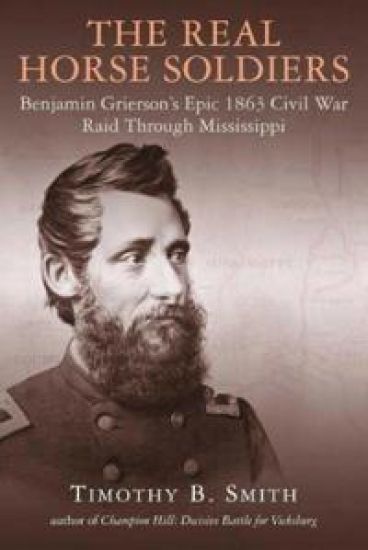
Benjamin Grierson’s Union cavalry thrust through Mississippi is one of the most well-known operations of the Civil War. The last serious study was published more than six decades ago. Since then other accounts have appeared, but none are deeply researched full-length studies of the raid and its more than substantial (and yet often overlooked) results. The publication of Timothy B. Smith’s The Real Horse Soldiers: Benjamin Grierson’s Epic 1863 Civil War Raid through Mississippi, now available in paperback, rectifies this oversight. There were other simultaneous operations to distract Confederate attention from the real threat posed by General U. S. Grant’s Army of the Tennessee across the Mississippi River from Vicksburg in Louisiana. Grierson’s operation, however, conducted with three cavalry regiments and a battery of small artillery pieces, is the most famous. For 16 days (April 17 to May 2), Grierson led Confederate pursuers on a high-stakes chase through the entire state of Mississippi, entering through the northern border with Tennessee and exiting its southern border with Louisiana. The daily rides were long, the rest stops short, and the danger as high as the tension. Ironically, the man who led the raid was a former music teacher who some say disliked horses. Throughout, he displayed outstanding leadership and cunning, destroyed railroad tracks and supplies, burned trestles and bridges, freed slaves, and created as much damage and chaos as possible. Novelists have attempted to capture the larger-than-life cavalry raid in the popular imagination, and Hollywood reproduced the daring cavalry action in The Horse Soldiers, a 1959 major motion picture starring John Wayne and William Holden. Readers of The Real Horse Soldiers who think they know all about this cavalry operation will quickly discover just how complex and important it was, and how close it came to abject failure. Based upon years of research and presented in gripping, fast-paced prose, Timothy B. Smith’s award-winning The Real Horse Soldiers captures the high drama and tension of the 1863 horse soldiers in a modern comprehensive study.
James Z. George

James Z. George

Timothy B. Smith

University Press of Mississippi
2012
sidottu
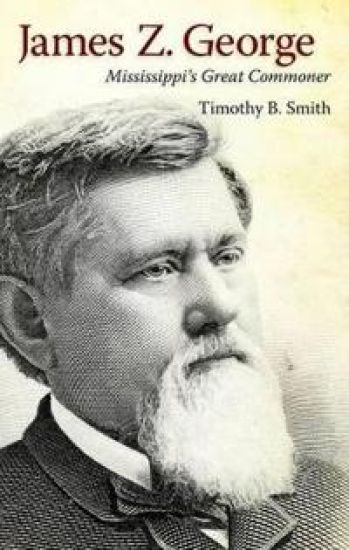
When the Mississippi school boy is asked who is called the 'Great Commoner' of public life in his State,"" wrote Mississippi's premier historian Dunbar Rowland in 1901, ""he will unhesitatingly answer James Z. George."" While George's prominence, along with his white supremacist views, have decreased through the decades since then, many modern historians still view him as a supremely important Mississippian, with one writing that George (1826-1897) was ""Mississippi's most important Democratic leader in the late nineteenth century."" Certainly, the Mexican War veteran, prominent lawyer and planter, Civil War officer, Reconstruction leader, state Supreme Court chief justice, and Mississippi's longest serving United States senator to that time deserves a full biography. And, George's importance was greater than just on the state level as other Southerners copied his tactics to secure white supremacy in their own states. That James Z. George has never had a full, academic biography is inexplicable. James Z. George: Mississippi's Great Commoner seeks to rectify the lack of attention to George's life. In doing so, this volume utilizes numerous sources never before or only slightly used, primarily a large collection of George's letters held by his descendents and never used by historians. Such wonderful sources allow a glimpse not only into the life and times of J. Z. George, but perhaps more importantly an exploration of the man himself, his traits, personality, and ideas. The result is a picture of an extremely commonplace individual on the surface, but an exceptionally complicated man underneath. James Z. George: Mississippi's Great Commoner will bring this important Mississippi leader of the nineteenth century back into the minds of twenty-first century Mississippians.
Altogether Fitting and Proper

Altogether Fitting and Proper

Timothy B. Smith

University of Tennessee Press
2017
sidottu
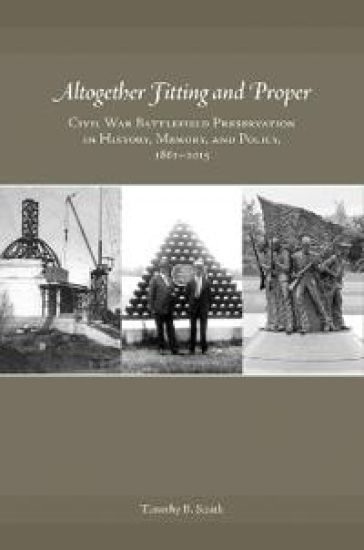
In the century and a half since the Civil War, various entities, both private and public, have earnestly sought to safeguard the legacy of that seismic conflict through the preservation of its battlefields. In Altogether Fitting and Proper—a title taken from Lincoln’s Gettysburg Address—Timothy B. Smith provides the most comprehensive synthesis ever written of the long, often fraught history of those preservation efforts, which began even as the war was still raging and have continued up through the present day.Smith traces the story of battlefield park establishment from the war and the Reconstruction era through the “Golden Age of Preservation” at the turn of the century, to the New Deal period and well beyond. He pays close attention to the evolution of public policy, as the creation and oversight of parks shifted from the War Department to the National Park Service, and explores the evolving ways in which the Civil War has been remembered over the years, most significantly with regard to its causes: slavery and race. While Smith’s primary focus is on the famous national parks—Gettysburg, Shiloh, Antietam, Chickamauga, and others—he also examines the endeavors of state and local governments, as well as an assortment of private organizations, to establish parks and monuments for lesser-known battle sites. The ongoing conflicts between preservationists and commercial developers form another key element of the narrative.As Smith makes clear, the story of battlefield preservation is in many ways a story of people—from Civil War veterans like Henry Boynton, the Medal of Honor winner who oversaw the development of the first national military park at Chickamauga, to Jim Lighthizer, the president of the Civil War Trust, the private charitable organization spearheading the twenty-first-century preservation movement. In their dedication to this particular cause, such individuals and the groups they represent have kept a central event in American history alive in our collective memory.TIMOTHY B. SMITH, who teaches history at the University of Tennessee at Martin, is the author of numerous books on the Civil War and its battlefields, including This Great Battlefield of Shiloh, A Chickamauga Memorial, and The Golden Age of Battlefield Preservation, all published by the University of Tennessee Press.
The Golden Age of Battlefield Preservation

The Golden Age of Battlefield Preservation

Timothy B. Smith

University of Tennessee Press
2025
nidottu
The 1890s, argues Timothy B. Smith, represented the pinnacle of battlefield preservation in America. But what makes this decade so important? This decade was the perfect time for the establishment of these national parks. Five Civil War battlegrounds—at Gettysburg, Chickamauga and Chattanooga, Shiloh, Antietam, and Vicksburg—were commemorated as national sites during this time. Just past the bitterness and racial tensions of Reconstruction and prior to the explosive growth brought on by the Second Industrial Revolution, the time was right for the war's veterans from both sides to come together, in a spirit of reconciliation and brotherhood, to lead the efforts to open the parks. As yet unmarred by development, these battlefield sites were preserved mostly intact, just how the veterans would have remembered them. To date, they represent the country's finest preserved battlefields. Smith's book is the first to look at the process of battlefield reservation as a whole. He focuses on how each of these sites was established and the important individuals—the congressmen, the former soldiers, the veteran commissioners—who were the catalysts for the creation of these parks. The Golden Age of Battlefield Preservation is a watershed book about an essential period in the history of battlefield preservation and will be of interest to any reader who wishes to have a better understanding how such preservation efforts were initiated.
James Z. George

James Z. George

Timothy B. Smith

University Press of Mississippi
2014
nidottu
When the Mississippi school boy is asked who is called the 'Great Commoner' of public life in his State,"" wrote Mississippi's premier historian Dunbar Rowland in 1901, ""he will unhesitatingly answer James Z. George."" While George's prominence has decreased through the decades since then, many modern historians still view him as a supremely important Mississippian, with one writing that George (1826-1897) was ""Mississippi's most important Democratic leader in the late nineteenth century."" Certainly, the Mexican War veteran, prominent lawyer and planter, Civil War officer, Reconstruction leader, state Supreme Court chief justice, and Mississippi's longest serving United States senator in his day deserves a full biography. And, George's importance was greater than just on the state level as other Southerners copied his tactics to secure white supremacy in their own states. James Z. George: Mississippi's Great Commoner seeks to rectify the lack of attention to George's life. In doing so, this volume utilizes numerous sources never before or only slightly used, primarily a large collection of George's letters held by his descendents and never used by historians. Such wonderful sources allow a glimpse not only into his times, but perhaps more importantly an exploration of the man himself, his traits, personality, and ideas. The result is a picture of an extremely commonplace individual on the surface but an exceptionally complicated man underneath. James Z. George: Mississippi's Great Commoner will bring this important Mississippi leader of the nineteenth century back into the minds of twenty-first-century Mississippians.
The Mississippi Secession Convention

The Mississippi Secession Convention

Timothy B. Smith

University Press of Mississippi
2014
sidottu
The Mississippi Secession Convention is the first full treatment of any secession convention to date. Studying the Mississippi convention of 1861 offers insight into how and why southern states seceded and the effects of such a breech. Based largely on primary sources, this book provides a unique insight into the broader secession movement.There was more to the secession convention than the mere act of leaving the Union, which was done only three days into the deliberations. The rest of the three-week January 1861 meeting as well as an additional week in March saw the delegates debate and pass a number of important ordinances that for a time governed the state. As seen through the eyes of the delegates themselves, with rich research into each member, this book provides a compelling overview of the entire proceeding.The effects of the convention gain the most analysis in this study, including the political processes that, after the momentous vote, morphed into unlikely alliances. Those on opposite ends of the secession question quickly formed new political allegiances in a predominantly Confederate-minded convention. These new political factions formed largely over the issues of central versus local authority, which quickly played into Confederate versus state issues during the Civil War. In addition, author Timothy B. Smith considers the lasting consequences of defeat, looking into the effect secession and war had on the delegates themselves and, by extension, their state, Mississippi.
Mississippi in the Civil War

Mississippi in the Civil War

Timothy B. Smith

University Press of Mississippi
2014
nidottu
In Mississippi in the Civil War: The Home Front, Timothy B. Smith examines Mississippi's Civil War defeat by both outside and inside forces. From without, the Union army dismantled the state's political system, infrastructure, economy, and fighting capability. The state saw extensive military operations, destruction, and bloodshed within her borders. One of the most frightful and extended sieges of the war ended in a crucial Confederate defeat at Vicksburg, the capstone to a tremendous Union campaign.As Confederate forces and Mississippi became overwhelmed militarily, the populace's morale began to crumble. Realizing that the enemy could roll unchecked over the state, civilians, Smith argues, began to lose the will to continue the struggle. Many white Confederates chose to return to the Union rather than see continued destruction in the name of a victory that seemed ever more improbable. When the tide turned, Unionists and African Americans boldly stepped up their endeavors. The result, Smith finds, was a state vanquished and destined to endure suffering far into its future.The first examination of the state's Civil War home front in seventy years, this book tells the story of all classes of Mississippians during the war, focusing new light on previously neglected groups such as women and African Americans. The result is a revelation of the heart of a populace facing the devastating impact of total war.
Napoleon's Long Shadow

Napoleon's Long Shadow

Timothy B. Smith

UNIVERSITY PRESS OF KANSAS
2026
sidottu
This pioneering work is the first to examine Napoleon’s influence on the Civil War through direct, battle-by-battle comparison. For the generation that fought the American Civil War, the wars of the early nineteenth century were not distant history—they were a professional guide. Military education at West Point and elsewhere immersed American officers in the campaigns of Europe’s great commanders, and none cast a longer shadow than the Corsican general Napoleon Bonaparte. Despite decades of casual analogy, until now, no comprehensive study has ever examined how Napoleon’s campaigns shaped Civil War operations on the battlefield. Through a series of clear, apples-to-apples comparisons, author Tim Smith places nine of Napoleon’ campaigns alongside their closest Civil War counterparts. The result is a fresh interpretation of how the Civil War was fought. Smith argues that the war’s early years were profoundly shaped by earlier models of warfare, while its final year marked a decisive break toward a more modern, industrial style of conflict. By placing these campaigns side by side, Napoleon’s Long Shadow not only clarifies how Civil War commanders operated, but also challenges long-held assumptions rooted more in legend than in reality.
Foundations of Multicultural Psychology

Foundations of Multicultural Psychology

Timothy B. Smith; Joseph Trimble

American Psychological Association
2015
sidottu
Multicultural psychology is a vibrant, emerging discipline with great potential to inform therapists about cultural considerations relevant to mental health. But to what extent are existing assumptions about culturally-informed practice based on research evidence? This book brings clarity to the current evidence base, shifting the conversation toward greater inclusion of cultural factors in psychotherapy and helping those conversations become more reliant on data than on opinion. Using meta-analytic methods to summarize what we know, this balanced, comprehensive book is a major step towards establishing a core set of principles for multicultural scholarship and providing answers to the fundamental questions in the field. For instance, how large are racial discrepancies in mental health service utilization and what factors predict those discrepancies? To what extent are perceptions of racism and ethnic identity associated with psychological well-being? And to what extent can therapists’ multicultural training and competence benefit diverse clients? The answers to these questions are relevant and important to every therapist who works in our multicultural world.
Multivariate Analysis for the Biobehavioral and Social Sciences

Multivariate Analysis for the Biobehavioral and Social Sciences

Bruce L. Brown; Suzanne B. Hendrix; Dawson W. Hedges; Timothy B. Smith

John Wiley Sons Inc
2012
sidottu
An insightful guide to understanding and visualizing multivariate statistics using SAS®, STATA®, and SPSS® Multivariate Analysis for the Biobehavioral and Social Sciences: A Graphical Approach outlines the essential multivariate methods for understanding data in the social and biobehavioral sciences. Using real-world data and the latest software applications, the book addresses the topic in a comprehensible and hands-on manner, making complex mathematical concepts accessible to readers. The authors promote the importance of clear, well-designed graphics in the scientific process, with visual representations accompanying the presented classical multivariate statistical methods . The book begins with a preparatory review of univariate statistical methods recast in matrix notation, followed by an accessible introduction to matrix algebra. Subsequent chapters explore fundamental multivariate methods and related key concepts, including: Factor analysis and related methods Multivariate graphics Canonical correlation Hotelling's T-squared Multivariate analysis of variance (MANOVA) Multiple regression and the general linear model (GLM) Each topic is introduced with a research-publication case study that demonstrates its real-world value. Next, the question "how do you do that?" is addressed with a complete, yet simplified, demonstration of the mathematics and concepts of the method. Finally, the authors show how the analysis of the data is performed using Stata®, SAS®, and SPSS®. The discussed approaches are also applicable to a wide variety of modern extensions of multivariate methods as well as modern univariate regression methods. Chapters conclude with conceptual questions about the meaning of each method; computational questions that test the reader's ability to carry out the procedures on simple datasets; and data analysis questions for the use of the discussed software packages. Multivariate Analysis for the Biobehavioral and Social Sciences is an excellent book for behavioral, health, and social science courses on multivariate statistics at the graduate level. The book also serves as a valuable reference for professionals and researchers in the social, behavioral, and health sciences who would like to learn more about multivariate analysis and its relevant applications.