Kirjojen hintavertailu. Mukana 12 016 292 kirjaa ja 12 kauppaa.

Kirjahaku

Etsi kirjoja tekijän nimen, kirjan nimen tai ISBN:n perusteella.

83 kirjaa tekijältä Walter Lippmann

The Good Society

The Good Society

Walter Lippmann

Routledge
2017
sidottu
The Good Society is a critical text in the history of liberalism. Initially a series of articles published in a variety of Lippmann's favorite magazines, as the whole evolved, it became a frontal assault against totalitarian tendencies within American society. Lippmann took to task those who sought to improve the lot of mankind by undoing the work of their predecessors and by undermining movements in which men struggle to be free. This book is a strong indictment of programs of reform that are at odds with the liberal tradition, and it is critical of those who ask people to choose between security and liberty.The Good Society falls naturally into two segments. In the first, Lippmann shows the errors and common fallacies of faith in government as the solution to all problems. He says, "from left to right, from communist to conservative. They all believe the same fundamental doctrine. All the philosophies go into battle singing the same tune with slightly different words." In the second part of the book, Lippmann offers reasons why liberalism lost sight of its purpose and suggests the first principles on which it can flourish again.Lippmann argues that liberalism's revival is inevitable because no other system of government can work, given the kind of economic world mankind seeks. He did not write The Good Society to please adherents of any political ideology. Lippmann challenges all philosophies of government, and yet manages to present a positive program. Bewildered liberals and conservatives alike will find this work a successful effort to synthesize a theory of liberalism with the practice of a strong democracy. Gary Dean Best has provided the twenty-first century reader a clear-eyed context for interpreting Lippmann's defense of classical liberalism.The Good Society is the eleventh in a series of books written by Walter Lippmann reissued by Transaction with new introductions and in a paperback format. As with other major figures of the twentieth century such as Thorstein Veblen, Peter Drucker, Margaret Mead, and Richard Hoggart, these are classic books with contemporary perspectives.
The Phantom Public

The Phantom Public

Walter Lippmann

Routledge
2017
sidottu
In an era disgusted with politicians and the various instruments of "direct democracy," Walter Lippmann's The Phantom Public remains as relevant as ever. It reveals Lippmann at a time when he was most critical of the ills of American democracy. Antipopulist in sentiment, this volume defends elitism as a serious and distinctive intellectual option, one with considerable precursors in the American past. Lippmann's demythologized view of the American system of government resonates today.The Phantom Public discusses the "disenchanted man" who has become disillusioned not only with democracy, but also with reform. According to Lippmann, the average voter is incapable of governance; what is called the public is merely a "phantom." In terms of policy-making, the distinction should not be experts versus amateurs, but insiders versus outsiders. Lippmann challenges the core assumption of Progressive politics as well as any theory that pretends to leave political decision making in the hands of the people as a whole.In his biography Walter Lippmann and the American Century, Ronald Steel praised The Phantom Public as "one of Lippmann's most powerfully argued and revealing books. In it he came fully to terms with the inadequacy of traditional democratic theory." This volume is part of a continuing series on the major works of Walter Lippmann. As more and more Americans are inclined to become apathetic to the political system, this classic will be essential reading for students, teachers, and researchers of political science and history.
The Public Philosophy

The Public Philosophy

Walter Lippmann

Routledge
2017
sidottu
Begun in 1938 and completed only in 1955, The Public Philosophy offers as much a glimpse into the private philosophy of America's premier journalist of the twentieth century as it does a public philosophy.The basis of Lippmann's effort is "that there is a deep disorder in our society which comes not from the machinations of our enemies and from the adversaries of the human condition but from within ourselves." He also provides a special sort of legacy to liberalism in its broadest sense - as the root approach to human existence that could provide civility and accommodation against incivilities and extremism, and that uniquely stood against the totalitarian counter-revolutions from Jacobism to Leninism. This work is a masterful defense of the public philosophy as a constitutional tradition, and can be easily read as such today.Paul Roazen, long identified with the analysis of Lippmann's work, points out that no matter how trenchantly Lippmann dissected democracy, and the populist faith in the people's wisdom, he still sought to study the world in order to help govern it. His constant flow of journalistic writing had the educative intent of raising the level of the public's knowledge. His rationalist conviction that clearheadedness on public matters can be effectively relayed to people is nowhere more evident than in The Public Philosophy. In this sense it is an argument for the democratic ideal that people can be rallied in defense of the public interest.
The Stakes of Diplomacy

The Stakes of Diplomacy

Walter Lippmann

Routledge
2017
sidottu
Walter Lippmann is arguably the most influential journalist in American history. From the time of Woodrow Wilson to the time of Lyndon Johnson, what Walter Lippmann said mattered. His word was valued because of his exceptional capacity for analysis, and because he had the rare ability to make complex ideas and problems manageable and understandable. Lippmann combined the practical and the theoretical and saw them as inseparable. He savored the life of the mind and relished the arena of politics. He was political philosopher, social commentator, political advisor and activist-intellectual.As the country grappled with an impressive influx of European ideas and with the threatening press of European problems, so did Lippmann. Like President Wilson, he came to believe that the condition of the modern world required that America either act or be acted upon. New methods of communication and propaganda meant that ideas contrary to America's would be widely heard. Reformed liberalism and the projection of that liberalism into a troubled world were the best hedge against totalitarian schemes and imperialist aggression. The Stakes of Diplomacy resulted from Lippmann's assignment by Wilson's Secretary of War Baker, to a project for studying possible terms of peace and ways to influence the world in a liberal-democratic direction.The Stakes of Diplomacy ends both with admiration for the peaceful nature of democracies and a plea for their further influence in the world, and with an understanding that democracy's influence will depend partly upon its physical might and geopolitical collaboration. Lippmann stands as a prominent figure in America's twentieth-century quest for power with honor. He concludes this volume with the warning that there is no safe way and no morally feasible way to turn back from our dangerous mission: "Unless the people who are humane and sympathetic, the people who wish to live and let live, are masters of the situation, the world faces an indefinite vista of conquest and terror."
Public Opinion

Public Opinion

Walter Lippmann

Lulu.com
2018
sidottu
Public Opinion is Walter Lippmann's groundbreaking work which demonstrates how individual beliefs are swayed by stereotypes, the mass media, and political propaganda. The book opens with the notion that democracy in the age of super fast communications is obsolete. He analyses the impact of several phenomena, such as the radio and newspapers, to support his criticisms of the sociopolitical situation as it stands. He famously coins the term 'manufactured consent', for the fomenting of views which ultimately work against the interests of those who hold them. Lippmann contends that owing to the masses of information flung at the population on a daily basis, opinions regarding entire groups in society are being reduced to simple stereotypes. The actual complexity and nuance of life, Lippmann contends, is undermined by the ever-faster modes of communication appearing regularly.
Public Opinion

Public Opinion

Walter Lippmann

Lulu.com
2018
pokkari
Public Opinion is Walter Lippmann's groundbreaking work which demonstrates how individual beliefs are swayed by stereotypes, the mass media, and political propaganda. The book opens with the notion that democracy in the age of super fast communications is obsolete. He analyses the impact of several phenomena, such as the radio and newspapers, to support his criticisms of the sociopolitical situation as it stands. He famously coins the term 'manufactured consent', for the fomenting of views which ultimately work against the interests of those who hold them. Lippmann contends that owing to the masses of information flung at the population on a daily basis, opinions regarding entire groups in society are being reduced to simple stereotypes. The actual complexity and nuance of life, Lippmann contends, is undermined by the ever-faster modes of communication appearing regularly. News by nature presents or emphasizes only some of the facts.
The Stakes of Diplomacy

The Stakes of Diplomacy

Walter Lippmann

AldineTransaction
2008
nidottu
Walter Lippmann is arguably the most influential journalist in American history. From the time of Woodrow Wilson to the time of Lyndon Johnson, what Walter Lippmann said mattered. His word was valued because of his exceptional capacity for analysis, and because he had the rare ability to make complex ideas and problems manageable and understandable. Lippmann combined the practical and the theoretical and saw them as inseparable. He savored the life of the mind and relished the arena of politics. He was political philosopher, social commentator, political advisor and activist-intellectual.As the country grappled with an impressive influx of European ideas and with the threatening press of European problems, so did Lippmann. Like President Wilson, he came to believe that the condition of the modern world required that America either act or be acted upon. New methods of communication and propaganda meant that ideas contrary to America's would be widely heard. Reformed liberalism and the projection of that liberalism into a troubled world were the best hedge against totalitarian schemes and imperialist aggression. The Stakes of Diplomacy resulted from Lippmann's assignment by Wilson's Secretary of War Baker, to a project for studying possible terms of peace and ways to influence the world in a liberal-democratic direction.The Stakes of Diplomacy ends both with admiration for the peaceful nature of democracies and a plea for their further influence in the world, and with an understanding that democracy's influence will depend partly upon its physical might and geopolitical collaboration. Lippmann stands as a prominent figure in America's twentieth-century quest for power with honor. He concludes this volume with the warning that there is no safe way and no morally feasible way to turn back from our dangerous mission: "Unless the people who are humane and sympathetic, the people who wish to live and let live, are masters of the situation, the world faces an indefinite vista of conquest and terror."
Public Persons

Public Persons

Walter Lippmann

AldineTransaction
2010
nidottu
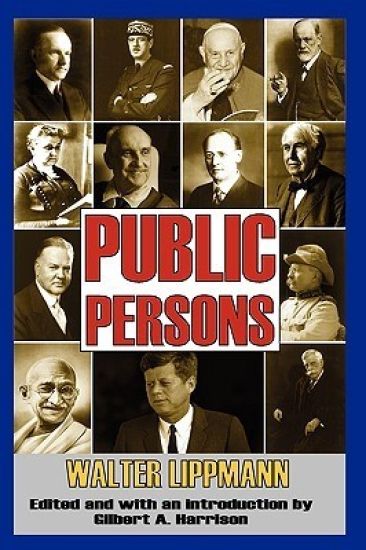
This set of brief pieces examines the relation of power to knowledge. Lippmann paid little homage to the innate wisdom of the people. While he had no wish to disenfranchise citizens, he believed elites drove the engines of power. His point was that liberty and democracy require government that will, when necessary, "swim against the tides of private feelings." Because the public is too divided, poorly informed, and too self-regarding, authority has to be delegated, perhaps to "intelligence bureaus," or at least to those who are wiser than the many that have the power to decide vexing questions on their own merits.Lippmann knew that in the real world we cannot expect to be ruled by philosopher-kings. While ready to settle for less, he was not ready to settle for politicians who get ahead "only as they placate, appease, bribe, seduce, bamboozle and otherwise manage to manipulate demanding and threatening elements in their constituencies." The seducers and bamboozlers were generally in charge, and because they were in an age "rich with varied and generous passions" they had become disorderly and deranged.Public Persons is the informal side of The Public Philosophy. Lippmann tries to account for the decline of Western democracies and prescribe for their revival. He concludes that it is not possible to discover by rational inquiry the conditions that must be met if there is to be a good society. Lippmann saw tension between private impulses and transcendent truth as the "inexhaustible theme of human discourse." The occasional harmonies in the lives of saints and the deeds of heroes and the excellence of genius are glorious. But glory was the exception, wretchedness the rule. In this casual volume both are given a human face.
Public Opinion

Public Opinion

Walter Lippmann

Digireads.com
2020
nidottu
First published in 1922, "Public Opinion" is the fascinating study of the role of citizens in a democracy by Walter Lippmann, an American writer, reporter and political commentator. Lippmann's notable career spanned decades and produced some of the most important journalism in American history. He was the first to introduce the concept of the Cold War, received many awards, including two Pulitzer Prizes, and wrote thousands of articles and columns, earning him the title of the "Great Elucidator". "Public Opinion" is Lippmann's assessment of a functional democratic government and the role that citizens play in the democracy. Lippmann examines the dilemmas presented in revolutionary periods of history and raises doubts on the ability of citizens to effectively govern themselves. He draws important attention to the media's role in shaping public perceptions and opinions and presciently warns against the power of propaganda. Lippmann's work exploring modern democracy, how it functions, and what situations most threaten its success have made "Public Opinion" a staple in the field of political science. Lippmann's work was far ahead of its time in understanding the dangers of propaganda and his conclusions remain relevant and thought-provoking nearly a century later. This edition is printed on premium acid-free paper.
Public Opinion

Public Opinion

Walter Lippmann

Literary Licensing, LLC
2014
sidottu
Public Opinion is a non-fiction book written by Walter Lippmann, first published in 1922. The book explores the concept of public opinion, its formation, and its role in shaping democratic societies. Lippmann argues that public opinion is largely a product of the media and that the average citizen is not capable of forming informed opinions on complex issues. He suggests that a small group of experts should be responsible for analyzing and interpreting information for the public, and that this group should be insulated from political pressures. Lippmann's ideas were highly influential in the development of modern political communication theory and have been widely debated and discussed in the decades since the book's publication. The book is considered a classic of political and social thought and remains relevant today as media and technology continue to shape the way we form opinions and make decisions.This Is A New Release Of The Original 1922 Edition.This scarce antiquarian book is a facsimile reprint of the old original and may contain some imperfections such as library marks and notations. Because we believe this work is culturally important, we have made it available as part of our commitment for protecting, preserving, and promoting the world's literature in affordable, high quality, modern editions, that are true to their original work.