Kirjojen hintavertailu. Mukana 11 699 587 kirjaa ja 12 kauppaa.

Kirjahaku

Etsi kirjoja tekijän nimen, kirjan nimen tai ISBN:n perusteella.

69 tulosta hakusanalla "Herbert Marcuse"

Herbert Marcuse
The Legacy of Herbert Marcuse: A Critical Reader is a collection of brand new papers by seventeen Marcuse scholars, which provides a comprehensive reassessment of the relevance of Marcuse's critical theory at the beginning of the 21st century.Although best known for his reputation in critical theory, Herbert Marcuse's work has had impact on areas as diverse as politics, technology, aesthetics, psychoanalysis and ecology. This collection addresses the contemporary relevance of Marcuse's work in this broad variety of fields and from an international perspective. In Part One, veteran scholars of Marcuse and the Frankfurt school examine the legacy of various specific areas of Marcuse's thought, including the quest for radical subjectivity, the maternal ethic and the negative dialectics of imagination. Part Two focuses on a very new trend in Marcuse scholarship: the link between Marcuse's ideas and environmental thought. The third part of this collection is dedicated to the work of younger Marcuse scholars, with the aim of documenting Marcuse's reception among the next generation of critical theorists. The final section of the book contains recollections on Marcuse's person rather than his critical theory, including an informative look back over his life by his son, Peter.
Herbert Marcuse
The Legacy of Herbert Marcuse: A Critical Reader is a collection of brand new papers by seventeen Marcuse scholars, which provides a comprehensive reassessment of the relevance of Marcuse's critical theory at the beginning of the 21st century.Although best known for his reputation in critical theory, Herbert Marcuse's work has had impact on areas as diverse as politics, technology, aesthetics, psychoanalysis and ecology. This collection addresses the contemporary relevance of Marcuse's work in this broad variety of fields and from an international perspective. In Part One, veteran scholars of Marcuse and the Frankfurt school examine the legacy of various specific areas of Marcuse's thought, including the quest for radical subjectivity, the maternal ethic and the negative dialectics of imagination. Part Two focuses on a very new trend in Marcuse scholarship: the link between Marcuse's ideas and environmental thought. The third part of this collection is dedicated to the work of younger Marcuse scholars, with the aim of documenting Marcuse's reception among the next generation of critical theorists. The final section of the book contains recollections on Marcuse's person rather than his critical theory, including an informative look back over his life by his son, Peter.
Herbert Marcuse

Herbert Marcuse

Malcolm Miles

Pluto Press
2011
pokkari
When capitalism is clearly catastrophically out of control and its excesses cannot be sustained socially or ecologically, the ideas of Herbert Marcuse become as relevant as they were in the 1960s. This is the first English introduction to Marcuse to be published for decades, and deals specifically with his aesthetic theories and their relation to a critical theory of society. Although Marcuse is best known as a critic of consumer society, epitomised in the classic One-Dimensional Man, Malcolm Miles provides an insight into how Marcuse's aesthetic theories evolved within his broader attitudes, from his anxiety at the rise of fascism in the 1930s through heady optimism of the 1960s, to acceptance in the 1970s that radical art becomes an invaluable progressive force when political change has become deadlocked. Marcuse's aesthetics of liberation, in which art assumes a primary role in interrupting the operation of capitalism, made him a key figure for the student movement in the 1960s. As diverse forms of resistance rise once more, a new generation of students, scholars and activists will find Marcuse's radical theory essential to their struggle.
Herbert Marcuse

Herbert Marcuse

Miles Malcolm

Pluto Press
2011
sidottu
When capitalism is clearly catastrophically out of control and its excesses cannot be sustained socially or ecologically, the ideas of Herbert Marcuse become as relevant as they were in the 1960s. This is the first English introduction to Marcuse to be published for decades, and deals specifically with his aesthetic theories and their relation to a critical theory of society. Although Marcuse is best known as a critic of consumer society, epitomised in the classic One-Dimensional Man, Malcolm Miles provides an insight into how Marcuse's aesthetic theories evolved within his broader attitudes, from his anxiety at the rise of fascism in the 1930s through heady optimism of the 1960s, to acceptance in the 1970s that radical art becomes an invaluable progressive force when political change has become deadlocked. Marcuse's aesthetics of liberation, in which art assumes a primary role in interrupting the operation of capitalism, made him a key figure for the student movement in the 1960s. As diverse forms of resistance rise once more, a new generation of students, scholars and activists will find Marcuse's radical theory essential to their struggle.
The Essential Marcuse: Selected Writings of Philosopher and Social Critic Herbert Marcuse
The Essential Marcuse provides an overview of Herbert Marcuse's political and philosophical writing over four decades, with excerpts from his major books as well as essays from various academic journals. The most influential radical philosopher of the 1960s, Marcuse's writings are noteworthy for their uncompromising opposition to both capitalism and communism. His words are as relevant to today's society as they were at the time they were written.
Herbert Marcuse, Philosopher of Utopia

Herbert Marcuse, Philosopher of Utopia

Angela Y. Davis; Angela Davis

City Lights Books
2019
pokkari
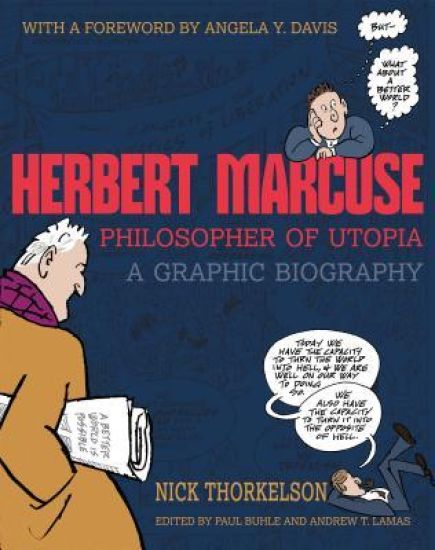
“I believe that Marcuse’s ideas can be as valuable today as they were fifty years ago.”—Angela Y. Davis, from the forewordHerbert Marcuse was one of the twentieth century’s most unlikely pop stars: a celebrity philosopher. In the 1960s, his argument for a “principled utopianism” catalyzed the idealism of a rebellious generation, and Marcuse became an intellectual guide for activists and revolutionaries around the world.From his early studies with Martin Heidegger, to his flight from Nazi Germany with Frankfurt School colleagues, to his status as a countercultural icon, readers are introduced to the development of Marcuse's philosophical theories and the political realities that shaped his work.Marcuse's advocacy for a more humane, sustainable world was grounded in a personal knowledge of authoritarianism's violence, and the risk of its resurgence. Perennially relevant, radical, and inspiring, Marcuse’s concept of a "Great Refusal"—the protest against that which is—is a guide for our times.Praise for Herbert Marcuse, Philosopher of Utopia:"Nick Thorkelson's exploration of the ideas and personality of Herbert Marcuse is exactly the sort of comic book I have longed to read. It is engaging, artful, and explores the world of revolutionary ideas. Books like this keep the fire going inside."—Joe Sacco, author of Footnotes in Gaza"A warm, funny, richly detailed biography. Thorkelson has found a powerful graphic style and narrative voice that animate Marcuse's life and his theory of rebellion. As both personal saga and primer on radical political philosophy, it could not be more relevant to today's resistance movement."—Dan Wasserman, editorial cartoonist for The Boston Globe"Marcuse's energizing sense of critique, hope, politics, and utopian vision are more necessary than ever, especially for the emerging generations of young activists."—Henry A. Giroux, author of American Nightmare: Facing the Challenge of Fascism"A riotous romp through 20th-century philosophy. The story of a man who exists at the eye of storm of ideas, of movements and of social strategies. With workers and students on the streets of Paris once more, Marcuse's life and work has never been more relevant."—Kate Evans, author of Red Rosa: A Graphic Biography"Philosopher of Utopia is art on the attack! A perfect celebration of this unique public intellectual done through a fusion of skill and imagination, Thorkelson's book provides access to the genius and the grit of this master of the dialectic."—Lowell Bergman, Winner of the Pulitzer Prize and Distinguished Chair in Investigative Reporting at UC Berkeley"[This book] confirms my belief that our medium can convey the most complex ideas while being witty and entertaining at the same time."—Sharon Rudahl, author of A Dangerous Woman: A Graphic Biography of Emma Goldman
Herbert Marcuse as Social Justice Educator

Herbert Marcuse as Social Justice Educator

Charles Reitz

TAYLOR FRANCIS LTD
2025
nidottu
Demonstrating the continued relevance of Marcuse’s work, Herbert Marcuse as Social Justice Educator details how his teachings remain a countervailing force to the conventional wisdom in intellectual and political matters today.By drawing on Marcuse’s critical analysis of the political economy, a profound concern for environmental issues, and an explicit critique of educational philosophy, this book illuminates not only the content and contours of Marcuse’s work but its importance for developing critical social scientific thinking and theoretical insight into contemporary issues such as genocide and ecocide, fascism and democratic crises, political economy and social inequality, and the role of culture and media in forming compliant consumer-citizens.From Charles Reitz, a prominent leader in Marcuse studies, this book will be an essential guide for instructors, students, and learners in sociology, social theory, political science, and environmental studies.
Herbert Marcuse as Social Justice Educator

Herbert Marcuse as Social Justice Educator

Charles Reitz

TAYLOR FRANCIS LTD
2025
sidottu
Demonstrating the continued relevance of Marcuse’s work, Herbert Marcuse as Social Justice Educator details how his teachings remain a countervailing force to the conventional wisdom in intellectual and political matters today.By drawing on Marcuse’s critical analysis of the political economy, a profound concern for environmental issues, and an explicit critique of educational philosophy, this book illuminates not only the content and contours of Marcuse’s work but its importance for developing critical social scientific thinking and theoretical insight into contemporary issues such as genocide and ecocide, fascism and democratic crises, political economy and social inequality, and the role of culture and media in forming compliant consumer-citizens.From Charles Reitz, a prominent leader in Marcuse studies, this book will be an essential guide for instructors, students, and learners in sociology, social theory, political science, and environmental studies.
Herbert Marcuse, les conférences à Vincennes

Herbert Marcuse, les conférences à Vincennes

Cristina Parapar; Arno Münster

Editions L'Harmattan
2025
pokkari
Ce volume r unit, pour la premi re fois en fran ais, les sept conf rences que Herbert Marcuse pronon a l'Universit exp rimentale de Vincennes au printemps 1974. la crois e de la rigueur philosophique et de la p dagogie militante, l'auteur de L'Homme unidimensionnel y expose les dynamiques internes du capitalisme dans la soci t industriellement avanc e qui pourraient, en m me temps, le conduire son autodestruction. Pour la premi re fois dans l'histoire, sugg re Marcuse Vincennes, ce n'est ni la mis re ni la pauvret qui mettraient le feu aux poudres du changement, mais bien l'opulence, l'exc s, le gaspillage, l'exub rance.
The Dialectic of Herbert Marcuse

The Dialectic of Herbert Marcuse

Patrick Gamsby

BLOOMSBURY PUBLISHING PLC
2024
sidottu
Herbert Marcuse (1898-1979) was one of the most recognizable and controversial public intellectuals throughout the 1960s until his death in the late 1970s, but today Marcuse’s work largely stands in the shadows of other Frankfurt School members and other critical thinkers. Despite having once held a prominent and influential position amongst scholars, activists, and readers in the twentieth-century, it is argued that Marcuse’s work nevertheless remains largely misunderstood. The Dialectic of Herbert Marcuse offers a new interpretation of Marcuse, one that attempts to show how Marcuse’s work has so often been turned into something else, into its opposite. In shining a light on parts of the unknown Marcuse through the use of archival material and published works, this book reveals Marcuse’s Critical Theory to be one of hope, not one of pessimism as it is so often portrayed to be. Ultimately, it is argued that Herbert Marcuse’s Critical Theory remains a vital and important body of work for present-day society and ought to be re-visited.