Kirjojen hintavertailu. Mukana 11 241 044 kirjaa ja 12 kauppaa.

Kirjahaku

Etsi kirjoja tekijän nimen, kirjan nimen tai ISBN:n perusteella.

48 tulosta hakusanalla "Random Matrices"

Random Matrices

Random Matrices

Madan Lal Mehta

Academic Press Inc
2004
sidottu
Random Matrices gives a coherent and detailed description of analytical methods devised to study random matrices. These methods are critical to the understanding of various fields in in mathematics and mathematical physics, such as nuclear excitations, ultrasonic resonances of structural materials, chaotic systems, the zeros of the Riemann and other zeta functions. More generally they apply to the characteristic energies of any sufficiently complicated system and which have found, since the publication of the second edition, many new applications in active research areas such as quantum gravity, traffic and communications networks or stock movement in the financial markets. This revised and enlarged third edition reflects the latest developements in the field and convey a greater experience with results previously formulated. For example, the theory of skew-orthogoanl and bi-orthogonal polynomials, parallel to that of the widely known and used orthogonal polynomials, is explained here for the first time.
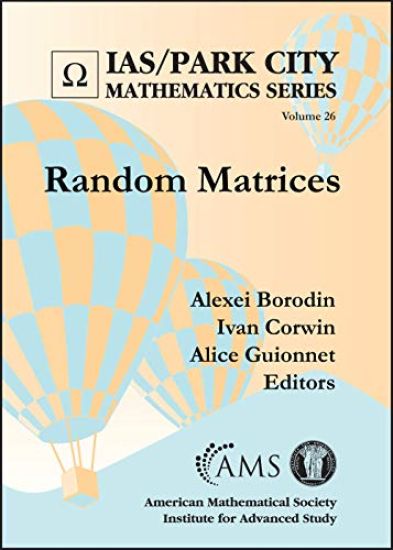
Random Matrices

Random Matrices

American Mathematical Society
2019
sidottu
Random matrix theory has many roots and many branches in mathematics, statistics, physics, computer science, data science, numerical analysis, biology, ecology, engineering, and operations research. This book provides a snippet of this vast domain of study, with a particular focus on the notations of universality and integrability. Universality shows that many systems behave the same way in their large scale limit, while integrability provides a route to describe the nature of those universal limits. Many of the ten contributed chapters address these themes, while others touch on applications of tools and results from random matrix theory.This book is appropriate for graduate students and researchers interested in learning techniques and results in random matrix theory from different perspectives and viewpoints. It also captures a moment in the evolution of the theory, when the previous decade brought major break-throughs, prompting exciting new directions of research.
Random Matrices and Non-Commutative Probability
This is an introductory book on Non-Commutative Probability or Free Probability and Large Dimensional Random Matrices. Basic concepts of free probability are introduced by analogy with classical probability in a lucid and quick manner. It then develops the results on the convergence of large dimensional random matrices, with a special focus on the interesting connections to free probability. The book assumes almost no prerequisite for the most part. However, familiarity with the basic convergence concepts in probability and a bit of mathematical maturity will be helpful. Combinatorial properties of non-crossing partitions, including the Möbius function play a central role in introducing free probability. Free independence is defined via free cumulants in analogy with the way classical independence can be defined via classical cumulants. Free cumulants are introduced through the Möbius function. Free product probability spaces are constructed using free cumulants. Marginal and joint tracial convergence of large dimensional random matrices such as the Wigner, elliptic, sample covariance, cross-covariance, Toeplitz, Circulant and Hankel are discussed. Convergence of the empirical spectral distribution is discussed for symmetric matrices. Asymptotic freeness results for random matrices, including some recent ones, are discussed in detail. These clarify the structure of the limits for joint convergence of random matrices. Asymptotic freeness of independent sample covariance matrices is also demonstrated via embedding into Wigner matrices. Exercises, at advanced undergraduate and graduate level, are provided in each chapter.
Random Matrices and Non-Commutative Probability
This is an introductory book on Non-Commutative Probability or Free Probability and Large Dimensional Random Matrices. Basic concepts of free probability are introduced by analogy with classical probability in a lucid and quick manner. It then develops the results on the convergence of large dimensional random matrices, with a special focus on the interesting connections to free probability. The book assumes almost no prerequisite for the most part. However, familiarity with the basic convergence concepts in probability and a bit of mathematical maturity will be helpful. Combinatorial properties of non-crossing partitions, including the Möbius function play a central role in introducing free probability. Free independence is defined via free cumulants in analogy with the way classical independence can be defined via classical cumulants. Free cumulants are introduced through the Möbius function. Free product probability spaces are constructed using free cumulants. Marginal and joint tracial convergence of large dimensional random matrices such as the Wigner, elliptic, sample covariance, cross-covariance, Toeplitz, Circulant and Hankel are discussed. Convergence of the empirical spectral distribution is discussed for symmetric matrices. Asymptotic freeness results for random matrices, including some recent ones, are discussed in detail. These clarify the structure of the limits for joint convergence of random matrices. Asymptotic freeness of independent sample covariance matrices is also demonstrated via embedding into Wigner matrices. Exercises, at advanced undergraduate and graduate level, are provided in each chapter.
Random Matrices: High Dimensional Phenomena

Random Matrices: High Dimensional Phenomena

Gordon Blower

Cambridge University Press
2009
pokkari
This book focuses on the behaviour of large random matrices. Standard results are covered, and the presentation emphasizes elementary operator theory and differential equations, so as to be accessible to graduate students and other non-experts. The introductory chapters review material on Lie groups and probability measures in a style suitable for applications in random matrix theory. Later chapters use modern convexity theory to establish subtle results about the convergence of eigenvalue distributions as the size of the matrices increases. Random matrices are viewed as geometrical objects with large dimension. The book analyzes the concentration of measure phenomenon, which describes how measures behave on geometrical objects with large dimension. To prove such results for random matrices, the book develops the modern theory of optimal transportation and proves the associated functional inequalities involving entropy and information. These include the logarithmic Sobolev inequality, which measures how fast some physical systems converge to equilibrium.
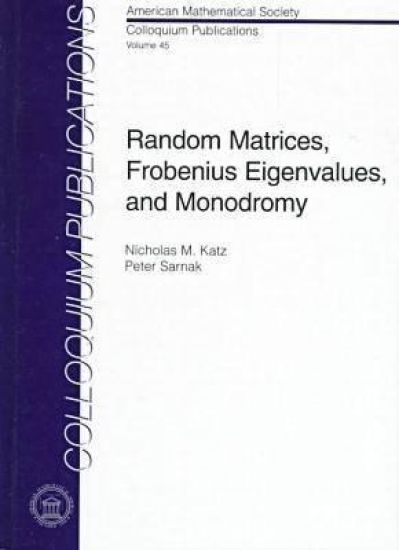
Random Matrices, Frobenius Eigenvalues, and Monodromy

Random Matrices, Frobenius Eigenvalues, and Monodromy

Nicholas M. Katz; Peter Sarnak

Amer Mathematical Society
1998
sidottu
The main topic of this book is the deep relation between the spacings between zeros of zeta and $L$-functions and spacings between eigenvalues of random elements of large compact classical groups. This relation, the Montgomery-Odlyzko law, is shown to hold for wide classes of zeta and $L$-functions over finite fields. The book draws on and gives accessible accounts of many disparate areas of mathematics, from algebraic geometry, moduli spaces, monodromy, equidistribution, and the Weil conjectures, to probability theory on the compact classical groups in the limit as their dimension goes to infinity and related techniques from orthogonal polynomials and Fredholm determinants.
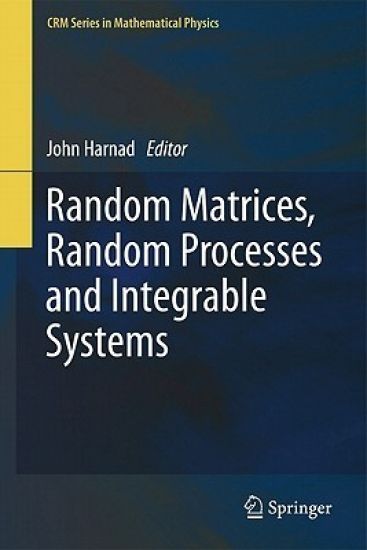
Random Matrices, Random Processes and Integrable Systems
This book explores the remarkable connections between two domains that, a priori, seem unrelated: Random matrices (together with associated random processes) and integrable systems. The relations between random matrix models and the theory of classical integrable systems have long been studied. These appear mainly in the deformation theory, when parameters characterizing the measures or the domain of localization of the eigenvalues are varied. The resulting differential equations determining the partition function and correlation functions are, remarkably, of the same type as certain equations appearing in the theory of integrable systems. They may be analyzed effectively through methods based upon the Riemann-Hilbert problem of analytic function theory and by related approaches to the study of nonlinear asymptotics in the large N limit. Associated with studies of matrix models are certain stochastic processes, the "Dyson processes", and their continuum diffusion limits, which govern the spectrum in random matrix ensembles, and may also be studied by related methods. Random Matrices, Random Processes and Integrable Systems provides an in-depth examination of random matrices with applications over a vast variety of domains, including multivariate statistics, random growth models, and many others. Leaders in the field apply the theory of integrable systems to the solution of fundamental problems in random systems and processes using an interdisciplinary approach that sheds new light on a dynamic topic of current research.
Random Matrices, Random Processes and Integrable Systems
This book explores the remarkable connections between two domains that, a priori, seem unrelated: Random matrices (together with associated random processes) and integrable systems. The relations between random matrix models and the theory of classical integrable systems have long been studied. These appear mainly in the deformation theory, when parameters characterizing the measures or the domain of localization of the eigenvalues are varied. The resulting differential equations determining the partition function and correlation functions are, remarkably, of the same type as certain equations appearing in the theory of integrable systems. They may be analyzed effectively through methods based upon the Riemann-Hilbert problem of analytic function theory and by related approaches to the study of nonlinear asymptotics in the large N limit. Associated with studies of matrix models are certain stochastic processes, the "Dyson processes", and their continuum diffusion limits, which govern the spectrum in random matrix ensembles, and may also be studied by related methods. Random Matrices, Random Processes and Integrable Systems provides an in-depth examination of random matrices with applications over a vast variety of domains, including multivariate statistics, random growth models, and many others. Leaders in the field apply the theory of integrable systems to the solution of fundamental problems in random systems and processes using an interdisciplinary approach that sheds new light on a dynamic topic of current research.
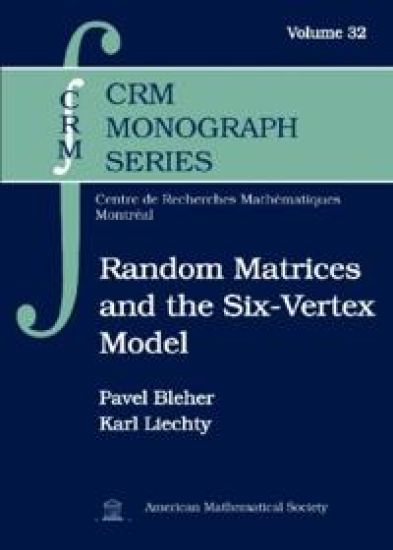
Random Matrices and the Six-Vertex Model

Random Matrices and the Six-Vertex Model

Pavel Bleher; Karl Liechty

American Mathematical Society
2013
sidottu
This book provides a detailed description of the Riemann-Hilbert approach (RH approach) to the asymptotic analysis of both continuous and discrete orthogonal polynomials, and applications to random matrix models as well as to the six-vertex model. The RH approach was an important ingredient in the proofs of universality in unitary matrix models. This book gives an introduction to the unitary matrix models and discusses bulk and edge universality. The six-vertex model is an exactly solvable two-dimensional model in statistical physics, and thanks to the Izergin-Korepin formula for the model with domain wall boundary conditions, its partition function matches that of a unitary matrix model with nonpolynomial interaction. The authors introduce in this book the six-vertex model and include a proof of the Izergin-Korepin formula. Using the RH approach, they explicitly calculate the leading and subleading terms in the thermodynamic asymptotic behavior of the partition function of the six-vertex model with domain wall boundary conditions in all the three phases: disordered, ferroelectric, and antiferroelectric.
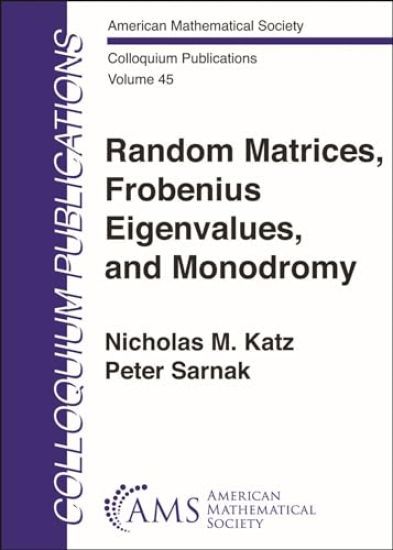
Random Matrices, Frobenius Eigenvalues, and Monodromy

Random Matrices, Frobenius Eigenvalues, and Monodromy

Nicholas M. Katz; Peter Sarnak

AMERICAN MATHEMATICAL SOCIETY
1999
nidottu
The main topic of this book is the deep relation between the spacings between zeros of zeta and $L$-functions and spacings between eigenvalues of random elements of large compact classical groups. The authors draw upon many disparate areas of mathematics from algebraic geometry, moduli spaces, mondromy, equidistribution, and the Weil conjectures to probability theory and the compact classical groups.
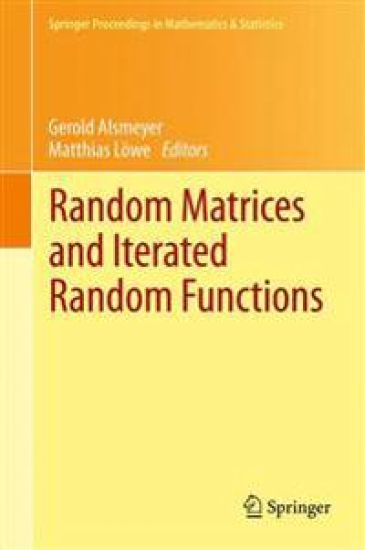
Random Matrices and Iterated Random Functions

Random Matrices and Iterated Random Functions

Springer-Verlag Berlin and Heidelberg GmbH Co. K
2013
sidottu
?Random Matrices are one of the major research areas in modern probability theory, due to their prominence in many different fields such as nuclear physics, statistics, telecommunication, free probability, non-commutative geometry, and dynamical systems. A great deal of recent work has focused on the study of spectra of large random matrices on the one hand and on iterated random functions, especially random difference equations, on the other. However, the methods applied in these two research areas are fairly dissimilar. Motivated by the idea that tools from one area could potentially also be helpful in the other, the volume editors have selected contributions that present results and methods from random matrix theory as well as from the theory of iterated random functions. This work resulted from a workshop that was held in Münster, Germany in 2011. The aim of the workshop was to bring together researchers from two fields of probability theory: random matrix theory and the theory of iterated random functions. Random matrices play fundamental, yet very different roles in the two fields. Accordingly, leading figures and young researchers gave talks on their field of interest that were also accessible to a broad audience.
Random Matrices and Iterated Random Functions

Random Matrices and Iterated Random Functions

Springer-Verlag Berlin and Heidelberg GmbH Co. K
2015
nidottu
?Random Matrices are one of the major research areas in modern probability theory, due to their prominence in many different fields such as nuclear physics, statistics, telecommunication, free probability, non-commutative geometry, and dynamical systems. A great deal of recent work has focused on the study of spectra of large random matrices on the one hand and on iterated random functions, especially random difference equations, on the other. However, the methods applied in these two research areas are fairly dissimilar. Motivated by the idea that tools from one area could potentially also be helpful in the other, the volume editors have selected contributions that present results and methods from random matrix theory as well as from the theory of iterated random functions. This work resulted from a workshop that was held in Münster, Germany in 2011. The aim of the workshop was to bring together researchers from two fields of probability theory: random matrix theory and the theory of iterated random functions. Random matrices play fundamental, yet very different roles in the two fields. Accordingly, leading figures and young researchers gave talks on their field of interest that were also accessible to a broad audience.
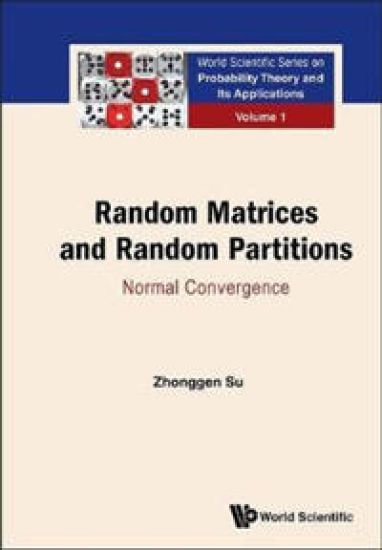
Random Matrices And Random Partitions: Normal Convergence

Random Matrices And Random Partitions: Normal Convergence

Zhonggen Su

World Scientific Publishing Co Pte Ltd
2015
sidottu
This book is aimed at graduate students and researchers who are interested in the probability limit theory of random matrices and random partitions. It mainly consists of three parts. Part I is a brief review of classical central limit theorems for sums of independent random variables, martingale differences sequences and Markov chains, etc. These classical theorems are frequently used in the study of random matrices and random partitions. Part II concentrates on the asymptotic distribution theory of Circular Unitary Ensemble and Gaussian Unitary Ensemble, which are prototypes of random matrix theory. It turns out that the classical central limit theorems and methods are applicable in describing asymptotic distributions of various eigenvalue statistics. This is attributed to the nice algebraic structures of models. This part also studies the Circular ß Ensembles and Hermitian ß Ensembles. Part III is devoted to the study of random uniform and Plancherel partitions. There is a surprising similarity between random matrices and random integer partitions from the viewpoint of asymptotic distribution theory, though it is difficult to find any direct link between the two finite models. A remarkable point is the conditioning argument in each model. Through enlarging the probability space, we run into independent geometric random variables as well as determinantal point processes with discrete Bessel kernels.This book treats only second-order normal fluctuations for primary random variables from two classes of special random models. It is written in a clear, concise and pedagogical way. It may be read as an introductory text to further study probability theory of general random matrices, random partitions and even random point processes.
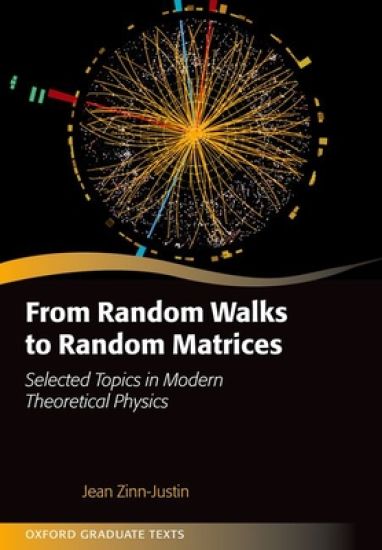
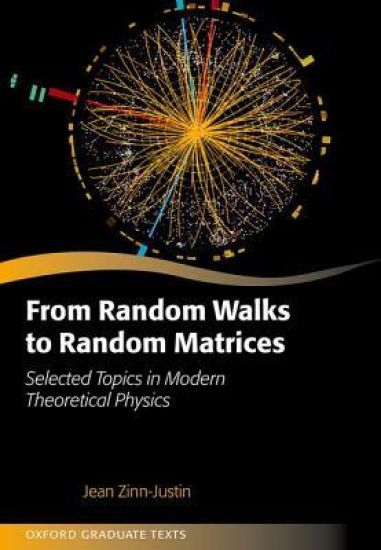
From Random Walks to Random Matrices

From Random Walks to Random Matrices

Jean Zinn-Justin

Oxford University Press
2021
nidottu
Theoretical physics is a cornerstone of modern physics and provides a foundation for all modern quantitative science. It aims to describe all natural phenomena using mathematical theories and models, and in consequence develops our understanding of the fundamental nature of the universe. This books offers an overview of major areas covering the recent developments in modern theoretical physics. Each chapter introduces a new key topic and develops the discussion in a self-contained manner. At the same time the selected topics have common themes running throughout the book, which connect the independent discussions. The main themes are renormalization group, fixed points, universality, and continuum limit, which open and conclude the work. The development of modern theoretical physics has required important concepts and novel mathematical tools, examples discussed in the book include path and field integrals, the notion of effective quantum or statistical field theories, gauge theories, and the mathematical structure at the basis of the interactions in fundamental particle physics, including quantization problems and anomalies, stochastic dynamical equations, and summation of perturbative series.
From Random Walks to Random Matrices

From Random Walks to Random Matrices

Jean Zinn-Justin

Oxford University Press
2019
sidottu
Theoretical physics is a cornerstone of modern physics and provides a foundation for all modern quantitative science. It aims to describe all natural phenomena using mathematical theories and models, and in consequence develops our understanding of the fundamental nature of the universe. This books offers an overview of major areas covering the recent developments in modern theoretical physics. Each chapter introduces a new key topic and develops the discussion in a self-contained manner. At the same time the selected topics have common themes running throughout the book, which connect the independent discussions. The main themes are renormalization group, fixed points, universality, and continuum limit, which open and conclude the work. The development of modern theoretical physics has required important concepts and novel mathematical tools, examples discussed in the book include path and field integrals, the notion of effective quantum or statistical field theories, gauge theories, and the mathematical structure at the basis of the interactions in fundamental particle physics, including quantization problems and anomalies, stochastic dynamical equations, and summation of perturbative series.
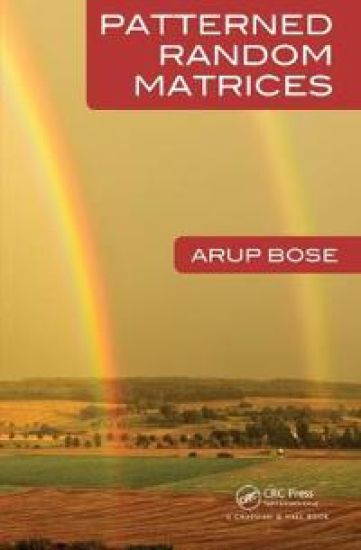
Patterned Random Matrices

Patterned Random Matrices

Arup Bose

CRC Press
2020
nidottu
Large dimensional random matrices (LDRM) with specific patterns arise in econometrics, computer science, mathematics, physics, and statistics. This book provides an easy initiation to LDRM. Through a unified approach, we investigate the existence and properties of the limiting spectral distribution (LSD) of different patterned random matrices as the dimension grows. The main ingredients are the method of moments and normal approximation with rudimentary combinatorics for support. Some elementary results from matrix theory are also used. By stretching the moment arguments, we also have a brush with the intriguing but difficult concepts of joint convergence of sequences of random matrices and its ramifications.This book covers the Wigner matrix, the sample covariance matrix, the Toeplitz matrix, the Hankel matrix, the sample autocovariance matrix and the k-Circulant matrices. Quick and simple proofs of their LSDs are provided and it is shown how the semi-circle law and the Marchenko-Pastur law arise as the LSDs of the first two matrices. Extending the basic approach, we also establish interesting limits for some triangular matrices, band matrices, balanced matrices, and the sample autocovariance matrix. We also study the joint convergence of several patterned matrices, and show that independent Wigner matrices converge jointly and are asymptotically free of other patterned matrices.
Patterned Random Matrices

Patterned Random Matrices

Arup Bose

CRC Press
2018
sidottu
Large dimensional random matrices (LDRM) with specific patterns arise in econometrics, computer science, mathematics, physics, and statistics. This book provides an easy initiation to LDRM. Through a unified approach, we investigate the existence and properties of the limiting spectral distribution (LSD) of different patterned random matrices as the dimension grows. The main ingredients are the method of moments and normal approximation with rudimentary combinatorics for support. Some elementary results from matrix theory are also used. By stretching the moment arguments, we also have a brush with the intriguing but difficult concepts of joint convergence of sequences of random matrices and its ramifications. This book covers the Wigner matrix, the sample covariance matrix, the Toeplitz matrix, the Hankel matrix, the sample autocovariance matrix and the k-Circulant matrices. Quick and simple proofs of their LSDs are provided and it is shown how the semi-circle law and the Marchenko-Pastur law arise as the LSDs of the first two matrices. Extending the basic approach, we also establish interesting limits for some triangular matrices, band matrices, balanced matrices, and the sample autocovariance matrix. We also study the joint convergence of several patterned matrices, and show that independent Wigner matrices converge jointly and are asymptotically free of other patterned matrices.Arup Bose is a Professor at the Indian Statistical Institute, Kolkata, India. He is a distinguished researcher in Mathematical Statistics and has been working in high-dimensional random matrices for the last fifteen years. He has been the Editor of Sankyha for several years and has been on the editorial board of several other journals. He is a Fellow of the Institute of Mathematical Statistics, USA and all three national science academies of India, as well as the recipient of the S.S. Bhatnagar Award and the C.R. Rao Award. His forthcoming books are the monograph, Large Covariance and Autocovariance Matrices (with Monika Bhattacharjee), to be published by Chapman & Hall/CRC Press, and a graduate text, U-statistics, M-estimates and Resampling (with Snigdhansu Chatterjee), to be published by Hindustan Book Agency.
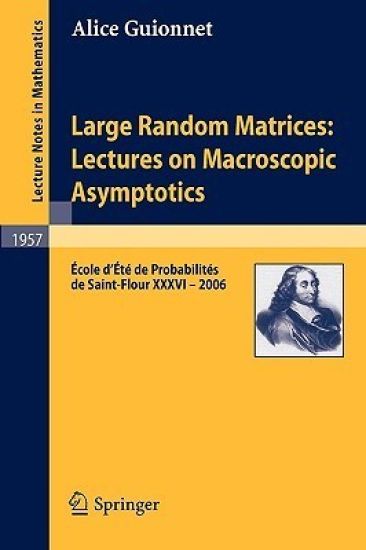
Large Random Matrices: Lectures on Macroscopic Asymptotics

Large Random Matrices: Lectures on Macroscopic Asymptotics

Alice Guionnet

Springer-Verlag Berlin and Heidelberg GmbH Co. K
2009
nidottu
Random matrix theory has developed in the last few years, in connection with various fields of mathematics and physics. These notes emphasize the relation with the problem of enumerating complicated graphs, and the related large deviations questions. Such questions are also closely related with the asymptotic distribution of matrices, which is naturally defined in the context of free probability and operator algebra.The material of this volume is based on a series of nine lectures given at the Saint-Flour Probability Summer School 2006. Lectures were also given by Maury Bramson and Steffen Lauritzen.
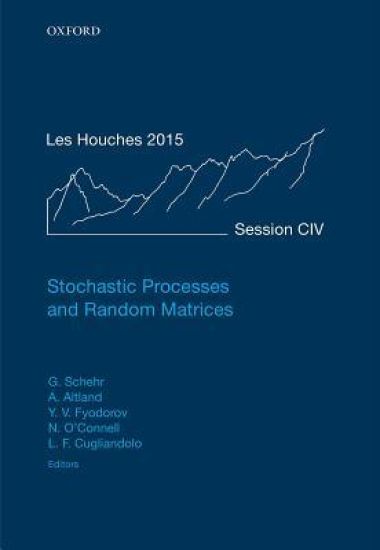
Stochastic Processes and Random Matrices
The field of stochastic processes and Random Matrix Theory (RMT) has been a rapidly evolving subject during the last fifteen years. The continuous development and discovery of new tools, connections and ideas have led to an avalanche of new results. These breakthroughs have been made possible thanks, to a large extent, to the recent development of various new techniques in RMT. Matrix models have been playing an important role in theoretical physics for a long time and they are currently also a very active domain of research in mathematics. An emblematic example of these recent advances concerns the theory of growth phenomena in the Kardar-Parisi-Zhang (KPZ) universality class where the joint efforts of physicists and mathematicians during the last twenty years have unveiled the beautiful connections between this fundamental problem of statistical mechanics and the theory of random matrices, namely the fluctuations of the largest eigenvalue of certain ensembles of random matrices. This text not only covers this topic in detail but also presents more recent developments that have emerged from these discoveries, for instance in the context of low dimensional heat transport (on the physics side) or integrable probability (on the mathematical side).