Kirjojen hintavertailu. Mukana 11 244 527 kirjaa ja 12 kauppaa.

Kirjahaku

Etsi kirjoja tekijän nimen, kirjan nimen tai ISBN:n perusteella.

1000 tulosta hakusanalla ALAN FORREST

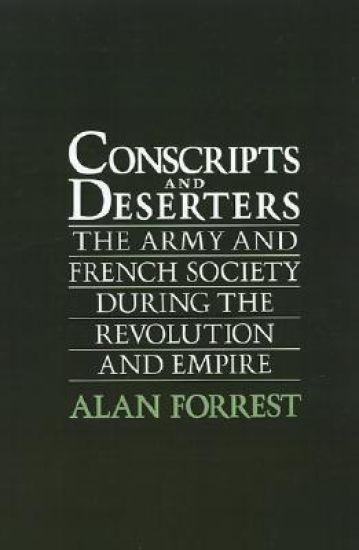
Conscripts and Deserters

Conscripts and Deserters

Alan Forrest

Oxford University Press Inc
1990
sidottu
Between the outbreak of war with Austria in 1792 and Napoleon's final débâcle in 1814, France remained almost continuously at war, recruiting, in the process, some two to three million Frenchmen - a level of recruitment unknown to previous generations and widely resented as an attack on the liberties of rural communities. Forrest challenges the notion of a nation heroically rushing to arms by examining the massive rates of desertion and avoidance of service as well as their consequences on French society, on military campaigns and the morale of armies, on political opinion at home, on the social fabric of local villages, and on the Napoleonic dream of bringing about a coherent and centralized state.
The Revolution in Provincial France

The Revolution in Provincial France

Alan Forrest

Clarendon Press
1996
sidottu
This book presents a provincial view of the French Revolution and assesses the experience of revolution across a broad swathe of south-western France, in an area which increasingly looked to Bordeaux as its capital city. Here the Revolution was not simply a pale reflection of events in Paris. Local conflicts and personal rivalries are vital to our understanding of the shape of events in the region, as are contrasting traditions of religious affiliation, peasant radicalism, and obedience to the state. The book examines the Revolution within a thematic framework, and discusses such aspects as the growth of a local political culture, the incidence of rural insurrection, religious responses to the Revolution, the chequered appeal of federalism, and the uneven experience of Terror and political repression.
The Death of the French Atlantic

The Death of the French Atlantic

Alan Forrest

Oxford University Press
2020
sidottu
The Death of the French Atlantic examines the sudden and irreversible decline of France's Atlantic empire in the Age of Revolution, and shows how three major forces undermined the country's competitive position as an Atlantic commercial power. The first was war, especially war at sea against France's most consistent enemy and commercial rival in the eighteenth century, Great Britain. A series of colonial wars, from the Seven Years' War and the War of American Independence to the Revolutionary and Napoleonic Wars did much to drive France out of the North Atlantic. The second was anti-slavery and the rise of a new moral conscience which challenged the right of Europeans to own slaves or to sacrifice the freedom of others to pursue national economic advantage. The third was the French Revolution itself, which not only raised French hopes of achieving the Rights of Man for its own citizens but also sowed the seeds of insurrection in the slave societies of the New World, leading to the loss of Saint-Domingue and the creation of the first black republic in Haiti at the beginning of the nineteenth century. This proved critical to the economy of the French Caribbean, driving both colons and slaves from Saint-Domingue to seek shelter across the Atlantic world, and leaving a bitter legacy in the French Caribbean. It has also created an uneasy memory of the slave trade in French ports like Nantes, La Rochelle, and Bordeaux, and has left an indelible mark on race relations in France today.
Waterloo

Waterloo

Alan Forrest

Oxford University Press
2015
sidottu
Waterloo was the last battle fought by Napoleon and the one which finally ended his imperial dreams. It involved the deployment of huge armies and incurred heavy losses on both sides; for those who fought in it, Dutch and Belgians, Prussians and Hanoverians as well as British and French troops, it was a murderous struggle. It was a battle that would be remembered very differently across Europe. In Britain it would be seen as an iconic battle whose memory would be enmeshed in British national identity across the following century. In London news of the victory unleashed an outburst of patriotic celebration and captured the imagination of the public. The Duke of Wellington would go on to build his political career on it, and towns and cities across Britain and the Empire raised statues and memorials to the victor. But it was only in Britain that Waterloo acquired this iconic status. In Prussia and Holland its memory was muted - in Prussia overshadowed by the Battle of the Nations at Leipzig, in Holland a simple appendage to the prestige of the House of Orange. And in France it would be portrayed as the very epitome of heroic defeat. Encapsulated in the bravery of General Cambronne and the last stand of the Old Guard, remembered movingly in the lines of Stendhal and Victor Hugo, the memory of Waterloo served to sustain the romantic legend of the Napoleonic Wars - and contributed to the growing cult of Napoleon himself.
Waterloo

Waterloo

Alan Forrest

Oxford University Press
2023
nidottu
Waterloo was the last battle fought by Napoleon and the one which finally ended his imperial dreams. It involved the deployment of huge armies and incurred heavy losses on both sides; for those who fought in it, Dutch and Belgians, Prussians and Hanoverians as well as British and French troops, it was a murderous struggle. It was a battle that would be remembered very differently across Europe. In Britain it would be seen as an iconic battle whose memory would be enmeshed in
Paris, the Provinces and the French Revolution
Tensions between Paris and the provinces have played a significant role in French history. This book examines the effect of the French Revolution in the provinces, on the tensions between provincial interests and those of Paris, and the mediation of different political cultures, which ensured that provincial France made a distinctive contribution to the history of the Revolutionary years.
The Legacy of the French Revolutionary Wars

The Legacy of the French Revolutionary Wars

Alan Forrest

Cambridge University Press
2009
sidottu
A major contribution to the study of collective identity and memory in France, this book examines a French republican myth: the belief that the nation can be adequately defended only by its own citizens, in the manner of the French revolutionaries of 1793. Alan Forrest examines the image of the citizen army reflected in political speeches, school textbooks, art and literature across the nineteenth century. He reveals that the image appealed to notions of equality and social justice, and with time it expanded to incorporate Napoleon's victorious legions, the partisans who repelled the German invader in 1814 and the people of Paris who rose in arms to defend the Republic in 1870. More recently it has risked being marginalized by military technology and by the realities of colonial warfare, but its influence can still be seen in the propaganda of the Great War and of the French Resistance under Vichy.
The French Revolution

The French Revolution

Alan Forrest

Blackwell Publishers
1995
nidottu
This book provides an interpretation of the French Revolution that is both thematic and accessible to the general reader. The discussion includes an analysis of the historiography of the subject, and reviews the range of literature produced around the recent Bicentenary. Insisting that the French Revolution had an important social dimension, Alan Forrest demonstrates that the revolutionaries, even the most extreme of them, were committed to an ordered society. He argues that in destroying the political institutions and the corporate structures of the Ancien Regime, they were conscious of the need to invent a new order of their own, one that would be consistent with their ideology. Chapters focus on the initial crisis of 1789, on the political and social experiments of the revolutionary years, and on the impact of war and counter-revolution. The study covers the period up to 1799, looking forward where appropriate to the Napoleonic Empire. The author's succinct and penetrating overview of events ensures that The French Revolution will be welcomed by all students of this fascinating and turbulent period in European history.
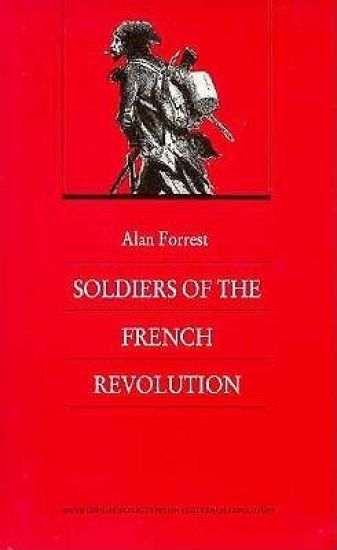
Soldiers of the French Revolution

Soldiers of the French Revolution

Alan Forrest

Duke University Press
1989
pokkari
In this work Alan Forrest brings together some of the recent research on the Revolutionary army that has been undertaken on both sides of the Atlantic by younger historians, many of whom look to the influential work of Braudel for a model. Forrest places the armies of the Revolution in a broader social and political context by presenting the effects of war and militarization on French society and government in the Revolutionary period.Revolutionary idealists thought of the French soldier as a willing volunteer sacrificing himself for the principles of the Revolution; Forrest examines the convergence of these ideals with the ordinary, and often dreadful, experience of protracted warfare that the soldier endured.
The Legacy of the French Revolutionary Wars

The Legacy of the French Revolutionary Wars

Alan Forrest

Cambridge University Press
2013
pokkari
A major contribution to the study of collective identity and memory in France, this book examines a French republican myth: the belief that the nation can be adequately defended only by its own citizens, in the manner of the French revolutionaries of 1793. Alan Forrest examines the image of the citizen army reflected in political speeches, school textbooks, art and literature across the nineteenth century. He reveals that the image appealed to notions of equality and social justice, and with time it expanded to incorporate Napoleon's victorious legions, the partisans who repelled the German invader in 1814 and the people of Paris who rose in arms to defend the Republic in 1870. More recently it has risked being marginalized by military technology and by the realities of colonial warfare, but its influence can still be seen in the propaganda of the Great War and of the French Resistance under Vichy.
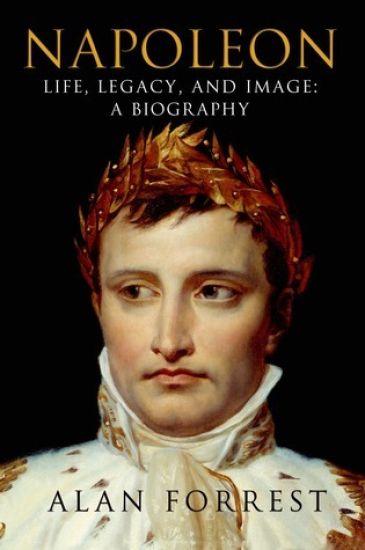
Napoleon: Life, Legacy, and Image: A Biography

Napoleon: Life, Legacy, and Image: A Biography

Alan Forrest

St. Martin's Griffin
2013
nidottu
From Alan Forrest, a preeminent British scholar, comes an exceedingly readable account of the man and his legend On a cold December day in 1840 Parisians turned out in force to watch as the body of Napoleon was solemnly carried on a riverboat from Courbevoie on its final journey to the Invalides. The return of their long-dead emperor's corpse from the island of St. Helena was a moment that Paris had eagerly awaited, though many feared that the memories stirred would serve to further destabilize a country that had struggled for order and direction since he had been sent into exile. In this book Alan Forrest tells the remarkable story of how the son of a Corsican attorney became the most powerful man in Europe, a man whose charisma and legacy endured after his lonely death many thousands of miles from the country whose fate had become so entwined with his own. Along the way, Forrest also cuts away the many layers of myth and counter myth that have grown up around Napoleon, a man who mixed history and legend promiscuously. Drawing on original research and his own distinguished background in French history, Forrest demonstrates that Napoleon was as much a product of his times as their creator.
Napoleon

Napoleon

Alan Forrest

Quercus Publishing
2012
pokkari
On a cold December day in 1840 Parisians turned out in force to watch as the body of Napoleon was solemnly carried on a riverboat from Courbevoie on its final journey to the Invalides. In this book Alan Forrest tells the remarkable story of how the son of a Corsican attorney became the most powerful man in Europe: a man whose charisma and legacy have endured since his lonely death on the Island of St Helena. Forrest cuts away the many layers of myth that have grown up around Napoleon, a man who mixed history and legend promiscuously. Drawing on original research and his own distinguished background in French history, Forrest undercuts the 'Great Man' theory of history to demonstrate that Napoleon was as much a product of his times as he was their creator.
Napoleon's Men

Napoleon's Men

Alan Forrest

Hambledon Continuum
2006
nidottu
Napoleon's soldiers marched across Europe from Lisbon to Moscow, and from Germany to Dalmatia. Many of the men, mostly conscripted by ballot, had never before been beyond their native village. What did they make of the extraordinary experiences, fighting battles thousands of miles from home, foraging for provisions or garrisoning towns in hostile countries? What was it like to be a soldier in the revolutionary and imperial armies? We know more about these men and their reactions to war than about the soldiers of any previous army in history, not just from offical sources but also from the large number of personal letters they wrote. Napoleon's Men provides a direct into the experiences and emotions of soldiers who risked their lives at Austerlitz, Wagram and Borodino. Not surprisingly, their minds often dwelt as much on what was happening at hime, and on mundane questions of food and drink as on Napoloen himself or the glory of France. Alan Forrest is Professor of Modern History at the University of York.Among his recent books are Paris, the Princes and the French Revolution (Arnold, 2004) and (co-authored with Jean-Paul Bertaud and Annie Jourdan), Napoleon, le monde et les Anglais (Paris, Autrement, 2004)
The Bee and the Eagle

The Bee and the Eagle

Alan Forrest; Peter H. Wilson

Palgrave Macmillan
2008
sidottu
This volume's juxtaposition of the empires of Germany and France in 1806, at the dissolution of The Holy Roman Empire, allows a comparison of their transition towards modernity, explored through the themes of Empire, monarchy, political cultures, feudalism, war and military institutions, nationalism and identity, and everyday experience.
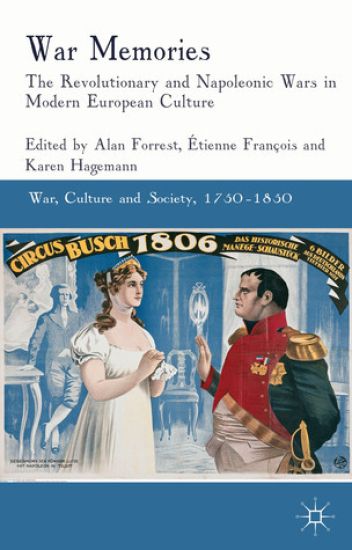
War Memories

War Memories

Alan Forrest; Étienne François

Palgrave Macmillan
2012
sidottu
The Revolutionary and Napoleonic Wars had an enduring influence on the collective memory of all European nations and regions, and have given them an international dimension. These essays look at how the French Wars were remembered in personal diaries, paintings and literature, allowing a comparative analysis with atransnational perspective.
War Memories

War Memories

Alan Forrest; Étienne François

Palgrave Macmillan
2012
nidottu
The Revolutionary and Napoleonic Wars had an enduring influence on the collective memory of all European nations and regions, and have given them an international dimension. These essays look at how the French Wars were remembered in personal diaries, paintings and literature, allowing a comparative analysis with atransnational perspective.
The Bee and the Eagle

The Bee and the Eagle

Alan Forrest; Peter H. Wilson

Palgrave Macmillan
2009
nidottu
This volume's juxtaposition of the empires of Germany and France in 1806, at the dissolution of The Holy Roman Empire, allows a comparison of their transition towards modernity, explored through the themes of Empire, monarchy, political cultures, feudalism, war and military institutions, nationalism and identity, and everyday experience.
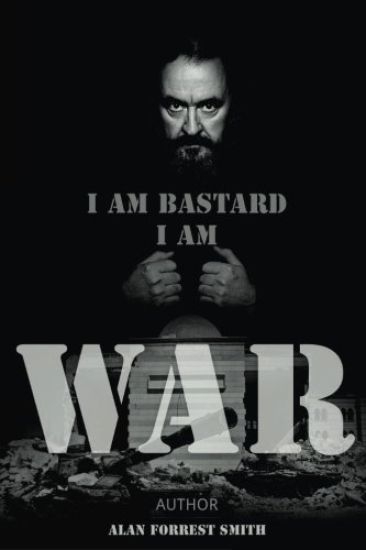
I Am Bastard I Am War: Zoomanity Loves a War

I Am Bastard I Am War: Zoomanity Loves a War

Alan Forrest Smith

Createspace Independent Publishing Platform
2015
nidottu
I felt inspired and moved to write my WAR piece after watching endless tragedy unraveling in the middle east on a daily basis as it was beamed live from the front lines directly to my news feeds. I was shocked, horrified and felt almost ashamed to be human. This piece began as a simple poem but then grew into something much larger. Since I first started this extremist groups such as ISIS or ISIL have appeared and taken the raw production of warfare to a horrifying new level but then again all war is horrifying is it not? Did you realise that two people are killed every minute of every day by war120 human beings are killed by war every hour.2880 human beings are killed in war each day1,051,200 human beings are killed each year I think this is a good enough reason to write and create a powerful piece that is designed to move even the hardest of hearts into thought. "In a media stream so rife with facile justifications for, and barbaric glorifications of, war - we need more voices like Alan Forrest Smith's. War is as lyrical as it is poignant."Mark Joyner, Founder and CEO of Simpleology----------------------------------Brilliant. Breakthrough literature Alan Forrest Smith's I AM BASTARD I AM WAR is waging heavy peace. Rarely has a master of commercial marketing spoken so truthfully of the systems thinking of demonizing words and the mechanism by which we justify the destruction of our own species, war.Smith appears to me as fighting for sanity, employing guerrilla poetry with lyrical language. I agree: War is a bloody insane disgrace against humanity. If you read this book, you'll agree Zoomanity loves a war. While there is ugliness depicted, it is masterfully beautiful in its call to action to think peace.Ben Mack, author of Think Two Products Ahead & Poker Without Cards