Kirjahaku
Etsi kirjoja tekijän nimen, kirjan nimen tai ISBN:n perusteella.
1000 tulosta hakusanalla ALEXANDER BAIN
Mind and Body. the theories of their Relation. by Alexander Bain.
Alexander Bain
University of Michigan Library
2006
pokkari
English Grammar As Bearing Upon Composition, by Alexander Bain ...
Alexander Bain
University of Michigan Library
2006
pokkari
Mental Science; A Compendium of Psychology, and the History of Philosophy, Designed as a Text-Book for High-Schools and Colleges. by Alexander Bain.
Alexander Bain
University of Michigan Library
2006
pokkari

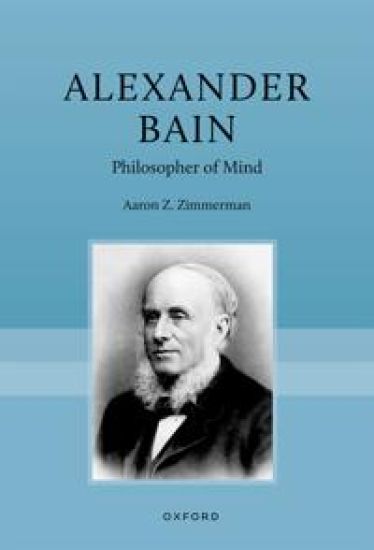
Alexander Bain (1818–1903) was once Britain's greatest philosopher of mind. Author of The Senses and the Intellect (1855) and The Emotions and the Will (1859), he articulated a comprehensive theory of the human mind, integrating cognitive, developmental, and evolutionary psychology with neuroscience and philosophy. John Stuart Mill utilized Bain's theory of moral judgment to clarify and defend utilitarianism. Charles Darwin leaned on Bain's theory of conscience to explain the evolution of morality. William James used Bain's texts to teach philosophy of mind at Harvard, launching psychology as an independent department of inquiry within American universities. Charles Sanders Peirce said Bain's theory of belief was the axiom of pragmatism. Bain also founded the journal Mind, doing more than anyone else in his day to build the cognitive sciences into the field it has become. Mill is still celebrated for his analyses of liberalism and utilitarianism. Darwin remains famous for his theory of natural selection. And James is well known as the father of both pragmatism and empirical psychology in America. Bain stands behind these accomplishments, his role unacknowledged. Alexander Bain: Philosopher of Mind seeks to rectify this oversight. After introducing the reader to Bain's life and early work, Zimmerman critically analyses Bain's solution to the mind-body problem, describes Bain's contributions to logic and his disagreement with Mill over the meaning of proper names, engages with Bain's theories of freewill, conscience, and moral responsibility, and explains Bain's theory of belief and its role in the genesis of pragmatism. The philosophy that emerges will engage philosophers of mind, cognitive scientists, historians of philosophy, and anyone interested in the "Darwinian revolution" in our understanding of life on Earth.

Alexander Bain
VDM Publishing House
2010
nidottu
Observera att förlaget som ger ut denna produkt baserar innehållet i sina produkter på fria källor som Wikipedia. Boken är med stor sannolikhet endast ett utdrag ur dessa informationskällor, alltså inte en vanlig bok i den bemärkelsen.
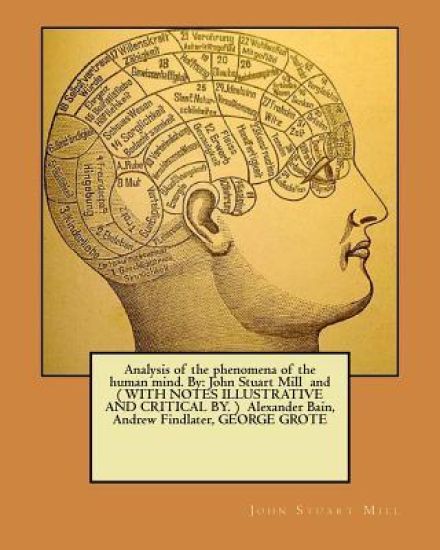
Analysis of the phenomena of the human mind. By: John Stuart Mill and ( WITH NOTES ILLUSTRATIVE AND CRITICAL BY. ) Alexander Bain, Andrew Findlater, G
Alexander Bain; Andrew Findlater; George Grote
Createspace Independent Publishing Platform
2017
nidottu
John Stuart Mill (20 May 1806 - 8 May 1873) was an English philosopher, political economist and civil servant. One of the most influential thinkers in the history of liberalism, he contributed widely to social theory, political theory and political economy. Dubbed "the most influential English-speaking philosopher of the nineteenth century", Mill's conception of liberty justified the freedom of the individual in opposition to unlimited state and social control
Aristotle / by George Grote; Edited by Alexander Bain and G. Croom Robertson
George Grote
Hutson Street Press
2025
sidottu
Aristotle / by George Grote; Edited by Alexander Bain and G. Croom Robertson
George Grote
Hutson Street Press
2025
pokkari
Aristotle / by George Grote; Edited by Alexander Bain and G. Croom Robertson
George Grote
Palala Press
2018
pokkari
This work has been selected by scholars as being culturally important, and is part of the knowledge base of civilization as we know it. This work was reproduced from the original artifact, and remains as true to the original work as possible. Therefore, you will see the original copyright references, library stamps (as most of these works have been housed in our most important libraries around the world), and other notations in the work.This work is in the public domain in the United States of America, and possibly other nations. Within the United States, you may freely copy and distribute this work, as no entity (individual or corporate) has a copyright on the body of the work.As a reproduction of a historical artifact, this work may contain missing or blurred pages, poor pictures, errant marks, etc. Scholars believe, and we concur, that this work is important enough to be preserved, reproduced, and made generally available to the public. We appreciate your support of the preservation process, and thank you for being an important part of keeping this knowledge alive and relevant.
Bain, A: Key to a Brief English Grammar o a Logical Method
Alexander Bain
Antigonos Verlag
2024
nidottu
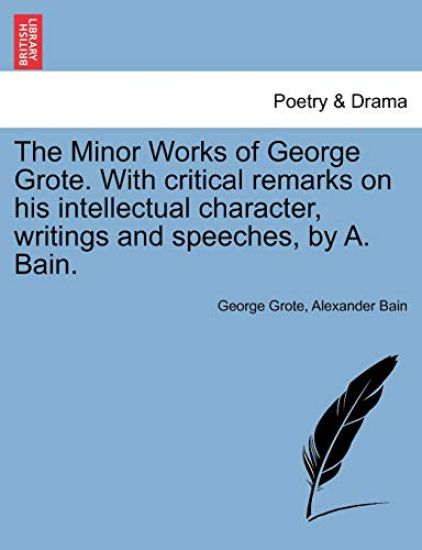
The Minor Works of George Grote. with Critical Remarks on His Intellectual Character, Writings and Speeches, by A. Bain.
George Grote; Alexander Bain
British Library, Historical Print Editions
2011
pokkari
The Minor Works of George Grote. with Critical Remarks on His Intellectual Character, Writings and Speeches, by A. Bain.
George Grote; Alexander Bain
British Library, Historical Print Editions
2011
pokkari