Kirjojen hintavertailu. Mukana 11 342 296 kirjaa ja 12 kauppaa.

Kirjahaku

Etsi kirjoja tekijän nimen, kirjan nimen tai ISBN:n perusteella.

1000 tulosta hakusanalla Andy Sumner

Global Poverty

Global Poverty

Andy Sumner

Oxford University Press
2016
sidottu
Why are some people poor? Why does absolute poverty persist despite substantial economic growth? What types of late economic development or 'catch-up' capitalism are associated with different poverty outcomes? Global Poverty addresses these apparently simple questions and the extent to which the answers may be shifting. One might expect global poverty to be focused in the world's poorest countries, usually defined as low-income countries, or least developed countries, or 'fragile states'. However, most of the world's absolute poor by monetary or multi-dimensional poverty - up to a billion people - live in growing and largely stable middle-income countries. At the same time, poverty has not fallen as much as the substantial economic growth would warrant. As a consequence, and as domestic resources have grown, much of global poverty has become less about a lack of domestic resources and more about questions of national inequality, social policy and welfare regimes, and patterns of economic development pursued.
Development and Distribution

Development and Distribution

Andy Sumner

Oxford University Press
2018
sidottu
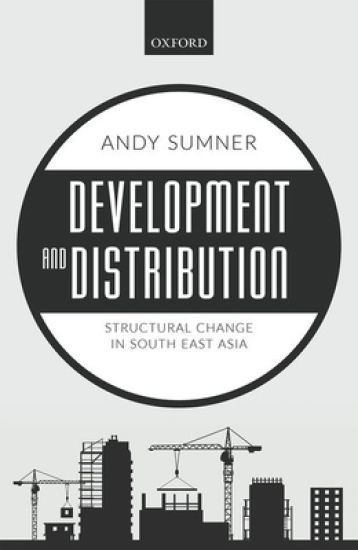
Since the Second World War, surprisingly few developing countries have experienced a truly sustained episode of economic and social convergence towards the structural characteristics of the advanced nations. East Asia has exceeded most regions in its achievement of convergence, and much has been written on comparative industrialization and development in North East Asia. Less discussed is South East Asia and the surprising and inclusive transformation several of its countries has undergone. Development and Distribution focuses on South East Asia and, more specifically, on Malaysia, Indonesia, and Thailand. These three nations have all undergone a major transformation - in a way never anticipated - from being poor, agrarian countries to middle-income countries with developed industrial and manufacturing bases. How did Malaysia, Indonesia, and Thailand achieve such a transformation, and how did they achieve the transformation with a form of economic growth that was driven by structural transformation, but that was 'inclusive'? Given that historically it has been thought that structural transformation tends to push up inequality, whilst inclusive growth necessitates static or even falling inequality, this last point is particularly salient to developing countries. Understanding how the transformation was possible in a relatively small space of time, the extent to which it was inclusive, and the caveats and prospects for South East Asia is thus an area of enquiry significant to all developing countries as they seek economic and social transformation.
Deindustrialization, Distribution, and Development

Deindustrialization, Distribution, and Development

Andy Sumner

Oxford University Press
2021
sidottu
The term rust belt has rarely been associated with developing countries. In fact, it is commonly used to discuss deindustrialization in advanced nations, particularly the US. However, this book argues that such a belt is now threatening the middle-income developing world, spreading across Brazil and other countries in Latin America, running down across South Africa, and then upwards to Malaysia, Indonesia, Thailand, and the Philippines in South East Asia. Deindustrialization, Distribution, and Development: Structural Change in the Global South explores the emergent processes of stalled industrialization and the spectre of deindustrialization in these developing countries. Building upon the author's previous work on economic development, structural change, and income inequality, this book examines the causes and consequences of these new issues, focusing on inequality both between and within countries since the Cold War. Providing a comparative, in-depth analysis of the varieties of contemporary structural change in the Global South and challenging many long-standing myths, this work explains why late development remains a crucial concept in understanding contemporary development and explores what deindustrialization means for the future of global development.
Disrupted Development and the Future of Inequality in the Age of Automation

Disrupted Development and the Future of Inequality in the Age of Automation

Andy Sumner; Lukas Schlogl

Saint Philip Street Press
2020
pokkari
This open access book examines the future of inequality, work and wages in the age of automation with a focus on developing countries. The authors argue that the rise of a global 'robot reserve army' has profound effects on labor markets and economic development, but, rather than causing mass unemployment, new technologies are more likely to lead to stagnant wages and premature deindustrialization. The book illuminates the debate on the impact of automation upon economic development, in particular issues of poverty, inequality and work. It highlights public policy responses and strategies-ranging from containment to coping mechanisms-to confront the effects of automation. This work was published by Saint Philip Street Press pursuant to a Creative Commons license permitting commercial use. All rights not granted by the work's license are retained by the author or authors.
Disrupted Development and the Future of Inequality in the Age of Automation

Disrupted Development and the Future of Inequality in the Age of Automation

Andy Sumner; Lukas Schlogl

Saint Philip Street Press
2020
sidottu
This open access book examines the future of inequality, work and wages in the age of automation with a focus on developing countries. The authors argue that the rise of a global 'robot reserve army' has profound effects on labor markets and economic development, but, rather than causing mass unemployment, new technologies are more likely to lead to stagnant wages and premature deindustrialization. The book illuminates the debate on the impact of automation upon economic development, in particular issues of poverty, inequality and work. It highlights public policy responses and strategies-ranging from containment to coping mechanisms-to confront the effects of automation. This work was published by Saint Philip Street Press pursuant to a Creative Commons license permitting commercial use. All rights not granted by the work's license are retained by the author or authors.
Great Gatsby and the Global South

Great Gatsby and the Global South

Diding Sakri; Andy Sumner; Arief Anshory Yusuf

Cambridge University Press
2023
pokkari
In the Global South economic mobility across generations or intergenerational economic mobility is in and of itself an important topic for research with consequences for policy. It concerns the 'stickiness' or otherwise of inequality because mobility is concerned with the extent to which children's economic outcomes are dependent on their parents' economic outcomes. Scholars have estimated levels of intergenerational mobility in many developed countries. Fewer estimates are available for developing countries, where mobility matters more due to starker differences in living standards. This Element surveys the area, conceptually and empirically; it presents a new estimate for a developing country, namely Indonesia; it discusses the 'Great Gatsby Curve' and highlights the different positions of developed and developing countries. Finally, it presents a theoretical framework to explain the drivers of mobility and the stickiness or otherwise of inequality across time. This title is also available as Open Access on Cambridge Core.
Aid, Growth and Poverty

Aid, Growth and Poverty

Jonathan Glennie; Andy Sumner

Palgrave Macmillan
2016
sidottu
The authors discuss the impact of foreign aid and tackle the question of why assessing the impact of aid is so difficult. The authors focus on peer-reviewed, cross-country studies published over the last decade and draw together some global-level assessments, considering the context and conditions under which aid might be said to ‘work’. Glennie and Sumner argue that the evidence in four areas shows signs of convergence that may have direct relevance for policy decisions on aid and for aid effectiveness discussions. These are as follows: Aid levels (meaning if aid is too low or too high); Domestic political institutions (including political stability and extent of decentralisation); Aid composition (including sectors, modalities, objectives and time horizons); and Aid volatility and fragmentation. Notably, this study finds that there is no consensus that the effectiveness of aid depends on orthodox economic policies.
The End of Poverty

The End of Poverty

Peter Edward; Andy Sumner

Springer Nature Switzerland AG
2019
sidottu
In this book Edward and Sumner argue that to better understand the impact of global growth on poverty it is necessary to consider what happens across a wide range of poverty lines. Starting with the same datasets used to produce official estimates of global poverty, they create a model of global consumption that spans the entire world’s population. They go on to demonstrate how their model can be utilised to understand how different poverty lines imply very different visions of how the global economy needs to work in order for poverty to be eradicated.
Disrupted Development and the Future of Inequality in the Age of Automation

Disrupted Development and the Future of Inequality in the Age of Automation

Lukas Schlogl; Andy Sumner

Springer Nature Switzerland AG
2020
sidottu
This open access book examines the future of inequality, work and wages in the age of automation with a focus on developing countries. The authors argue that the rise of a global ‘robot reserve army’ has profound effects on labor markets and economic development, but, rather than causing mass unemployment, new technologies are more likely to lead to stagnant wages and premature deindustrialization. The book illuminates the debate on the impact of automation upon economic development, in particular issues of poverty, inequality and work. It highlights public policy responses and strategies–ranging from containment to coping mechanisms—to confront the effects of automation.
Economics and Development Studies

Economics and Development Studies

Michael Tribe; Frederick Nixson; Andy Sumner

Routledge
2010
nidottu
Development studies textbooks and courses have sometimes tended to avoid significant economic content. However, without an understanding of the economic aspects of international development many of the more complex issues cannot be fully comprehended. Economics and Development Studies makes the economic dimension of discourse around controversial issues in international development accessible to second and third year undergraduate students working towards degrees in development studies.Following an introductory chapter outlining the connections between development economics and development studies, this book consists of eight substantive chapters dealing with the nature of development economics, economic growth and structural change, economic growth and developing countries, economic growth and economic development since 1960, the global economy and the Third World, developing countries and international trade, economics and development policy, and poverty, equality and development economists, with a tenth concluding chapter.This book synthesizes existing development economics literature in order to identify the salient issues and controversies and make them accessible and understandable. The concern is to distinguish differences within the economics profession, and between economists and non-economists, so that the reader can make informed judgments about the sources of these differences, and about their impact on policy analysis and policy advice. The book features explanatory text boxes, tables and diagrams, suggestions for further reading, and a listing of the economic concepts used in the chapters.
Economics and Development Studies

Economics and Development Studies

Michael Tribe; Frederick Nixson; Andy Sumner

Routledge
2010
sidottu
Development studies textbooks and courses have sometimes tended to avoid significant economic content. However, without an understanding of the economic aspects of international development many of the more complex issues cannot be fully comprehended. Economics and Development Studies makes the economic dimension of discourse around controversial issues in international development accessible to second and third year undergraduate students working towards degrees in development studies.Following an introductory chapter outlining the connections between development economics and development studies, this book consists of eight substantive chapters dealing with the nature of development economics, economic growth and structural change, economic growth and developing countries, economic growth and economic development since 1960, the global economy and the Third World, developing countries and international trade, economics and development policy, and poverty, equality and development economists, with a tenth concluding chapter.This book synthesizes existing development economics literature in order to identify the salient issues and controversies and make them accessible and understandable. The concern is to distinguish differences within the economics profession, and between economists and non-economists, so that the reader can make informed judgments about the sources of these differences, and about their impact on policy analysis and policy advice. The book features explanatory text boxes, tables and diagrams, suggestions for further reading, and a listing of the economic concepts used in the chapters.
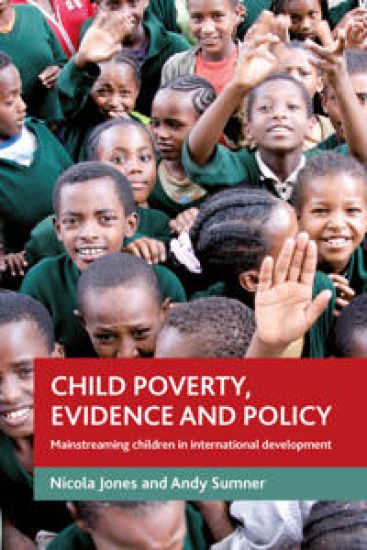
Child poverty, evidence and policy

Child poverty, evidence and policy

Nicola A. Jones; Andy Sumner

Policy Press
2011
nidottu
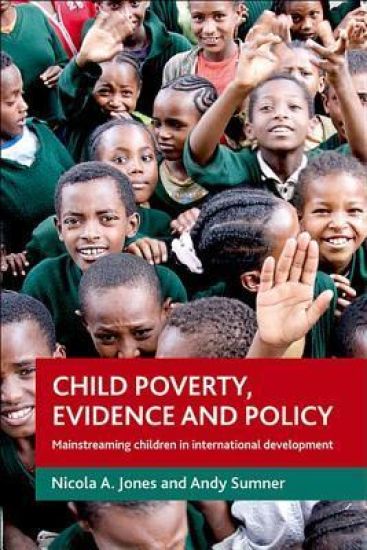
Available Open Access under CC-BY-NC licence. This book is about the opportunities and challenges involved in mainstreaming knowledge about children in international development policy and practice. It focuses on the ideas, networks and institutions that shape the development of evidence about child poverty and wellbeing, and the use of such evidence in development policy debates. It also pays particular attention to the importance of power relations in influencing the extent to which children's voices are heard and acted upon by international development actors. The book weaves together theory, mixed method approaches and case studies spanning a number of policy sectors and diverse developing country contexts in Africa, Asia and Latin America. It therefore provides a useful introduction for students and development professionals who are new to debates on children, knowledge and development, whilst at the same time offering scholars in the field new methodological and empirical insights.
Child poverty, evidence and policy

Child poverty, evidence and policy

Nicola A. Jones; Andy Sumner

Policy Press
2011
sidottu
Available Open Access under CC-BY-NC licence. This book is about the opportunities and challenges involved in mainstreaming knowledge about children in international development policy and practice. It focuses on the ideas, networks and institutions that shape the development of evidence about child poverty and wellbeing, and the use of such evidence in development policy debates. It also pays particular attention to the importance of power relations in influencing the extent to which children's voices are heard and acted upon by international development actors. The book weaves together theory, mixed method approaches and case studies spanning a number of policy sectors and diverse developing country contexts in Africa, Asia and Latin America. It therefore provides a useful introduction for students and development professionals who are new to debates on children, knowledge and development, whilst at the same time offering scholars in the field new methodological and empirical insights.
Hello Muddah, Hello Faddah: Andy Sweet's Summer Camp 1977
The golden days of tube socks, bunk beds, marshmallows and first crushes: 1970s summer camp, from the photographer behind Shtetl in the Sun A companion volume to Shtetl in the Sun, Andy Sweet's love letter to the colorful Jewish community of late 1970s South Beach, Hello Muddah, Hello Faddah chronicles the summer of 1977 at Camp Mountain Lake, serving up a knowing portrait of the era's fashion, pop culture and frank expressions of adolescent sexuality. Set against the cherished rituals of camp life—from the parade of trunks as 300 campers arrive at Mountain Lake's rural North Carolina setting to the end-of-August Dionysian frenzy of "Color War"—Sweet's photos tell a classic coming-of-age story, one full of awkward crushes, intense friendships and the kind of deep truths that emerge over late-night, campfire-toasted marshmallows. As the camp's photography instructor and one of its counselors, Sweet brings an intimate familiarity to his subject, capturing the rhythms of the camp's daily life through both posed compositions and spontaneous images. By turns nostalgic, poignant and laugh-out-loud funny, this collection includes a foreword by award-winning Miami arts journalist Brett Sokol and an introductory essay by New Yorker staff writer Naomi Fry.
Andy & Sandy and the First Day of Summer

Andy & Sandy and the First Day of Summer

Tomie dePaola

Simon Schuster Books for Young Readers
2022
sidottu
Andy and Sandy celebrate the summer in this fifth book of an easy-to-read picture book series about friendship--from Caldecott and Newbery Honoree Tomie dePaola and Emmy Award-winning writer for the Muppets Jim Lewis. Summer is here What shall Andy and Sandy do first? Sandy has plenty of ideas, like jumping rope, playing catch, riding bikes, and more. But when the summer sun gets too hot, Andy knows the very best way to have fun: sharing a cool glass of lemonade with his best friend Written in simple words and short, declarative sentences, this book is perfect for little ones just learning to read on their own.
Summer

Summer

Andy Young

Lulu.com
2017
pokkari
Summer the Fairy, twelve years old, has no interest in the big, wide, wonderful world beyond her canyon. She doesn't even know it's there, and still wouldn't care even if she did. She's happy being alone, happy spending her time wandering and sleeping, happy killing and eating all the birds and butterflies she wants. But all that is going to change: somebody, or something, or maybe a lot of Somethings, have decided that Summer is very important, so important that she needs to die. Summer doesn't understand what's going on, and has no interest in being important, and certainly has no plans on dying, no matter how many Somethings want her to. Avoiding her fate is, frankly, impossible. But she's going to try anyway.
The End of Summer

The End of Summer

Andy N

Lulu.com
2012
pokkari
Following on from his debut collection 'Return to Kemptown', 'The End of Summer' is a poetry collection capturing both the every-moment of perpetual seasons as well as the vital minutiae of daily life, all wrapped up a whirl of words like autumn leaves kicked up by the last of summer's winds taking nature's contradictions and her false promises and casts them over our human condition, as hopeful and nostalgic disciples of the glorious sun and the beautiful snow. Told often in taut, short little pieces, the book invites comparisons with the poet Hugo Williams but also shows a love of music through two of the author's own favourite music groups with July Skies and Epic 45, which explores the Englishness of the countryside in sparse, echoing brush-stroke, s which often need more than one read to breathe the images he portraits. With an introduction by noted American writer, Amanda Silbernagel. 'The End of Summer' is a book that tunnels into memories, creating new emotions at the end of it.
Why Can't Freshman Summer Be Like Pizza?

Why Can't Freshman Summer Be Like Pizza?

Andy V Roamer

Ninestar Press, LLC
2020
pokkari
RV, having successfully completed his freshman year at the demanding Boston Latin School, is hoping for a great summer. He's now fifteen years old and looking forward to sharing many languid summer days with his friend Bobby, who's told him he has gay feelings too. But life and family and duties for a son of immigrant parents makes it difficult to steal time away with Bobby.Bobby, too, has pressures. He spends part of the summer away at football camp, and his father pushes him to work a summer job at a friend's accounting firm. Bobby takes the job grudgingly, wanting to spend any extra time practicing the necessary skills to make Latin's varsity football team.On top of everything, RV's best friend Carole goes away for the summer, jumping at an opportunity to spend it with her father in Paris. Luckily, there is always Mr. Aniso, RV's Latin teacher, to talk to whenever RV is lonely. He's also there for RV when he inadvertently spills one of Bobby's secrets, and Bobby is so angry RV is afraid he is ready to cut off the friendship.