Kirjojen hintavertailu. Mukana 11 627 463 kirjaa ja 12 kauppaa.

Kirjahaku

Etsi kirjoja tekijän nimen, kirjan nimen tai ISBN:n perusteella.

486 tulosta hakusanalla Apollonius of Rhodes

Apollonius of Rhodes: Argonautica Book III

Apollonius of Rhodes: Argonautica Book III

Apollonius of Rhodes

Cambridge University Press
1989
pokkari
The Argonautica of Apollonius of Rhodes, composed in the third century BC and the only extant Greek epic between Homer and the later Roman empire, tells of Jason’s successful expedition with the Argonauts to recover the Golden Fleece from Colchis on the Black Sea. Book III relates the story of Jason and Medea, a young Colchian princess who falls in love with Jason and helps him by magic to survive the ordeals imposed by her father. The description of Medea’s emotional suffering exercised a profound influence on subsequent writers and especially on Virgil in his account of Dido and Aeneas. Dr Hunter’s edition provides a full introduction to the poem and its poet, an up-to-date text of Book III and a full commentary which covers problems of language and translation as well as dealing with the poetic meaning of the work and Apollonius’ creative use of the Homeric heritage. It is the first full-scale treatment in English of Book III to be written in the modern period of renewed interest in Hellenistic poetry. This edition makes Argonautica III available to students of Greek at university and in the upper forms of schools, but scholars of Greek and Latin, especially those interested in Hellenistic literature and in epic, will also find it valuable.
Apollonius of Rhodes: Argonautica Book IV

Apollonius of Rhodes: Argonautica Book IV

Apollonius of Rhodes

Cambridge University Press
2015
sidottu
Apollonius' epic, the Argonautica, is not just a masterpiece of Hellenistic poetry drawing on the entire tradition of previous Greek literature, but was enormously influential on Latin epic, especially Virgil's Aeneid. Book IV tells the story of the Argonauts' return to Greece with the Golden Fleece, their nightmarish trips through the uncharted rivers of central Europe and the desert wastes of North Africa, the terrible killing of Medea's brother, and the anguish of the young girl which foreshadows her bloody future. This is the first modern commentary in English. Problems of syntax and language are fully explained, and there is a sophisticated discussion of the poem as literature. It will be useful for advanced undergraduates and graduate students studying Greek poetry, as well as of interest to scholars.
Apollonius of Rhodes and the Spaces of Hellenism

Apollonius of Rhodes and the Spaces of Hellenism

William G. Thalmann

Oxford University Press Inc
2011
sidottu
Although Apollonius of Rhodes' extraordinary epic poem on the Argonauts' quest for the Golden Fleece has begun to get the attention it deserves, it still is not well known to many readers and scholars. This book explores the poem's relation to the conditions of its writing in third century BCE Alexandria, where a multicultural environment transformed the Greeks' understanding of themselves and the world. Apollonius uses the resources of the imagination - the myth of the Argonauts' voyage and their encounters with other peoples - to probe the expanded possibilities and the anxieties opened up when definitions of Hellenism and boundaries between Greeks and others were exposed to question. Central to this concern with definitions is the poem's representation of space. Thalmann uses spatial theories from cultural geography and anthropology to argue that the Argo's itinerary defines space from a Greek perspective that is at the same time qualified. Its limits are exposed, and the signs with which the Argonauts mark space by their passage preserve the stories of their complex interactions with non-Greeks. The book closely considers many episodes in the narrative with regard to the Argonauts' redefinition of space and the implications of their actions for the Greeks' situation in Egypt, and it ends by considering Alexandria itself as a space that accommodated both Greek and Egyptian cultures.
Apollonius of Rhodes: Argonautica Book IV
Apollonius' epic, the Argonautica, is not just a masterpiece of Hellenistic poetry drawing on the entire tradition of previous Greek literature, but was enormously influential on Latin epic, especially Virgil's Aeneid. Book IV tells the story of the Argonauts' return to Greece with the Golden Fleece, their nightmarish trips through the uncharted rivers of central Europe and the desert wastes of North Africa, the terrible killing of Medea's brother, and the anguish of the young girl which foreshadows her bloody future. This is the first modern commentary in English. Problems of syntax and language are fully explained, and there is a sophisticated discussion of the poem as literature. It will be useful for advanced undergraduates and graduate students studying Greek poetry, as well as of interest to scholars.
A Companion to Apollonius of Rhodes

A Companion to Apollonius of Rhodes

THE UNIVERSITY OF MICHIGAN PRESS
2025
sidottu
This volume presents a companion text to ancient Greek poet Apollonius of Rhodes, author of the epic poem Argonautica, which stands on a level of importance with other major ancient epics like the Aeneid or the Odyssey. Ruth Scodel and her contributors examine Apollonius’ work from three points of view—his literary influences and impact on contemporary writers, the actual work of Apollonius, and his later reception in Latin. This companion volume seeks to help readers with varied reasons to be interested in Apollonius—whether they are interested in Latin poets whom he influenced, or in patronage, or narrative method.A Companion to Apollonius of Rhodes aims to help contemporary readers appreciate what is most characteristic of Apollonius’ epic—its fascination with ritual and myth, gods who act without the direction of Zeus, frequent distanced narration, the portrayal of characters in situations where there are no good choices. It includes thorough analyses of the poem’s relationship to contemporary art with illustrations and treats familiar topics, such as Jason’s leadership, with nuance. Contributors include Benjamin Acosta-Hughes, Annemarie Ambühl, Anja Bettenworth, Keyne Cheshire, Christopher Chinn, James Clauss, Adele Teresa Cozzoli, Kristopher Fletcher, Alexander Hollmann, Regina Höschele, Niklas Holzberg, Alison Keith, Adolf Köhnken†, Anatole Mori, William H. Race, Norman Sandridge, Selina Stewart, Stefanie Stürner, and Graham Zanker.
The Voyage of the Argo

The Voyage of the Argo

Apollonius of Rhodes

Graphic Arts Books
2021
sidottu
The Voyage of the Argo is an epic poem centering Jason and his legendary crew as they venture to find the Golden Fleece. Faced with various hurdles and unbeatable odds, they’re committed to achieving their ultimate goal. When a young man threatens the throne, King Pelias sends him on a futile mission to Colchis. Once there, the fearless Jason must confront the volatile King Aetes and seize his most valued possession—the Golden Fleece. With help from the Argonauts, Jason navigates multiple challenges including winged harpies, violent waters and six-armed brutes. Despite surprising obstacles, the heroes continue and are pushed to their mental and physical limits. Much like Homer’s Odyssey, The Voyage of the Argo is a staple in Greek mythology. It’s a classic hero’s journey full of unexpected detours and ambiguous characters. Although a product of the Hellenistic period, this enduring epic has stood the test of time, continuing to captivate and inspire. With an eye-catching new cover, and professionally typeset manuscript, this edition of The Voyage of the Argo is both modern and readable.
The Voyage of the Argo

The Voyage of the Argo

Apollonius of Rhodes

Graphic Arts Books
2021
pokkari
The Voyage of the Argo is an epic poem centering Jason and his legendary crew as they venture to find the Golden Fleece. Faced with various hurdles and unbeatable odds, they’re committed to achieving their ultimate goal. When a young man threatens the throne, King Pelias sends him on a futile mission to Colchis. Once there, the fearless Jason must confront the volatile King Aetes and seize his most valued possession—the Golden Fleece. With help from the Argonauts, Jason navigates multiple challenges including winged harpies, violent waters and six-armed brutes. Despite surprising obstacles, the heroes continue and are pushed to their mental and physical limits. Much like Homer’s Odyssey, The Voyage of the Argo is a staple in Greek mythology. It’s a classic hero’s journey full of unexpected detours and ambiguous characters. Although a product of the Hellenistic period, this enduring epic has stood the test of time, continuing to captivate and inspire. With an eye-catching new cover, and professionally typeset manuscript, this edition of The Voyage of the Argo is both modern and readable.
Jason and Medea

Jason and Medea

Apollonius of Rhodes

Penguin Classics
2015
nidottu
'The Argonauts were terrified at the sight. But Jason planting his feet apart stood to receive them, as a reef in the sea confronts the tossing billows in a gale.' The tragic, epic love affair that allowed Jason to get the Golden Fleece. Introducing Little Black Classics: 80 books for Penguin's 80th birthday. Little Black Classics celebrate the huge range and diversity of Penguin Classics, with books from around the world and across many centuries. They take us from a balloon ride over Victorian London to a garden of blossom in Japan, from Tierra del Fuego to 16th-century California and the Russian steppe. Here are stories lyrical and savage; poems epic and intimate; essays satirical and inspirational; and ideas that have shaped the lives of millions. Apollonius of Rhodes (3rd century BCE). Apollonius of Rhodes's The Voyage of Argo is also available in Penguin Classics.
Jason and the Argonauts

Jason and the Argonauts

Apollonius of Rhodes

Penguin Classics
2015
pokkari
Now in a riveting new verse translation Jason and the Argonauts (also known as the Argonautica), is the only surviving full account of Jason's voyage on the Argo in quest of the Golden Fleece aided by the sorceress princess Medea. Written in third century B.C., this epic story of one of the most beloved heroes of Greek mythology, with its combination of the fantastical and the real, its engagement with traditions of science, astronomy and medicine, winged heroes, and a magical vessel that speaks, is truly without exact parallel in classical or contemporary Greek literature and is now available in an accessible and engaging translation.Apollonius of Rhodes published his first version of the Argonautica sometime in the middle of the third century B.C. At the end of his life he was director of the famous Library of Alexandria, which was the principal storehouse of all literature and learning at the time.Aaron Poochigian, born in 1973, is a poet and an associated lecturer in Classics at The Ohio State University and has translated the Penguin Classics edition of Stung with Love: Poems and Fragments by Sappho, as well as works by Aeschylus and Aratus. He lives in New York City. Benjamin Acosta-Hughes is Professor of Greek and Latin at The Ohio State University. He is the author of several works of nonfiction, including Arion's Lyre: Archaic Lyric into Hellenistic Poetry.
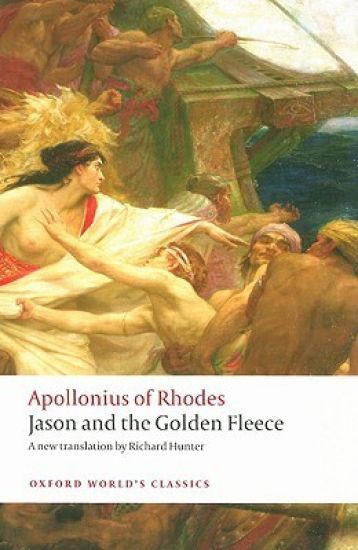
Jason and the Golden Fleece (The Argonautica)

Jason and the Golden Fleece (The Argonautica)

Apollonius of Rhodes

Oxford University Press
2009
nidottu
The Argonautica is the dramatic story of Jason's quest for the Golden Fleece and his relations with the dangerous Colchian princess, Medea. The only extant Greek epic poem to bridge the gap between Homer and late antiquity, it is a major product of the brilliant world of the Ptolemaic court at Alexandria, written by Apollonius of Rhodes in the 3rd century BC. Apollonius explores many of the fundamental aspects of life in a highly original way: love, deceit, heroism, human ignorance of the diven, the limits of science. This volume offers the first scholarly translation into English prose for many years, combining readability with accuracy and an attention to detail that will appeal to readers both with and without Greek. `Based on a deep understanding of the text, this translation, with informative notes and an excellent introduction, will bring Apollonius to the audience he deserves....' (TLS) ABOUT THE SERIES: For over 100 years Oxford World's Classics has made available the widest range of literature from around the globe. Each affordable volume reflects Oxford's commitment to scholarship, providing the most accurate text plus a wealth of other valuable features, including expert introductions by leading authorities, helpful notes to clarify the text, up-to-date bibliographies for further study, and much more.
Jason and the Golden Fleece

Jason and the Golden Fleece

Apollonius of Rhodes

Digireads.com
2020
pokkari
Written in Greek in the 3rd century BC, "Jason and the Golden Fleece" or "The Argonautica" is the epic of Apollonius of Rhodes. It is the only surviving Hellenistic epic and recounts the timeless tale of Jason and the Argonauts and their quest to retrieve the Golden Fleece. Based upon sources such as Homer and Pindar and written during the age of the famous Library of Alexandria, Apollonius was the first to include in his retelling of the already famous tale information about the geography, ethnography, and comparative religions of the places and people Jason encountered on his voyage. Apollonius revolutionized this ancient dramatic form and developed narrative techniques such as the interior monologue so that the audience could truly understand and identify with the character's thoughts and feelings. "The Argonautica" explored in detail the love between Jason and the foreign princess and sorceress Medea in a much more expansive and emotional way than had Homer. Apollonius is often credited with beginning the tradition of the romantic novel. "The Argonautica" influenced such ancient writers as Catullus, Ovid, and Virgil and remains widely studied and adapted for modern audiences. This edition is printed on premium acid-free paper and follows the prose translation of R. C. Seaton.