
Kirjojen hintavertailu. Mukana 11 342 296 kirjaa ja 12 kauppaa.

Kirjahaku

Etsi kirjoja tekijän nimen, kirjan nimen tai ISBN:n perusteella.

1000 tulosta hakusanalla Auguste Devin

Lettres de M. Auguste Devin, Préfet Apostolique de Syrie, Au Frère Génin, Au Sujet
Lettres de M. Auguste Devin... prefet apostolique de Syrie, au Frere Genin, ... au sujet des missions de Syrie.]Date de l'edition originale: 1874Ce livre est la reproduction fidele d'une oeuvre publiee avant 1920 et fait partie d'une collection de livres reimprimes a la demande editee par Hachette Livre, dans le cadre d'un partenariat avec la Bibliotheque nationale de France, offrant l'opportunite d'acceder a des ouvrages anciens et souvent rares issus des fonds patrimoniaux de la BnF.Les oeuvres faisant partie de cette collection ont ete numerisees par la BnF et sont presentes sur Gallica, sa bibliotheque numerique.En entreprenant de redonner vie a ces ouvrages au travers d'une collection de livres reimprimes a la demande, nous leur donnons la possibilite de rencontrer un public elargi et participons a la transmission de connaissances et de savoirs parfois difficilement accessibles.Nous avons cherche a concilier la reproduction fidele d'un livre ancien a partir de sa version numerisee avec le souci d'un confort de lecture optimal. Nous esperons que les ouvrages de cette nouvelle collection vous apporteront entiere satisfaction.Pour plus d'informations, rendez-vous sur www.hachettebnf.fr
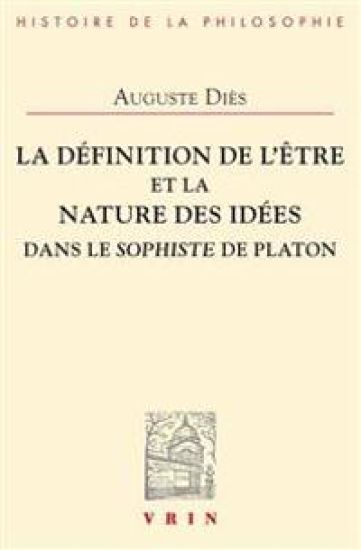
La Definition de L'Etre Et La Nature Des Idees Dans Le Sophiste de Platon
Traducteur des oeuvres de Platon aux Belles Lettres, Auguste Dies s'est attache a rendre le sens authentique d'un Dialogue qui avait jusqu'alors donne liue a des interpretations divergentes. Le Sophiste, dont le but avoue est de condamner l'art d'illusion et de mensonge pratique par la sophistique et de resoudre le probleme de l'erreur en demontrant l'existence du non-etre, introduit dans son argumentation le concept de mouvement: attribuant a ce concept un role primordial, les lectures modernes du Sophiste ont pu croire que ce dialogue avait pour but d'inaugurer une nouvelle conception energetique de l'Etre, modifiant considerablement la theorie platonicienne des Idees. Dans la presente etude, publiee pour la premiere fois en 1909, Auguste Dies se propose de verifier si la definition de l'Etre formulee dans le Sophiste entraine, annonce, ou tout du moins, accompagne une conception nouvelle de la nature des Idees.
Les Pots-De-Vin Parlementaires

Les Pots-De-Vin Parlementaires

Auguste Chirac

Hachette Livre - BNF
2013
pokkari
Les Pots-de-vin parlementaires . (Signe: Auguste Chirac.)Date de l'edition originale: 1888Sujet de l'ouvrage: France (1870-1940, 3e Republique)Ce livre est la reproduction fidele d une uvre publiee avant 1920 et fait partie d une collection de livres reimprimes a la demande editee par Hachette Livre, dans le cadre d un partenariat avec la Bibliotheque nationale de France, offrant l opportunite d acceder a des ouvrages anciens et souvent rares issus des fonds patrimoniaux de la BnF.Les uvres faisant partie de cette collection ont ete numerisees par la BnF et sont presentes sur Gallica, sa bibliotheque numerique.En entreprenant de redonner vie a ces ouvrages au travers d une collection de livres reimprimes a la demande, nous leur donnons la possibilite de rencontrer un public elargi et participons a la transmission de connaissances et de savoirs parfois difficilement accessibles.Nous avons cherche a concilier la reproduction fidele d un livre ancien a partir de sa version numerisee avec le souci d un confort de lecture optimal. Nous esperons que les ouvrages de cette nouvelle collection vous apporteront entiere satisfaction.Pour plus d informations, rendez-vous sur www.hachettebnf.fr
Auguste Comte

Auguste Comte

Mike Gane

Routledge
2006
nidottu
Auguste Comte is widely acknowledged as the founder of the science of sociology and the 'Religion of Humanity'. In this fascinating study, the first major reassessment of Comte’s sociology for many years, Mike Gane draws on recent scholarship and presents a new reading of this remarkable figure. Comte’s contributions to the history and philosophy of science have decisively influenced positive methodologies. He coined the term ‘sociology’ and gave it its first content, and he is renowned for having introduced the sociology of gender and emotion into sociology. What is less well known however, is that Comte contributed to ethics, and indeed coined the word ‘altruism’. In this important work Gane examines Comte's sociological vision and shows that, because he thought sociology could and should be reflexive, encyclopaedic and utopian, he considered topics such as fetishism, polytheism, fate, love, and the relations between sociology, science, theology and culture.This fascinating account of the birth of sociology is an unprecedented introductory text on Comte. Gane’s work is an essential read for all sociologists and students of the discipline.
Auguste Comte

Auguste Comte

Mike Gane

Routledge
2006
sidottu
Auguste Comte is widely acknowledged as the founder of the science of sociology and the 'Religion of Humanity'. In this fascinating study, the first major reassessment of Comte’s sociology for many years, Mike Gane draws on recent scholarship and presents a new reading of this remarkable figure. Comte’s contributions to the history and philosophy of science have decisively influenced positive methodologies. He coined the term ‘sociology’ and gave it its first content, and he is renowned for having introduced the sociology of gender and emotion into sociology. What is less well known however, is that Comte contributed to ethics, and indeed coined the word ‘altruism’. In this important work Gane examines Comte's sociological vision and shows that, because he thought sociology could and should be reflexive, encyclopaedic and utopian, he considered topics such as fetishism, polytheism, fate, love, and the relations between sociology, science, theology and culture.This fascinating account of the birth of sociology is an unprecedented introductory text on Comte. Gane’s work is an essential read for all sociologists and students of the discipline.
Auguste Rodin

Auguste Rodin

Le Normand-Romain Antoinette; Buley-Uribe Christina

Thames Hudson Ltd
2006
sidottu
Auguste Rodin: Drawings & Watercolours reveals what has until now been a little-known aspect of the great sculptor’s work, presenting an extensive panorama of his graphic output. It reproduces 350 of the most beautiful pieces from the collection at the Musée Rodin and the most important foreign collections, including a considerable number of never-beforereproduced works, to give as complete a picture as possible of a rich, often sumptous graphic oeuvre.
Auguste Comte and the Religion of Humanity

Auguste Comte and the Religion of Humanity

Andrew Wernick

Cambridge University Press
2005
pokkari
This 2001 book offers an exciting reinterpretation of Auguste Comte, the founder of French sociology. Following the development of his philosophy of positivism, Comte later focused on the importance of the emotions in his philosophy resulting in the creation of a new religious system, the Religion of Humanity. Andrew Wernick provides the first in-depth critique of Comte's concept of religion and its place in his thinking on politics, sociology and philosophy of science. He places Comte's ideas in the context of post-1789 French political and intellectual history, and of modern philosophy, especially postmodernism. Wernick relates Comte to Marx and Nietzsche as seminal figures of modernity and examines key features of modern and postmodern French social theory, tracing the inherent flaws and disintegration of Comte's system. Wernick offers original and fascinating insights in this rich study which will attract a wide audience from sociologists and philosophers to cultural theorists and historians.
Auguste Comte: Volume 1

Auguste Comte: Volume 1

Mary Pickering

Cambridge University Press
2006
pokkari
This book constitutes the first volume of a two-volume intellectual biography of Auguste Comte, the founder of modern sociology and a philosophical movement called positivism. Volume One offers a reinterpretation of Comte's 'first career' (1798–1842), when he completed the scientific foundation of his philosophy. It describes the interplay between Comte's ideas and the historical context of post-revolutionary France, his struggles with poverty and mental illness, and his volatile relationships with friends, family and colleagues, including such famous contemporaries as Saint-Simon, the Saint-Simonians, Guizot and John Stuart Mill. Pickering shows that the man who called for a new social philosophy based on the sciences was not only ill at ease in the most basic human relationships, but also profoundly questioned the ability of the purely scientific spirit to regenerate the political and social world.
Auguste Comte: Volume 3

Auguste Comte: Volume 3

Mary Pickering

Cambridge University Press
2009
sidottu
This volume continues to explore the life and works of Auguste Comte during his so-called second career. It covers the period from the coup d'état of Louis Napoleon in late 1851 to Comte's death in 1857. During these early years of the Second Empire, Comte became increasingly conservative and anxious to control his disciples. This study offers the first study of the tensions within his movement. Focusing on his second masterpiece, the Système de politique positive, and other important books, such as the Synthèse subjective, Mary Pickering not only sheds light on Comte's intellectual development but also traces the dissemination of positivism and the Religion of Humanity throughout many parts of the world.