Kirjojen hintavertailu. Mukana 11 342 296 kirjaa ja 12 kauppaa.

Kirjahaku

Etsi kirjoja tekijän nimen, kirjan nimen tai ISBN:n perusteella.

1000 tulosta hakusanalla B. Vickers

Panic in the Loop

Panic in the Loop

Raymond B. Vickers

Lexington Books
2011
sidottu
Relying on a broad array of records used together for the first time, Panic in the Loop reveals widespread fraud and insider abuse by bankers—and the complicity of corrupt politicians—that caused the Chicago banking debacle of 1932. It provides a fresh interpretation of the role played by bankers who turned the nation’s financial crisis of the early 1930s into the decade-long Great Depression. It also calls for the abolition of secrecy that still permeates the bank regulatory system, which would have prevented the Enron fiasco and the financial meltdown of 2008. This book focuses on the recurrent failures of the financial system—the savings and loan crisis of the 1980s, the Enron debacle of the early 2000s, and finally the financial collapse of 2008. Because of regulatory secrecy, knowing what happened in Chicago in 1932 is critical to understanding the glaring problems in the regulation of American finance, in particular the lack of transparency, the abuse of financial institutions by insiders, and the capture of public institutions by insiders going through the revolving door between the private and public sectors. Eight decades later little has changed. The regulatory failures of the 1930s—especially the pervasive system of secrecy that allowed the fraud and insider abuse to flourish—were repeated during the collapse of 2008. Transparency would strike at the alliance between the executives of financial institutions and public officials, who caused the worst economic upheaval since the Great Depression.
Panic in the Loop

Panic in the Loop

Raymond B. Vickers

Lexington Books
2013
nidottu
Relying on a broad array of records used together for the first time, Panic in the Loop reveals widespread fraud and insider abuse by bankers—and the complicity of corrupt politicians—that caused the Chicago banking debacle of 1932. It provides a fresh interpretation of the role played by bankers who turned the nation’s financial crisis of the early 1930s into the decade-long Great Depression. It also calls for the abolition of secrecy that still permeates the bank regulatory system, which would have prevented the Enron fiasco and the financial meltdown of 2008. This book focuses on the recurrent failures of the financial system—the savings and loan crisis of the 1980s, the Enron debacle of the early 2000s, and finally the financial collapse of 2008. Because of regulatory secrecy, knowing what happened in Chicago in 1932 is critical to understanding the glaring problems in the regulation of American finance, in particular the lack of transparency, the abuse of financial institutions by insiders, and the capture of public institutions by insiders going through the revolving door between the private and public sectors. Eight decades later little has changed. The regulatory failures of the 1930s—especially the pervasive system of secrecy that allowed the fraud and insider abuse to flourish—were repeated during the collapse of 2008. Transparency would strike at the alliance between the executives of financial institutions and public officials, who caused the worst economic upheaval since the Great Depression.
Panic in Paradise

Panic in Paradise

Raymond B. Vickers

The University of Alabama Press
2007
nidottu
Panic in Paradise is a comprehensive study of bank loan failures during the Florida land boom of the mid-1920s, during the years preceding the stock market crash of 1929. Florida and Georgia experienced a banking panic in 1926 when, in a ten-day period in July, after uncontrollable depositor runs, 117 banks closed in the two states. Uninsured depositors lost millions, and several suicides followed the financial havoc. This volume makes use of banking records that were legally sealed for almost 70 years and provides a shocking story of professional corruption and conspiracy."An extraordinary and unusual book that makes an important contribution to our understanding of banking history and the general economic history oof the 1920s. The banking collapse in the Southeast is virtually unknown, even to specialists in banking and financial history. No one who is interested in the banking history of the United States will want to miss this book." -- Eugene N. White, Rutgers University"An exhaustively researched pioneering study; brilliant investigative reporting." -- Jack Blicksilver, Georgia State University
Native American Identities

Native American Identities

Scott B. Vickers

University of New Mexico Press
1998
nidottu
Issues of identity and authenticity present perennial challenges to both Native Americans and critics of their art. Vickers examines the long history of dehumanizing depictions of Native Americans while discussing such purveyors of stereotypes as the Puritans, the Bureau of Indian Affairs, and Hollywood. These stereotypes abetted a national policy robbing Indians of their cultural identity. As a contrast to these, he examines the work of white authors and artists such as Helen Hunt Jackson, Oliver La Farge, the Taos Society of Artists, and Frank Waters, who created more archetypal fictional Indian characters.In the second half of the book, Vickers explores the work of Indian artists and writers, such as Edgar Heap of Birds, Jaune Quick-to-See Smith, Linda Hogan, and Sherman Alexie who craft humanizing new images of authenticity and legitimacy, bridging the gap between stereotype and archetype. This is an essential book for all readers with an interest in the tragic history of Indian-white conflict.""Vickers is one of the few to consider artists and writers in relation to each other. He offers a refreshingly commonsensical approach.""-Herta Wong, University of California, Berkley
Panic in Paradise

Panic in Paradise

Raymond B Vickers

The University of Alabama Press
1994
sidottu
A study of bank-loan failures during the Florida land-boom of the mid-1920s. The author shows that, despite official disclaimers and previous historical accounts, virtually every bank failure that occurred involved massive insider abuses, a conscious conspiracy to defraud - or both.
The Golden Book of Marcus Aurelius: A companion to the podcast www.themapodcast.wordpress.com

The Golden Book of Marcus Aurelius: A companion to the podcast www.themapodcast.wordpress.com

Barry Vickers LL B.

Createspace Independent Publishing Platform
2013
nidottu
Marcus Aurelius lived from AD 26 April 121 until 17 March 180 and was Roman Emperor from AD 161 to 180. This book is an accompaniment to the podcast "The Golden Book of Marcus Aurelius" which you can find on iTunes or at www.themapodcast.wordpress.com. It contains links to audio recordings of the Golden Book, links to contemporary maps and many other interesting links and facts about Marcus. Marcus was the last of the so called "five good emperors". He came from a wealthy family, who had grown rich from their family brick-works during the time of the Emperor Hadrian (of wall-building fame). Hadrian was aware of, and fond of Marcus as a boy, and interceded in his educational arrangements, sponsoring him - and putting him on what could be regarded as an inevitable path to public office. As part of his education he was trained by several of the brightest minds of his time, but he was particularly struck by the teachings of the stoic philosophers and aspects of the philosophy related to duty.
Where There's Smoke

Where There's Smoke

E. B. Vickers

RANDOM HOUSE USA INC
2023
sidottu
In this fast-paced thriller, eighteen-year-old Calli finds herself alone after the loss of her father--until a bruised and broken girl shows up on her property, forcing her to face the present, rethink her future, and unearth the skeletons of her own past. Life has never been easy in the small desert town of Harmony, but even on the day Calli Christopher buries her father, she knows she is surrounded by people who care about her. But after the funeral, when everyone has finally gone home, Calli discovers a girl on her property. A girl who's dirty and bruised and unable to speak. And petrified. Calli keeps the girl secret--well, almost secret. She calls her Ash and begins to nurture her back to health. But word spreads in a small town, and soon a detective comes around asking questions about a missing girl from another town. But these only raise more questions--about Ash and about the people Calli knows well. Still, she must ask: is Ash in danger...or is she the danger?
Where There's Smoke

Where There's Smoke

E. B. Vickers

RANDOM HOUSE USA INC
2024
nidottu
In this fast-paced thriller, eighteen-year-old Calli finds herself alone after the loss of her father--until a bruised and broken girl shows up on her property, forcing her to face the present, rethink her future, and unearth the skeletons of her own past. Life has never been easy in the small desert town of Harmony, but even on the day Calli Christopher buries her father, she knows she is surrounded by people who care about her. But after the funeral, when everyone has finally gone home, Calli discovers a girl on her property. A girl who's dirty and bruised and unable to speak. And petrified. Calli keeps the girl secret--well, almost secret. She calls her Ash and begins to nurture her back to health. But word spreads in a small town, and soon a detective comes around asking questions about a missing girl from another town. But these only raise more questions--about Ash and about the people Calli knows well. Still, she must ask: is Ash in danger...or is she the danger?
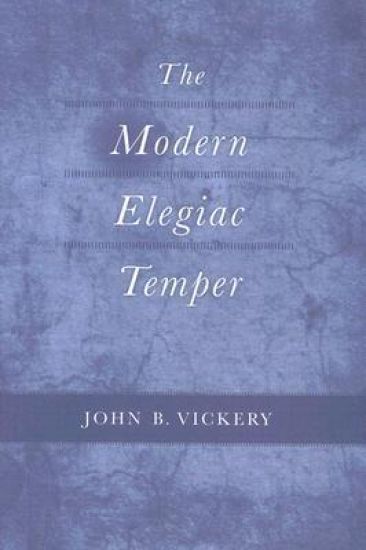
The Modern Elegiac Temper

The Modern Elegiac Temper

John B. Vickery

Louisiana State University Press
2006
sidottu
Lamentation of death is the traditional elegiac focus, but in the twentieth century the elegy has become characterized as well by the mourning of other kinds of loss- those personal, familial, romantic, cultural, and philosophical privations and dispossessions that have so greatly shaped the modern sensibility. According to John B. Vickery, a profound elegiac temper is itself the major trait of twentieth-century culture, registered in attitudes ranging from regret, sorrow, confusion, anger, anxiety, doubt, and alienation to outright despair. He transforms our understanding of the elegy and its relation to modernism in The Modern Elegiac Temper. Vickery offers in-depth readings of a broad sampling of British and American poems written from World War I to the present. He considers works of overlooked poets such as Vernon Watkins, George Barker, and Edith Sitwell while also attending to canonical writers such as T. S. Eliot, Ezra Pound, W. H. Auden, and Wallace Stevens. Taking a text-oriented rather than author- or theory-oriented approach, he discusses in turn the personal, love, cultural, and philosophical elegy and shows how war, the Great Depression, the Holocaust, and other major historical events influenced poets' elegiac expressions. By suggesting ways in which the individual-centered concerns of the traditional elegy metamorphose under the depersonalizing lens of high modernism, Vickery reveals the modern elegy to be a finely calibrated instrument for reading and expressing, absorbing and reflecting, the modern temperament.
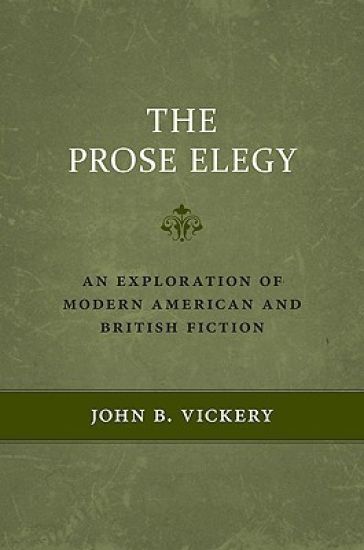
The Prose Elegy

The Prose Elegy

John B. Vickery

Louisiana State University Press
2009
sidottu
Traditional English poetic elegists offer both writers and readers hope. After lamenting an individual's death and confronting the mortality of all living things, these poets seek consolation from religion, philosophy, or culture for the inevitability of death. The modern prose elegy, however, follows a different path -- one that determinedly questions all possible resolutions. In The Prose Elegy, John B. Vickery continues the work he began in The Modern Elegiac Temper, which examined the form in British and American poetry. He now considers the works of American and British fiction writers from Henry James to Joan Didion and reveals how the elegy expanded into prose and why it evolved so as to deal not only with death but also with other forms of loss.Focusing on individual works, Vickery explores both the forms the elegy takes throughout the twentieth century and the skeptical and uncertain attitudes of writers struggling to confront the trauma of loss. He offers detailed interpretations of the elegiac components in the works of novelists James Joyce, William Faulkner, Virginia Woolf, and Ernest Hemingway, each of whom forged a distinctive style, as well as chroniclers of a pervasive stoicism, such as Malcolm Lowry and Joan Didion, and writers as nuanced as Sherwood Anderson, F. Scott Fitzgerald, James Agee, and Ford Madox Ford. For these writers, Vickery shows, sorrow intrudes upon the personal, intellectual, and cultural aspects of daily living. By exploring how loss touches each of these areas, their books probe intellectual boundaries and discover new elegiac themes. Truman Capote and John Updike, for example, view memory -- which can disappear quickly -- as inherently sad. They therefore elegize memory. What consoles writers of the modern elegy changes too. In place of Milton's religion or Shelley's philosophy, twentieth-century writers also seek comfort from what also saddens them: family, marriage, and ideas of the self. In The Prose Elegy, Vickery convincingly demonstrates that the elegy remains a dominant mode throughout British and American literature -- with perhaps greater pertinence to our lives than ever before.
The Literary Impact of The Golden Bough

The Literary Impact of The Golden Bough

John B Vickery

Princeton University Press
2015
pokkari
Frazer, with Freud, Marx, and Jung, is one of the thinkers who have had a deep and pervasive influence on modern literature. One of the great nineteenth-century syntheses, The Golden Bough was the culmination of a century of investigations into myth and ritual. John Vickery locates The Golden Bough in the context of its age and shows how, by gathering up many strands of nineteenth-century thought, it embodied the dominant intellectual tradition shaping the modern spirit. The author's intimate acquaintance with an extraordinary range of modern literature enables him to demonstrate the variety of strategies that poets and novelists have used to assimilate The Golden Bough in their individual attitudes and preoccupations. The remaining chapters of the book are devoted to extended discussions of the intellectual, thematic, and format impact of The Golden Bough on Yeats, Eliot, Lawrence, and Joyce. Originally published in 1973. The Princeton Legacy Library uses the latest print-on-demand technology to again make available previously out-of-print books from the distinguished backlist of Princeton University Press. These editions preserve the original texts of these important books while presenting them in durable paperback and hardcover editions. The goal of the Princeton Legacy Library is to vastly increase access to the rich scholarly heritage found in the thousands of books published by Princeton University Press since its founding in 1905.
The Literary Impact of The Golden Bough

The Literary Impact of The Golden Bough

John B Vickery

Princeton University Press
2016
sidottu
Frazer, with Freud, Marx, and Jung, is one of the thinkers who have had a deep and pervasive influence on modern literature. One of the great nineteenth-century syntheses, The Golden Bough was the culmination of a century of investigations into myth and ritual. John Vickery locates The Golden Bough in the context of its age and shows how, by gathering up many strands of nineteenth-century thought, it embodied the dominant intellectual tradition shaping the modern spirit. The author's intimate acquaintance with an extraordinary range of modern literature enables him to demonstrate the variety of strategies that poets and novelists have used to assimilate The Golden Bough in their individual attitudes and preoccupations. The remaining chapters of the book are devoted to extended discussions of the intellectual, thematic, and format impact of The Golden Bough on Yeats, Eliot, Lawrence, and Joyce. Originally published in 1973. The Princeton Legacy Library uses the latest print-on-demand technology to again make available previously out-of-print books from the distinguished backlist of Princeton University Press. These editions preserve the original texts of these important books while presenting them in durable paperback and hardcover editions. The goal of the Princeton Legacy Library is to vastly increase access to the rich scholarly heritage found in the thousands of books published by Princeton University Press since its founding in 1905.
Information Science In Theory And Practice

Information Science In Theory And Practice

B. C. Vickery; A. Vickery

K G Saur Verlag
2004
sidottu
This is the 3rd revised edition of the classic work "Information Science in Theory and Practice." There is a completely new chapter on the "The Internet and Information Science." This will take up themes discussed in earlier chapters and reconsiders them in the light of the new information environment.