Kirjojen hintavertailu. Mukana 12 390 323 kirjaa ja 12 kauppaa.

Kirjahaku

Etsi kirjoja tekijän nimen, kirjan nimen tai ISBN:n perusteella.

1000 tulosta hakusanalla Barry Bozeman

Science Competes

Science Competes

Barry Bozeman

MIT PRESS LTD
2025
nidottu
When science competes with myriad influences in public policymaking, how can we ensure that it does so effectively? Policymakers, like most people today, have a world of information within easy reach, much of it wrong. How, amidst the chaos and misdirection of our day's information ecosystem, can science compete for the attention and trust of those who make public policy--especially at a time when issues like proliferating infectious diseases and climate change put a premium on accurate and relevant scientific information? What's needed, Barry Bozeman suggests in Science Competes, is a clearer understanding of how scientific information is conveyed, how it is understood and used, and where it fits in the wide array of information that might be of use to those who make and administer policy, laws, and regulations, as well as citizens who actively participate in public life. Acknowledging the importance of different sorts of information--historical, experiential, political, e.g.--to decision making, Bozeman focuses on enhancing, not maximizing, the effective use of science in public policy. This entails recognizing that valid and useful scientific information is not necessarily formal scientific knowledge, but often takes the form of science by-products such as raw or structured data, graphics, and conceptual models. Explaining how such information can be better distinguished from half-truths and pernicious falsehoods, Science Competes also raises the possibility that effective competition might require improvements in science institutions, norms, and ideas about acceptable behavior.
Public Values and Public Interest

Public Values and Public Interest

Barry Bozeman

Georgetown University Press
2007
pokkari
Economic individualism and market-based values dominate today's policymaking and public management circles - often at the expense of the common good. In his new book, Barry Bozeman demonstrates the continuing need for public interest theory in government. "Public Values and Public Interest" offers a direct theoretical challenge to the "utility of economic individualism," the prevailing political theory in the western world. The book's arguments are steeped in a practical and practicable theory that advances public interest as a viable and important measure in any analysis of policy or public administration. According to Bozeman, public interest theory offers a dynamic and flexible approach that easily adapts to changing situations and balances today's market-driven attitudes with the concepts of common good advocated by Aristotle, Saint Thomas Aquinas, John Locke, and John Dewey. In constructing the case for adopting a new governmental paradigm based on what he terms "managing publicness," Bozeman demonstrates why economic indices alone fail to adequately value social choice in many cases. He explores the implications of privatization of a wide array of governmental services - among them Social Security, defense, prisons, and water supplies. Bozeman constructs analyses from both perspectives in an extended study of genetically modified crops to compare the policy outcomes using different core values and questions the public value of engaging in the practice solely for the sake of cheaper food. Thoughtful, challenging, and timely, "Public Values and Public Interest" shows how the quest for fairness can once again play a full part in public policy debates and public administration.
Synthetic Fuel Technology Development in the United States

Synthetic Fuel Technology Development in the United States

Barry Bozeman; Michael Crow; Walter Meyer; Ralph Shangraw

Praeger Publishers Inc
1988
sidottu
Direct coal liquefaction, a synthetic liquid fuel process, is one of the major developmental alternatives for meeting the anticipated fuel demands for the twenty-first century. This work provides a retrospective assessment of past attempts in this century to develop synthetic liquid fuel and applies the findings to produce reliable and pertinent data for the future. Retrospective technology assessment, a recent methodological invention, is used by the authors to analyze the past synthetic liquid fuel programs and the reasons for their failures. Bringing to bear four different perspectives--economic, technological, policy, and historical--the authors draw broad conclusions that will help guide the next development effort in the United States.
The Strength in Numbers

The Strength in Numbers

Barry Bozeman; Jan Youtie

PRINCETON UNIVERSITY PRESS
2017
sidottu
Once upon a time, it was the lone scientist who achieved brilliant breakthroughs. No longer. Today, science is done in teams of as many as hundreds of researchers who may be scattered across continents and represent a range of hierarchies. These collaborations can be powerful, but they demand new ways of thinking about scientific research. When three hundred people make a discovery, who gets credit? How can all collaborators' concerns be adequately addressed? Why do certain STEM collaborations succeed while others fail? Focusing on the nascent science of team science,The Strength in Numbers synthesizes the results of the most far-reaching study to date on collaboration among university scientists to provide answers to such questions. Drawing on a national survey with responses from researchers at more than one hundred universities, anonymous web posts, archival data, and extensive interviews with active scientists and engineers in over a dozen STEM disciplines, Barry Bozeman and Jan Youtie set out a framework to characterize different types of collaboration and their likely outcomes. They also develop a model to define research effectiveness, which assesses factors internal and external to collaborations. They advance what they have found to be the gold standard of science collaborations: consultative collaboration management. This strategy--which codifies methods of consulting all team members on a study's key points and incorporates their preferences and values--empowers managers of STEM collaborations to optimize the likelihood of their effectiveness. The Strength in Numbers is a milestone in the science of team science and an indispensable guide for scientists interested in maximizing collaborative success.
The Strength in Numbers

The Strength in Numbers

Barry Bozeman; Jan Youtie

Princeton University Press
2020
pokkari
Why collaborations in STEM fields succeed or fail and how to ensure successOnce upon a time, it was the lone scientist who achieved brilliant breakthroughs. No longer. Today, science is done in teams of as many as hundreds of researchers who may be scattered across continents. These collaborations can be powerful, but they also demand new ways of thinking. The Strength in Numbers illuminates the nascent science of team science by synthesizing the results of the most far-reaching study to date on collaboration among university scientists. Drawing on a national survey with responses from researchers at more than one hundred universities, archival data, and extensive interviews with scientists and engineers in over a dozen STEM disciplines, Barry Bozeman and Jan Youtie establish a framework for characterizing different collaborations and their outcomes, and lay out what they have found to be the gold-standard approach: consultative collaboration management. The Strength in Numbers is an indispensable guide for scientists interested in maximizing collaborative success.
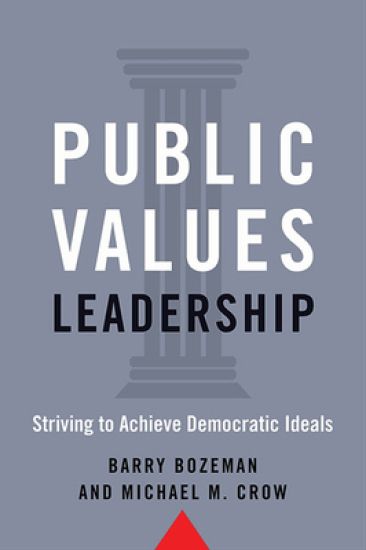
Public Values Leadership

Public Values Leadership

Barry Bozeman; Michael M. Crow

Johns Hopkins University Press
2021
sidottu
Instead of private gain or corporate profits, what if we set public values as the goal of leadership?Leadership means many things and takes many forms. But most studies of the topic give little attention to why people lead or to where they are leading us. In Public Values Leadership, Barry Bozeman and Michael M. Crow explore leadership that serves public values—that is to say, values that are focused on the collective good and fundamental rights rather than profit, organizational benefit, or personal gain. While nearly everyone agrees on core public values, there is less agreement on how to obtain them, especially during this era of increased social and political fragmentation. How does public values leadership differ from other types of organizational leadership, and what distinctive skills does it require? Drawing on their extensive experience as higher education leaders, Bozeman and Crow wrestle with the question of how to best attain universally agreed-upon public values like freedom, opportunity, health, and security. They present conversations and interviews with ten well-known leaders—people who have achieved public values objectives and who are willing to discuss their leadership styles in detail. They also offer a series of in-depth case studies of public values leadership and accomplishment. Public values leadership can only succeed if it includes a commitment to pragmatism, a deep skepticism about government versus market stereotypes, and a genuine belief in the fundamental importance of partnerships and alliances. Arguing for a "mutable leadership," they suggest that different people are leaders at different times and that ideas about natural leaders or all-purpose leaders are off the mark. Motivating readers, including students of public policy administration and practitioners in public and nonprofit organizations, to think systematically about their own values and how these can be translated into effective leadership, Public Values Leadership is highly personal and persuasive.
Bureaucratization in Academic Research Policy

Bureaucratization in Academic Research Policy

Barry Bozeman; Jiwon Jung

now publishers Inc
2017
nidottu
In the U.S. and throughout most of the world, university research is becoming increasingly bureaucratized. Remarkably, there is almost no scholarly attention devoted to answering the question of what explains the continual growth in rules and regulations surrounding publicly funded research. Many efforts have been made to document the growth of rules and administrative burden in research policy - blue ribbon panels have been convened and made recommendations about reducing rules and their costs - but the causes of this bureaucratization have generated much less systematic explanation. Bureaucratization in Academic Research Policy: What Causes It? explains the reasons of bureaucratization and, in doing so, relies on theory and research about red tape and bureaucratic pathology. The monograph is organized as follows: The first section provides a brief, necessary preamble to organizational analysis - a review and conceptual demarcation of bureaucratization, red tape and formalization. After clarifying closely related concepts, the authors review some of the studies documenting the bureaucratization of research policy and administration in the U.S. and the responses to the bureaucratization, both institutional responses and responses and attitudes of individual investigators. The next section introduces theory of rules and red tape, the theory-base is used as a lens to asking the study’s key question concerning the growth of rules in research policy and administration. After providing a theory base, the authors turn to the core question of the paper: What explains the continual growth in rules and regulations surrounding publicly funded research? And provide a conceptual model to answer this question. Finally, the monograph examines key elements of the conceptual model in terms of a variety of government rules and procedures promulgated, ones that almost always have good intentions but, when taken together, vastly increase administrative burden while only rarely demonstrating the social value purchased by the administrative burden.
Research Collaboration and Team Science

Research Collaboration and Team Science

Barry Bozeman; Craig Boardman

Springer International Publishing AG
2014
nidottu
Today in most scientific and technical fields more than 90% of research studies and publications are collaborative, often resulting in high-impact research and development of commercial applications, as reflected in patents. Nowadays in many areas of science, collaboration is not a preference but, literally, a work prerequisite. The purpose of this book is to review and critique the burgeoning scholarship on research collaboration. The authors seek to identify gaps in theory and research and identify the ways in which existing research can be used to improve public policy for collaboration and to improve project-level management of collaborations using Scientific and Technical Human Capital (STHC) theory as a framework.Broadly speaking, STHC is the sum of scientific and technical and social knowledge, skills and resources embodied in a particular individual. It is both human capital endowments, such as formal education and training and social relations and network ties that bind scientists and the users of science together. STHC includes the human capital which is the unique set of resources the individual brings to his or her own work and to collaborative efforts. Generally, human capital models have developed separately from social capital models, but in the practice of science and the career growth of scientists, the two are not easily disentangled.Using a multi-factor model, the book explores various factors affecting collaboration outcomes, with particular attention on institutional factors such as industry-university relations and the rise of large-scale university research centers.
Limited by Design

Limited by Design

Michael Crow; Barry Bozeman

Columbia University Press
1998
sidottu
Limited by Design is the first comprehensive study of the varying roles played by the more than 16,000 research and development laboratories in the U.S. national innovation system. Michael Crow and Barry Bozeman offer policy makers and scientists a blueprint for making more informed decisions about how to best utilize and develop the capabilities of these facilities. Some labs, such as Bell Labs, Westinghouse, and Eastman Kodak, have been global players since the turn of the century. Others, such as Los Alamos National Laboratory, have been mainstays of the military/energy industrial complex since they evolved in the 1940s. These and other institutions have come to serve as the infrastructure upon which a range of industries have relied and have had a tremendous impact on U.S. social and economic history. Michael Crow and Barry Bozeman illustrate the histories, missions, structure, and behavior of individual laboratories, and explore the policy contexts in which they are embedded. In studying this large and varied collection of labs, Crow, Bozeman, and their colleagues develop a new framework for understanding the structure and behavior of laboratories that also provides a basis for rationalizing federal science and technology policy to create more effective laboratories. The book draws upon interviews and surveys collected from thousands of scientists, administrators, and policy makers, and features boxed "lab windows" throughout that provide detailed information on the variety of laboratories active in the U.S. national innovation system. Limited by Design addresses a range of questions in order to enable policy makers, university administrators, and scientists to plan effectively for the future of research and development.
Advanced Introduction to Innovation and Public Values

Advanced Introduction to Innovation and Public Values

John P. Nelson; Barry Bozeman

EDWARD ELGAR PUBLISHING LTD
2025
sidottu
Elgar Advanced Introductions are stimulating and thoughtful introductions to major fields in the social sciences, business and law, expertly written by the world’s leading scholars. Designed to be accessible yet rigorous, they offer concise and lucid surveys of the substantive and policy issues associated with discrete subject areas.This illuminating book explores how societies reshape themselves through innovation, reviewing methods for foreseeing, guiding and evaluating these changes. It demonstrates how a community can use shared goals and priorities to promote and pursue outcome-oriented public values innovation.John Nelson and Barry Bozeman examine the impacts of innovation on public values such as economic prosperity and equity, national security, public health and safety, and environmental wellbeing. They discuss the positive and negative features of these impacts, including job creation and destruction, economic restructuring, shifting circumstances for conventional warfare and cyberattacks, and pollution output or remediation. The Advanced Introduction to Innovation and Public Values synthesizes existing social and policy scholarship into practical guidance, advocating for innovation that advances prosperity, health, and liberty for all citizens.Key Features:Articulates the novel concept of ‘public values innovation’ to assess the impact of innovation systems on public prioritiesOutlines frameworks by which governments, corporations and civil society shape the aims, content and outcomes of innovationInvestigates the role of existing innovation systems, which run primarily through markets and private corporations, in shaping innovation outcomes—sometimes to public detrimentStudents and scholars of organisational innovation, the economics of innovation, public policy and administration, engineering, and the sciences will greatly benefit from this insightful book. It is also an essential resource for policymakers and practitioners in public, private, and nonprofit innovation policy and management.
Advanced Introduction to Innovation and Public Values

Advanced Introduction to Innovation and Public Values

John P. Nelson; Barry Bozeman

EDWARD ELGAR PUBLISHING LTD
2025
nidottu
Elgar Advanced Introductions are stimulating and thoughtful introductions to major fields in the social sciences, business and law, expertly written by the world’s leading scholars. Designed to be accessible yet rigorous, they offer concise and lucid surveys of the substantive and policy issues associated with discrete subject areas.This illuminating book explores how societies reshape themselves through innovation, reviewing methods for foreseeing, guiding and evaluating these changes. It demonstrates how a community can use shared goals and priorities to promote and pursue outcome-oriented public values innovation.John Nelson and Barry Bozeman examine the impacts of innovation on public values such as economic prosperity and equity, national security, public health and safety, and environmental wellbeing. They discuss the positive and negative features of these impacts, including job creation and destruction, economic restructuring, shifting circumstances for conventional warfare and cyberattacks, and pollution output or remediation. The Advanced Introduction to Innovation and Public Values synthesizes existing social and policy scholarship into practical guidance, advocating for innovation that advances prosperity, health, and liberty for all citizens.Key Features:Articulates the novel concept of ‘public values innovation’ to assess the impact of innovation systems on public prioritiesOutlines frameworks by which governments, corporations and civil society shape the aims, content and outcomes of innovationInvestigates the role of existing innovation systems, which run primarily through markets and private corporations, in shaping innovation outcomes—sometimes to public detrimentStudents and scholars of organisational innovation, the economics of innovation, public policy and administration, engineering, and the sciences will greatly benefit from this insightful book. It is also an essential resource for policymakers and practitioners in public, private, and nonprofit innovation policy and management.
University-Industry R&D Collaboration in the United States, the United Kingdom, and Japan
Over the last several decades there has been a growing interest in Research & Development (R&D) policy. This is particularly so in advanced industrialized nations that have adopted science- and technology- based strategies for national economic competitiveness. The United States, the United Kingdom, and Japan -- the three nations that are the subjects of this book -- share this policy strategy. Each of these nations is committed to hamessing the innovations that stern from scientific and technological advance to promote national economic prosperity. Governments can influence their nation's R&D efIort in three general ways. First, they can directly fund the R&D efIort through grants, loans, appropriations, or government contracts. Second, they can provide tax and financing incentives to encourage higher levels of private sector R&D. Third, they can use their power to create inter-organizational collaborations that vastly extend and expand the nation's collective R&D efIort. University-industry collaborations are a principal type of these inter­ organizational R&D efIorts -- and the focus of this book.
University-Industry R&D Collaboration in the United States, the United Kingdom, and Japan
Over the last several decades there has been a growing interest in Research & Development (R&D) policy. This is particularly so in advanced industrialized nations that have adopted science- and technology- based strategies for national economic competitiveness. The United States, the United Kingdom, and Japan -- the three nations that are the subjects of this book -- share this policy strategy. Each of these nations is committed to hamessing the innovations that stern from scientific and technological advance to promote national economic prosperity. Governments can influence their nation's R&D efIort in three general ways. First, they can directly fund the R&D efIort through grants, loans, appropriations, or government contracts. Second, they can provide tax and financing incentives to encourage higher levels of private sector R&D. Third, they can use their power to create inter-organizational collaborations that vastly extend and expand the nation's collective R&D efIort. University-industry collaborations are a principal type of these inter­ organizational R&D efIorts -- and the focus of this book.
Barry

Barry

Geoffrey A North

The History Press Ltd
1996
nidottu
In this collection of over 200 postcards and family snapshots, author Geoffrey North taps a rich vein of nostalgia for the past of Barry and the surrounding area. The book examines all those settings which have provided the background or stimulus for the many wonderful memories held by residents and holiday-makers alike. Several striking images of pleasure cruises, a packed Barry Island, or of the Docks heaving with ships testify to Barry's dual importance as both a focal point for leisure activities and as a thriving port, despatching the coal of South Wales to all corners of the globe. The cards also reveal the quieter corners as well as the busy town centre. All in all, this is a selection which should delight everybody who holds Barry close to their heart.