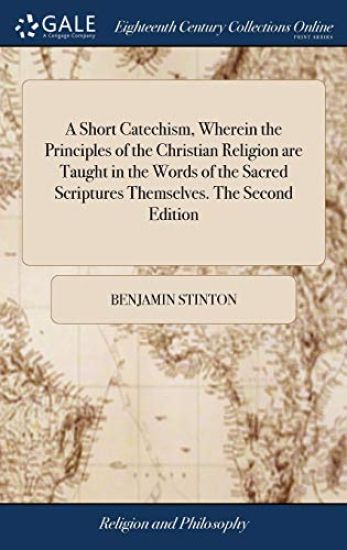
The 18th century was a wealth of knowledge, exploration and rapidly growing technology and expanding record-keeping made possible by advances in the printing press. In its determination to preserve the century of revolution, Gale initiated a revolution of its own: digitization of epic proportions to preserve these invaluable works in the largest archive of its kind. Now for the first time these high-quality digital copies of original 18th century manuscripts are available in print, making them highly accessible to libraries, undergraduate students, and independent scholars.The Age of Enlightenment profoundly enriched religious and philosophical understanding and continues to influence present-day thinking. Works collected here include masterpieces by David Hume, Immanuel Kant, and Jean-Jacques Rousseau, as well as religious sermons and moral debates on the issues of the day, such as the slave trade. The Age of Reason saw conflict between Protestantism and Catholicism transformed into one between faith and logic -- a debate that continues in the twenty-first century.++++The below data was compiled from various identification fields in the bibliographic record of this title. This data is provided as an additional tool in helping to insure edition identification: ++++British LibraryT104559London: printed by J. Darby, and sold by A. Bell, J. Baker, J. Browne and A. Dodd, 1714. 28p.; 8
The 18th century was a wealth of knowledge, exploration and rapidly growing technology and expanding record-keeping made possible by advances in the printing press. In its determination to preserve the century of revolution, Gale initiated a revolution of its own: digitization of epic proportions to preserve these invaluable works in the largest archive of its kind. Now for the first time these high-quality digital copies of original 18th century manuscripts are available in print, making them highly accessible to libraries, undergraduate students, and independent scholars.The Age of Enlightenment profoundly enriched religious and philosophical understanding and continues to influence present-day thinking. Works collected here include masterpieces by David Hume, Immanuel Kant, and Jean-Jacques Rousseau, as well as religious sermons and moral debates on the issues of the day, such as the slave trade. The Age of Reason saw conflict between Protestantism and Catholicism transformed into one between faith and logic -- a debate that continues in the twenty-first century.++++The below data was compiled from various identification fields in the bibliographic record of this title. This data is provided as an additional tool in helping to insure edition identification: ++++British LibraryT005984London: printed by J. Darby, and sold by J. Harrison, 1714. 32p.; 8
The 18th century was a wealth of knowledge, exploration and rapidly growing technology and expanding record-keeping made possible by advances in the printing press. In its determination to preserve the century of revolution, Gale initiated a revolution of its own: digitization of epic proportions to preserve these invaluable works in the largest archive of its kind. Now for the first time these high-quality digital copies of original 18th century manuscripts are available in print, making them highly accessible to libraries, undergraduate students, and independent scholars.The Age of Enlightenment profoundly enriched religious and philosophical understanding and continues to influence present-day thinking. Works collected here include masterpieces by David Hume, Immanuel Kant, and Jean-Jacques Rousseau, as well as religious sermons and moral debates on the issues of the day, such as the slave trade. The Age of Reason saw conflict between Protestantism and Catholicism transformed into one between faith and logic -- a debate that continues in the twenty-first century.++++The below data was compiled from various identification fields in the bibliographic record of this title. This data is provided as an additional tool in helping to insure edition identification: ++++British LibraryT124023The preface signed: Benj. Stinton.London: printed for Richard Ford, 1730. 23, 1]p.; 8
This unconventional biography of Benjamin Franklin, the great American Renaissance man, explores examples of Franklin's diverse genius and accomplishments in different fields. Among the topics explored are Franklin's views on women's issues, such as disapproving of impractical hoopskirts, supporting their education, and suggesting insurance for widows and spinsters. It describes his love of a good hoax, contributions to ballooning while an ambassador in France, experiments with the famous kite, and advances in heating houses. His work with money is also covered, including methods of printing money to confuse counterfeiters, a revolutionary way of making a print of a real leaf, and his updated portrait on the present $100 bill. Franklin's role as head of a commission to examine (and debunk) mesmerism is addressed. No stranger to controversy, Franklin headed the first successful attempt to unify the colonies to create a country. This work shows that Franklin is more responsible than any other for the founding of the United States--and also that he was a leading cause of the French Revolution, providing the French with an example of a successful rebellion, lessons on how to shift power from the king, and ideas about erecting a constitutional government (in addition, he weakened the French royal treasury by extracting loans and gifts to support America).
An energetic generation of spiritual leaders is reviving religion in the United States. They are creating enterprising grassroots organizations that have brought forth new expressions of belief and belonging for people who continue to long for deeper engagement in spiritual life and practice. For the first time in the United States, most Americans do not belong to a church. And yet, while churches are emptier, new spiritual leadership is hard at work building inventive centers of belonging rooted in the search for meaning, values, and guidance for this time of technological change and social fracture. Some of these spiritual entrepreneurs and builders are clergy. Many more are laypeople who have heard a call to higher purpose out of the pain of peers and distinct from denomination. America’s spiritual revival now emerges, and through the portraits of those shaping this awakening we witness new and innovative ways they fulfill people through belief, feelings of belonging, and activation. American Revival: Portraits of Today's Spiritual Builders spotlights these exciting new leaders and the communities they are creating, shining light on innovative paths forward for those yearning for more connection and meaning in their lives. Highlighted leaders include Alejandro Aguilera-Titus, Imam Abdullah Antelpli, Rabbi Elan Babchuck, Rev Jennifer Bailey, Helen A. Berger, Anju Bhargava, Yolanda Blue Horse, Dr. Rabbi Marc Borovitz, Dr. Matthew Bowman, Blake Chastain, Rev. Tyler Coles, Dr. Brian Corbin, Halil Demir, Lisa Doi, Kevin Garcia, Kate Gordon, Matthew Johnson Harris, Casper Ter Juile, Dr. Rucha Kaur, Dr. Uriah Kim, Rev Dr, Karoline Lewis, Kathryn Lohre, Pastor Daniel Lybarger, James Martin, Dr. Scott Mitchell, Nadiah Mohair, Reverend Luke Moon, Rev Dr. Joy J. Moore, Dr. Rami Nahashibi, Kursat Ozenc, Anthony Cruz Pantojas, Dr Eboo Patel, Rev Dr. Marc Rivera, Rabbi Or N. Rose, Harriet Rossetto, Dr. Simran Jeet Singh, Rev Dr. Matthew Skinner, Bishop Robert Stearns, Dr Stephanie Varnon-Hughes, Ani Zoonveld.
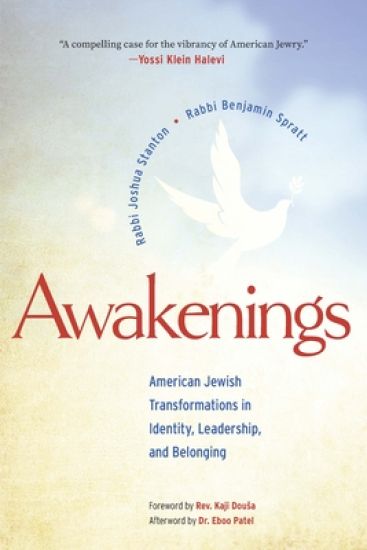
"Strong debut . . . this nuanced portrait of the state of American Judaism proffers a cogent vision of how to revitalize the faith." --Publisher's Weekly Why are religious organizations on the decline? What changes have caused many of them to lose touch with modern spiritual needs? What does it take to remain relevant in today's world? Rabbis Joshua Stanton and Benjamin Spratt take on these and other critical questions facing religion today. And they have answers that are frank and yet surprisingly upbeat.Nearly every facet of American Jewish life--and of American religious life in general--faces both disruption and great prospects for renewal. In every corner of our community, Jewish identity, wisdom, ritual, and power are being remixed and reimagined. As centralized authority declines, American Judaism moves and grows in a multitude of directions. As technology reduces the importance of geographic boundaries, new opportunities for connection and new modes of exercising power emerge. New mixtures of ancient Jewish practice and modern needs are beginning to shape the renewal of American Judaism, widening access to Jewish wisdom and ritual, transforming Jewish consumers into Jewish co-creators, and building new networks of Jewish belonging.The initial purposes that inspired much of the American Jewish infrastructure are now falling victim to their own success. An emphasis on nostalgia and authenticity encourages us to mythologize the past and narrow our awareness of the present. A focus on buildings and centralized power by much of American Judaism reflects the realities of a century ago.In understanding what keeps these organizations mired in the past, we can unearth a new purpose to unify the American Diaspora and guide it toward a new golden age. The Foreword by Rev. Kaji Dousa, Senior Pastor of Park Avenue Christian Church, asks what a Black pastor can add to the work of two white rabbis, and the answer is that "cherished thinking needs a hard look everywhere. Particularly as we rightly orient our resources to protecting the good, to eliminating poverty that need not exist, to eradicating the hatred that threatens the very existence of our people--we need to look, together. Blacks and Jews and those living in the intersections therein will only survive and thrive with the survival and thriving of each other. So, of course, it makes sense that we will awaken, together."The Afterword by Dr. Eboo Patel, Founder and President of Interfaith Youth Core cites the story of Rabbi Akiva, who "did not mourn when he saw the ruins of the Temple but rather was delighted. 'We always knew these stones must come down. In order to move forward, this had to fall apart first. Now we can begin.' All of our religions have history and theology like this. I think about the emergence of everything from Catholic orders to Sufi tariqas--renewal movements that changed the map of entire religions. We are at that same point again. Rabbis Stanton and Spratt propose we meet the moment with the generosity and power that are at the heart of all our religions. Their work gives me confidence that we can."
Walter Benjamin (1896-1940) has been called by Hannah Arendt the "greatest critic of the century." While an increasing number of Anglo-American literary critics draw upon Benjamin's writings in their own works, their colleagues in the philosophical community remain relatively unacquainted with his legacy. In the European intellectual world, by contrast, Benjamin's critical epistemological program, his philosophies of history and language, and his aesthetics have long since become part of philosophical discourse. The present collection of articles, many of which were contained in earlier versions in the Winter 1983 special issue of the journal The Philosophical Forum, initiates the project of establishing Benjamin's importance to philosophy. A balance of original work by Benjamin and important commentary on his works, this volume includes the crucial chapter from Benjamin's magnum opus The Arcades Project, his "Program of the Coming Philosophy," and "Central Park," as well as essays by leading scholars (including Theodor W. Adorno, Leo Lowenthal, and Rolf Tiedemann) that treat single philosophical themes and relate his ideas to those of other thinkers such as Gadamer, Goodmann, and Rosenzweig. Gary Smith's introduction to the volume provides an extremely useful and sophisticated entrée for readers unaccustomed to the breadth of Benjamin's philosophical allusions, as well as an informative summation of the contents of the volume. This book will be of interest to philosophers, literary theorists, art historians, anthropologists, and other social scientists.
Photographic model turned minor actor Benjamin Zambraia feels mocked by his spurious sort of fame. He is also haunted by Castana Beatriz, a love he lost 30 years before, but whose double has begun to crop up around town. Could Arieta Muse be Castana's daughter?
The harsh winter and great outdoors of upstate New York provide Benjamin with the only solace from an otherwise agonizing existence. His mother's abusive alcoholic boyfriend, the bully on the bus, and a Math teacher who pays a little too much attention to schoolboys are slowly chipping away at his dignity and feelings of self-worth. Benjamin clings to any sense of normalcy, until a series of escalating events drives him to the very edge of suicide. He begs God for help-a divine intervention-but his prayers go unanswered until he has an epiphany: God helps those who help themselves.