Pascal was a scientist and man of the world who came to be a passionately devout Christian. The fragments of his great defense of Christianity, left unfinished at his death in 1662, survive in the form of the Pensees. This series of brief, dramatic notes on his religious convictions are here translated into English. These thoughts expose Pascal's vision of the world and display powerful reasoning and a profound faith.
This chronological survey explores Pascal's (162362) achievement as mathematician, physicist and religious thinker; it also has a chapter on his life. His work on conic sections, the probability calculus, number theory, cycloid curves and hydrostatics is considered in detail. Analyses of the Provincial Letters and the Thoughts bring out the many distinctive features, thematicnn and technical, of each text. Pascal's lesser known works are also studied. There is a chapter on the Wager argument. A wide-ranging bibliography completes the book.
This book focuses on Blaise Pascal's Pensées, an apology for Christianity, which is regarded as Pascal's crowning achievement. Professor Charles Sherrard MacKenzie maintains that the lens best enabling us to understand Pensées is his fragment on the three orders of life: mental, material, and spiritual. This analysis also highlights the frustrations Pascal encountered while making scientific discoveries, as part of his quest for certainty in his and others' faith.
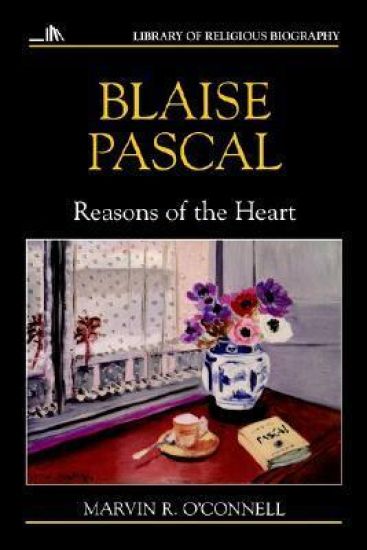
Blaise Pascal (1623-1662), mathematician, physicist, inventor, and religious thinker was a man at odds with his time. The optimism of the Enlightenment and the belief among philosophers and scientists that the universe was both discoverable and rational made them feel invincible. Reason alone, declared the intellectuals, could discover a God of natural religion that was to replace the God of traditional Christianity. Pascal, on the other hand, was not so confident. In his Pensees, he wrote, "The eternal silence of these infinite spaces fills me with dread." For Pascal, the universe was full of a mystery that went far beyond the powers of reason. Blaise Pascal: Reasons of the Heart, the latest addition to Eerdmans LIBRARY OF RELIGIOUS BIOGRAPHY series, captures Pascal's life and times with a chronicle narrative based on the published sources and Pascal's own works. Marvin O'Connell takes readers on an eloquent journey into Pascal's world, showing the passion that drove the man and the radical spirituality he sought in his own heart.In the process, O'Connell also illumines the social, political, and religious intrigue of seventeenth-century Paris, especially the winner-take-all struggle between the Jesuits and the Jansenists, with whom Pascal himself was allied. Written in an enjoyable style accessible to all, this meticulously researched biography will acquaint readers with the life and thought of Blaise Pascal, a remarkable human being and luminous Christian thinker.
Originally published in 1908, this book contains selections from Pascal's Pensées, translated into English. The text is divided into two main parts: the first part concerns the 'Misery of Man without God'; the second part discusses the 'Happiness of Man with God'. This book will be of value to anyone with an interest in Pascal and his theological ideas.