Kirjojen hintavertailu. Mukana 12 016 292 kirjaa ja 12 kauppaa.

Kirjahaku

Etsi kirjoja tekijän nimen, kirjan nimen tai ISBN:n perusteella.

1000 tulosta hakusanalla Bridget Riley

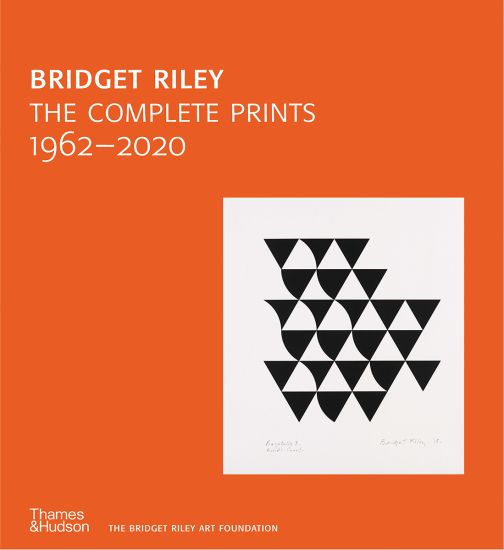
Bridget Riley: The Complete Prints

Bridget Riley: The Complete Prints

Bridget Riley

Thames Hudson Ltd
2020
sidottu
Bridget Riley has made screenprints throughout her career, extending the principles of her paintings into a new, reproducible medium. Bringing together the complete, updated inventory of this substantial body of work, this volume explores Riley's development as a printmaker and her relationship to the screenprint medium. Newly revised, updated and designed, this catalogue raisonné richly illustrates Bridget Riley's graphic work in a larger, enhanced format. Alongside a full-colour inventory of the prints are updated essays by Lynn MacRitchie and Craig Hartley and an additional essay by Robert Kudielka, which provide a greater context for Riley's work. This revised volume, a co-publication with The Bridget Riley Art Foundation, also benefits from supplemental material including an artist biography and selected solo and group exhibition history. Published by Thames & Hudson and the Bridget Riley Art Foundation
Bridget Riley: Working Drawings

Bridget Riley: Working Drawings

Bridget Riley

Thames Hudson Ltd
2021
sidottu
Bridget Riley’s paintings are developed carefully over time, the result of methodically working through pictorial variables such as colour, tone, scale, and rhythm. Studies are central to this process, allowing Riley to concentrate on the analysis and synthesis that lie at the heart of her working practice. Riley says, ‘Because my work is based on enquiry, studies are my chief method of exploration and my way into paintings’ (2005). This volume richly illustrates the thinking that goes into Riley’s work through a selection of over 150 drawings, colour analyses, notations, scale studies and cartoons, most of which were exhibited at the artist’s recent seminal retrospective exhibitions in Edinburgh and London from 2019 to 2020 organized by the National Galleries of Scotland. The selection spans most of Riley’s working life, tracing the origins and evolving nature of her remarkable body of work. Riley’s beginnings are also documented through selected childhood drawings, work made during and immediately following her studies at Goldsmiths’ College and the Royal College of Art, and her early explorations into abstraction. The artist’s working method is brought into high relief in a newly commissioned conversation with Riley and Sir John Leighton, Director of the National Galleries of Scotland. The text explores the cardinal moments in the artist’s practice and the impulses that bring her work into existence. The volume also includes four previously published texts dedicated to Riley’s studies and practice written by the artist herself, art historians, curators and museum directors, which shed further light on the enduring role of drawing and the process of exploration central to her work.With over 200 illustrations
Bridget Riley

Bridget Riley

David Zwirner
2014
sidottu
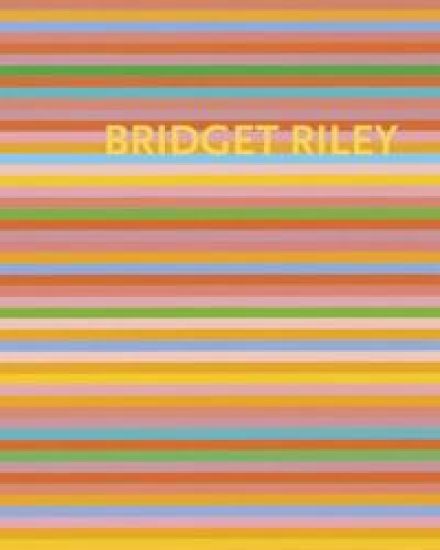
Published on the occasion of Bridget Riley’s major exhibition at David Zwirner in London in the summer of 2014, this fully illustrated catalogue offers intimate explorations of paintings and works on paper produced by the legendary British artist over the past fifty years, focusing specifically on her recurrent use of the stripe motif. Riley has devoted her practice to actively engaging viewers through elementary shapes such as lines, circles, curves, and squares, creating visual experiences that at times trigger optical sensations of vibration and movement. The London show, her most extensive presentation in the city since her 2003 retrospective at Tate Britain, explored the stunning visual variety she has managed to achieve working exclusively with stripes, manipulating the surfaces of her vibrant canvases through subtle changes in hue, weight, rhythm, and density. As noted by Paul Moorhouse, “Throughout her development, Riley has drawn confirmation from Eugène Delacroix’s observation that ‘the first merit of a painting is to be a feast for the eyes.’ [Her] most recent stripe paintings are a striking reaffirmation of that principle, exciting and entrancing the eye in equal measure.” Created in close collaboration with the artist, the publication’s beautifully produced color plates offer a selection of the iconic works from the exhibition. These include the artist’s first stripe works in color from the 1960s, a series of vertical compositions from the 1980s that demonstrate her so-called “Egyptian” palette—a “narrow chromatic range that recalled natural phenomena”—and an array of her modestly scaled studies, executed with gouache on graph paper and rarely before seen. A range of texts about Riley’s original and enduring practice grounds and contextualizes the images, including new scholarship by art historian Richard Shiff, texts on both the artist’s wall paintings and newest body of work by Paul Moorhouse, 20th Century Curator at the National Portrait Gallery in London, and a 1978 interview with Robert Kudielka, her longtime confidant and foremost critic. Additionally, the book features little-seen archival imagery of Riley at work over the years; documentation of her recent commissions for St. Mary’s Hospital in West London, taken especially for this publication; and installation views of the exhibition itself, installed throughout the three floors of the gallery’s eighteenth-century Georgian townhouse located in the heart of Mayfair.
Bridget Riley

Bridget Riley

Ridinghouse
2013
sidottu
Filled with Bridget Riley's mesmerising stripe paintings, this catalogue conveys the artist's unique development in using stripes to animate the entire visual field. Published in conjunction with the Bridget Riley: The Stripe Paintings 1961-2012 exhibition at Galerie Max Hetzler, Berlin, key paintings and studies of Riley's stripe works are collected for the first time. This well-illustrated title demonstrates how Riley regularly returned to this seemingly simple pictorial device to achieve complex, surprising results. The volume includes full-colour illustrations alongside important texts by John Elderfield and Paul Moorhouse - in both English and German - which situate these exhilarating works within the artist's oeuvre and a broader art historical context.
Bridget Riley

Bridget Riley

Ridinghouse
2014
nidottu
This volume documents a group of gouache studies by Bridget Riley from 1969 to 1972 that reflects a major reconfiguration of Riley’s style. The shapes formed in these gouaches are arranged from a limited selection of colours – namely violet, green and pink – to explore the visual relationship between 'contrast and harmony’. Accompanying full colour illustrations, a conversation between the artist and Robert Kudielka from 1972 posits the works within the context of Bridget Riley’s oeuvre.
Bridget Riley

Bridget Riley

Robert Kudielka

Ridinghouse
2015
sidottu
Marking the first major survey of Bridget Riley's use of the curve motif, this volume explores how the artist has often returned to this theme over a fifty-year time span. Coinciding with the artist's exhibition at De La Warr Pavilion, Bexhill On Sea (summer 2015), this publication features studies and paintings from throughout Riley's career.
Bridget Riley

Bridget Riley

Paul Moorhouse

Ridinghouse
2016
nidottu
During the early 1960s, Riley’s black-and-white work employed elementary shapes to convey movement and light. Having tested this limited set of means, the artist incorporated colour into her paintings in 1967. This volume accompanied an exhibition at Graves Gallery, Sheffield (18 February–25 June 2016) that chronicles the period of change which took place before, during and after Riley’s representation of Great Britain at the 34th Venice Biennale. Using Rise 1 (1968) as a starting point, the carefully selected group of paintings and works on paper from 1967–85 situate this important painting within its context. Alongside over 30 full-colour illustrations, an essay by Paul Moorhouse explores how the adoption of colour informs developments throughout Riley’s ensuing career.
Bridget Riley

Bridget Riley

National Galleries of Scotland
2019
nidottu
This landmark book reflects on almost 70 years of works by Bridget Riley (b.1931), from some of her earliest to very recent projects, providing a unique record of the work of an artist still very much at the height of her powers. Essays from leading scholars and commentators on Riley's work will make this title the authority on Riley's practice. In the last decade, Riley has continued to push her practice considerably, producing several large-scale site-specific wall paintings as well as continuing to develop new paintings. This book will explore these recent developments. It will also examine the notable influence that other artists such as Georges Seurat and Piet Mondrian have had on Riley's work.
Bridget Riley: Wall Works 1983-2023

Bridget Riley: Wall Works 1983-2023

Bridget Riley

Holzwarth Publications
2025
sidottu
Riley's geometric language spreads to walls as she explores the perception of color and rhythmSince the late 1970s, British painter Bridget Riley (born 1931) has often moved beyond the canvas to wall paintings, engendering a direct communication between work, viewer and space. This volume gathers 13 of these wall works spanning 40 years.
Bridget Riley: The Complete Paintings

Bridget Riley: The Complete Paintings

Robert Kudielka; Alexandra Tommasini; Natalia Naish

Thames Hudson Ltd
2018
sidottu
Bridget Riley is one of the most important British painters of our time. Since the early 1960s, when she first gained recognition with her powerful black and white paintings, the artist has continued to explore the principles of abstraction in startling and original ways. Through her systematic engagement with colour, tone, form and structure, Riley pushes the boundaries of perception, challenging us to look at the world anew. This landmark publication brings together for the first time all of Bridget Riley’s known paintings, including well over 650 works ranging from the late 1940s to 2017. Each painting is illustrated with a full-page colour image, many of which have been sourced from the artist’s extensive archive and rarely published. Drawing on archival research and expert knowledge, the publication includes an introductory essay, explanation of materials and methods, extended exhibition history, biographical information and explanatory notes. The publication benefits from the remarkable input of Bridget Riley herself, who has been present at every stage of the project and has provided first-hand information about her work and exhibition and sales history. Bridget Riley: The Complete Paintings is a seminal visual resource and provides the most comprehensive overview of the artist’s paintings to date.
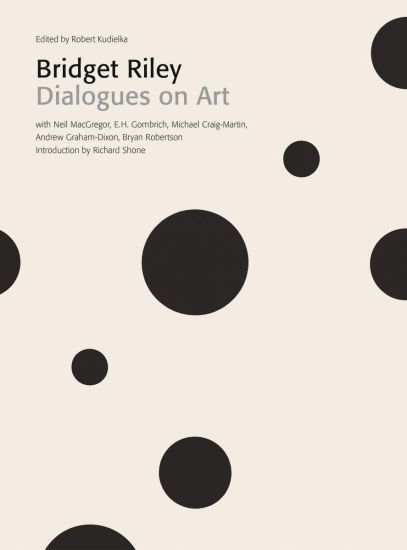
Bridget Riley: Dialogues on Art
Bridget Riley is one of the outstanding figures of modern painting. She has pursued a course of rigorous abstraction for over fifty years, from her celebrated black and white Op Art works in the 1960s to the complex colour paintings of the 1990s. On the occasion of a major exhibition of her work in 1992 at London’s Hayward Gallery, BBC Radio broadcast a series of five dialogues, each one between Riley and a well-known figure from the art world. These encounters, edited by an art historian, are contained in this book. With Neil MacGregor, Riley discusses the art of the past in relation to the art of the present; with Sir Ernst Gombrich the perception of colour in painting; with the artist Michael Craig-Martin, the theory and practice of abstraction; and with the critics Bryan Robertson and Andrew Graham-Dixon, she talks about events and travels that have influenced her as an artist. Taken as a whole, this series forms an excellent introduction to the work and ideas of one of the most creative minds of today.
Bridget Riley: Past into Present

Bridget Riley: Past into Present

Bridget Riley; Éric de Chassey

David Zwirner
2023
sidottu
“I am sometimes asked ‘What is your objective’ and this I cannot truthfully answer. I work ‘from’ something rather than ‘towards’ something. It is a process of discovery.” Since 1961, Riley has focused exclusively on seemingly simple geometric forms, such as lines, circles, curves, and squares, arrayed across a surface—whether a canvas, wall, or paper—according to an internal logic. The resulting compositions actively engage the viewer, at times triggering sensations of vibration and movement. In the present selection, Riley advances her Measure by Measure series, her most extensive body of work to date, into a new, darker color palette. Once again, changing the way we look and offering a powerful effect on our eyes. This sense of dynamism was explored to great effect in the artist’s earliest black-and-white paintings, which established the basis of her enduring formal vocabulary. In 2020, after visiting her own earlier works at her retrospective exhibition organized by the National Galleries of Scotland, Riley returned to black-and-white lozenges, adjusting the orientation of each shape to create a new visual sensation. In 1967, Riley introduced colour into her work, thus expanding the perceptual and optical possibilities of her compositions. Published on the occasion of the 2021 exhibition at David Zwirner, London, this monograph features new scholarship on the artist by art historian Éric de Chassey, who looks at how Riley’s past, as well as previous artists, has led to this body of work.
Bridget Riley: New Paintings and Gouaches
This volume focuses on Bridget Riley's energetic ‘curvilinear’ works from a 2006 exhibition by Bridget Riley. The paintings incorporate complex layers of flowing forms that interlock and move with one another, reflecting the artist's exploration of curves to create paintings of great energy and movement. Using a patch of colour that is similar to a brush mark, Riley’s forms interrupt and threaten to break out from the picture plane, overhanging the frame to jostle and animate the visual field. Refining and developing this form in recent paintings, the artist's work offers an incredible melding of form and colour. Featuring over 20 full-colour illustrations, this publication includes an in-depth essay by Paul Moorhouse examining the changes within Riley’s work throughout her multi-decade career.
Bridget Riley: Circles Colour Structure
Bringing together over 20 gouache studies by the celebrated British Op artist Bridget Riley, this exhibition catalogue reveals something of Riley’s process. Originally published to accompany an exhibition at Karsten Schubert, London, the studies explore the results of Riley setting circles of colours – such as turquoise, cerise and ochre – at different distances. The images are accompanied by an interview with the artist by Robert Kudielka from 1972, just following the creation of these works. In the discussion, Riley touches upon the role of her studies and the effects of her colour choices on light and movement in the picture plane.
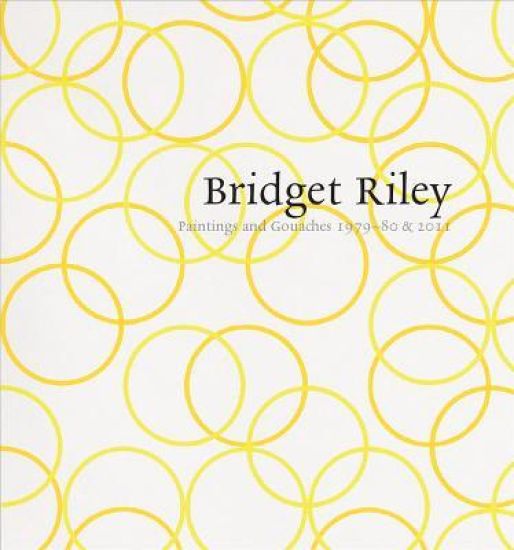
Bridget Riley: Paintings and Gouaches 1979–80 & 2011
First published to accompany a 2011 exhibition, this catalogue features three new paintings that bring Bridget Riley's exploration of the circle from the wall to the canvas, and from black and white to colour. By placing Riley’s new paintings in relation to her early gouaches, this publication highlights new directions taken by the famous British artist. Through the layering of circles of yellow and orange in her exploration of interplaying colours, Riley asks the viewer's eye to continuously adjust as the shapes grow, compress and dance across the canvas. Full-colour illustrations are accompanied by a conversation between Riley and Robert Kudielka from 1978, in which the artist discusses her move away from the blacks, greys and whites of her 1960s works and towards the use of the curve ‘as a rhythmic vehicle for colour’.
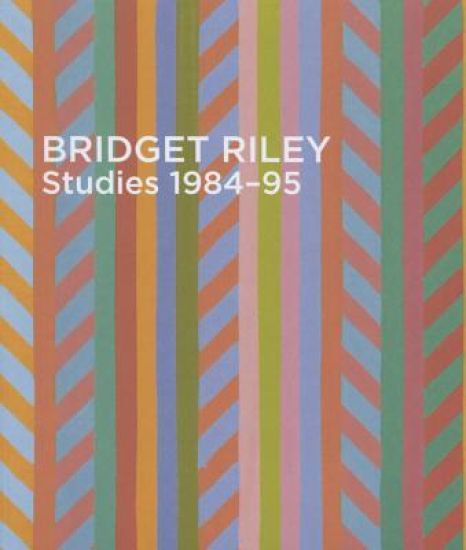
Bridget Riley: Studies 1984–95

Bridget Riley: Studies 1984–95

Natalia Naish; Alexandra Tommasini

Ridinghouse
2015
nidottu
During the mid-1980s, Riley introduced a new pictorial device, the rhomboid, to her then predominantly vertical stripes, developing her exploration of interplaying tones of green, yellow and orange. This allowed the artist to construct new visual relationships between divergent colours and forms, creating what she terms a ‘harmony of contrasts’ that animates the entire visual field. Tracking a transitional period in Riley’s career, the works on paper in this volume – studies produced between 1984 and 1995 – shift from a focus on the vertical stripe to increasingly complex diagonal compositions. Illustrated in full colour, the works are accompanied by a historic interview with the artist by Robert Kudielka and a text by Riley’s archivists Natalia Naish and Alexandra Tommasini, situating these studies in relation to major paintings produced during this period.
Bridget Riley: Learning from Seurat
In 1959, Bridget Riley’s copy of Georges Seurat’s Bridge at Courbevoie (1886–87) offered the artist a new understanding of colour and tone, which led her to produce her first major works of pure abstraction during the early 1960s. In 2015–16, an exhibition at the Courtauld Gallery, London, presented seven of Riley’s paintings and this key Pointillist work by Seurat from the museum's collection. Brought together for the first time, the exhibition demonstrated the two artists’ shared preoccupation with perception by looking at pivotal points throughout Riley’s career. Alongside full-colour illustrations, this publication features two essays written by Riley that offer the artist’s insights on Seurat’s importance to her own practice. An interview with the artist by Éric de Chassey, complemented by an introductory text by Karen Serres and Barnaby Wright, make this an important resource for art historians and general readers alike.
Bridget Riley: Paintings 1963–2015
Spanning over 50 years of Bridget Riley’s career, this volume explores the dialogue between black-and-white and colour in the artist’s work. Riley gained critical attention internationally for her black-and-white paintings during the mid-1960s, using elementary shapes to engage the eye by creating flux and rhythm within the pictorial field. Throughout the succeeding decades, she has continued her investigation into perception through related bodies of work in rich colour. This volume accompanied a focused display at the Scottish National Gallery of Modern Art, Edinburgh (2016–17), that tracks Riley’s work up to her recent reintroduction of a monochromatic palette. It includes essays by Éric de Chassey and Frances Spalding as well as a historic interview with the artist by Robert Kudielka, which together contextualise Riley’s early developments and demonstrate how her latest black-and-white paintings progress directly out of a rigorous engagement with colour.
Bridget Riley: A Very Very Person

Bridget Riley: A Very Very Person

Paul Moorhouse

Ridinghouse
2019
nidottu
'"As Paul Moorhouse shows in this thorough and sensitive first biography, which concentrates on [Riley's] early years up to the age of thirty-four, it was only after many false starts, bracing shocks and firm decisions that Riley found her way as an abstract painter in the early 1960s with her eye-dazzling lines, squares, curves ... in ultra-hard-edged black-and-white". –Times Literary Supplement "In “Bridget Riley: A Very Very Person – The Early Years,” Paul Moorhouse ... homes in on the period between the artist’s childhood and her earliest success, and makes a surprising but compelling case for the influence of landscape on Ms Riley’s distinctive style." –Wall Street Journal "An entertaining and informative text that adds greatly to our understanding of a very prominent and still highly intriguing British artist." –Hyperallergic In January 1965 the international art world converged on New York to pay homage to a brilliant new star. The glittering opening of The Responsive Eye, a major exhibition of abstract painting at the Museum of Modern Art, signalled the latest phenomenon, op art – and its centre of attention was a young painter named Bridget Riley, whose dazzling painting Current appeared on the cover of the catalogue. Riley’s first solo show in New York sold out, and, following a feature in Vogue magazine, the Riley 'look' became a fashion craze. Overnight, she had become a sensation, yet only three years earlier, she was a virtual unknown. How did success arrive so suddenly? Authored by the acclaimed curator and writer Paul Moorhouse, A Very Very Person is the first biography of Bridget Riley and addresses that tantalising question. Focusing on her early years, it tells the story of a remarkable woman whose art and life were entwined in surprising ways. This intimate narrative explores Riley’s wartime childhood spent in the idyllic Cornish countryside, her subsequent struggles to find her way as an artist, and the personal challenges she faced before finally arriving as one of the world’s most celebrated artists in Swinging Sixties London.