Kirjojen hintavertailu. Mukana 11 699 587 kirjaa ja 12 kauppaa.

Kirjahaku

Etsi kirjoja tekijän nimen, kirjan nimen tai ISBN:n perusteella.

1000 tulosta hakusanalla Carleton Mabee

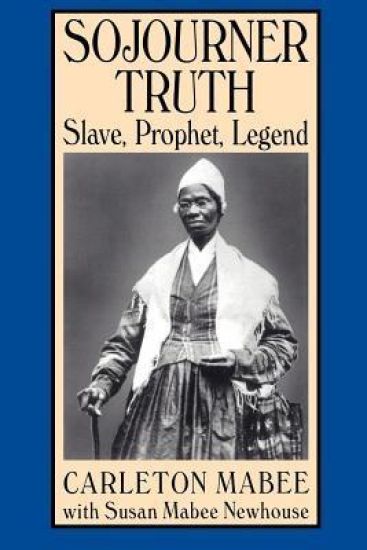
Sojourner Truth

Sojourner Truth

Carleton Mabee

New York University Press
1995
pokkari
Goes beyond the myths and legends to reveal new insights into the real life of Sojourner Truth Many Americans have long since forgotten that there ever was slavery along the Hudson River. Yet Sojourner Truth was born a slave near the Hudson River in Ulster County, New York, in the late 1700s. Called merely Isabella as a slave, once freed she adopted the name of Sojourner Truth and became a national figure in the struggle for the emancipation of both Blacks and women in Civil War America. Despite the dual discrimination she suffered as a Black woman, Truth significantly shaped both her own life and the struggle for human rights in America. Through her fierce intelligence, her resourcefulness, and her eloquence, she became widely acknowledged as a remarkable figure during her life, and she has become one of the most heavily mythologized figures in American history. While some of the myths about Truth offer inspiration, they have also contributed to distortions about American history, especially about the experiences of Black Americans and women. In this landmark work, the product of years of primary research, Pulizter-Prize winning biographer Carleton Mabee has unearthed the best available sources about this remarkable woman to reconstruct the most authentic account of her life to date. Mabee offers new insights on why she never learned to read, on the authenticity of the famous quotations attributed to her (such as Ar'n't I a woman?), her relationship to President Lincoln, her role in the abolitionist movement, her crusade to move freed slaves from the South to the North, and her life as a singer, orator, feminist and woman of faith. This is an engaging, historically precise biography that reassesses the place of Sojourner Truth—slave, prophet, legend—in American history.
Black Education in New York State

Black Education in New York State

Carleton Mabee

Syracuse University Press
1979
pokkari
In this first comprehensive history of black education in New York State, Carleton Mabee contributes to a fuller understanding of the role blacks have played in American education. As he says in the final chapter, "This agonizing narrative, stretching over more than three centuries, reveals not only the severe limits as to what education by itself can achieve, but also significant improvement in the education of blacks—halting and limited improvement, to be sure, but nevertheless improvement, and thus can give us hope."Mabee discusses colonial church-sponsored efforts to educate slaves, the work of nineteenth-century white abolitionists in promoting black education, and the role of both blacks and whites in developing public schools and other kinds of schools for blacks. Extensive research into primary sources provides new insights into the major nineteenth-­century school issues as they related to blacks in the state. Mabee also examines the impact of the "Great Migration" of blacks into the state in the early twentieth century and the revival of segregated schools that followed.
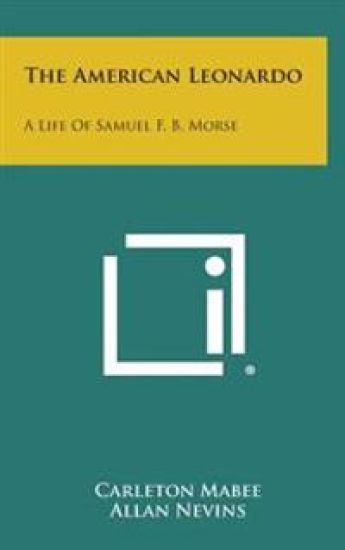
The American Leonardo: A Life of Samuel F. B. Morse

The American Leonardo: A Life of Samuel F. B. Morse

Carleton Mabee

Literary Licensing, LLC
2013
sidottu
The American Leonardo: A Life Of Samuel F. B. Morse is a biography written by Carleton Mabee about the life of Samuel F. B. Morse, an American inventor and artist who is best known for inventing the telegraph and developing Morse code. The book provides a comprehensive account of Morse's life, from his early years as a struggling artist to his later success as an inventor and businessman. Mabee explores Morse's complex personality and his many achievements, including his role in the development of the American art scene and his contributions to the fields of science and technology. The book also delves into Morse's personal life, including his relationships with his family and his struggles with illness and financial difficulties. Overall, The American Leonardo provides a fascinating and in-depth look at the life and legacy of one of America's most important inventors and artists.This is a new release of the original 1944 edition.This scarce antiquarian book is a facsimile reprint of the old original and may contain some imperfections such as library marks and notations. Because we believe this work is culturally important, we have made it available as part of our commitment for protecting, preserving, and promoting the world's literature in affordable, high quality, modern editions, that are true to their original work.
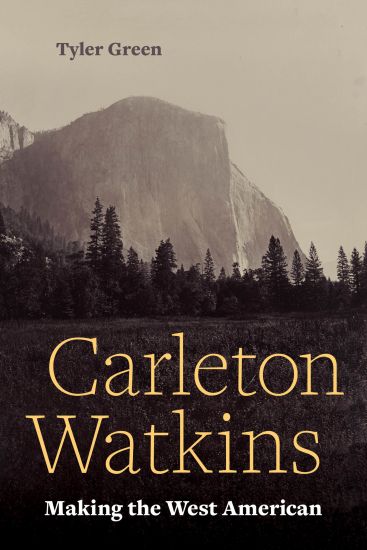
Carleton Watkins

Carleton Watkins

Tyler Green

University of California Press
2018
sidottu
"A fascinating and indispensable book."—Christopher Knight, Los Angeles TimesBest Books of 2018—The Guardian Gold Medal for Contribution to Publishing, 2018 California Book Awards Carleton Watkins (1829–1916) is widely considered the greatest American photographer of the nineteenth century and arguably the most influential artist of his era. He is best known for his pictures of Yosemite Valley and the nearby Mariposa Grove of giant sequoias. Watkins made his first trip to Yosemite Valley and Mariposa Grove in 1861 just as the Civil War was beginning. His photographs of Yosemite were exhibited in New York for the first time in 1862, as news of the Union’s disastrous defeat at Fredericksburg was landing in newspapers and while the Matthew Brady Studio’s horrific photographs of Antietam were on view. Watkins’s work tied the West to Northern cultural traditions and played a key role in pledging the once-wavering West to Union. Motivated by Watkins’s pictures, Congress would pass legislation, later signed by Abraham Lincoln, that preserved Yosemite as the prototypical “national park,” the first such act of landscape preservation in the world. Carleton Watkins: Making the West American includes the first history of the birth of the national park concept since pioneering environmental historian Hans Huth’s landmark 1948 “Yosemite: The Story of an Idea.” Watkins’s photographs helped shape America’s idea of the West, and helped make the West a full participant in the nation. His pictures of California, Oregon, and Nevada, as well as modern-day Washington, Utah, and Arizona, not only introduced entire landscapes to America but were important to the development of American business, finance, agriculture, government policy, and science. Watkins’s clients, customers, and friends were a veritable “who’s who” of America’s Gilded Age, and his connections with notable figures such as Collis P. Huntington, John and Jessie Benton Frémont, Eadweard Muybridge, Frederick Billings, John Muir, Albert Bierstadt, and Asa Gray reveal how the Gilded Age helped make today’s America. Drawing on recent scholarship and fresh archival discoveries, Tyler Green reveals how an artist didn’t just reflect his time, but acted as an agent of influence. This telling of Watkins’s story will fascinate anyone interested in American history; the West; and how art and artists impacted the development of American ideas, industry, landscape, conservation, and politics.
Carleton Watkins

Carleton Watkins

Tyler Green

University of California Press
2020
pokkari
"[A] fascinating and indispensable book."—Christopher Knight, Los Angeles TimesBest Books of 2018—The Guardian Gold Medal for Contribution to Publishing, 2019 California Book Awards Carleton Watkins (1829–1916) is widely considered the greatest American photographer of the nineteenth century and arguably the most influential artist of his era. He is best known for his pictures of Yosemite Valley and the nearby Mariposa Grove of giant sequoias. Watkins made his first trip to Yosemite Valley and Mariposa Grove in 1861 just as the Civil War was beginning. His photographs of Yosemite were exhibited in New York for the first time in 1862, as news of the Union’s disastrous defeat at Fredericksburg was landing in newspapers and while the Matthew Brady Studio’s horrific photographs of Antietam were on view. Watkins’s work tied the West to Northern cultural traditions and played a key role in pledging the once-wavering West to Union. Motivated by Watkins’s pictures, Congress would pass legislation, signed by Abraham Lincoln, that preserved Yosemite as the prototypical “national park,” the first such act of landscape preservation in the world. Carleton Watkins: Making the West American includes the first history of the birth of the national park concept since pioneering environmental historian Hans Huth’s landmark 1948 “Yosemite: The Story of an Idea.” Watkins’s photographs helped shape America’s idea of the West, and helped make the West a full participant in the nation. His pictures of California, Oregon, and Nevada, as well as modern-day Washington, Utah, and Arizona, not only introduced entire landscapes to America but were important to the development of American business, finance, agriculture, government policy, and science. Watkins’s clients, customers, and friends were a veritable “who’s who” of America’s Gilded Age, and his connections with notable figures such as Collis P. Huntington, John and Jessie Benton Frémont, Eadweard Muybridge, Frederick Billings, John Muir, Albert Bierstadt, and Asa Gray reveal how the Gilded Age helped make today’s America. Drawing on recent scholarship and fresh archival discoveries, Tyler Green reveals how an artist didn’t just reflect his time, but acted as an agent of influence. This telling of Watkins’s story will fascinate anyone interested in American history; the West; and how art and artists impacted the development of American ideas, industry, landscape, conservation, and politics.
Carleton Watkins in Yosemite

Carleton Watkins in Yosemite

. Naef

J. Paul Getty Museum
2009
sidottu
This is a stunning photographic journey around the great Yosemite Valley, following in the footsteps of one of its first surveyors. Carleton Eugene Watkins (1829-1916) was one of the most highly acclaimed early western photographers, and one of the first to photograph the natural beauty of Yosemite. It was partly due to Watkins' photographs that President Lincoln declared Yosemite Valley inviolable, leading to the creation of the America's National Parks system. "Carleton Watkins in Yosemite" is a lavishly illustrated volume that takes readers on a stunning tour through Yosemite Valley from the view at Inspiration Point to the panorama high above the valley at Glacier Point - all from the perspective of one of Yosemite's first surveyors. The images reproduced here, all selected from the J. Paul Getty Museum's collection, range from groves of giant Sequoia trees and breathtaking waterfalls to the landmarks that best symbolize the natural beauty of the Yosemite Valley.
The Carleton 1959-60; 14

The Carleton 1959-60; 14

Carleton University

Hassell Street Press
2021
sidottu
This work has been selected by scholars as being culturally important and is part of the knowledge base of civilization as we know it.This work is in the public domain in the United States of America, and possibly other nations. Within the United States, you may freely copy and distribute this work, as no entity (individual or corporate) has a copyright on the body of the work.Scholars believe, and we concur, that this work is important enough to be preserved, reproduced, and made generally available to the public. To ensure a quality reading experience, this work has been proofread and republished using a format that seamlessly blends the original graphical elements with text in an easy-to-read typeface.We appreciate your support of the preservation process, and thank you for being an important part of keeping this knowledge alive and relevant.
The Carleton 1957-58; 13

The Carleton 1957-58; 13

Carleton University

Hassell Street Press
2021
sidottu
This work has been selected by scholars as being culturally important and is part of the knowledge base of civilization as we know it.This work is in the public domain in the United States of America, and possibly other nations. Within the United States, you may freely copy and distribute this work, as no entity (individual or corporate) has a copyright on the body of the work.Scholars believe, and we concur, that this work is important enough to be preserved, reproduced, and made generally available to the public. To ensure a quality reading experience, this work has been proofread and republished using a format that seamlessly blends the original graphical elements with text in an easy-to-read typeface.We appreciate your support of the preservation process, and thank you for being an important part of keeping this knowledge alive and relevant.
The Carleton 1951-52; 7

The Carleton 1951-52; 7

Carleton University

Hassell Street Press
2021
sidottu
This work has been selected by scholars as being culturally important and is part of the knowledge base of civilization as we know it.This work is in the public domain in the United States of America, and possibly other nations. Within the United States, you may freely copy and distribute this work, as no entity (individual or corporate) has a copyright on the body of the work.Scholars believe, and we concur, that this work is important enough to be preserved, reproduced, and made generally available to the public. To ensure a quality reading experience, this work has been proofread and republished using a format that seamlessly blends the original graphical elements with text in an easy-to-read typeface.We appreciate your support of the preservation process, and thank you for being an important part of keeping this knowledge alive and relevant.
The Carleton 1959-60; 14

The Carleton 1959-60; 14

Carleton University

Hassell Street Press
2021
nidottu
This work has been selected by scholars as being culturally important and is part of the knowledge base of civilization as we know it.This work is in the public domain in the United States of America, and possibly other nations. Within the United States, you may freely copy and distribute this work, as no entity (individual or corporate) has a copyright on the body of the work.Scholars believe, and we concur, that this work is important enough to be preserved, reproduced, and made generally available to the public. To ensure a quality reading experience, this work has been proofread and republished using a format that seamlessly blends the original graphical elements with text in an easy-to-read typeface.We appreciate your support of the preservation process, and thank you for being an important part of keeping this knowledge alive and relevant.
The Carleton; 2

The Carleton; 2

Carleton University

Hassell Street Press
2021
nidottu
This work has been selected by scholars as being culturally important and is part of the knowledge base of civilization as we know it.This work is in the public domain in the United States of America, and possibly other nations. Within the United States, you may freely copy and distribute this work, as no entity (individual or corporate) has a copyright on the body of the work.Scholars believe, and we concur, that this work is important enough to be preserved, reproduced, and made generally available to the public. To ensure a quality reading experience, this work has been proofread and republished using a format that seamlessly blends the original graphical elements with text in an easy-to-read typeface.We appreciate your support of the preservation process, and thank you for being an important part of keeping this knowledge alive and relevant.
The Carleton; 3

The Carleton; 3

Carleton University

Hassell Street Press
2021
sidottu
This work has been selected by scholars as being culturally important and is part of the knowledge base of civilization as we know it.This work is in the public domain in the United States of America, and possibly other nations. Within the United States, you may freely copy and distribute this work, as no entity (individual or corporate) has a copyright on the body of the work.Scholars believe, and we concur, that this work is important enough to be preserved, reproduced, and made generally available to the public. To ensure a quality reading experience, this work has been proofread and republished using a format that seamlessly blends the original graphical elements with text in an easy-to-read typeface.We appreciate your support of the preservation process, and thank you for being an important part of keeping this knowledge alive and relevant.
The Carleton 1957-58; 13

The Carleton 1957-58; 13

Carleton University

Hassell Street Press
2021
nidottu
This work has been selected by scholars as being culturally important and is part of the knowledge base of civilization as we know it.This work is in the public domain in the United States of America, and possibly other nations. Within the United States, you may freely copy and distribute this work, as no entity (individual or corporate) has a copyright on the body of the work.Scholars believe, and we concur, that this work is important enough to be preserved, reproduced, and made generally available to the public. To ensure a quality reading experience, this work has been proofread and republished using a format that seamlessly blends the original graphical elements with text in an easy-to-read typeface.We appreciate your support of the preservation process, and thank you for being an important part of keeping this knowledge alive and relevant.