Kirjojen hintavertailu. Mukana 11 627 363 kirjaa ja 12 kauppaa.

Kirjahaku

Etsi kirjoja tekijän nimen, kirjan nimen tai ISBN:n perusteella.

1000 tulosta hakusanalla Christa Wolf

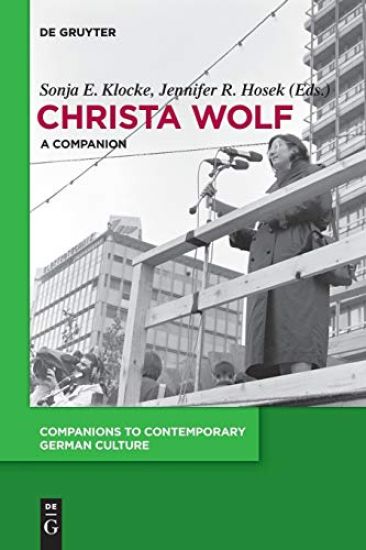
Christa Wolf

Christa Wolf

De Gruyter
2018
isokokoinen pokkari
Interest in Christa Wolf continues to grow. Her classics are being reprinted and new titles are appearing posthumously, becoming bestsellers, and being translated. Energetic scholarly debates engage well-known aesthetic and political issues that the public intellectual herself fore-fronted. This broad-ranging introduction to the author, her work and times builds upon and moves beyond such foundational interpretative frameworks by articulating the global relevance of Wolf’s oeuvre today, also for non-German readers. Thus, it brings East German culture alive to students, teachers, scholars and the general public by connecting the socialist German Democratic Republic (GDR) and the lived experiences of its citizens to nations and cultures around the world. The collection focuses on topical matters including the search for authenticity, agency, race, cosmopolitanism, gender, environmentalism, geopolitics, war, and memory debates, as well as movie adaptations and Wolf’s film work with DEFA, marketing, and international reception. Our contributions – by senior and emerging scholars from across the globe – emphasize Wolf’s position as an author of world literature and an important critical voice in the 21st century.
Christa Wolf's Utopian Vision

Christa Wolf's Utopian Vision

Anna K. Kuhn

Cambridge University Press
2009
pokkari
This is a book-length chronological study in English of Christa Wolf's works. It traces the development and continuity of the writer's major themes and concerns against the backdrop of her constantly evolving relationship to Marxism, and documents the rise of her feminist consciousness. It does not, however, focus only on political and feminist issues, but addresses all facets of Wolf's identity by showing how her works reflect her own self-understanding. Forced by the clash between her vision of a humane socialism and the practice of socialism she observed in the German Democratic Republic to reassess her role as a writer and critic, Wolf broke through to her unique style in The Quest for Christa T., a work initially repudiated in the GDR both for its unorthodox subject matter and for its unconventional form. Since then, Wolf has effectively challenged the restrictions placed on writers in the GDR by writing on topics such as the Nazi past (Patterns of Childhood), Romanticism (No Place on Earth), patriarchal attitudes in the GDR (Cassandra) and the Chernobyl nuclear disaster (Störfall).
Christa Wolf und Durs Grünbein

Christa Wolf und Durs Grünbein

Matthias Kandziora

De Gruyter
2021
sidottu
In der Studie wird untersucht, wie sich die ostdeutschen Selbstbilder von Christa Wolf und Durs Grünbein in ihren (autobiographischen Texten) »Stadt der Engel« und »Die Jahre im Zoo« ausbilden. In der Beschäftigung mit den jeweiligen Erinnerungs- und Gedächtniskonzeptionen an die DDR verfolgt die Arbeit, wie die literarischen Selbstentwürfe keineswegs auf feste Identitäten abzielen, sondern in narrativen Prozessen der Identifizierung ständig wandelnde ostdeutsche Selbstbilder entwerfen. Dabei spielen verschiedene Bezugsrahmen eine zentrale Rolle: Globalisierungserfahrungen, Photographie, Utopien, essayistische Selbstentwürfe, intertextuelle Beziehungen zur Literatur der Moderne, der Psychoanalyse und der Kritischen Theorie etc. Neben den genannten Werken gibt die Arbeit weiträumige Einblicke in das jeweilige Gesamtœuvre Wolfs und Grünbeins und zeigt, wie sich Selbsterfahrungen in der Post-DDR-Literatur ausbilden. Die eigenen Erinnerungen der literarischen Subjekte stehen dabei im Mittelpunkt und werden immer wieder unter Einbezug verschiedener Erinnerungs- und Gedächtnistheorien neu konstelliert.
Christa Wolf Und Sowjetrußland 1945-1991

Christa Wolf Und Sowjetrußland 1945-1991

Tanja Walenski

Peter Lang AG
1999
nidottu
Die Publikation untersucht zwei weithin unerforschte Aspekte der Biographie und des Werkes der Schriftstellerin Christa Wolf: Zum einen ihr Bild von der Sowjetunion von Stalin bis Gorbacev, das sie sich auf Reisen und in Bekanntschaften mit Russen gemacht hat, zum anderen die Rezeption ihres Werkes in der UdSSR im gleichen Zeitraum. Beide Aspekte werden in ihrer Entwicklung und Wandlung nachgezeichnet. Die Studie fragt auch, welche Bedeutung russische und sowjetische Schriftsteller fur Wolfs Werk hatten, und verfolgt konkrete komparatistische Ansatze. Im Ergebnis wird hervorgehoben, dass die UdSSR fur die Autorin zeitlebens einen zentralen Bezugspunkt bildete. Der Anhang bietet erstmals ein umfangreiches chronologisches Verzeichnis der Schriften Wolfs in russischer Sprache sowie ein alphabetisches Verzeichnis der sowjetischen literaturkritischen Texte zu Christa Wolf."
Christa Wolf's Kassandra. the Representation of Patriarchy and Power Relations
Essay from the year 2011 in the subject German Studies - Modern German Literature, grade: 1,5, University of Nottingham (School of Cultures, Languages and Area Studies), course: Recent Women's Writing, language: English, abstract: Cassandra - a modern woman in ancient times. The East-German writer Christa Wolf publishes the story about the Trojan king's daughter Cassandra, who is judged to be unseen although being blessed with the gift of prophecy in 1983. The story is told retrospectively by the dying Cassandra waiting in front of the "L wentor" for her execution in Agamemnon's castle. Throughout the story, one can figure out a re-creation process of herself and a development from a silent female object into a conscious subject. Similarly to Christa Wolf, who tried to achieve a certain self-understanding as a woman author while writing the narrative (Kuhn, p. 186). In addition, there are some suppositions that Wolf criticises in Cassandra the political structure of the former GDR. Even the characters represent political entities. Priam, in that sense, stands for the social state, Hecuba for the party and Eumelus for the State Security Service (Kuhn, p. 184). Furthermore, it is a "feminist critique of literature and society" (Kuhn, p. 178) and describes a radical social change from matriarchy to patriarchy on the basis of the ancient myth of Cassandra. For this purpose, Wolf uses the male figures partly to correct the exclusion of women in the ancient models by Aeschylus and Homer. In these dramas women were depicted as dependent objects. In Christa Wolf's famous Frankfurter Poetik-Vorlesung in 1982, she speaks about questions which might arise by the reader. More specifically, in A Letter, her fourth lecture on poetics, Wolf disapproves the constant exclusion of female writers in the history of literature and in society. Wolf declares in her essay that an essential characteristic of the origins of the Greek epic] is the] amalgamation of patriarchy, property,
Christa Wolf-Handbuch

Christa Wolf-Handbuch

Springer-Verlag Berlin and Heidelberg GmbH Co. KG
2020
nidottu
Das Handbuch informiert über Leben, Werk und Wirkung von Christa Wolf (1929 2011), der engagierten Intellektuellen und wichtigsten gesamtdeutschen Autorin mit Werken wie „Der geteilte Himmel“, „Kindheitsmuster“, „Kassandra“ und „Medea“. Wolfs Entwicklung von der Literaturkritikerin, die bis in die Mitte der 1960er Jahren dem Sozialistischen Realismus anhing, zu einer Schriftstellerin der subjektiven Authentizität, die in ihren Texten ein dichtes Gewebe von Bezügen herstellt, wird anhand von detaillierten Werk- und Werkgruppenbeschreibungen deutlich. Auch die Essays, Vorträge, Reden, Interviews und Tagebücher sowie die Briefwechsel werden vorgestellt, außerdem die Kontexte von Wolfs Schaffen, die deutsch-deutsche und die internationale Rezeption.
Christa Wolf : den lojala dissidenten
Christa Wolf anses tillhöra efterkrigs-Tysklands främsta författare tillsammans med Heinrich Böll och Günter Grass. Under huvuddelen av livet levde och verkade Wolf i DDR, Östtyskland, som upphörde som stat i samband med Murens fall då Väst- och Östtyskland blev ett gemensamt Tyskland.Från början var hon i stor utsträckning lojal med den nya öststaten när den var ung. Hon var aktiv i författarförbundet och deltog även i partikongressen hon visades då gärna upp av de styrande männen som intellektuell vän till den socialistiska staten. Hon var aktiv i föreningar och framträdde i sammanhang där partiet/staten uppskattade hennes samverkan.Men efter hand växte hennes politiska obehag och främlingskap i det hårdnande politiska förtrycket. Till slut blev hon övervakad av hemliga polisen, telefonen avlyssnades, brev kom bort eller öppnades. Hon blev en förtryckets motståndare. Hon tog parti för Wolf Bierman som förbjöds återkomma till landet. Uppskattningen av hennes författarskap växte runt om i världen. Här redogörs också för hennes romaner som blev uppskattade i många länder. Läsaren får följa hennes författarbana.Sture Packalén, bosatt i Uppsala och prof. em. med ett flertal uppskattade böcker om tysk litteratur bakom sig, senast Tysk litteratur och Günter Grass.___"Kapitlen är korta och bilderna många i boken Christa Wolf. Den lojala dissidenten och biografin ger en bra presentation av författaren." Catharina Bergman, BTJ. Helhetsbetyg: 3