

Kirjahaku
Etsi kirjoja tekijän nimen, kirjan nimen tai ISBN:n perusteella.
1000 tulosta hakusanalla Claus Medved
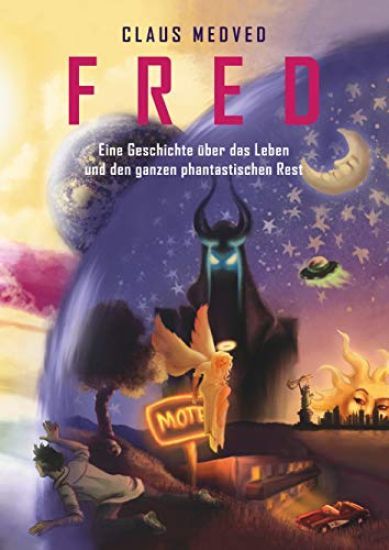

När blicken sveper över himlen kan den hamna på den kosmiska ”kartfläcken” för Universums uppkomst i en ”Big Bang” för mer än 13 miljarder år sedan. Blicken kan även råka riktas mot en avlägsen plats i rymden med myllrande liv; kanske med hög civilisation och teknologi. Tanken svindlar inför ett universum med 1000-tals miljarder galaxer.Då tittar vi kanske ödmjukt ner eller blundar. Vi vänder kanske sinnet inåt för en annan svindlande tankeresa; in i vårt eget kosmos. Är inte jag – liksom varje annan människa – också ett slags universum? Ett universum, där 100-tals miljarder neuroner och andra celler samverkar till organ, kroppsdelar och den personlighet man är och har varit. Tanken kan vandra vidare till insikt om, att varje livsform – utifrån sin särart – också är ett slags universum i det Totala Alltet.I den berömda TV-serien ”Star Trek” for kapten Kirk och besättningen i överljushastighet med rymdskeppet Explorer för att utforska den interstellära rymden. Vi delar med kapten Kirk de nyfikna frågorna om Vem? Vad? Mening? och Mål? Den här boken är också en slags resa för att utforska och ta del av perspektiv, upplevelser, idéer och frågor om att vara människa och medmänniska med ett nyfiket utåt- och inåtblickande medvetande om tillvaron.ERBJUDANDE: När du köper denna bok får du även en gedigen pdf med mängder av information om vårt gåtfulla medvetande! Maila oss för mer info: [email protected]örfattaren är Fil.Dr och hans forskningsinriktning är innovativ systemutveckling och sociotekniskt entreprenörskap.




In the early 1800s, Nicholas, Jessica, and Jon Santa attempt the first human trek to the North Pole and stumble upon an ancient race of people left over from the Ice Age. They are short, fat, and hairy. They slide across the ice on scaly soles and carve their homes in the ice that floats on the Arctic Ocean. The elven are adapted to life in the extreme cold. They are as wise as they are ancient.Their scientific advancements have yielded great inventions - time-stopping devices and gravitational spheres that build living snowmen and genetically-modified reindeer that leap great distances. They've even unlocked the secrets to aging. For 40,000 years, they have lived in peace.Until now.An elven known as The Cold One has divided his people. He's tired of their seclusion and wants to conquer the world. Only one elven stands between The Cold One and total chaos. He's white-bearded and red-coated. The Santa family will help him stop The Cold One. They will come to the aid of a legendary elven known as...Claus.

Christmas is hot. When Kandi's dad gets a mysterious call, they fly to a tropical island where the buildings are enormous and the rooms empty. Despite the heat, his sunburned client wears a heavy cloak. Kandi meets a boy living all alone in one of the empty resorts. When he goes missing, she enlists the help of the technological wonders that haunt the island to find him. What she uncovers is a much deeper mystery that will affect more than just Christmas. The world doesn't know it yet, but Santa Claus is missing. Kandi knows where he is. And why.


Claus: A Christmas Incarnation B2
C. John Coombes
2013
nidottu

Claus: A Christmas Incarnation B3
C. John Coombes
2013
nidottu





Parzifal Von Claus Wisse Und Philipp Colin, 1331-1336
Claus Wisse; Philipp Colin; Karl (EDT) Schorbach
Kessinger Pub
2009
pokkari

Parzifal Von Claus Wisse Und Philipp Colin, 1331-1336
Claus Wisse; Philipp Colin; Karl (EDT) Schorbach
Kessinger Pub
2009
sidottu

Claus Offe and the Critical Theory of the Capitalist State
Jens Borchert; Stephan Lessenich
Routledge
2018
nidottu
Back in 1972, German political sociologist Claus Offe published a book on the Structural Problems of Late Capitalism which, for almost two decades, inspired and stimulated an international and transdisciplinary debate on the role of the state in contemporary capitalism. An academic debate which, paradoxically, began to wane as the issues about which Offe had been writing became even more prominent: the "Contradictions of the Welfare State" (the title of a collection of Offe’s main contributions to the debate published in English in 1984) and democratic capitalism’s reality of the permanent "crises of crisis management". Since 2008, it has again become a widely shared diagnosis that advanced capitalism is in crisis. However, there is either scholarly disagreement or (more often so) mere perplexity when it comes to understanding this crisis and to explaining the prevalent patterns in dealing with it.In this volume, Jens Borchert and Stephan Lessenich critically combine a reconstruction Claus Offe’s approach to state theory with an analysis of the current constellation of democratic capitalism based on that same theory. In doing so, they expertly argue that his relational approach to state theory is much better equipped analytically to grasp the contradictory dynamics of the financial crisis and its political regulation than competing contributions. This is why systematically revisiting the theory of "late capitalism" is not only of a historical concern, but constitutes an essential contribution to a political sociology of our time.

Claus Offe and the Critical Theory of the Capitalist State
Jens Borchert; Stephan Lessenich
Routledge
2016
sidottu
Back in 1972, German political sociologist Claus Offe published a book on the Structural Problems of Late Capitalism which, for almost two decades, inspired and stimulated an international and transdisciplinary debate on the role of the state in contemporary capitalism. An academic debate which, paradoxically, began to wane as the issues about which Offe had been writing became even more prominent: the "Contradictions of the Welfare State" (the title of a collection of Offe’s main contributions to the debate published in English in 1984) and democratic capitalism’s reality of the permanent "crises of crisis management". Since 2008, it has again become a widely shared diagnosis that advanced capitalism is in crisis. However, there is either scholarly disagreement or (more often so) mere perplexity when it comes to understanding this crisis and to explaining the prevalent patterns in dealing with it.In this volume, Jens Borchert and Stephan Lessenich critically combine a reconstruction Claus Offe’s approach to state theory with an analysis of the current constellation of democratic capitalism based on that same theory. In doing so, they expertly argue that his relational approach to state theory is much better equipped analytically to grasp the contradictory dynamics of the financial crisis and its political regulation than competing contributions. This is why systematically revisiting the theory of "late capitalism" is not only of a historical concern, but constitutes an essential contribution to a political sociology of our time.