Kirjojen hintavertailu. Mukana 11 244 527 kirjaa ja 12 kauppaa.

Kirjahaku

Etsi kirjoja tekijän nimen, kirjan nimen tai ISBN:n perusteella.

1000 tulosta hakusanalla Clive Gamble

Making Deep History

Making Deep History

Clive Gamble

Oxford University Press
2021
sidottu
One afternoon in late April 1859 two geologically minded businessmen, John Evans and Joseph Prestwich, found and photographed the proof for great human antiquity. Their evidence -- small, hand-held stone tools found in the gravel quarries of the Somme among the bones of ancient animals -- shattered the timescale of Genesis and kicked open the door for a time revolution in human history. In the space of a calendar year, and at a furious pace, the relationship between humans and time was forever changed. This interpretation of deep human history was shaped by the optimistic decade of the 1850s, the Victorian Heyday in the age of equipoise. Proving great human antiquity depended on matching the principles of geology with the personal values of scientific zeal and perseverance; qualities which time-revolutionaries such as Evans and Prestwich had in abundance. Their revolution was driven by a small group of weekend scientists rather than some great purpose, and it proved effective because of its bonds of friendship stiffened by scientific curiosity and business acumen. Clive Gamble explores the personalities of these time revolutionaries and their scientific co-collaborators and adjudicators -- Darwin, Falconer, Lyell, Huxley, and the French antiquary Boucher de Perthes -- as well as their sisters, wives, and nieces Grace McCall, Civil Prestwich, and Fanny Evans. As with all scientific discoveries getting there was often circuitous and messy; the revolutionaries changed their minds and disagreed with those who should have been allies. Gamble's chronological narrative reveals each step from discovery to presentation, reception, consolidation, and widespread acceptance, and considers the impact of their work on the scientific advances of the next 160 years and on our fascination with the shaping power of time.
Origins and Revolutions

Origins and Revolutions

Clive Gamble

Cambridge University Press
2007
pokkari
In this study Clive Gamble presents and questions two of the most famous descriptions of change in prehistory. The first is the 'human revolution', when evidence for art, music, religion and language first appears. The second is the economic and social revolution of the Neolithic period. Gamble identifies the historical agendas behind 'origins research' and presents a bold alternative to these established frameworks, relating the study of change to the material basis of human identity. He examines, through artefact proxies, how changing identities can be understood using embodied material metaphors and in two major case-studies charts the prehistory of innovations, asking, did agriculture really change the social world? This is an important and challenging book that will be essential reading for every student and scholar of prehistory.
Origins and Revolutions

Origins and Revolutions

Clive Gamble

Cambridge University Press
2007
sidottu
In this study Clive Gamble presents and questions two of the most famous descriptions of change in prehistory. The first is the 'human revolution', when evidence for art, music, religion and language first appears. The second is the economic and social revolution of the Neolithic period. Gamble identifies the historical agendas behind 'origins research' and presents a bold alternative to these established frameworks, relating the study of change to the material basis of human identity. He examines, through artefact proxies, how changing identities can be understood using embodied material metaphors and in two major case-studies charts the prehistory of innovations, asking, did agriculture really change the social world? This is an important and challenging book that will be essential reading for every student and scholar of prehistory.
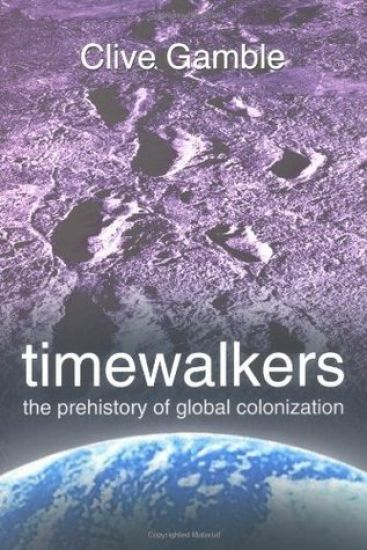
Timewalkers

Timewalkers

Clive Gamble

The History Press Ltd
2003
nidottu
Clive Gamble's book reinterprets three million years of archaeology to show how the earliest humans of the African savannah spread out to other continents, along the Old World track, and eventually colonized the world.
Settling the Earth

Settling the Earth

Clive Gamble

Cambridge University Press
2013
sidottu
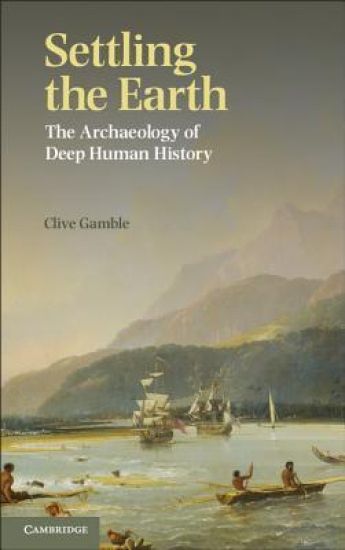
In this worldwide survey, Clive Gamble explores the evolution of the human imagination, without which we would not have become a global species. He sets out to determine the cognitive and social basis for our imaginative capacity and traces the evidence back into deep human history. He argues that it was the imaginative ability to 'go beyond' and to create societies where people lived apart yet stayed in touch that made us such effective world settlers. To make his case Gamble brings together information from a wide range of disciplines: psychology, cognitive science, archaeology, palaeoanthropology, archaeogenetics, geography, quaternary science and anthropology. He presents a novel deep history that combines the archaeological evidence for fossil hominins with the selective forces of Pleistocene climate change, engages with the archaeogeneticists' models for population dispersal and displacement, and ends with the Europeans' rediscovery of the deep history settlement of the Earth.
Settling the Earth

Settling the Earth

Clive Gamble

Cambridge University Press
2013
pokkari
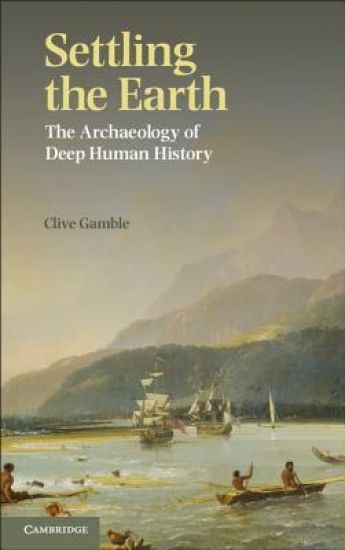
In this worldwide survey, Clive Gamble explores the evolution of the human imagination, without which we would not have become a global species. He sets out to determine the cognitive and social basis for our imaginative capacity and traces the evidence back into deep human history. He argues that it was the imaginative ability to 'go beyond' and to create societies where people lived apart yet stayed in touch that made us such effective world settlers. To make his case Gamble brings together information from a wide range of disciplines: psychology, cognitive science, archaeology, palaeoanthropology, archaeogenetics, geography, quaternary science and anthropology. He presents a novel deep history that combines the archaeological evidence for fossil hominins with the selective forces of Pleistocene climate change, engages with the archaeogeneticists' models for population dispersal and displacement, and ends with the Europeans' rediscovery of the deep history settlement of the Earth.
Thinking Big

Thinking Big

Clive Gamble; John Gowlett; Robin Dunbar

Thames Hudson Ltd
2018
nidottu
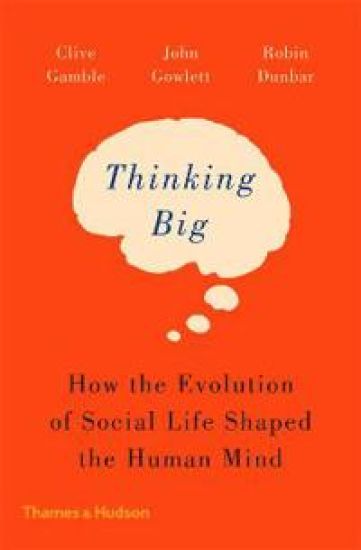
When and how did the brains of our hominin ancestors become human minds? When and why did our capacity for language or art, music and dance evolve? It is the contention of this pathbreaking and provocative book that it was the need for early humans to live in ever-larger social groups, and to maintain social relations over ever-greater distances – the ability to ‘think big’ – that drove the enlargement of the human brain and the development of the human mind. This ‘social brain hypothesis’, put forward by evolutionary psychologists such as Robin Dunbar, one of the authors of this book, can be tested against archaeological and fossil evidence, as archaeologists Clive Gamble and John Gowlett show in the second part of Thinking Big. Along the way, the three authors touch on subjects as diverse and diverting as the switch from finger-tip grooming to vocal grooming or the crucial importance of making fire for the lengthening of the social day. As this remarkable book shows, it seems we still inhabit social worlds that originated deep in our evolutionary past – by the fireside, in the hunt and on the grasslands of Africa.
Evolution, Denken, Kultur

Evolution, Denken, Kultur

Clive Gamble; John Gowlett; Robin Dunbar

Springer-Verlag Berlin and Heidelberg GmbH Co. KG
2015
sidottu
Die Entdeckung der Gemeinsamkeit Dieses bemerkenswerte Buch, das die Evolution und die Archäologie des menschlichen Sozialverhaltens zusammenführt, spannt den Bogen von den sozialen Gruppen der Steinzeit bis zu den modernen digitalen Netzwerken – und zeigt, dass wir heute in sozialen Welten leben, die sich tief in unserer evolutionären Vergangenheit entwickelt haben. Sie werden in diesem Jahr kein wichtigeres Buch lesen. Es könnte uns ein bisschen weiser in unserer Selbsteinschätzung machen. Minerva Ein wunderbares Kompendium von Geschichte, Theorien und faszinierenden Experimenten, das Sie durchweg fesseln wird. BBC Focus In einem Stil geschrieben, der in so bewundernswerter Weise wissenschaftliches Fachvokabular und Soziologenjargon vermeidet, dass man nicht mehr als ein normales menschliches Gehirn braucht, um es zu lesen und zu verstehen … eine sehr wertvolle Zusammenfassung unseres gegenwärtigenWissens über die Evolution des Menschen und den möglichen Ursprung und die Entwicklung [solcher] menschlicher Eigenschaften und Fähigkeiten … Evolution, Denken, Kultur ist wie der Urknall: wahrscheinlich noch nicht die ganze Antwort, aber zweifellos schon die Erklärung einer großen Zahl beobachtbarer Phänomene, und für die Debatte und Weiterentwicklung unserer Vorstellungen über die Ursprünge und die Evolution der menschlichen Kognition wird es auf Jahrzehnte hinaus als führendes Modell dienen. Society of Antiquaries Newsletter Ein dramatischer Schlag gegen den “Steine und Knochen”-Ansatz der Archäologie. New Scientist Zugleich ein Triumph der Zusammenarbeit und eine packende Detektivgeschichte. New Statesman _____ Wann und wie entwickelte sich das Gehirn unserer frühen Vorfahren zu einem menschlichen Gehirn? Wann und wie entstand in der Evolution unsere Fähigkeit, zu sprechen und Kunstwerke zu schaffen, zu musizieren und zu tanzen? Die Größe der sozialen Gruppen, in denen Menschen heute leben – Angehörige, Freunde, Bekannte –, beträgt ungefähr 150 Personen. Diese „Dunbar-Zahl“ liegt etwa dreifach höher als bei Menschenaffen und unseren ältesten Vorfahren. Wie die Autoren dieses bahnbrechenden Buches darlegen, waren die frühen Menschen im Kampf ums Überleben gezwungen, sich zu immer größeren Gruppen zusammenzuschließen und zwischenmenschliche Beziehungen über weite Distanzen aufrechtzuerhalten. Sie mussten „im Großen denken“, und dies wiederum trieb sowohl das Wachstum des menschlichen Gehirns als auch die Entstehung des menschlichen Geistes voran. Aus dem gegenseitigen Kraulen der Menschenaffen erwuchs die für Menschen kennzeichnende sprachliche Zuwendung. Musik und Tanz verstärkten die Bindungen zwischen ihnen. Und die Beherrschung des Feuers verlängerte den Tag für zwischenmenschliche Aktivitäten. Heute beherrschen soziale Netzwerke die Welt. Doch erstaunlicherweise entspricht die Zahl unserer Facebook- oder Twitter-Kontakte im Mittel der Dunbar-Zahl. Offenbar leben wir immer noch in einer sozialen Welt, die ihre Wurzeln tief in unserer Evolutionsvergangenheit hat – am Lagerfeuer, auf der Jagd und in den Graslandschaften Afrikas.
Ancestral Images

Ancestral Images

Stephanie Moser; Clive Gamble

Cornell University Press
1998
sidottu
Pictorial reconstructions of ancient human ancestors have twin purposes: to make sense of shared ancestry and to bring prehistory to life. Stephanie Moser analyzes the close relationship between representations of the past and theories about human evolution, showing how this relationship existed even before a scientific understanding of human origins developed. How did mythological, religious, and historically inspired visions of the past, in existence for centuries, shape this understanding? Moser treats images as primary documents, and her book is lavishly illustrated with engravings, paintings, photographs, and reconstructions. In surveying the iconography of prehistory, Moser explores visions of human creation from their origins in classical, early Christian, and medieval periods through traditions of representation initiated in the Renaissance. She looks closely at the first scientific reconstructions of the nineteenth century, which dramatized and made comprehensible the Darwinian theory of human descent from apes. She considers, as well, the impact of reconstructions on popular literature in Europe and North America, showing that early visualizations of prehistory retained a firm hold on the imagination—a hold that archaeologists and anthropologists have found difficult to shake.
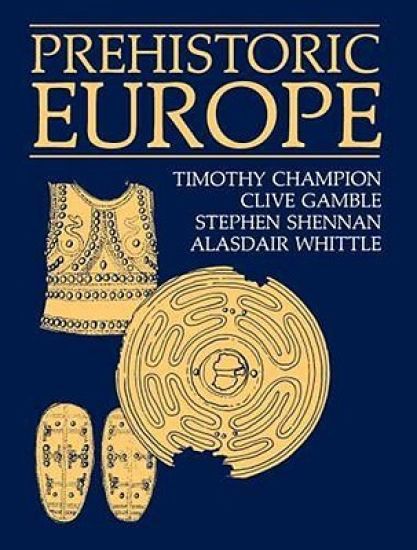
Prehistoric Europe

Prehistoric Europe

Timothy Champion; Clive Gamble; Stephen Shennan; Alasdair Whittle

Routledge
2017
sidottu
The study of European prehistory has been revolutionized in recent years by the rapid growth rate of archeological discovery, advances in dating methods and the application of scientific techniques to archaeological material and new archaeological aims and frameworks of interpretation. Whereas previous work concentrated on the recovery and description of material remains, the main focus is now on the reconstruction of prehistoric societies and the explanation of their development. This volume provides that elementary and comprehensive synthesis of the new discoveries and the new interpretations of European prehistory. After and introductory chapter on the geographical setting and the development of prehistoric studies in Europe, the text is divided chronologically into nine chapters. Each one describes, with numerous maps, plans and drawings, the relevant archaeological data, and proceeds to a discussion of the societies they represent. Particular attention is paid to the major themes of recent prehistoric research, especially subsistence economy, trade, settlement, technology and social organization.
Prehistoric Europe

Prehistoric Europe

Timothy Champion; Clive Gamble; Stephen Shennan; Alasdair Whittle

Left Coast Press Inc
2009
nidottu
The study of European prehistory has been revolutionized in recent years by the rapid growth rate of archeological discovery, advances in dating methods and the application of scientific techniques to archaeological material and new archaeological aims and frameworks of interpretation. Whereas previous work concentrated on the recovery and description of material remains, the main focus is now on the reconstruction of prehistoric societies and the explanation of their development. This volume provides that elementary and comprehensive synthesis of the new discoveries and the new interpretations of European prehistory. After and introductory chapter on the geographical setting and the development of prehistoric studies in Europe, the text is divided chronologically into nine chapters. Each one describes, with numerous maps, plans and drawings, the relevant archaeological data, and proceeds to a discussion of the societies they represent. Particular attention is paid to the major themes of recent prehistoric research, especially subsistence economy, trade, settlement, technology and social organization.
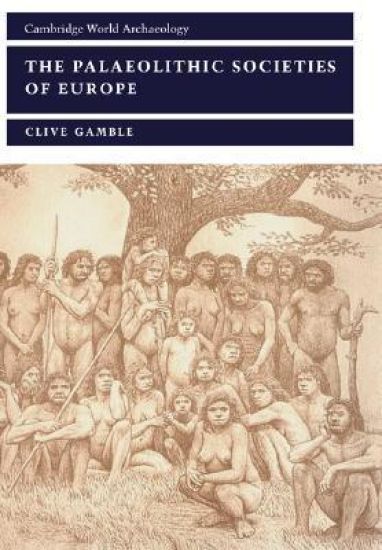
The Palaeolithic Societies of Europe

The Palaeolithic Societies of Europe

Gamble Clive

Cambridge University Press
1999
pokkari
Palaeolithic societies have been a neglected topic in the discussion of human origins. In this book, which succeeds and replaces The Palaeolithic Settlement of Europe, published by Cambridge University Press in 1986, Clive Gamble challenges the established view that the social life of Europeans over the 500,000 years of the European Palaeolithic must remain a mystery. In the past forty years archaeologists have recovered a wealth of information from sites throughout the continent. Professor Gamble now introduces a new approach to this material. He examines the archaeological evidence from stone tools, hunting and campsites for information on the scale of social interaction, and the forms of social life. Taking a pan-European view of the archaeological evidence, he reconstructs ancient human societies, and introduces new perspectives on the unique social experience of human beings.
Clive

Clive

C. Brad Faught

Potomac Books Inc
2013
sidottu
Robert Clive (1725–1774), later 1st Baron Clive, is widely considered the founder of British India. He arrived in Madras as a clerk for the East India Company in 1744. Through timely promotion and a clear affinity for military leadership, he proceeded to consolidate the company’s commercial and territorial position in South India before doing the same in the northeast in Bengal. In 1757 company troops under his command defeated the nawab of Bengal at the Battle of Plassey. This victory set in motion the East India Company’s ascendancy over much of India, paving the way for the 1857 creation of the British Raj, which would last for another ninety years. Clive is a fascinating and important historical figure: a lowly company employee who rose to great heights; an informally trained military commander who led company and local Indian troops to a series of stirring victories over local rivals who were supported by the French; a grasping politician who used his great wealth to secure a prominent social position; and, finally, a hounded society notable who, plagued by illness, allegedly took his own life. No one in the early days of the British ventures in India was as well known or as controversial as Clive became. In our own day, when empire and globalism are witnessed and talked about with ease, Clive’s position as both a servant of the East India Company-which developed into the world’s largest transnational trading company at the time-and an agent of imperialism makes him a surprisingly resonant figure.
Essential Clive Barker

Essential Clive Barker

Clive Barker

HARPERCOLLINS PUBLISHERS
2000
nidottu
With a special introduction by Armistead Maupin, author of Tales of the City, this is a unique selection of the author's best short stories and extracts from his novels, chosen by Clive and accompanied by a personal commentary which reveals the man behind the art.
Clive Cussler's The Devil's Sea

Clive Cussler's The Devil's Sea

Dirk Cussler

PENGUIN BOOKS LTD
2021
sidottu
DIRK PITT IS BACK. AND ON HIS SHOULDERS RESTS THE FATE OF THE ENTIRE PLANET.JOIN THE LATEST THRILL RIDE FROM THE GRAND MASTER OF ADVENTURE, CLIVE CUSSLER_________Tibet, 1959.In the turmoil of the Communist takeover of the mountain kingdom, a Buddhist artefact of immense importance appears to have been lost to history.Until, sixty years later, clues to its survival emerged from the wreckage of a cargo plane discovered deep beneath the surface of the Philippine Sea . . .NUMA Director Dirk Pitt and his old friend Al Giordino already have their hands full dealing with the recovery of a top secret hypersonic missile that went down in the Luzon Strait. Especially when it becomes clear that a rogue Chinese military team has its sights set on the same prize.And that, after making their own earth-shattering discovery about what lies below the waves, they're prepared to go to any lengths to ensure that they possess it.Any lengths at all.From the cold, dark depths of the Pacific Ocean to the vertiginous peaks of the Himalayas, only Dirk Pitt can unravel the mysteries that will bring the world back from the brink of war . . .Praise for Clive Cussler:'The Adventure King' Sunday Express'Just about the best in the business' New York Post 'Cussler is hard to beat' Daily Mail
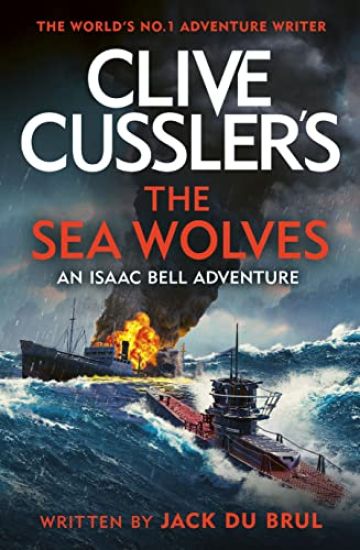
Clive Cussler's The Sea Wolves

Clive Cussler's The Sea Wolves

Jack du Brul

PENGUIN BOOKS LTD
2022
sidottu
ISAAC BELL RETURNS IN A BRAND NEW THRILLING MISSION FROM THE GRAND MASTER OF ADVENTURE, CLIVE CUSSLERAn old nemesis. A secret technology. The fate of a Great War at stake . . .__________Summer, 1914.As New England swelters, Detective Isaac Bell is asked to investigate a cache of missing rifles. But whoever broke into this Winchester Factory wasn't just looking to take weapons - they wanted to leave something in the shipping crates . . . A radio transmitter, set to summon a fleet of dreaded German U-boats to their location in the seas.This means only one thing: someone is trying to keep American supplies from reaching British shores. And if Bell doesn't crack the conspiracy in time, the Atlantic Ocean will run red with blood.With the outcome of the war in the balance and Franklin Roosevelt's orders on the line, Bell must confront an old enemy, and hunt down a new piece of technology that is allowing the Germans to rule the seas from New York to England.In a high-stakes, high seas pursuit of explosive suspense, Bell will risk everything to stop the U-Boats, before they strike again . . .__________Praise for Clive Cussler:'The Adventure King' Sunday Express'Just about the best in the business' New York Post 'Cussler is hard to beat' Daily Mail