Kirjojen hintavertailu. Mukana 12 390 323 kirjaa ja 12 kauppaa.

Kirjahaku

Etsi kirjoja tekijän nimen, kirjan nimen tai ISBN:n perusteella.

1000 tulosta hakusanalla D.Z. Lazba

Probuzhdenie voina. Vospitanie, myshlenie, zdorove i otnoshenija v zhizni muzhchiny
"MUZHCHINA DOLZHEN..." - a chto on dolzhen? Pochemu kto-to diktuet emu, kakim byt i chto delat? Muzhchiny tozhe ustali zhit po chuzhim ustanovkam i ispolnjat chi-to prikhoti. Mozhet, pora eto izmenit? Devid Lazba gotov podelitsja s vami instrumentami, kotorye ukrepjat vashu muzhestvennost. Sleduja instruktsijam iz knigi:*Razberites so svoimi kompleksami,*Zajmites svoim zdorovem,*Postrojte zdorovye otnoshenija vo vsekh sferakh zhizni,*Samosovershenstvujtes. "Probuzhdenie voina" rasskazhet vam o tom, kakimi mogut byt tsennosti; kak funktsioniruet muzhskoj organizm i kak uluchshit svoju zhizn.Eta kniga napisana MUZHCHINOJ dlja MUZHCHINPrjamolinejnoOtkrovennoBez navjazannykh klishe
(D - Z)

(D - Z)

Walter de Gruyter
2003
sidottu
Das seit 1949 von der Berliner Akademie der Wissenschaften betreute Polybios-Lexikon erschliesst in Form eines Bedeutungsworterbuchs umfassend den Wortschatz der Historien des Polybios (um 200-120 v. Chr.), der wichtigsten Quelle fur die Geschichte der hellenistischen Welt im 3. und 2. vorchristlichen Jahrhundert. In detaillierter Analyse des Materials fuhrt es unter semantisch, grammatisch oder phraseologisch begrundeten Subrubriken der einzelnen Stichwortartikel nach Angabe der Frequenzzahl alle einschlagigen Belege auf; es gibt Auskunfte uber die syntaktische Verwendung eines Wortes, Hinweise auf Synonyme und Antonyme, morphologische Angaben zu jedem Verb und bei Bedarf auch Sachinformationen. Weitere lieferbare Bande: Band I, Lieferung 1 (alpha-gamma/Korrektur ins Griechische ), ISBN 3-05-003499-8 Band I, Lieferung 2 (delta-zeta/Korrektur ins Griechische ), ISBN 3-05-004012-2 Band I, Lieferung 3 (eta-kappa/Korrektur ins Griechische ), ISBN 3-05-004021-1 Band I, Lieferung 4 (lambda-omikron/Korrektur ins Griechische ), ISBN 3-05-004022-X Band II, Lieferung 1 (Korrektur ins Griechische ), ISBN 3-05-003154-9 Band II, Lieferung 2 (Korrektur ins Griechische ), ISBN 3-05-004023-8 Band III, Lieferung 1 (Korrektur ins Griechische ), ISBN 3-05-003437-8 Band III, Lieferung 2 (Korrektur ins Griechische ), ISBN 3-05-004024-6 Das Lexikon liegt vollstandig vor."
D.Z. Phillips' Contemplative Philosophy of Religion
This collection presents a critical discussion and exploration of the late D.Z. Phillips' contemplative approach in the philosophy of religion. What are the main characteristics of this ground-breaking approach, which is inspired by thinkers like Kierkegaard and Wittgenstein and meant as a serious, critical alternative to the mainstream way of doing philosophy of religion? What is its aim, if it is deliberately avoiding apology and defence of faith? How does Phillips' approach relate to systematic, historical and empirical theology and is it really as 'neutral' as he claims it to be? Or is he, perhaps, a certain kind of theologian? What are the implications of his contemplative philosophy for central issues of religious life today, such as petitionary prayer, the hope of 'eternal life' and radical religious diversity? The essays of six distinguished scholars from five different nations critically and sympathetically address these questions and are responded to by Phillips in essays of his own, written briefly before his sudden death in July 2006.
D.Z. Phillips' Contemplative Philosophy of Religion
This collection presents a critical discussion and exploration of the late D.Z. Phillips' contemplative approach in the philosophy of religion. What are the main characteristics of this ground-breaking approach, which is inspired by thinkers like Kierkegaard and Wittgenstein and meant as a serious, critical alternative to the mainstream way of doing philosophy of religion? What is its aim, if it is deliberately avoiding apology and defence of faith? How does Phillips' approach relate to systematic, historical and empirical theology and is it really as 'neutral' as he claims it to be? Or is he, perhaps, a certain kind of theologian? What are the implications of his contemplative philosophy for central issues of religious life today, such as petitionary prayer, the hope of 'eternal life' and radical religious diversity? The essays of six distinguished scholars from five different nations critically and sympathetically address these questions and are responded to by Phillips in essays of his own, written briefly before his sudden death in July 2006.
Ethics of Belief: Essays in Tribute to D.Z. Phillips

Ethics of Belief: Essays in Tribute to D.Z. Phillips

E.T. Long

Springer-Verlag New York Inc.
2008
nidottu
Eugene Thomas Long Originally published in the International Journal for Philosophy of Religion, Volume 63, Nos 1–3. DOI: 10. 1007/s11153-007-9155-4 © Springer Science+Business Media B. V. 2007 This volume is presented as a tribute to the life and work of D. Z. Phillips. Six of the articles were originally presented at the annual conference on the philosophy of religion organized by Phillips and held at Claremont Graduate University, February 9–10, 2007. Unfortunately, Phillipsdidnotlivetoparticipateintheconferenceitself. HediedunexpectedlyJuly25,2006 in the library of his beloved University of Wales, Swansea. Previously published volumes of essays,basedonconferencesorganizedbyPhillipsinClaremont,includedachapterentitled, “Voices in Discussion,” in which Phillips provided his own reactions to the discussions wr- ten almost immediately after the conference. Sadly, this volume appears without the addition of his voice. Born in Morriston, near Swansea, Phillips was a Welsh speaker, a strong supporter of Welsh speaking schools and the author of many works in philosophy and literature in Welsh and English. Known widely as the leading representative of the movement in the philo- phy of religion called Wittgensteinianism, Phillips spent much of his effort challenging the tendency of philosophers to elevate one kind of discourse to the point where it becomes the norm by which other forms of discourse are to be judged.
Contemplating Religious Forms of Life: Wittgenstein and D.Z. Phillips
Ludwig Wittgenstein (1889-1951) made profound contributions to many areas of philosophy and cultural understanding, and his thought and methods have inspired numerous inquirers into the forms of our religious life. D. Z. Phillips (1934-2006) pioneered the application of Wittgenstein-influenced approaches to the philosophy of religion, and emphasized the contemplative, non-dogmatic nature of the philosophical task. In Contemplating Religious Forms of Life, Mikel Burley elucidates and critically examines the work of these two philosophers in relation to various aspects of religion, including ritual, mystical experience, faith and reason, realism and non-realism, conceptions of eternal life, and the use of literature as a resource for the contemplation of religious and non-religious beliefs. The book will be of significant value to academics, students and general readers interested in philosophy, religious studies, theology, and the interrelations between these disciplines.
Contemplating Religious Forms of Life: Wittgenstein and D.Z. Phillips
Ludwig Wittgenstein (1889-1951) made profound contributions to many areas of philosophy and cultural understanding, and his thought and methods have inspired numerous inquirers into the forms of our religious life. D. Z. Phillips (1934-2006) pioneered the application of Wittgenstein-influenced approaches to the philosophy of religion, and emphasized the contemplative, non-dogmatic nature of the philosophical task. In Contemplating Religious Forms of Life, Mikel Burley elucidates and critically examines the work of these two philosophers in relation to various aspects of religion, including ritual, mystical experience, faith and reason, realism and non-realism, conceptions of eternal life, and the use of literature as a resource for the contemplation of religious and non-religious beliefs. The book will be of significant value to academics, students and general readers interested in philosophy, religious studies, theology, and the interrelations between these disciplines.
The Problem of Evil and the Problem of God
By his own admission this is by far D Z Phillip’s most systematic attempt to discuss the problem of evil. Within the text the author argues that the majority of Anglo-American philosophers of religion who make a distinction between what is called the logical problem of evil and what is known as the practical, emotive or pastoral problem of evil are making false distinction. He argues that the logical is rooted in the practical. He does not intend to offer one 'correct' response to the problem of evil, but to point out the the confusions that are created by reflecting on the logical, conceptual problem in isolation. He advocates that there will always be more than one response to dealing with the problem of evil, but sees it as the job pf philosophers to point out where conceptual confusion arises.
Moral Practices Vol 6

Moral Practices Vol 6

D.Z. Phillips; H.O. Mounce

Routledge
2010
nidottu
This is Volume VI of nine in a collection of studies in Ethics and the Philosophy of Religion. Originally published in 1970, this volume looks at moral practices and the question which has puzzled philosophers: whether any value judgement can follow logically from the facts, can follow in such a way that someone who assents to the facts is bound in logic to assent also to the value judgement based upon them.
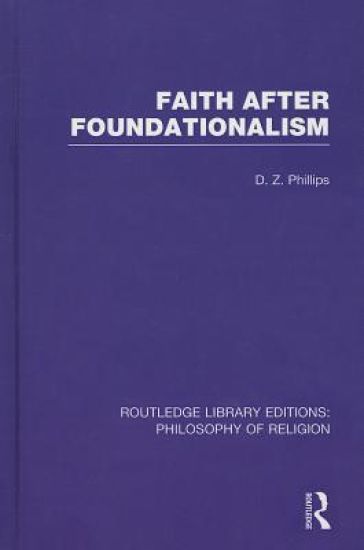
Faith after Foundationalism

Faith after Foundationalism

D.Z. Phillips

Routledge
2013
sidottu
Foundationalism is the view that philosophical propositions are of two kinds, those which need supporting evidence, and those which in themselves provide the evidence which renders them irrefutable. This book, originally published 1988, describes the battle between foundationalism, which places belief in God in the first category, and various other approaches to the problem of faith – ‘Reformed Epistemology’, hermeneutics; and sociological analysis. In the concluding section of the book, an examination of concept formation in religious belief is used to reinterpret the gap between the expressive power of language and the reality of God.
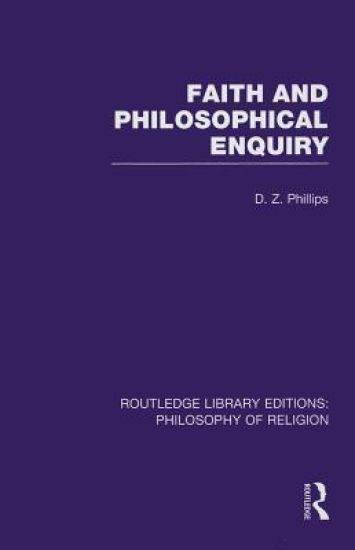
Faith and Philosophical Enquiry

Faith and Philosophical Enquiry

D.Z. Phillips

Routledge
2013
sidottu
The concern of this book is the nature of religious belief and the ways in which philosophical enquiry is related to it. Six chapters present the positive arguments the author wishes to put forward to discusses religion and rationality, scepticism about religion, language-games, belief and the loss of belief.The remaining chapters include criticisms of some contemporary philosophers of religion in the light of the earlier discussions, and the implications for more specific topics, such as religious education, are investigated. The book ends with a general attempt to say something about the character of philosophical enquiry, and to show how important it is to realise this character in the philosophy of religion.
Religion and Friendly Fire

Religion and Friendly Fire

D.Z. Phillips

Ashgate Publishing Limited
2004
sidottu
In locating friendly fire in contemporary philosophy of religion, D.Z. Phillips shows that more harm can be done to religion by its philosophical defenders than by its philosophical despisers. Friendly fire is the result of an uncritical acceptance of empiricism, and Phillips argues that we need to examine critically the claims that individual consciousness is the necessary starting point from which we have to argue: for the existence of an external world and the reality of God; that God is a person without a body, a pure consciousness; and that to assent to a religious belief is essentially to assign a truth value to a proposition independent of any confessional context. When these products of friendly fire are avoided, we arrive at a new understanding of belief, trust and the soul, and refuse to say more or less than we know about the realities of human life in the service of religious apologetics.
Religion and Friendly Fire

Religion and Friendly Fire

D.Z. Phillips

Routledge
2017
nidottu
In locating friendly fire in contemporary philosophy of religion, D.Z. Phillips shows that more harm can be done to religion by its philosophical defenders than by its philosophical despisers. Friendly fire is the result of an uncritical acceptance of empiricism, and Phillips argues that we need to examine critically the claims that individual consciousness is the necessary starting point from which we have to argue: for the existence of an external world and the reality of God; that God is a person without a body, a pure consciousness; and that to assent to a religious belief is essentially to assign a truth value to a proposition independent of any confessional context. When these products of friendly fire are avoided, we arrive at a new understanding of belief, trust and the soul, and refuse to say more or less than we know about the realities of human life in the service of religious apologetics.