Kirjojen hintavertailu. Mukana 12 595 353 kirjaa ja 12 kauppaa.

Kirjahaku

Etsi kirjoja tekijän nimen, kirjan nimen tai ISBN:n perusteella.

1000 tulosta hakusanalla David Shapiro

Your Old Wiring

Your Old Wiring

David Shapiro

McGraw-Hill
2000
nidottu
*Written by a master electrician this book shows homeowners and do-it-yourselfers how to go behind the walls of their old homes and correct messy, outdated wiring*Packed with over 250 photos and illustrations, 10 common wiring projects (like installing ceiling fans) and before and after photographs *The only house wiring book that shows how to identify and correct old electrical wiring, simply and safely IS IT WIRING—OR IS IT AN OCTOPUS? If you live in an older building, you never know what lurks behind switchplates and outlet covers, inside fuse boxes and breaker panels, writes master electrician David Shapiro. He's conquered the tangles masquerading as wiring in hundreds of old buildings, and in this book, he shows you not just what should be in your electrical system, as other books do, but also what really may be there—and how to deal with it. Your Old Wiring is the only guidebook available with this important feature. At last there's an easy, safe approach to that possible fire hazard (a.k.a.: your wiring system). This informative, photo-packed book can help anyone do home electrical jobs with ease, confidence, and skill. Your Old Wiring provides pictures that help you do everything from simple splicing repairs to installing a ceiling fan. Simple and Safe Master electrician David E. Shapiro's unique pictorial approach walks you through every step, making every task simple and safe. Clear photographs show you not only what to do, but also how to handle old wiring that may not match the ideal.

A Psychodynamic View of Action and Responsibility
This new book by David Shapiro, author of the classic Neurotic Styles, throws light, from a clinical standpoint, on a subject of importance, both theoretically and for therapeutic practice, for psychoanalysts and psychotherapists, as well as for those with general interests in philosophy or psychology. A Psychodynamic View of Action and Responsibility explores the individual’s experience of ownership or responsibility for what he or she does, says, and even believes, and their avoidance of that experience.David Shapiro considers the self-deception necessary for these disclaimers of responsibility and the surrender of personal conviction and autonomous judgment. With numerous excerpts from therapeutic sessions, he shows these to be self-protective reactions forestalling or dispelling the anxiety of internal conflict and also, as in false confessions, external threat or intimidation. Shapiro presents this important thesis in his usual lucid way and in many contexts. Its recognition, in his view, is critical for therapeutic work. This book demonstrates the central place in psychological dynamics of the subjective sense of personal responsibility or ownership of what one says or does. The subject is nowhere treated with the depth and emphasis on subjective experience seen in these chapters. A Psychodynamic View of Action and Responsibility will appeal to professionals and students of psychoanalysis and psychodynamic psychotherapy, as well as clinical psychologists, CBT practitioners, philosophers, and legal scholars.
A Psychodynamic View of Action and Responsibility
This new book by David Shapiro, author of the classic Neurotic Styles, throws light, from a clinical standpoint, on a subject of importance, both theoretically and for therapeutic practice, for psychoanalysts and psychotherapists, as well as for those with general interests in philosophy or psychology. A Psychodynamic View of Action and Responsibility explores the individual’s experience of ownership or responsibility for what he or she does, says, and even believes, and their avoidance of that experience.David Shapiro considers the self-deception necessary for these disclaimers of responsibility and the surrender of personal conviction and autonomous judgment. With numerous excerpts from therapeutic sessions, he shows these to be self-protective reactions forestalling or dispelling the anxiety of internal conflict and also, as in false confessions, external threat or intimidation. Shapiro presents this important thesis in his usual lucid way and in many contexts. Its recognition, in his view, is critical for therapeutic work. This book demonstrates the central place in psychological dynamics of the subjective sense of personal responsibility or ownership of what one says or does. The subject is nowhere treated with the depth and emphasis on subjective experience seen in these chapters. A Psychodynamic View of Action and Responsibility will appeal to professionals and students of psychoanalysis and psychodynamic psychotherapy, as well as clinical psychologists, CBT practitioners, philosophers, and legal scholars.
Autonomy and Rigid Character

Autonomy and Rigid Character

David Shapiro

Basic Books
1984
pokkari
Beginning with a discussion of the problem of autonomy in dynamic psychiatry and a review of its development from infancy to adolescence, the author of Neurotic Styles explores, with numerous clinical examples, the distortion of the development of autonomy in obsessive-compulsive conditions, in sadism and masochism, and, finally, in paranoia.
Neurotic Styles

Neurotic Styles

David Shapiro

Basic Books
1973
pokkari
This new edition of one of the books most closely identified with clinical psychology since 1965 will expose a new generation to Shapiro's stunningly defining conceptualizations of the Obsessive-Compulsive, Paranoid, Hysterical, and Impulsive ways of being.
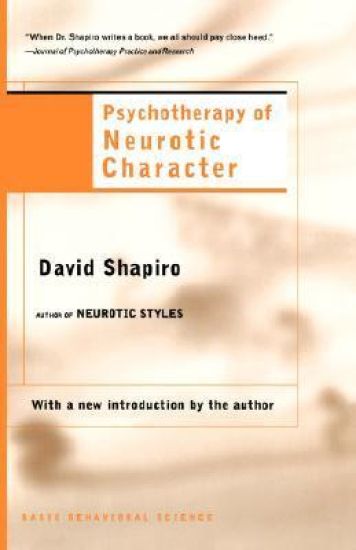
Psychotherapy Of Neurotic Character

Psychotherapy Of Neurotic Character

David Shapiro

Basic Books
1999
pokkari
Shapiro's keenness of observation and profound clinical wisdom are once again in evidence, as he brings to bear his brilliant ideas about neurotic character on the actual conduct of psychotherapy. The therapeutic material, argues Shapiro, consists not merely of what the patient provides but of the patient. Pay attention not only to the words, Shapiro says, but also to the speaker.Shapiro's highly original view of the dynamics of neurosis emphasizes subjective experience and revises classical conflict theory. The therapist's goal is to introduce the patient to himself and thus to end the self-estrangement that characterizes neurosis. In a series of eloquent chapters, richly illustrated with clinical vignettes, he elabourates this view, exploring such topics as the process of change, the psychology of raising consciousness," and the therapeutic relationship. No therapist, regardless of persuasion, will fail to be enlightened and inspired by this essential contribution to the field.
Dynamics of Character

Dynamics of Character

David Shapiro

Basic Books
2002
pokkari
Dr. David Shapiro's first new book in ten years, Dynamics of Character deepens his now-classic studies of psychopathology with this conceptualization of a dynamics of the whole character- a self-regulatory system that encompasses personal attitudes, modes of activity, and relationship with the external world. Extending and magnifying Shapiro's original vision of psychopathology, Dynamics of Character is a resonantly reasoned response to the reduction of complex processes of mind to products of biological defect of psychological trauma.
In Memory of an Angel

In Memory of an Angel

David Shapiro

City Lights Books
2017
pokkari
David Shapiro is a second-generation member of the New York School. His associations with Frank O'Hara and Allen Ginsberg, Frank Lima and Joe Ceravolo, Jasper Johns and Andy Warhol, in short his personal connections to modernist and postmodernist art and artists make his work part of the continuing legacy of that group of New York artists.This is the first book of new writing from Shapiro in 15 years, and his place in the literary vanguard makes this is a major poetry book in 2017.David's work is very New York, fragmented and kaleidoscopic, erudite and abstract, lyrical and cosmopolitan-we will push for profiles and interviews in larger profile New York media.
Plato Was Wrong!

Plato Was Wrong!

David Shapiro

Rowman Littlefield Education
2012
nidottu
This book is a compendium of lesson plans for classroom exercises designed to foster philosophical inquiry with young people. It introduces the reader to a wide range of activities for exploring philosophical questions and problems with children from preschool age through high-school. There are lessons for a full-range of topics in philosophy, including metaphysics, epistemology, ethics, and aesthetics, and each is intended to help foster a supportive and caring classroom community of inquiry. All of the activities have been used on numerous occasions and include reflections on what teachers who employ the lesson might expect when doing so. Using this book, teachers, parents, and others can successfully being fostering philosophical inquiry with young people of all ages.
Kinshasa in Transition

Kinshasa in Transition

David Shapiro; B. Oleko Tambashe

University of Chicago Press
2003
sidottu
Kinasha is the capital of the Democratic Republic of the Congo and the second-largest urban area in sub-Saharan Africa. As the city has grown tremendously - from around 300,000 people in the mid-1950s to more than five million today - it has experienced seismic social, economic and demographic changes. In this book, David Shapiro and B. Oleko Tambashe trace the impact of these changes on women's lives. They find that fertility has declined significantly in Kinasha since the 1970s and that women's increasing access to secondary education has played a key role in this decline. Better access to education has also given women greater access to employment opportunities. By examining the impact of such factors as economic well-being and household demographic composition on the schooling of children, Shapiro and Tambashe demonstrate how one generation's fertility affects the next generation's education. This book should be a valuable guide for anyone who wants to understand the complex and ongoing social, demographic, economic and developmental changes in contemporary sub-Saharan Africa.
Principles of Macroeconomics 3e (2025)

Principles of Macroeconomics 3e (2025)

David Shapiro; Daniel MacDonald; Steven A Greenlaw

Independently Published
2025
pokkari
Includes all Errata as of January 2025. Principles of Macroeconomics 3e (2025) covers the scope and sequence of most one semester introductory macroeconomics courses. The third edition takes a balanced approach to the theory and application of macroeconomics concepts. The text uses conversational language and ample illustrations to explore economic theories, and provides a wide array of examples using both fictional and real-world scenarios. The third edition has been carefully and thoroughly updated to reflect current data and understanding, as well as to provide a deeper background in diverse contributors and their impacts on economic thought and analysis. For example, the third edition highlights the research and views of a broader group of economists. Brief references and deeply explored socio-political examples have also been updated to showcase the critical - and sometimes unnoticed - ties between economic developments and topics relevant to students.
Something to Live For: Finding Your Way in the Second Half of Life.

Something to Live For: Finding Your Way in the Second Half of Life.

David Shapiro; Richard J Leider

Berrett-Koehler
2008
nidottu
Drawing on ancient and contemporary wisdom, as well as modern research, Richard Leider and David Shapiro provide insightful ways of thinking and being that help us find meaning and purpose in the second half of life. This deeply reflective book uses a safari, (referencing a trip the authors took to Africa in 2006) as a metaphor to show how the second half of life can be a journey of discovery. In what may be their most personal book to date, Leider and Shapiro share dozens of moving stories, from both their own experiences and those of their safari companions, that offer sometimes surprising examples of lives well-lived, lives that exemplify the qualities of authenticity and wholeheartedness that they believe are essential to finding meaning and purpose in the second half of life. There are many pathways to putting our whole selves into life, especially during the second half, and in Something to Live For," Leider and Shapiro explore many routes to vital aging.
You Are The You

You Are The You

David Shapiro; David Lehman

Madhat, Inc.
2025
pokkari
"Poetry is magic after Rimbaud," Shapiro writes at 17 in the prescient piece that opens the volume-then goes on in the works that follow to dis- seminate the magic. His bent is artistic and pluralistic; a sui generis mix of lightness and depth, of wide-minded, many-angled, improvisatory verve and great freshness of thought and language. Sympathetic insight into the aesthetic processes of others is his forte. He invokes William James: love discerns more than "blinding objectivity." He relates the discontinuities of John Ashbery to the Uncertainty Principle and notes that Frank Lima's use of "the disjunctive poetics of the New York School" is an art of "welding disparate worlds" together. It's an art innate to Shapiro's prose, where voic- es and ideas from multiple perspectives combine to shed light on a work, amplify a discussion, deepen a context. Likewise, the interviews are rivet- ing partly because of the candor and camaraderie with which he brings the words and views of other thinkers into his replies ... As for the New York School, thanks in part to David Shapiro's remarkable elucidations, it's a movement that has expanded the sayable for innumerable poets and read- ers and remains a liberating, poetry-wide force.The volume fairly vibrates with erudition and esprit. In his prose, as in his poetry, Shapiro enchants. -Ange Mlinko, winner of the Randall Jarrell Award in Criticism The prose assembled in You Are The You, an invaluable complement to Da- vid's poetry, is a master class in the aesthetics of the New York School and the Avant Garde in general. -David Lehman All of David Shapiro's writing is simultaneously earnest and explosive. -Joanna Fuhrman, author of Data Mind and co-editor of Hanging Loose Press