Kirjojen hintavertailu. Mukana 12 353 311 kirjaa ja 12 kauppaa.

Kirjahaku

Etsi kirjoja tekijän nimen, kirjan nimen tai ISBN:n perusteella.

1000 tulosta hakusanalla David Walker

David Walker's Appeal

David Walker's Appeal

David Walker

Hill Wang Inc.,U.S.
1995
nidottu
"David Walker's Appeal is a landmark work of American history and letters, the most radical piece of writing by an African American in the nineteenth century. Startling in its intensity, unrelenting in its attacks on slavery and white racism, it alarmed Southern slaveholders, inspired Northern abolitionists, and hastened the sectional conflicts that led to the Civil War. In this new edition of the "Appeal, the distinguished historian Sean Wilentz draws on a generation of innovative research to throw fresh light on Walker's life and ideas--and their enduring importance.
David Walker

David Walker

Sherrow O. Pinder

JOHN WILEY AND SONS LTD
2024
sidottu
David Walker, a free (with a small f) black man, was one of the most significant African-American abolitionists of the nineteenth century. Born in a slave society before moving to Boston where, after the American Revolutionary War, slavery was abolished, Walker devoted his life to fighting slavery and antiblack racism. In this book, Sherrow O. Pinder brings to light Walker’s lived experience, activism, and the synchronizing of his Christian principles and reformist radicalism to demonstrate why and how slavery must be eliminated. Walker’s call for blacks to regain their natural rights culminated in his Appeal to the Coloured Citizens of the World, an enormously influential work that is now considered a founding text of black studies. Today, given the escalation of antiblack racism manifested in the upholding of institutionalized violence by the state and the continued marginality of African-Americans, we cannot afford to forget Walker’s push for racial egalitarianism: it is more urgent than ever.
David Walker

David Walker

Sherrow O. Pinder

JOHN WILEY AND SONS LTD
2024
nidottu
David Walker, a free (with a small f) black man, was one of the most significant African-American abolitionists of the nineteenth century. Born in a slave society before moving to Boston where, after the American Revolutionary War, slavery was abolished, Walker devoted his life to fighting slavery and antiblack racism. In this book, Sherrow O. Pinder brings to light Walker’s lived experience, activism, and the synchronizing of his Christian principles and reformist radicalism to demonstrate why and how slavery must be eliminated. Walker’s call for blacks to regain their natural rights culminated in his Appeal to the Coloured Citizens of the World, an enormously influential work that is now considered a founding text of black studies. Today, given the escalation of antiblack racism manifested in the upholding of institutionalized violence by the state and the continued marginality of African-Americans, we cannot afford to forget Walker’s push for racial egalitarianism: it is more urgent than ever.
David Walker's Appeal Hardcover

David Walker's Appeal Hardcover

David Walker

LUSHENA BOOKS INC
2022
sidottu
David Walker's Appeal is an uncompromising African-centered discourse that attacks white injustice and advocates Black self-reliance. Its publication in 1830 intensified the debate and struggle against slavery. More than a petition against slavery, the Appeal is a foundational document from which many contemporary themes in Black political philosophy have evolved, Walker asserted the right of Black people to defend themselves against a common enemy by any means necessary. Because of his Appeal, David Walker remains one of the most durable political figures in our history. His clear presentation of the problems confronting people of African descent is prophetic, and it assures the relevance of the Appeal to contemporary readers.
David Walker’s Appeal to the Coloured Citizens of the World
In 1829 David Walker, a free black born in Wilmington, North Carolina, wrote one of America’s most provocative political documents of the nineteenth century, Walker’s Appeal to the Coloured Citizens of the World. Decrying the savage and unchristian treatment blacks suffered in the United States, Walker challenged his “afflicted and slumbering brethren” to rise up and cast off their chains. Walker worked tirelessly to circulate his book via underground networks in the South, and he was so successful that Southern lawmakers responded with new laws cracking down on “incendiary” antislavery material. Although Walker died in 1830, the Appeal remained a rallying point for African Americans for many years to come, anticipating the radicalism of later black leaders, from Malcolm X to Martin Luther King, Jr. In this new edition of the Appeal, the first in over thirty years, Peter P. Hinks, the leading authority on David Walker, provides a masterly introduction and extensive annotations that incorporate the most up-to-date research on Walker, much of it first reported by Hinks in his highly acclaimed biography, To Awaken My Afflicted Brethren. Hinks also includes a unique appendix of documents showing the contemporary response—from North and South, black and white—to the Appeal itself and Walker’s attempts to distribute it in the South. Historians and political activists have long recognized the importance of Walker’s Appeal. At last we have an edition worthy of its persuasive immediacy and its enduring place in American history.
David Walker’s Appeal to the Coloured Citizens of the World
In 1829 David Walker, a free black born in Wilmington, North Carolina, wrote one of America’s most provocative political documents of the nineteenth century, Walker’s Appeal to the Coloured Citizens of the World. Decrying the savage and unchristian treatment blacks suffered in the United States, Walker challenged his “afflicted and slumbering brethren” to rise up and cast off their chains. Walker worked tirelessly to circulate his book via underground networks in the South, and he was so successful that Southern lawmakers responded with new laws cracking down on “incendiary” antislavery material. Although Walker died in 1830, the Appeal remained a rallying point for African Americans for many years to come, anticipating the radicalism of later black leaders, from Malcolm X to Martin Luther King, Jr. In this new edition of the Appeal, the first in over thirty years, Peter P. Hinks, the leading authority on David Walker, provides a masterly introduction and extensive annotations that incorporate the most up-to-date research on Walker, much of it first reported by Hinks in his highly acclaimed biography, To Awaken My Afflicted Brethren. Hinks also includes a unique appendix of documents showing the contemporary response—from North and South, black and white—to the Appeal itself and Walker’s attempts to distribute it in the South. Historians and political activists have long recognized the importance of Walker’s Appeal. At last we have an edition worthy of its persuasive immediacy and its enduring place in American history.
David Walker's Appeal
David Walker's Appeal is an uncompromising African-centered discourse that attacks white injustice and advocates Black self-reliance. Its publication in 1830 intensified the debate and struggle against slavery. More than a petition against slavery, the Appeal is a foundational document from which many contemporary themes in Black political philosophy have evolved, Walker asserted the right of Black people to defend themselves against a common enemy by any means necessary. Because of his Appeal, David Walker remains one of the most durable political figures in our history. His clear presentation of the problems confronting people of African descent is prophetic, and it assures the relevance of the Appeal to contemporary readers.
The Spirit of David Walker

The Spirit of David Walker

James S. Peters

University Press of America
2002
nidottu
The Spirit of David Walker gives readers information about a forgotten hero of the anti-slavery movement, seldom found in traditional historical works. In an effort to bridge the gap between known historical events of slavery in 18th and 19th century America, James Peters II details the life and work of an American visionary prophet and writer. Walker, a leading abolitionist, envisioned the eventual emancipation of slaves in the South and the war that it would take to accomplish this.
The Textual Effects of David Walker's "Appeal"

The Textual Effects of David Walker's "Appeal"

Marcy J. Dinius

UNIVERSITY OF PENNSYLVANIA PRESS
2022
sidottu
Historians and literary historians alike recognize David Walker's Appeal to the Coloured Citizens of the World (1829-1830) as one of the most politically radical and consequential antislavery texts ever published, yet the pamphlet's significant impact on North American nineteenth-century print-based activism has gone under-examined. In The Textual Effects of David Walker's "Appeal" Marcy J. Dinius offers the first in-depth analysis of Walker's argumentatively and typographically radical pamphlet and its direct influence on five Black and Indigenous activist authors, Maria W. Stewart, William Apess, William Paul Quinn, Henry Highland Garnet, and Paola Brown, and the pamphlets that they wrote and published in the United States and Canada between 1831 and 1851. She also examines how Walker's Appeal exerted a powerful and lasting influence on William Lloyd Garrison's Liberator and other publications by White antislavery activists. Dinius contends that scholars have neglected the positive, transnational, and transformative effects of Walker's Appeal on print-based political activism and literary and book history-that is, its primarily textual effects-due to an enduringly narrow focus on the violence that the pamphlet may have occasioned. She offers as an alternative a broadened view of activism and resistance that centers the works of Walker, Stewart, Apess, Quinn, Garnet, and Brown within an exploration of radical forms of authorship, publication, civic participation, and resistance. In doing so, she has written a major contribution to African American literary studies and the history of the book in antebellum America.
The Amazing Adventures of David Walker Blackstone

The Amazing Adventures of David Walker Blackstone

Kevin Sipp

Lulu Publishing Services
2014
pokkari
SPECIAL EDITION PROLOGUE ISSUE Born into slavery in 1840, on the Amelia islands off the coast of Florida, David Walker Blackstone is an initiate of a host of African and world indigenous mystical traditions. Having settled in Boston after traveling the world and fighting in the civil war, Blackstone secures a job writing about crime and spiritual matters for a Boston newspaper. When a secret society of former abolitionists and post slavery freedom fighters, headed by Frederick Douglas, come looking for his spiritual services, Blackstone soon finds himself at the vanguard of a war between men, demons, and gods for the soul of the world. The Amazing Adventures of David Walker Blackstone: Special Edition Prologue is the debut graphic novel installment in a series of high adventures inspired by classic pulp fiction stories of the past.
The Textual Effects of David Walker's "Appeal"

The Textual Effects of David Walker's "Appeal"

Marcy J. Dinius

UNIVERSITY OF PENNSYLVANIA PRESS
2025
pokkari
Historians and literary historians alike recognize David Walker's Appeal to the Coloured Citizens of the World (1829-1830) as one of the most politically radical and consequential antislavery texts ever published, yet the pamphlet's significant impact on North American nineteenth-century print-based activism has gone under-examined. In The Textual Effects of David Walker's "Appeal" Marcy J. Dinius offers the first in-depth analysis of Walker's argumentatively and typographically radical pamphlet and its direct influence on five Black and Indigenous activist authors, Maria W. Stewart, William Apess, William Paul Quinn, Henry Highland Garnet, and Paola Brown, and the pamphlets that they wrote and published in the United States and Canada between 1831 and 1851. She also examines how Walker's Appeal exerted a powerful and lasting influence on William Lloyd Garrison's Liberator and other publications by White antislavery activists. Dinius contends that scholars have neglected the positive, transnational, and transformative effects of Walker's Appeal on print-based political activism and literary and book history-that is, its primarily textual effects-due to an enduringly narrow focus on the violence that the pamphlet may have occasioned. She offers as an alternative a broadened view of activism and resistance that centers the works of Walker, Stewart, Apess, Quinn, Garnet, and Brown within an exploration of radical forms of authorship, publication, civic participation, and resistance. In doing so, she has written a major contribution to African American literary studies and the history of the book in antebellum America.
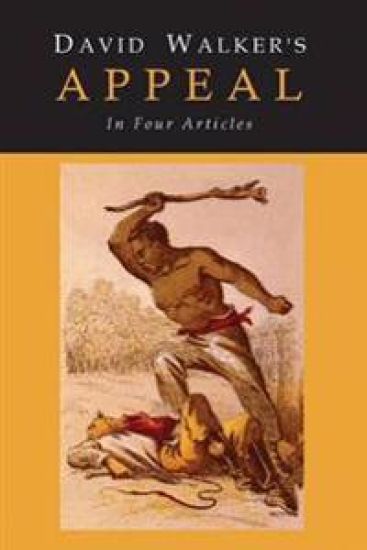
Walker's Appeal, in Four Articles: Walker's Appeal, in Four Articles; Together with a Preamble, to the Coloured Citizens of the World, but in Particul
IT will be recollected, that I, in the first edition of my "Appeal,"*promised to demonstrate in the course of which, viz. in the course of my Appeal, to the satisfaction of the most incredulous mind, that we Coloured People of these United States, are, the most wretched, degraded and abject set of beings that over lived since the world began, down to the present day, and, that, the white Christians of America, who hold us in slavery, (or, more properly speaking, pretenders to Christianity, ) treat us more cruel and barbarous than any Heathen nation did any people whom it had subjected, or reduced to the same condition, that the Americans (who are, notwithstanding, looking for the Millennial day) have us. All I ask is, for a candid and careful perusal of this the third and last edition of my Appeal, where the world may see that we, the Blacks or Coloured People, are treated more cruel by the white Christians of America, than devils themselves ever treated a set of men, women and children on this earth
Walker's appeal, in four articles,

Walker's appeal, in four articles,

David Walker

Alpha Edition
2020
pokkari
This book has been considered by academicians and scholars of great significance and value to literature. This forms a part of the knowledge base for future generations. So that the book is never forgotten we have represented this book in a print format as the same form as it was originally first published. Hence any marks or annotations seen are left intentionally to preserve its true nature.