Kirjahaku
Etsi kirjoja tekijän nimen, kirjan nimen tai ISBN:n perusteella.
1000 tulosta hakusanalla Dide
Diderot'S Treatment of the Christian Religion in the Encyclopédie
Joseph Edmund Barker
Columbia University Press
2022
sidottu
This work has been selected by scholars as being culturally important, and is part of the knowledge base of civilization as we know it. This work was reproduced from the original artifact, and remains as true to the original work as possible. Therefore, you will see the original copyright references, library stamps (as most of these works have been housed in our most important libraries around the world), and other notations in the work.This work is in the public domain in the United States of America, and possibly other nations. Within the United States, you may freely copy and distribute this work, as no entity (individual or corporate) has a copyright on the body of the work.As a reproduction of a historical artifact, this work may contain missing or blurred pages, poor pictures, errant marks, etc. Scholars believe, and we concur, that this work is important enough to be preserved, reproduced, and made generally available to the public. We appreciate your support of the preservation process, and thank you for being an important part of keeping this knowledge alive and relevant.
Diderot et la médecine; ses amis médecins, transformisme, médecine contre chirurgie, inoculation [par] Dr. P.-H. Tribouillet. Avec 4 hors-textes
Tribouillet P H
Wentworth Press
2018
pokkari
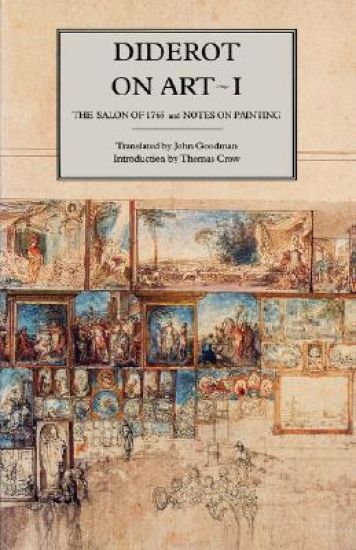
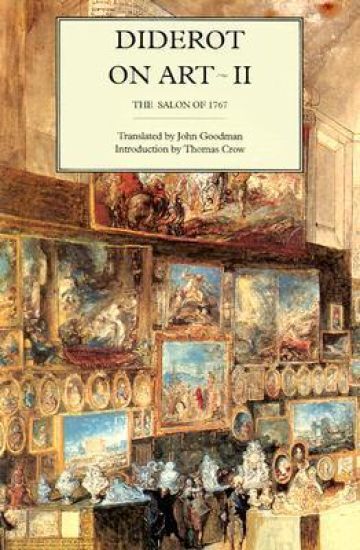
The eighteenth-century French philosophe Denis Diderot—the principal intelligence behind the Encyclopédie and the author of idiosyncratic fictional works such as Jacques the Fatalist and Rameau’s Nephew—was also the first great art critic. Until now, however, Diderot’s treatises on the visual arts have been available only in French. This two-volume edition makes the most important of his art-critical texts available in English for the first time. Diderot’s works are among the most provocative and engaging products of the French Enlightenment. Moreover, their ruminations on many issues of perennial interest (invention versus convention, nature versus culture, and technique versus imagination; the complex relations between economic reality and artistic achievement) give them a rare pertinence to current debates on the nature and function of representation. All the celebrated pieces are here: the rhapsodic dream meditation inspired by Fragonards’ Corésus and Callierhoé; the incident-packed “excursion” through a set of landscapes by Joseph Vernet; the evocative consideration of the nature of ruins and historical nostalgia prompted by the first showing of works by Hubert Robert. But these famous passages can now be considered in their proper context, surrounded by meditations that are less well known but equally sparkling. The book also includes brief introductory texts and annotations by John Goodman that clarify the many references to contemporary Parisian culture, as well as an introduction by Thomas Crow that sets the texts in their historical and art-historical context.
The eighteenth-century French philosophe Denis Diderot—the principal intelligence behind the Encyclopédie and the author of idiosyncratic fictional works such as Jacques the Fatalist and Rameau's Nephew—was also the first great art critic. Until now, however, Diderot's treatises on the visual arts have been available only in French. This two-volume edition makes the most important of his art-critical texts available in English for the first time.Diderot's works are among the most provocative and engaging products of the French Enlightenment. Moreover, their ruminations on many issues of perennial interest (invention versus convention, nature versus culture, and technique versus imagination; the complex relations between economic reality and artistic achievement) give them a rare pertinence to current debates on the nature and function of representation. All the celebrated pieces are here: the rhapsodic dream meditation inspired by Fragonard's Corésus and Callierhoé; the incident-packed "excursion" through a set of landscapes by Joseph Vernet; the evocative consideration of the nature of ruins and historical nostalgia prompted by the first showing of works by Hubert Robert. But these famous passages can now be considered in their proper context, surrounded by meditations that are less well known but equally sparkling. The book also includes brief introductory texts and annotations by John Goodman that clarify the many references to contemporary Parisian culture, as well as an introduction by Thomas Crow that sets the texts in their historical and art-historical context.
In this study Dr. Gregory examines how Diderot borrowed from Lucretius, Buffon, Maupertuis, and probability theory, and combined ideas from these sources in an innovative fashion to hypothesize that species are mutable and that all life arose randomly from a single prototype.
The publication of the Encyclopedie in the middle of the eighteenth century is generally recognised as a decisive factor in the conflict ideas which led to the French Revolution of 1789. Yet, despite its importance in the history of eighteenth-century French thought, no outstanding work of the period is less read today, simple because of its bulk and inaccessibility. Those parts reproduced in this edition cover religion, philosophy, science and political and social ideas and include articles which reflect the humanitarian outlook of the contributors and their attitude to the abuses of the ancien regime. The selection is of value not only to students of French literature and thought, but also to all those interested in the history and political ideas of France on the eve of the Revolution; in these pages Diderot, D'Alembert and D'Holbach are allowed to speak for themselves, instead of having their ideas summarised (and sometimes misinterpreted) by others.
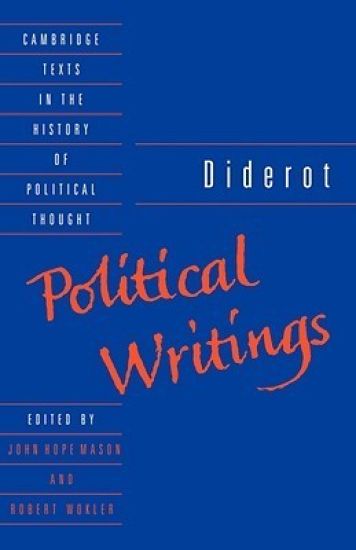
Denis Diderot (1713-1784) was one of the most significant figures of the French enlightenment. His political writings cover the period from the first volume of the Encyclopedie (1751), of which he was principal editor, to the third edition of Raynal's Histoire des Deux Indes (1780), one of the most widely read books of the pre-revolutionary period. This volume contains the most important of Diderot’s articles for the Encyclopedie, a substantial number of his contributions to the Histoire, the complete texts of his Supplement au Voyage de Bougainville, one of his most visionary works, and his Observations sur le Nakaz, a precise and detailed political work translated here into English for the first time. The editors’ introduction sets these works in their context and shows the underlying coherence of Diderot’s thought. A chronology of events and a bibliography are included as further aids to the reader.
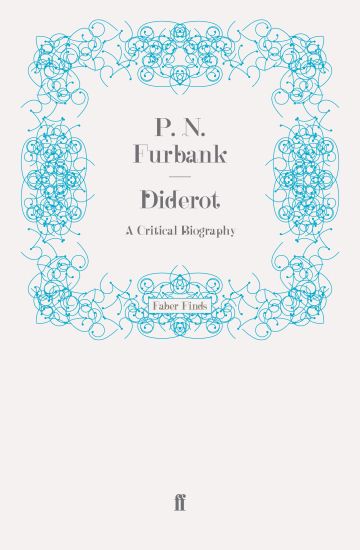
Author of that inexhaustibly strange masterpiece Rameau's Nephew, Denis Diderot (1713-84) was also a dramatist, a speculative philosopher, the founder of modern art criticism and a tireless correspondent; he has also been called the most talkative man of his generation. His genius was profoundly subversive, and he spent much of his working life under the threat of exile. The son of a cutler, Diderot had an empathy with trades, tools and machinery that flowered magnificently in some of his contributions to the great Encyclopédie, which he edited with d'Alembert and published over a period of some twenty years. Diderot's range of contacts was prodigious: a close friend of Rousseau, Grimm and d'Alembert, a familiar figure in the literary salons of Paris, he also met and corresponded with Hume, Garrick and Laurence Sterne. It was the support of Catherine the Great (as her agent, Diderot in effect laid the foundations of the Hermitage collection) that led to the most extraordinary episode in an astonishing life: at the age of sixty Diderot travelled to St Petersburg where he drew up outline plans for the conversion of Russia into an ideal republic. P. N. Furbank's sympathetic and probing analysis of Diderot's work and influence was first published in 1992 and won a Truman Capote Award for Literary Criticism.
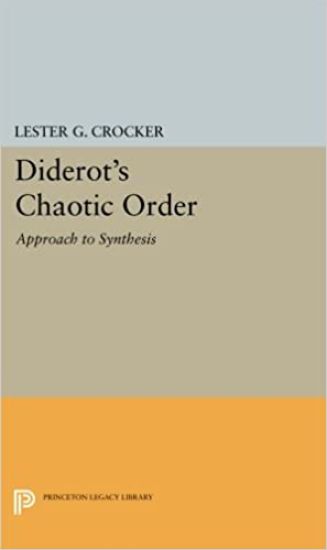
Because of its fragmentary, evolving, exploratory, and dialectical character, Diderot's thought has continuously resisted overall synthesis. In the ideas of "order" and "disorder," ideas important in all of eighteenth-century thought, Lester G. Crocker finds the key to an outline of a structure that leads to a genuine synthesis of Diderot's writings on philosophy, morality, politics, and aesthetics. The tensions in Diderot's thought, Professor Crocker shows, reflect his understanding of reality itself--paradoxically, an anarchic order, a dynamic universe governed by laws but always changing in a chaotic way. The book examines Diderot's approach to aesthetics as a human ordering response to the world, and his approach to morals and politics as practical ways of dealing with the problems of order and disorder in the context of life in society. In light of the concepts of order and disorder, the inextricable associations of all of these realms of thought in Diderot's work become clear, and a unity is perceived. Since the problem of order and disorder was fundamental to an age faced with the dissolution of the Christian view of cosmic order, this novel approach to Diderot's work suggests new ways of understanding the Enlightenment as a whole. Originally published in 1974. The Princeton Legacy Library uses the latest print-on-demand technology to again make available previously out-of-print books from the distinguished backlist of Princeton University Press. These editions preserve the original texts of these important books while presenting them in durable paperback and hardcover editions. The goal of the Princeton Legacy Library is to vastly increase access to the rich scholarly heritage found in the thousands of books published by Princeton University Press since its founding in 1905.
A study of scientific naturalism in the Enlightenment. In tracing the materialism of Diderot, La Mettrie, Buffon, and D'Holbach to its sources, it offers a fresh appraisal of the total influence of Descartes on the Enlightenment. Originally published in 1953. The Princeton Legacy Library uses the latest print-on-demand technology to again make available previously out-of-print books from the distinguished backlist of Princeton University Press. These editions preserve the original texts of these important books while presenting them in durable paperback and hardcover editions. The goal of the Princeton Legacy Library is to vastly increase access to the rich scholarly heritage found in the thousands of books published by Princeton University Press since its founding in 1905.