Kirjojen hintavertailu. Mukana 11 244 527 kirjaa ja 12 kauppaa.

Kirjahaku

Etsi kirjoja tekijän nimen, kirjan nimen tai ISBN:n perusteella.

1000 tulosta hakusanalla Donald Stephens

Texas Wildcatter: The Life Story of William Donald Stephenson, A Texas Oil and Gas Pioneer
William Donald Stephenson, known later in his life as "Mr. Donald," was born October 14,1889 in Waco, Texas . At age 11 he lost the two middle fingers and almost his thumb on his left hand to a dynamite cap blast. At 16 he drove, alone, a team of "Indian Ponies" and a four wheeled buggy 300 miles over unmarked territory from Central Texas to the edge of the "Big Thicket of Texas" swamps. The next 7 years he lived in a tent in the East Texas swampland and in a hotel in Batson, Texas. He learned, from the ground up, and down, the "trade" of an oil and gas field "Driller" and became a "Wildcatter". IIn 1917 he moved to McMullen County 75 miles south of San Antonio where he, his Dad, and brother began searching for oil and gas via their new "company" - the Grubstake Investment Association. They struck both gas and oil. In 1963, at 74, Donald hand wrote a 21 page letter to his grandchildren he titled "Lets Tell A Story" describing his life from childhood thru about age 35. In November 1970 Donald died at age 81 and not as a wealthy man. His letter was never completed, mailed, or known until 48 years later. It was discovered in January of 2018 in his older son's home as it was being made ready for sale after that son, Robert, died at age 88 in Austin, Texas.Throughout Donald's life he took photos or had them taken and wrote pencil notes on their backs to explain who and what they were about. He kept handwritten notes and legal documents all his life. After discovery of Donald's letter his younger son, John, along with John's two daughters researched the family photos, and various documents and books about their family. John then wrote a biographical sketch of Donald's life for the benefit of Donald's descendants and for the benefit of Texas History. This is that writing. It includes a transcription of "Donald's Letter" along with other relevant "Wildcatter" information and photographs, some of which today are over 100 years old. A copy of Donald's handwritten letter is included as an Appendix for historical purposes. --John Russell Stephenson, Colonel (Ret), USAF, MSC; Donald's youngest son
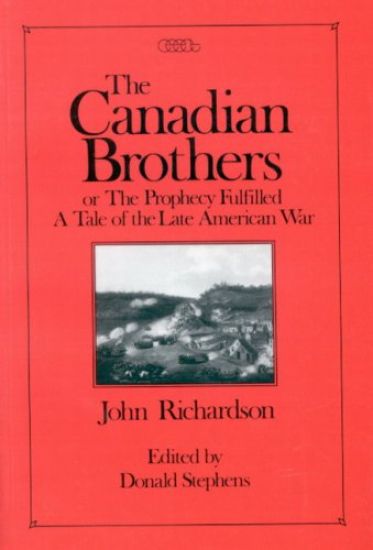
Canadian Brothers or the Prophecy Fulfilled

Canadian Brothers or the Prophecy Fulfilled

John Richardson; Donald Stephens

Carleton University Press,Canada
1992
nidottu
Major John Richardson (1796-1852) was a prolific and popular Canadian author. The Canadian Brothers, first published in 1840 in Montreal, is set on the northwest frontier during the War of 1812 and features such historical personages as Sir Isaac Brock, Captain Robert Heriot Barclay, and the famous Indian chief Tecumseh. The sequel to Wacousta (1832), The Canadian Brothers is not only a suitably horrific completion to the story of vengeance and hate begun in Richardson's earlier novel. It is also, and most importantly, a fictionalized narrative of events, people, and places from Richardson's own childhood and adolescence in Amherstburg, Upper Canada, that both reveals the psychology of its author and reflects seminal mythologies about Ontario and Canada.
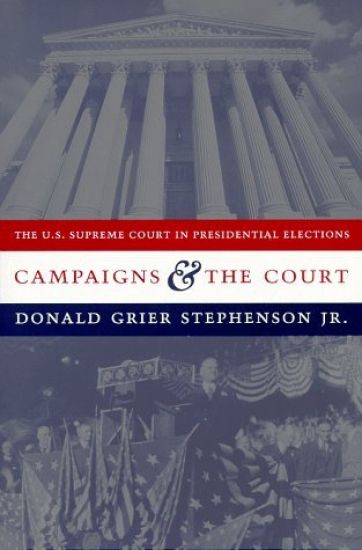
Campaigns and the Court

Campaigns and the Court

Donald Grier Stephenson Jr.

Columbia University Press
1999
pokkari
Over two centuries of American history the Supreme Court has often become a significant issue in presidential elections, with voters acutely aware that the dominance of one party at the polls may translate into that party's dominance on the nation's highest court. Should Americans presume that votes at the ballot box will have an effect on votes at the Supreme Court on what our Constitution means? Donald Grier Stephenson Jr. explores the periods when the Court has been an issue in elections-and when it has not--investigating ten elections in which the Court was clearly an issue and looking also at the election of 1992, in which it could have become a major issue but did not. Drawing from four areas of political history-party evolution, presidential campaigns, as well as judicial and constitutional development-Stephenson presents a sophisticated inquiry into the relationship of the Supreme Court to the electoral process and considers whether this recurring electoral phenomenon is a beneficial feature of democratic politics-or one that ought to be met with concern.
An Essential Safeguard

An Essential Safeguard

Donald Grier Stephenson

Praeger Publishers Inc
1991
sidottu
This timely collection examines the record of current and recent justices in fashioning the Constitution and looks at the larger political context in which their work has occurred. The eight essays, written by distinguished scholars of the Supreme Court, review the achievements of current Justices O'Connor and Rehnquist as well as recent justices Douglas, Black, and Harlan. The essay on Justice O'Connor is one of the first overall assessments of her record to appear in print. Editor D. Grier Stephenson, Jr.'s introductory chapter presents an insightful overview of the Supreme Court's role in American government today. Collectively these chapters make a rich contribution to an understanding of constitutional government and render a complex subject both accessible to general readers and interesting to experts.Following editor Stephenson's cogent introduction, Henry Abraham's Can Presidents Really Pack the Supreme Court? focuses on the political and intellectual environments within which the Supreme Court functions and on the candidates selected by presidents to sit on the High Bench. In Chapter Three, former solicitor general Rex E. Lee zeroes on a central aspect of, and a key player in, the judicial process. Leadership and the relationships among the justices are the subject of Chapter Four. Harold J. Spaeth's essay on Justice Sandra Day O'Connor emphasizes personality as an element contributing to the Court's decisions. The legacy of Justice William O. Douglas and the impact of the Court's past on its present decisions are both examined by Walter Murphy. Similarly, the next chapter's study of Justice John Marshall Harlan shows the importance of the Constitutional legacy in understanding the Supreme Court. Affirmative Action and the Supreme Court reviews the responses of current members of the Court to one of the most divisive and significant policy questions of our time. The concluding essay surveys Chief Justice Rehnquist and the Future of the Supreme Court. This volume is important reading for students of law, history, and political science.
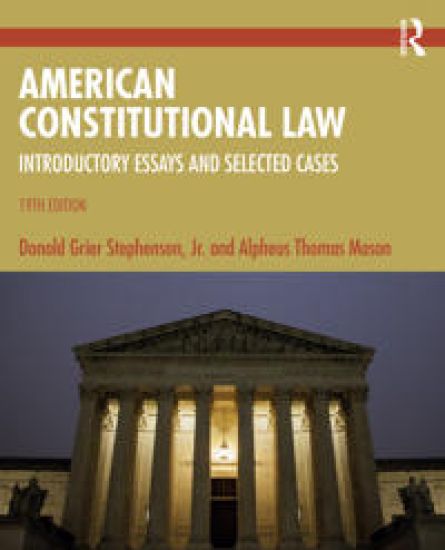
American Constitutional Law

American Constitutional Law

Donald Grier Stephenson Jr.; Alpheus Thomas Mason

TAYLOR FRANCIS LTD
2024
nidottu
This book is a collection of comprehensive background essays coupled with carefully edited Supreme Court case excerpts designed to explore constitutional law and the role of the Supreme Court in its development and interpretation. Well-grounded in both theory and politics, the book endeavors to heighten students’ understanding of this critical part of the American political system. NEW TO THE 19th EDITION• An account of the recent Supreme Court transitions, including the Biden Court commission, the appointment of Ketanji Brown Jackson, and the heightened political and ethical difficulties facing the Court. • Five new cases carefully edited and excerpted, including Minor v. Happersett (1875) on gender and voting rights, Trump v. Anderson (2024) on access to the ballot, Carson v. Makin (2022) on religious freedom, New York Rifle & Pistol Assn. v. Bruen (2023) on Second Amendment rights, Dobbs v. Jackson Women’s Health Organization (2023) on abortion rights, and Students for Fair Admissions, Inc. v. President and Fellows of Harvard College, together with Students for Fair Admissions, Inc. v. University of North Carolina on affirmative action. • Twenty-one new cases discussed in chapter essays. • Tips on reading a Supreme Court decision remains as a box in Chapter One.
American Constitutional Law

American Constitutional Law

Donald Grier Stephenson Jr.; Alpheus Thomas Mason

TAYLOR FRANCIS LTD
2024
sidottu
This book is a collection of comprehensive background essays coupled with carefully edited Supreme Court case excerpts designed to explore constitutional law and the role of the Supreme Court in its development and interpretation. Well-grounded in both theory and politics, the book endeavors to heighten students’ understanding of this critical part of the American political system. NEW TO THE 19th EDITION• An account of the recent Supreme Court transitions, including the Biden Court commission, the appointment of Ketanji Brown Jackson, and the heightened political and ethical difficulties facing the Court. • Five new cases carefully edited and excerpted, including Minor v. Happersett (1875) on gender and voting rights, Trump v. Anderson (2024) on access to the ballot, Carson v. Makin (2022) on religious freedom, New York Rifle & Pistol Assn. v. Bruen (2023) on Second Amendment rights, Dobbs v. Jackson Women’s Health Organization (2023) on abortion rights, and Students for Fair Admissions, Inc. v. President and Fellows of Harvard College, together with Students for Fair Admissions, Inc. v. University of North Carolina on affirmative action. • Twenty-one new cases discussed in chapter essays. • Tips on reading a Supreme Court decision remains as a box in Chapter One.
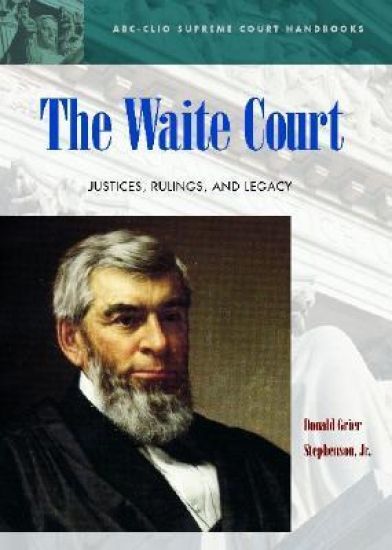
The Waite Court

The Waite Court

Donald Grier Stephenson

ABC-CLIO
2003
sidottu
An extensive exploration of the major decisions and personalities of the Supreme Court during the 14-year tenure of Chief Justice Morrison Remick Waite.The Waite Court: Justices, Rulings, and Legacy presents a fresh interpretation of the Supreme Court under the tenure of Chief Justice Morrison Remick Waite (1874–1888). An in-depth analysis of key decisions demonstrates how the Waite Court confronted such profound issues as the post-Civil War rights of African Americans and state regulations intended to cope with rampant industrialization.Highlighting the Court's most famous decision, Munn v. Illinois, which upheld legislation regulating railroad and grain elevator rates, this careful analysis also reviews the Court's unique involvement in the 1876 presidential election electoral predicament. Profiles of the 15 justices who served on the Waite Court include extensive descriptions of the five that rank among the most outstanding justices ever to serve on the Supreme Court.A–Z entries on key people, laws, cases, events, and concepts that were relevant during the Waite Court era, including the growing volume of state economic regulations enacted to cope with industrial expansion and urban growth fueled by the Civil War and by a nationwide rail network for people and goodsAn appendix including a timeline of important events for the years 1865 through 1890, plus excerpts from other important source materials, such as landmark decisions of the Waite Court
American Constitutional Law

American Constitutional Law

Alpheus Thomas Mason; Donald Grier Stephenson

Routledge Member of the Taylor and Francis Group
2011
nidottu
Updated in its 16th edition, American Constitutional Law: Introductory Essays and Selected Cases is a classic collection of carefully selected and edited Supreme Court case excerpts and comprehensive background essays that explores constitutional law and the role of the Supreme Court in its development and interpretation. Well-grounded in both theory and politics, it endeavors to heighten understanding of and interest in these critical areas of our governmental system.
Toxic Tales: A Caustic Collection of Donald J. Trump's Very Important Letters
After crashing his way to the presidency with the subtlety of a sledgehammer, Donald J. Trump was now faced with tackling the most important job stretched out before him during the next four years: proving he was indeed magnificent. There had to be a way for this great and powerful titan of titans to separate himself from the rest and exhibit how a man's man, a genuine hero, and an off-the-charts genius carried himself. So incorporating the masterful skills he honed as a razor-sharp orator along 2016's brutal Campaign Trail of Fears, he decided he would write letters, and not just any letters. No, these would be positively stuffed with powerful, masterful prose and Jeffersonian in weight. They would be Very Important Letters. Armed with only a nuclear-powered typewriter, the vocabulary of a true giant and a yet unseen command of centuries and centuries of history and perspective, the very important man wrote his very important letters to chronicle his very important, if not very improbable, presidency.
Phase-Locked Loops for Wireless Communications
Phase-Locked Loops for Wireless Communications: Digitial, Analog and Optical Implementations, Second Edition presents a complete tutorial of phase-locked loops from analog implementations to digital and optical designs. The text establishes a thorough foundation of continuous-time analysis techniques and maintains a consistent notation as discrete-time and non-uniform sampling are presented. New to this edition is a complete treatment of charge pumps and the complementary sequential phase detector. Another important change is the increased use of MATLAB®, implemented to provide more familiar graphics and reader-derived phase-locked loop simulation. Frequency synthesizers and digital divider analysis/techniques have been added to this second edition. Perhaps most distinctive is the chapter on optical phase-locked loops that begins with sections discussing components such as lasers and photodetectors and finishing with homodyne and heterodyne loops. Starting with a historical overview, presenting analog, digital, and optical PLLs, discussing phase noise analysis, and including circuits/algorithms for data synchronization, this volume contains new techniques being used in this field. Highlights of the Second Edition: Development of phase-locked loops from analog to digital and optical, with consistent notation throughout; Expanded coverage of the loop filters used to design second and third order PLLs; Design examples on delay-locked loops used to synchronize circuits on CPUs and ASICS; New material on digital dividers that dominate a frequency synthesizer's noise floor. Techniques to analytically estimate the phase noise of a divider; Presentation of optical phase-locked loops with primers on the optical components and fundamentals of optical mixing; Section on automatic frequency control to provide frequency-locking of the lasers instead ofphase-locking; Presentation of charge pumps, counters, and delay-locked loops. The Second Edition includes the essential topics needed by wireless, optics, and the traditional phase-locked loop specialists to design circuits and software algorithms. All of the material has been updated throughout the book.
Phase-locked Loops for Wireless Communications

Phase-locked Loops for Wireless Communications

Donald R. Stephens

Kluwer Academic Publishers
1998
sidottu
This is a contemporary reference work on phase-locked loops for wireless communications engineers. The coverage is comprehensive and includes summary chapters on the circuit theory needed to explain the theory and operation of phase-locked loops and the supporting mathematics necessary for analysis. These include concise discussions of Laplace transformations, z-Transformations, root locus, Bode analysis, partial fraction expansion, and others. The material develops systematically from analog through digital loops. Included is broad coverage of synchronization methods and techniques, modern digital interpolation techniques in modem design, modem acquisition and tracking, fading channel performances, as well as practical rules-of-thumb for modem designers to use in specifying loop bandwidths for good performances. The book provides numerous real world applications, and each chapter has problem sets that reinforce important concepts presented. "Phase-Locked Loops for Wireless Communications: Digital and Analog Implementations" features a complete collection of topics needed by both the wireless and traditional phase-locked loop specialist to design and analyze high performance circuits and software algorithms.
Phase-Locked Loops for Wireless Communications

Phase-Locked Loops for Wireless Communications

Donald R. Stephens

Springer-Verlag New York Inc.
2012
nidottu
This book is intended for the graduate or advanced undergraduate engineer. The primary motivation for writing the text was to present a complete tutorial of phase-locked loops with a consistent notation. As such, it can serve as a textbook in formal classroom instruction, or as a self-study guide for the practicing engineer. A former colleague, Kevin Kreitzer, had suggested that I write a text, with an emphasis on digital phase-locked loops. As modem designers, we were continually receiving requests from other engineers asking for a definitive reference on digital phase-locked loops. There are several good papers in the literature, but there was not a good textbook for either classroom or self-paced study. From my own experience in designing low­ phase noise synthesizers, I also knew that third-order analog loop design was omitted from most texts. With those requirements, the material in the text seemed to flow naturally. Chapter 1 is the early history of phase-locked loops. I believe that historical knowledge can provide insight to the development and progress of a field, and phase-locked loops are no exception. As discussed in Chapter 1, consumer electronics (color television) prompted a rapid growth in phase-locked loop theory and applications, much like the wireless communications growth today. xiv Preface Although all-analog phase-locked loops are becoming rare, the continuous­ time nature of analog loops allows a good introduction to phase-locked loop theory.
Phase-Locked Loops for Wireless Communications

Phase-Locked Loops for Wireless Communications

Donald R. Stephens

Springer-Verlag New York Inc.
2013
nidottu
Phase-Locked Loops for Wireless Communications: Digitial, Analog and Optical Implementations, Second Edition presents a complete tutorial of phase-locked loops from analog implementations to digital and optical designs. The text establishes a thorough foundation of continuous-time analysis techniques and maintains a consistent notation as discrete-time and non-uniform sampling are presented. New to this edition is a complete treatment of charge pumps and the complementary sequential phase detector. Another important change is the increased use of MATLAB®, implemented to provide more familiar graphics and reader-derived phase-locked loop simulation. Frequency synthesizers and digital divider analysis/techniques have been added to this second edition. Perhaps most distinctive is the chapter on optical phase-locked loops that begins with sections discussing components such as lasers and photodetectors and finishing with homodyne and heterodyne loops. Starting with a historical overview, presenting analog, digital, and optical PLLs, discussing phase noise analysis, and including circuits/algorithms for data synchronization, this volume contains new techniques being used in this field. Highlights of the Second Edition: Development of phase-locked loops from analog to digital and optical, with consistent notation throughout; Expanded coverage of the loop filters used to design second and third order PLLs; Design examples on delay-locked loops used to synchronize circuits on CPUs and ASICS; New material on digital dividers that dominate a frequency synthesizer's noise floor. Techniques to analytically estimate the phase noise of a divider; Presentation of optical phase-locked loops with primers on the optical components and fundamentals of optical mixing; Section on automatic frequency control to provide frequency-locking of the lasers instead ofphase-locking; Presentation of charge pumps, counters, and delay-locked loops. The Second Edition includes the essential topics needed by wireless, optics, and the traditional phase-locked loop specialists to design circuits and software algorithms. All of the material has been updated throughout the book.