Kirjahaku
Etsi kirjoja tekijän nimen, kirjan nimen tai ISBN:n perusteella.
1000 tulosta hakusanalla Edward Carson

Edward Carson, Baron Carson
OmniScriptum
2026
pokkari

in the poem / of the world / there once / was a map / of the map / composed in / the likeness / of a poemIn this riddling and seeking book of poems, Edward Carson navigates the emotional, often contradictory intelligence of the heart and mind. In three interrelated segments, whereabouts powerfully charts the tight emotional spaces between thinking and language, beauty and perception, love and the polemics of self and other.Taking on cartographic distortions and dynamics of the map metaphor, "thereabouts (or the mapmaker's dilemma)" playfully confronts the quandaries of personal navigation when the wants and needs of the esemplastic mind are forever devising new places to be. Exploring the brain, its neurons, and serpentine synaptic connections, "hereabouts (in fourteen scans)" advances a poetry of rhizomic communication capturing networks of thought and feeling that spring from both conflict and caress. Within a relationship's countless masquerades and revelations, "whereabouts (the lovers' discourse)" invites the reader to eavesdrop on a series of intimate conversations wherein lovers argue and act out their richly populated inner lives, addressing issues of gender, pleasure, communication, control, and sex.

the body / knows what / it truly / wants yet / the mind / wavers allIn Edward Carson’s provocative new work, the poetic moving parts of movingparts confront and breathe new life into what’s true and what’s not in Aesop’s fable "The Fox and the Crow," as well as the shifting, often fragmentary ground between what’s said and what’s not about identity and intimacy in Sappho’s lyrics.Reflecting the moment-to-moment ways our minds think, these poems take us from a creative process of disconnection and reassembly to a sonic pacing of words arising out of their stillness on the page. A flair for syntactical compression is found throughout, balanced by a capricious yet transforming diction, what John Ashbery described as seeking to stretch “the bond between language and communication.” Calling witness to the narratives of history while pivoting their reach forward to the present, the rhythms, allusions, and resulting outcomes of Carson’s use of language expand both narrative and discovery. movingparts is brought full circle when an unexpected historical connection between Sappho and Aesop is revealed, hinting that what is true or false in the past or present of our lives can arrive at an intimacy with and illumination of more than we imagine.

The poet Charles Simic wrote, “Short poems: be brief and tell us everything.”Edward Carson’s extraordinary new work gathers concise diptych – or twofold – poems exploring themes of love, relationships, myth, art, language, math, physics, geometry, and artificial intelligence. Within the two sections of twofold, “dialogues” and “binaries,” the form of the diptych shapes language and meaning as paired poems engage each other across the margins of facing pages. Caroline Bem, author of A Moveable Form, writes: “The diptych, you see, is beautiful. It is symmetry and difference, doubling and mirroring, binarism and seriality. It is the form of paradox, both open and closed, free and contained.”Negotiating surprising twinning combinations, comparisons, and outcomes, the poems in twofold are lively, thought-provoking, and playful interchanges that are also mischievously literate, questioning, and intuitive.
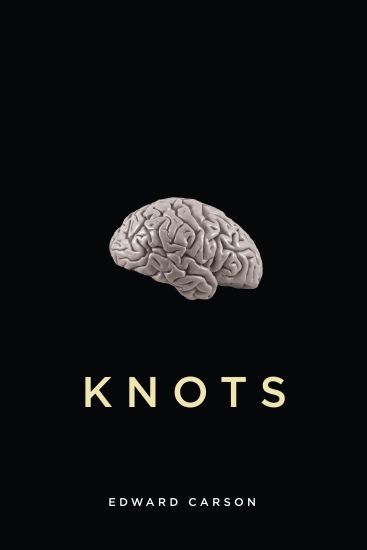
The mind is made / of pleasures and / uncertainty, inviting / as it yearns to be both / puzzle and adversity Full of philosophical digressions, questions, and answers, Knots forms a series of cyclical narrations, a kind of verbal asymmetry or mathematician's knot, continuously mirroring its ideas and subject matter in a play of language and contrasting points of view. "Flight of the Mind & Measure of the Stars" sets an itinerary and series of proposed directions for the book, its poems introducing the mind in action, laying down themes of art and memory, reason and belief, intimacy and desire. The final sections are composed of verses that can also be read as parts of two longer, interconnected poems. "The Occupied Mind" enticingly pulls us deeper into philosophical questions and answers about the needs of the mind and the ambiguities of love. The central conceit of "Minutes" offers sixty meditations that are both a measure of time and testimony, as well as a witnessing and confession of what takes place within a changing relationship. Confronting the riddles and dualities of mind and heart, Knots provokes a layered interplay of reason, paradox, code, and cipher from our daily thinking and feeling. Actively engaging with the spoken strategies of thought, the nature of art, and our always unpredictable, evolving experience of love, we quickly discover the mind and heart are rarely what we expect.
an orientation of thought in thinking how a / thought begins and then travels on to arrive / at another place connected and like-minded A work of art is never entirely present in itself but rather is always at large in the mind of the viewer. So it is that a painting needs to know the simplest question those viewing it are asking themselves. From the intimate starting point of observer and observed, Carson's seductive, exhilarating new collection turns poetry and paintings, making and representation, language and thought on their heads.
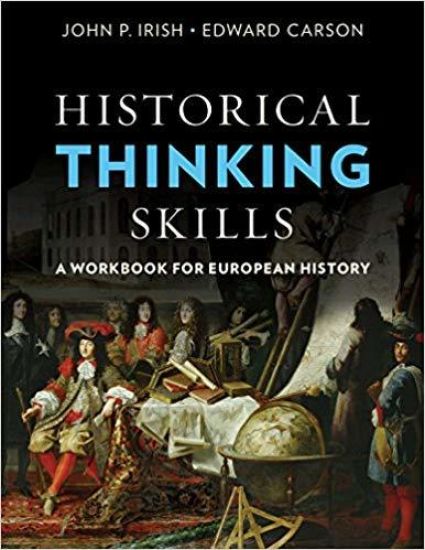
Nine types of graphic organizers help students hone the skills essential for success in the course, including cause and effect, chronological reasoning, comparison, contextualization, continuity and change over time, defining the period, historical argument and turning points.

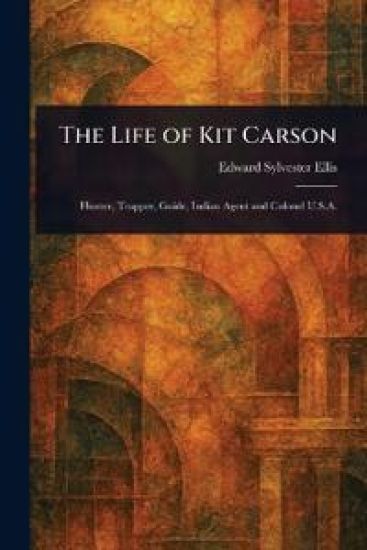
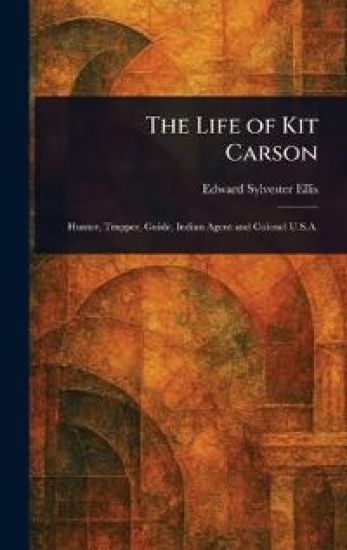
The life of Kit Carson, hunter, trapper, guide, Indian agent, and colonel U.S.A. By: Edward Sylvester Ellis (Original Version)
Edward Sylvester Ellis
Createspace Independent Publishing Platform
2016
nidottu
Edward Sylvester Ellis (April 11, 1840 - June 20, 1916) was an American author who was born in Ohio and died at Cliff Island, Maine. Ellis was a teacher, school administrator, journalist, and the author of hundreds of books and magazine articlesthat he produced by his name and by a number of noms de plume. Notable fiction stories by Ellis include The Steam Man of the Prairies and Seth Jones, or the Captives of the Frontier.Internationally, Edward S. Ellis is probably known best for his Deerfoot novels read widely by young boys until the 1950s Seth Jones was the most significant of early dime novels of publishers Beadle and Adams. During the mid-1880s, after a fiction-writing career of some thirty years, Ellis eventually began composing more serious works of biography, history, and persuasive writing. Of note was "The Life of Colonel David Crockett", which had the story of Davy Crockett giving a speech usually called "Not Yours To Give". It was a speech in opposition to awarding money to a Navy widow on the grounds that Congress had no Constitutional mandate to give charity. It was said to have been inspired by Crockett's meeting with a Horatio Bunce, a much quoted man in Libertarian circles, but one for whom historical evidence is non-existent. It is said that Seth Jones was one of Abraham Lincoln's favorite stories

Sustainability and the American Naturalist Tradi – Revisiting Henry David Thoreau, Aldo Leopold, Rachel Carson, and Edward O. Wilson
Craig Thomas
Transcript Verlag
2021
nidottu
Humanity is failing at solving complex socio-ecological problems like global climate change, biodiversity loss and population growth. The existing 'sustainable development' paradigm and its reliance on trade-offs between the three pillars of environment, economics, and equity is not robust enough to maintain global carrying capacity. In this timely intervention, Thomas argues that the holistic and transdisciplinary thinking of four iconic American naturalists – Henry David Thoreau, Aldo Leopold, Rachel Carson, and Edward O. Wilson – can instead help to solve our biggest twenty-first century challenges by synthesizing values from four eras of cultural and environmental history.

This work has been selected by scholars as being culturally important, and is part of the knowledge base of civilization as we know it. This work was reproduced from the original artifact, and remains as true to the original work as possible. Therefore, you will see the original copyright references, library stamps (as most of these works have been housed in our most important libraries around the world), and other notations in the work.This work is in the public domain in the United States of America, and possibly other nations. Within the United States, you may freely copy and distribute this work, as no entity (individual or corporate) has a copyright on the body of the work.As a reproduction of a historical artifact, this work may contain missing or blurred pages, poor pictures, errant marks, etc. Scholars believe, and we concur, that this work is important enough to be preserved, reproduced, and made generally available to the public. We appreciate your support of the preservation process, and thank you for being an important part of keeping this knowledge alive and relevant.