

Kirjahaku
Etsi kirjoja tekijän nimen, kirjan nimen tai ISBN:n perusteella.
1000 tulosta hakusanalla Edwin H 1905-2001 Colbert

Edwin H. Sutherland is widely identified as the single most important and influential criminologist of the twentieth century. He is especially well-known for his path-breaking criminology textbook (first published in 1924), his promotion of a sociological (and scientific) approach to the understanding of crime and its control, his theory of differential association, and his work over his final ten years on white-collar crime, a term he is credited with having introduced. This book explores the contemporary meaning of Edwin Sutherland and considers why criminologists today should continue to engage with his work. What can and should Sutherland mean to future 21st century criminologists, those working in the field say between 2021 and 2050, or some one hundred years after the 1921 to 1950 period that encompassed Sutherland’s criminological career? Which dimensions of Sutherland’s work have best survived the march of time and which are most likely to – and deserve to – survive going forward?Making the case that Sutherland is important to both mainstream and critical criminologists, to positivistic criminologists and those who study crimes of the powerful, this book is essential reading for both students and scholars interested in exploring the enduring legacy of this key thinker in criminology.
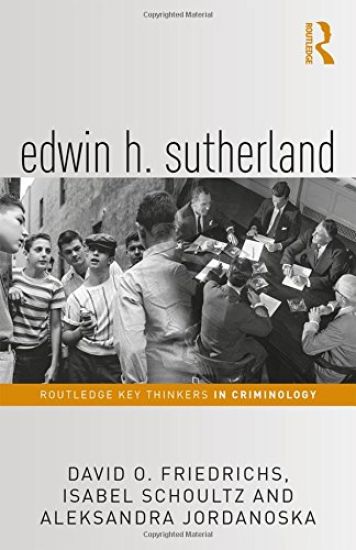
Edwin H. Sutherland is widely identified as the single most important and influential criminologist of the twentieth century. He is especially well-known for his path-breaking criminology textbook (first published in 1924), his promotion of a sociological (and scientific) approach to the understanding of crime and its control, his theory of differential association, and his work over his final ten years on white-collar crime, a term he is credited with having introduced. This book explores the contemporary meaning of Edwin Sutherland and considers why criminologists today should continue to engage with his work. What can and should Sutherland mean to future 21st century criminologists, those working in the field say between 2021 and 2050, or some one hundred years after the 1921 to 1950 period that encompassed Sutherland’s criminological career? Which dimensions of Sutherland’s work have best survived the march of time and which are most likely to – and deserve to – survive going forward?Making the case that Sutherland is important to both mainstream and critical criminologists, to positivistic criminologists and those who study crimes of the powerful, this book is essential reading for both students and scholars interested in exploring the enduring legacy of this key thinker in criminology.

Land Values in New York in Relation to Transit Facilities / by Edwin H. Spengler.
Edwin H (Edwin Harold) Spengler
University of Michigan Library
2006
pokkari


Reprint of the original, first published in 1883.

Reprint of the original, first published in 1883.


Life of Edwin H. Chapin, D.D.
Antigonos Verlag
2025
sidottu


Life of Edwin H. Chapin
Antigonos Verlag
2025
sidottu

Fall of an Icon: Polaroid after Edwin H. Land: An Insider's View of the Once Great Company
Milton P. Dentch
Riverhaven Books
2012
nidottu

Land Values in New York in Relation to Transit Facilities
Edwin H. Spengler
Columbia University Press
2022
sidottu
Presents evidence to support a thesis that there is much crime in the upper socio-economic classes and only the administrative procedures, used to deal with it, separate it from other animal behavior


This first volume in a two-volume biography of William Dean Howells is the story of a series of intermingling lines of growth: the growth of admirable personality, the growth of a great career in letters, the growth of a penetrating mind, of a major command of literary art, of an influence of predominant importance to an age and to its legacy to the present. Because the importance of Howells' life lies in his novels, close attention is paid to his principal writings.