Kirjojen hintavertailu. Mukana 11 244 527 kirjaa ja 12 kauppaa.

Kirjahaku

Etsi kirjoja tekijän nimen, kirjan nimen tai ISBN:n perusteella.

1000 tulosta hakusanalla Edwin L. Drake

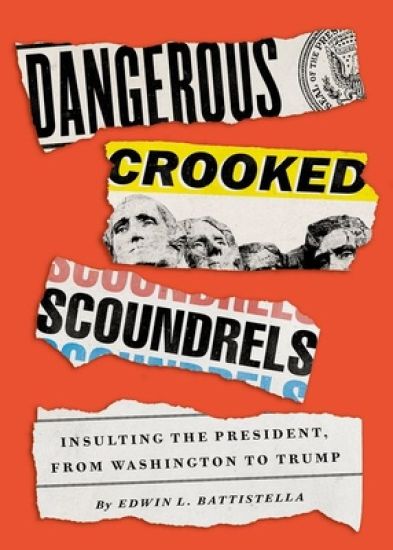
Dangerous Crooked Scoundrels

Dangerous Crooked Scoundrels

Edwin L. Battistella

Oxford University Press Inc
2020
sidottu
Insulting the president is an American tradition. From Washington to Trump, presidents have been called "lazy," "feeble," "pusillanimous," and more. Our leaders have been derided as "ignoramuses," "idiots," "morons," and "fatheads," and have been compared to all manner of animals--worms and whales and hyenas, sad jellyfish, strutting crows, lap dogs, reptiles, and monkeys. Political insults tell us what we value in our leaders by showing how we devalue them. In Dangerous Crooked Scoundrels, linguist Edwin Battistella collects over five hundred insults aimed at American presidents. Covering the broad sweep of American history, he puts insults in their place-the political and cultural context of their times. Along the way, Battistella illustrates the recurring themes of political insults: too little intellect or too much, inconsistency or obstinacy, worthlessness, weakness, dishonesty, sexual impropriety, appearance, and more. The kinds of insults we use suggest what our culture finds most hurtful, and reveal society's changing prejudices as well as its most enduring ones. How we insult presidents and how they react tells us about the presidents, but it also tells us about our nation's politics. Readers discover how the style of insults evolves in different historical periods: gone are "apostate," "mountebank," "flathead," and "doughface." Say hello to "moron," "jerk," "asshole," and "flip-flopper." Dangerous Crooked Scoundrels covers the broad sweep of American history, from the founder's debates over the nature of government to world wars and culture wars and social media. Whatever your politics, you'll find Dangerous Crooked Scoundrels an invaluable source of invigorating invective-and a healthy perspective on today's political climate.
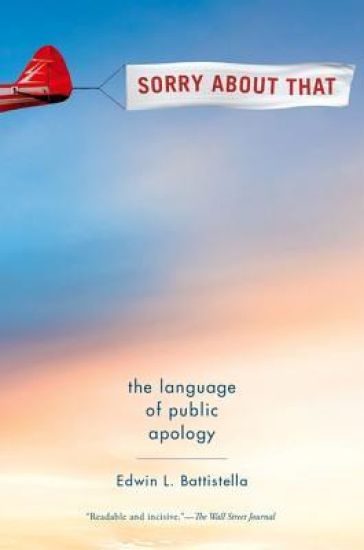
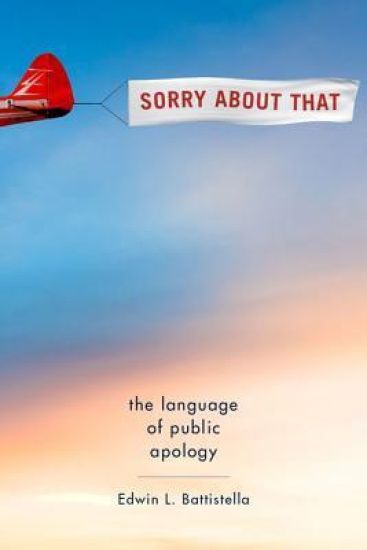
Sorry About That

Sorry About That

Edwin L. Battistella

Oxford University Press Inc
2016
nidottu
People do bad things. They misspeak, mislead, and misbehave. They lie, cheat, steal, and kill. Often, afterward, they apologize. But what makes a successful apology? Why does Joe Biden's 2007 apology for referring to Barack Obama as "articulate and bright" succeed, whereas Mel Gibson's 2006 apology for his anti-Semitic tirade fails? Naturally, the effectiveness of an apology depends on the language used, as well as the conditions under which we offer our regrets. In Sorry About That, linguist Edwin Battistella analyzes the public apologies of presidents, politicians, entertainers, and businessmen, situating the apology within American popular culture. Battistella offers the fascinating stories behind these apologies alongside his own analysis of the language used in each. He uses these examples to demonstrate the ways in which language creates sincere or insincere apologies, why we choose to apologize or don't, and how our efforts to say we are sorry succeed or fail. Each chapter expands on a central concept or distinction that explains part of the apology process. Battistella covers over fifty memorable apologies from McDonald's, Martha Stewart, Oprah Winfrey, Jane Fonda, Bill Clinton, and many more. Moving back and forth between examples and concepts, Battistella connects actual apologies with the broader social, ethical, and linguistic principles behind them. Readers will come away from the book better consumers of apologies - and better apologizers as well.
The Logic of Markedness

The Logic of Markedness

Edwin L. Battistella

Oxford University Press Inc
1997
sidottu
Theories of language espoused by linguists during much of this century have assumed that there is a hierarchy to the elements of language such that certain constructions, rules, and features are unmarked while others are marked; "play" for example, is unmarked or neutral, while "played" or "player" is marked. This opposition, referred to as markedness, is one of the concepts which both Chomskyan generative grammar and Jakobsonian structuralism appear to share, yet which each tradition has treated differently. Battistella studies the historical development of the concept of markedness in the Prague School structuralism of Roman Jakobson, its importation into generative linguistics, and its subsequent development within Chomsky's Principles and Parameters framework. He traces how structuralist and generative linguistics have drawn on and expanded the notion of markedness, both as a means of characterizing linguistic constructs and as a theory of the innate language faculty.
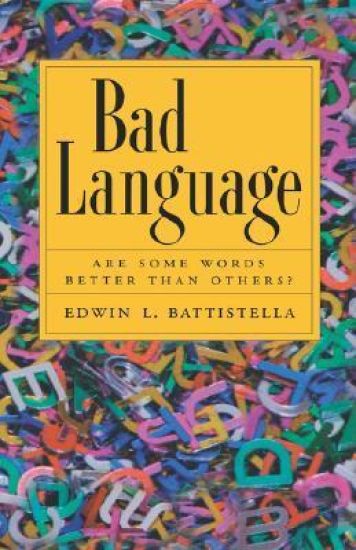
Bad Language

Bad Language

Edwin L. Battistella

Oxford University Press Inc
2005
sidottu
Is today's language at an all-time low? Are pronunciations like "cawfee" and "chawklit" bad English? Is slang like "my bad" or "hook up" improper? Is it incorrect to mix English and Spanish, as in "Yo quiero Taco Bell"? Can you write "Who do you trust?" rather than "Whom do you trust?" Linguist Edwin Battistella takes a hard look at traditional notions of bad language, arguing that they are often based in sterile conventionality. Examining grammar and style, cursing, slang, and political correctness, regional and ethnic dialects, and foreign accents and language mixing, Battistella discusses the strong feelings evoked by language variation, from objections to the pronunciation NU-cu-lar to complaints about bilingual education. He explains the natural desire for uniformity in writing and speaking and traces the association of mainstream norms to ideas about refinement, intelligence, education, character, national unity and political values. Battistella argues that none of these qualities is inherently connected to language. It is tempting but wrong, Battistella argues, to think of slang, dialects and nonstandard grammar as simply breaking the rules of good English. Instead, we should view language as made up of alternative forms of orderliness adopted by speakers depending on their purpose. Thus we can study the structure and context of nonstandard language in order to illuminate and enrich traditional forms of language, and make policy decisions based on an informed engagement. Re-examining longstanding and heated debates, Bad Language will appeal to a wide spectrum of readers engaged and interested in the debate over what constitutes "proper" language.
Bad Language

Bad Language

Edwin L. Battistella

Oxford University Press Inc
2007
nidottu
Is today's language at an all-time low? Edwin Battistella argues that it is wrong to think of slang, regional dialects and nonstandard grammar as simply breaking the rules of good English. Reexamining debates over relativism in language, Battistella argues that we should view language as made up of alternative forms of regularity and orderliness, which require informed engagement with usage.
Do You Make These Mistakes in English?

Do You Make These Mistakes in English?

Edwin L Basttistella

Oxford University Press Inc
2008
sidottu
In the early 1900s, the language of America was becoming colloquial Englishthe language of the businessman, manager, and professional. Since college and high school education were far from universal, many people turned to correspondence educationthat eras distance learningto learn the art of speaking and writing. By the 1920s and 1930s, thousands of Americans were sending coupons from newspapers and magazines to order Sherwin Codys 100% Self-correcting Course in the English Language, a patented mail-order course in English that was taken by over 150,000 people. Codys ubiquitous signature advertisement, which ran for over forty years, promised a scientifically-tested invention that improved speaking and writing in just 15 minutes a day. Codys ad explained that people are judged by their English, and he offered self-improvement and self-confidence through the mail. In this book, linguist Edwin Battistella tells the story of Sherwin Cody and his famous English course, situating both the man and the course in early twentieth century cultural history. The author shows how Cody became a businessmana writer, grammatical entrepreneur, and mass-marketer whose ads proclaimed Good Money in Good English and asked Is Good English Worth 25 Cents to You? His course, perhaps the most widely-advertised English education program in history, provides a unique window onto popular views of language and culture and their connection to American notions of success and failure. But Battistella shows Sherwin Cody was also part of a larger shift in attitudes. Using Codys course as a reference point, he also looks at the self-improvement ethic reflected in such courses and products as the Harvard Classics, The Book of Etiquette, the Book-of-the-Month Club, the U.S. School of Music, and the Charles Atlas and Dale Carnegie courses to illustrate how culture became popular and how self-reliance evolved into self-improvement.
Sorry About That

Sorry About That

Edwin L. Battistella

Oxford University Press Inc
2014
sidottu
People do bad things. They misspeak, mislead, and misbehave. They lie, cheat, steal, and kill. Often, afterward, they apologize. In Sorry About That, linguist Edwin Battistella analyzes the public apologies of presidents, politicians, entertainers, and businessmen, situating the apology within American popular culture. Battistella offers the fascinating stories behind these apologies alongside his own analysis of the language used in each. He uses these examples to demonstrate the ways in which language creates sincere or insincere apologies, why we choose to apologize or don't, and how our efforts to say we are sorry succeed or fail. Each chapter expands on a central concept or distinction that explains part of the apology process. Battistella covers memorable apologies from McDonald's and Martha Stewart, Oprah Winfrey and James Frey, Mel Gibson and Jane Fonda, Bill Clinton and Barack Obama, and many more. Moving back and forth between examples and concepts, Battistella connects actual apologies with the broader social, ethical, and linguistic principles behind them. Readers will come away from the book better consumers of apologies-and better apologizers as well.
The Allegheny Pilot

The Allegheny Pilot

Edwin L. Babbitt

Pennsylvania State University Press
2013
pokkari
The Allegheny Pilot, first published in 1855, is an early travel guide to western Pennsylvania’s rivers and navigable waterways, complete with detailed maps, notes, and charts. Originally written for lumber raftsmen and even considered to be the “Lumberman’s Bible,” it remains an important document on the original path of the Allegheny and its tributaries, which have since been changed by the construction of the Kinzua Dam and other man-made alterations to the landscape. The book benefits not only from Babbitt’s own knowledge, experience, and research on the Allegheny, but also from his having “spent much time in conversing with many of the oldest settlers along the river, collecting from them, orally, many historical facts besides those pertaining to the navigation of the river.” The Allegheny Pilot is a fascinating look at a transient historical landscape in a time when the beginnings of modern industrialization began to push westward across the state’s frontiers, irrevocably changing them.
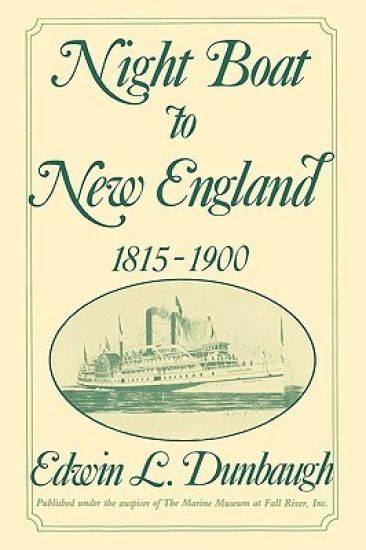
Night Boat to New England, 1815-1900

Night Boat to New England, 1815-1900

Edwin L. Dunbaugh

Praeger Publishers Inc
1992
sidottu
Taking the subject of much lore as the topic of his book, Dunbaugh has written a carefully researched, comprehensive history of the overnight steamboat on Long Island Sound. In the nineteenth century, these steamboats provided the major means of transportation from New York to ports in southern New England or from Boston north to ports on the coast of Maine. Earlier accounts have either focused on the lore or been heavy with statistical data. Dunbaugh here provides a readable narrative history based on solid research.The book's approach is chronological, discussing the early steamboat era, 1815-1835, in the first chapter and the feeder lines developing with the advent of the railroad in chapter 2. Chapter 3 covers the Vanderbilt era of the 1840s, while the next chapter turns to the Great Fall River Line, 1847-1854. Chapter 5 discusses the years from 1854 to 1861, a period of stability, and chapter 6 covers the Civil War years. Chapters on the era of Fisk and Gould and the Depression and Recovery of 1873-1880 follow. The final chapter covers the last decade of the independent lines and of the century. This volume will be of interest to historians specializing in the history of technology, business, or economic history--as well as to those interested in the history of steamboat transportation.
The Best Of Planet Stories

The Best Of Planet Stories

Edwin L Graber

Lulu.com
2018
pokkari
Journey Across the stars and universe with four classical science fiction tales to excite and inspire your Imagination. 1.....Flame-Jewel of the Ancients. The tiny golden sphere, blazed with terrible energy, and spelled doom for the Galactic Empire. 2.....The Rebel of Valkyr. From the dark ages of space emerged the second Empire ruled by a child, a usurper, and a fool. 3.....The Rocketeers have Shaggy Ears. Someday there will be a Legend, from steamy Venus or arid Mars, building a great glory the men of Terra will choke with pride. 4.....Witch of the Demon Seas. A black Galleon is guided back to the lost Citadel of Xanthi, A tale of Corun the condemned pirate of Conahur and his lover, the Demon Witch! Classical science fiction from the masters of the genre!
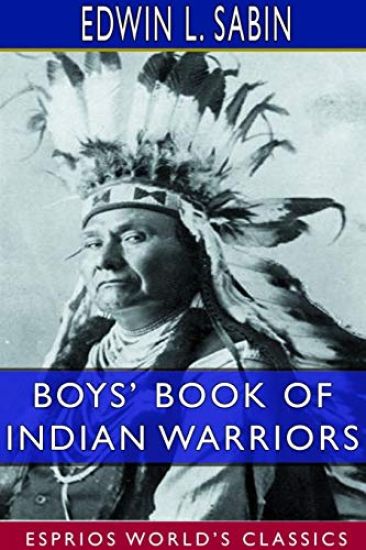
Boys' Book of Indian Warriors and Heroic Indian Women (Esprios Classics)
Edwin Legrand Sabin (December 23, 1870 - November 24, 1952) was an American author, primarily of boys' adventure stories, mostly set in the American West. Sabin graduated from Clinton High School in 1888. He attended the University of Iowa until his senior year in 1892, when he left to begin his career as a newspaper reporter. He returned to graduate with Phi Beta Kappa honors in 1900. At the University of Iowa, he was a member of Beta Theta Pi and the school's first rugby team. From 1913 to 1931 he published dozens of critically acclaimed adventure books about the American West and though aimed at an audience of boys, Sabin conducted copious research, even visiting institutions like the Bancroft Library and state historical societies and conducting interviews with people who had interacted with historical figures like Calamity Jane and George Armstrong Custer.
Lifecycle of a Technology Company

Lifecycle of a Technology Company

Edwin L. Miller

John Wiley Sons Inc
2008
sidottu
Praise for Lifecycle of a Technology Company "Lifecycle of a Technology Company is a comprehensive business and legal handbook for all but the most experienced technology entrepreneurs. I shared my copy with a few colleagues at MIT who have either started or are contemplating launching their own companies, and I had a real problem retrieving it. The data supports my opinion that this book will attain 'handbook' status on the desks of technology entrepreneurs." -Dr. George B. Kenney, Associate Director Materials Processing & Microphotonics Centers at MIT "This book will help entrepreneurs avoid the pitfalls on the long road to success for venture-backed technology companies. It distills a lifetime of experience in advising technology companies in a concise and understandable way." -Howard Berke, Serial Entrepreneur and Venture Capitalist "Lifecycle of a Technology Company provides a valuable resource for lawyers at a variety of experience levels. The junior lawyer will use this resource for the basics. More experienced lawyers with a broad practice will use this for a 'sanity check' relative to market terms and business rationale. In the trenches, it will assist lawyers by providing practical, plain speaking explanations for why things operate as they do in the finance, intellectual property, and merger & acquisition segments of the technology world. If you expect to represent technology clients, keep this book nearby." -James O'Hare, Partner Kirkpatrick & Lockhart Preston Gates Ellis, Boston