Kirjojen hintavertailu. Mukana 11 717 486 kirjaa ja 12 kauppaa.

Kirjahaku

Etsi kirjoja tekijän nimen, kirjan nimen tai ISBN:n perusteella.

1000 tulosta hakusanalla Erica Howard

Law and the Wearing of Religious Symbols in Europe
Written in accessible language, this book provides a comprehensive analysis of a topical subject that is being widely debated across Europe. The work presents an overview of emerging case law from the European Court of Human Rights and the Court of Justice of the European Union, as well as from national courts and equality bodies in European countries, on the wearing of religious symbols in public spaces. The author persuasively argues that bans on the wearing of religious symbols constitutes a breach of an individual’s human rights and contravene existing anti-discrimination legislation. Fully updated to take account of recent case law, this second edition has been expanded to consider bans in public spaces more generally, including employment, an area where some of the recent developments have taken place.
Freedom of Expression and Religious Hate Speech in Europe
In recent years, the Danish cartoons affair, the Charlie Hebdo murders and the terrorist attacks in Brussels and Paris have resulted in increasingly strident anti-Islamic speeches by politicians. This raises questions about the limits to freedom of expression and whether this freedom can and should be restricted to protect the religious feelings of believers. This book uses the case law of the European Court of Human Rights to provide a comprehensive analysis of the questions: whether legal prohibitions of religious hate speech violate the right to freedom of expression; and, whether such laws should be used to prosecute politicians and others who contribute to current debates when they use anti-Islam rhetoric. A well-known politician who uses such rhetoric is Dutch politician Geert Wilders. He has been prosecuted twice for hate speech, and was acquitted in the first case and recently convicted in the second. These prosecutions are used to illustrate the issues involved in drawing the line between freedom of expression and religious hate speech. The author argues that freedom of expression of politicians and those contributing to the public debate should not be restricted except in two very limited circumstances: when they incite to hatred or violence and there is an imminent danger that violence will follow or where it stops people from holding or manifesting their religion. Based on this, the author concludes that the European Court of Human Rights should decide, if it is asked to do so, that Wilders conviction for hate speech violates his freedom of expression.
The EU Race Directive

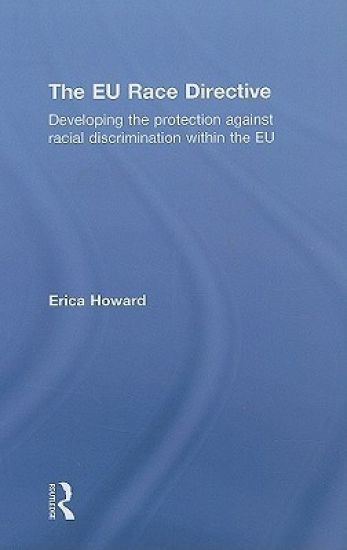
The EU Race Directive

Erica Howard

Routledge
2009
sidottu
In 2000, the European Union adopted a Directive against discrimination on the grounds of racial or ethnic origin. This book provides an in-depth evaluation of the Race Directive and its effects, questioning how successful the Race directive has been. The EU Race Directive discusses the history of the fight against racial discrimination in the EU and the equality clauses in international Human Rights instruments. It then examines the terms race, racism and racial discrimination and equality in the Directive. The book also looks at the concepts of equality which can be distinguished in the Race Directive and in the subsequent developments at EU level. Examining whether the Directive has improved the protection against racial or ethnic origin discrimination for people within the EU, the book concludes with an assessment of how far the EU has come on the road to racial equality with the adoption of the Race Directive and the subsequent developments. It also contains proposals for possible improvements. The comprehensive and up-to-date analysis in this book goes beyond most other books written on the subject and the specific focus on racism and racial discrimination means a more thorough examination than most texts focusing on discrimination on a larger number of grounds.This book will be of great value to students and academics in (European) law, social sciences and human rights, researching racism, racial discrimination, ethnicity and race relations. It will also be useful for policy makers.
The EU Race Directive

The EU Race Directive

Erica Howard

Routledge
2012
nidottu
In 2000, the European Union adopted a Directive against discrimination on the grounds of racial or ethnic origin. This book provides an in-depth evaluation of the Race Directive and its effects, questioning how successful the Race directive has been. The EU Race Directive discusses the history of the fight against racial discrimination in the EU and the equality clauses in international Human Rights instruments. It then examines the terms race, racism and racial discrimination and equality in the Directive. The book also looks at the concepts of equality which can be distinguished in the Race Directive and in the subsequent developments at EU level. Examining whether the Directive has improved the protection against racial or ethnic origin discrimination for people within the EU, the book concludes with an assessment of how far the EU has come on the road to racial equality with the adoption of the Race Directive and the subsequent developments. It also contains proposals for possible improvements. The comprehensive and up-to-date analysis in this book goes beyond most other books written on the subject and the specific focus on racism and racial discrimination means a more thorough examination than most texts focusing on discrimination on a larger number of grounds.This book will be of great value to students and academics in (European) law, social sciences and human rights, researching racism, racial discrimination, ethnicity and race relations. It will also be useful for policy makers.
Law and the Wearing of Religious Symbols in Europe
Written in accessible language, this book provides a comprehensive analysis of a topical subject that is being widely debated across Europe. The work presents an overview of emerging case law from the European Court of Human Rights and the Court of Justice of the European Union, as well as from national courts and equality bodies in European countries, on the wearing of religious symbols in public spaces. The author persuasively argues that bans on the wearing of religious symbols constitutes a breach of an individual’s human rights and contravene existing anti-discrimination legislation. Fully updated to take account of recent case law, this second edition has been expanded to consider bans in public spaces more generally, including employment, an area where some of the recent developments have taken place.
Headscarves and the Court of Justice of the European Union
This book contains an in-depth examination of the Islamic headscarf cases of the Court of Justice of the European Union (CJEU) and places these against the background of the Islamophobia existing across Europe. It assesses how EU law can best protect women who want to wear headscarves at work for religious reasons and why this protection is important not only for the women themselves but also for the EU, taking into account its values as laid down in the Treaties, the Charter of Fundamental Rights of the EU and in the anti-discrimination Directives. It puts forward arguments for a finding that workplace neutrality bans constitute direct religion or belief discrimination and examines the way that the justification test for indirect discrimination has been applied by the CJEU. The work suggests that such bans could be more successfully challenged as gender and/or racial or ethnic origin discrimination, because the protection against these forms of discrimination is stronger. It also suggests that a claim for intersectional discrimination – on the grounds of gender, racial and ethnic origin, and religion or belief – should be possible in EU anti-discrimination law. The book will be of interest to academics, researchers and policy-makers working in the areas of equality and non-discrimination law, EU law and law and religion.
Headscarves and the Court of Justice of the European Union
This book contains an in-depth examination of the Islamic headscarf cases of the Court of Justice of the European Union (CJEU) and places these against the background of the Islamophobia existing across Europe. It assesses how EU law can best protect women who want to wear headscarves at work for religious reasons and why this protection is important not only for the women themselves but also for the EU, taking into account its values as laid down in the Treaties, the Charter of Fundamental Rights of the EU and in the anti-discrimination Directives. It puts forward arguments for a finding that workplace neutrality bans constitute direct religion or belief discrimination and examines the way that the justification test for indirect discrimination has been applied by the CJEU. The work suggests that such bans could be more successfully challenged as gender and/or racial or ethnic origin discrimination, because the protection against these forms of discrimination is stronger. It also suggests that a claim for intersectional discrimination – on the grounds of gender, racial and ethnic origin, and religion or belief – should be possible in EU anti-discrimination law. The book will be of interest to academics, researchers and policy-makers working in the areas of equality and non-discrimination law, EU law and law and religion.
Freedom of Expression and Religious Hate Speech in Europe
In recent years, the Danish cartoons affair, the Charlie Hebdo murders and the terrorist attacks in Brussels and Paris have resulted in increasingly strident anti-Islamic speeches by politicians. This raises questions about the limits to freedom of expression and whether this freedom can and should be restricted to protect the religious feelings of believers. This book uses the case law of the European Court of Human Rights to provide a comprehensive analysis of the questions: whether legal prohibitions of religious hate speech violate the right to freedom of expression; and, whether such laws should be used to prosecute politicians and others who contribute to current debates when they use anti-Islam rhetoric. A well-known politician who uses such rhetoric is Dutch politician Geert Wilders. He has been prosecuted twice for hate speech, and was acquitted in the first case and recently convicted in the second. These prosecutions are used to illustrate the issues involved in drawing the line between freedom of expression and religious hate speech. The author argues that freedom of expression of politicians and those contributing to the public debate should not be restricted except in two very limited circumstances: when they incite to hatred or violence and there is an imminent danger that violence will follow or where it stops people from holding or manifesting their religion. Based on this, the author concludes that the European Court of Human Rights should decide, if it is asked to do so, that Wilders conviction for hate speech violates his freedom of expression.
Taliban Beach Party

Taliban Beach Party

Eric Howard

Turtle Point Press
2017
pokkari
"As adept working with the sonnet and sestina as with loose-fitting lines, Howard produces poems of great immediacy that stir with emotional depth. . . . [His] vision of our post-9/11 culture is offbeat, yet 'wisdomtight.'"—David Trinidad Eric Howard’s debut poetry collection reveals the secrets that bind office work to war, Gidget to the damned, the Bible to popular song, mythology to fact, and Los Angeles to Ovid. On a bicycle ride through heavy traffic, it versifies the last days of a failed pimp, gives a tarot reading to warplanes, and deciphers the hieroglyphics of lost empire.Eric Howard is an LA-based poet and editor. His work has appeared in the Birmingham Poetry Review, Caveat Lector, Conduit, Gulf Stream Magazine, Hawaii Pacific Review, Plainsong, The Sun, and in the anthology Wide Awake: Poets of Los Angeles and Beyond.
Eliminating Serious Injury and Death from Road Transport

Eliminating Serious Injury and Death from Road Transport

Ian Ronald Johnston; Carlyn Muir; Eric William Howard

CRC Press
2017
nidottu
Listen: Ian Johnston busts the bad behavior myth.Should we really accept road trauma as collateral damage from daily road use? Eliminating Serious Injury and Death from Road Transport: A Crisis of Complacency explores why societies and their elected leaders view traffic safety as a (relatively) minor problem. It examines the changes in the culture of road use that need to occur if this public health problem is to be effectively resolved. Examines why road use culture is ego-centric ("what’s in it for me?") and why this blocks progressExplores current traffic safety measurement methods and demonstrates how they have underpinned our flawed approachDiscusses the controversial issue of speed and speeding and shows how a new approach to speed management will be fundamental to transformational change Details a simple account of the concept of a "Safe System" (as now promoted by the WHO and the OECD) while exploring the failure to get beyond the principles to extensive implementation The book dispels the myths that currently drive societies’ (misguided) view of traffic safety—the bad behavior myth and the official myth that everything that can be done is being done—and how these myths limit progress in reducing death and serious injury. It presents current scientific knowledge and draws parallels with other areas of public safety and health. The book draws on examples from the media and from public policy debates to paint a clear picture of a flawed public policy approach. It presents a model for a preventive medicine approach to traffic safety policy to get beyond an ego-centric culture to a communal safety culture.
Eliminating Serious Injury and Death from Road Transport

Eliminating Serious Injury and Death from Road Transport

Ian Ronald Johnston; Carlyn Muir; Eric William Howard

Apple Academic Press Inc.
2013
sidottu
Listen: Ian Johnston busts the bad behavior myth.Should we really accept road trauma as collateral damage from daily road use? Eliminating Serious Injury and Death from Road Transport: A Crisis of Complacency explores why societies and their elected leaders view traffic safety as a (relatively) minor problem. It examines the changes in the culture of road use that need to occur if this public health problem is to be effectively resolved. Examines why road use culture is ego-centric ("what’s in it for me?") and why this blocks progressExplores current traffic safety measurement methods and demonstrates how they have underpinned our flawed approachDiscusses the controversial issue of speed and speeding and shows how a new approach to speed management will be fundamental to transformational change Details a simple account of the concept of a "Safe System" (as now promoted by the WHO and the OECD) while exploring the failure to get beyond the principles to extensive implementation The book dispels the myths that currently drive societies’ (misguided) view of traffic safety—the bad behavior myth and the official myth that everything that can be done is being done—and how these myths limit progress in reducing death and serious injury. It presents current scientific knowledge and draws parallels with other areas of public safety and health. The book draws on examples from the media and from public policy debates to paint a clear picture of a flawed public policy approach. It presents a model for a preventive medicine approach to traffic safety policy to get beyond an ego-centric culture to a communal safety culture.
Howard E. Spain Correspondence, 1957-1974

Howard E. Spain Correspondence, 1957-1974

Eric P Newman

Hassell Street Press
2021
nidottu
This work has been selected by scholars as being culturally important and is part of the knowledge base of civilization as we know it.This work is in the public domain in the United States of America, and possibly other nations. Within the United States, you may freely copy and distribute this work, as no entity (individual or corporate) has a copyright on the body of the work.Scholars believe, and we concur, that this work is important enough to be preserved, reproduced, and made generally available to the public. To ensure a quality reading experience, this work has been proofread and republished using a format that seamlessly blends the original graphical elements with text in an easy-to-read typeface.We appreciate your support of the preservation process, and thank you for being an important part of keeping this knowledge alive and relevant.
Howard's Gift

Howard's Gift

Eric Sinoway; Merrill Meadow

St. Martin's Griffin
2013
pokkari
"A timeless classic . . . This is a book of head and heart, of wisdom and emotion . . . "Tuesdays with Morrie" meets "What Color is Your Parachute"?" -Mindy Grossman, CEO of HSNiWith forty years at Harvard Business School, Howard Stevenson is renowned as an entrepreneur and business strategist, author, philanthropist, and professor. He has mentored more than ten thousand business founders, CEOs, professionals, and top business school faculty around the world. Written by his student and successful entrepreneur Eric Sinoway, "Howard's Gift "offers Stevenson's timeless lessons on life and career. Full of personal and professional insight, this guide presents savvy practical strategies that can be applied to professional decisions on any scale. Through warm and engaging conversations with Sinoway, Stevenson focuses not just on business success, but on deep personal satisfaction through self-defined benchmarks for development and accomplishment. Stevenson's lessons include: - Create a vision of your own legacy through a process called "business planning for life.- "Be entrepreneurial in driving your career ahead (even if you're not an entrepreneur). - Exploit the inflection points in your life-whether "friend," "foe," or "silent." - Cut risk in tough career and life decisions by shining the "light of predictability" on them. - Plan for the ripples, not just the splash from your actions and choices.