Kirjojen hintavertailu. Mukana 11 342 296 kirjaa ja 12 kauppaa.

Kirjahaku

Etsi kirjoja tekijän nimen, kirjan nimen tai ISBN:n perusteella.

1000 tulosta hakusanalla Evripides

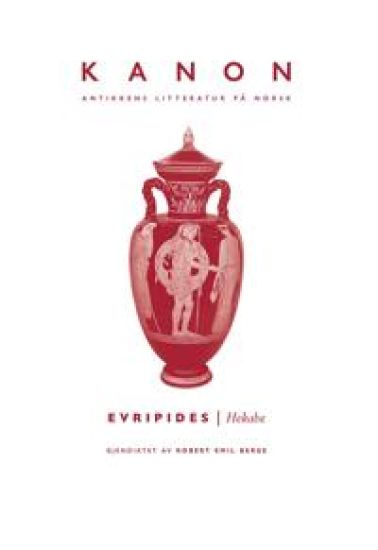
Hekabe

Hekabe

Evripides

Gyldendal
2018
sidottu
Evripides’ Hekabe, skrevet ca. 424 f.Kr., er en av de mørkeste av de antikke greske tragediene. Handlingen finner sted rett etter Trojas fall. Etter å ha beseiret Troja, drepte grekerne alle trojanske menn og tok kvinnene som slaver. Hekabe, trojanerkongen Priamos’ hustru, har over natten gått fra å være dronning til å bli en slave på skipene som seiler mot Hellas. Om bord får hun plutselig vite at Akhillevs’ spøkelse har bedt om at datteren hennes, Polyxene, skal ofres på gravhaugen hans. Mens hun sørger over å skulle miste datteren, vet hun ikke at nyheter om enda mer fortvilelse og svik er på vei.Stykket uttrykker en dyp undring over menneskelivets tilsynelatende vilkårlighet og spør om hva vi skal med moral og verdighet hvis ingenting er sikkert, verken de godes belønning eller de ondes straff.
Helena

Helena

Evripides

Gyldendal
2022
sidottu
Helena av Evripides ble oppført for første gang i Athen i år 412 f.Kr., og er tidligere ikke oversatt til norsk. Det er en gresk tragedie som ender godt, og som attpåtil er morsom av og til. Men i det som kan synes som en lystig fortelling, lurer det også noen alvorlige og skremmende tanker.De fleste har hørt om den skjønne Helena som forlot ektemannen i Sparta og dro til Troja med prins Paris, og dermed utløste trojanerkrigen. Men var det virkelig det som skjedde? Hvordan vet vi at det vi har hørt er sant? I Helena settes det spørsmåltegn ved alt vi trodde vi visste, ved mytene, sansene våre og ved sannheten selv.I Evripides’ alternative versjon av myten skaper Hera en tro kopi av Helena, og det er den som blir med til Troja, mens den virkelige Helena blir fraktet til Egypt. Helenas ektemann Menelaos vinner krigen, tar med seg kopien av Helena, og på vei tilbake til Sparta havner han i Egypt. Men da han møter den virkelige kona si der, har han ingen mulighet til å vite sikkert hvem som er ekte. Og om han skulle gå med på at den kvinnen han kjempet for i Troja, er falsk, må han også ta innover seg at han har kriget i ti år og styrtet en hel by basert på en løgn.
Euripides and the Gods

Euripides and the Gods

Mary Lefkowitz

Oxford University Press Inc
2019
nidottu
Modern readers find it hard to come to terms with the gods in Euripides' dramas. Readers try to dismiss them as a literary convention. Stage productions leave them out, especially in the cases when they appear ex machina. Instead, they place disproportionate emphasis on the harsh criticisms of the gods uttered by some of the characters in the dramas, and have sought to interpret Euripides ironically, viewing his portrayal of the cruel and capricious gods as a means of drawing attention to the deficiencies of ancient Greek religion. In their view Euripides' dramas seek to question the nature and sometimes even the very existence of traditional Greek gods. In Euripides and the Gods, classicist Mary Lefkowitz sets out to show that the tragedian is not undermining ancient religion, but rather describing with a brutal realism what the gods are like, impressing upon his mortal audience the limitations of human understanding. Writing the first extended treatment of these issues for a general audience, Lefkowitz provides a book that deals with all of Euripides' dramas, and argues for a more tolerant and nuanced understanding of ancient Greek religion. Euripides, like Homer, is making a statement about the nature of the world and human life, terrifying but accurate. She explains how the idea that Euripides was an atheist derives from ancient biographies that drew their evidence from comic poets, and shows why the doubts about the gods expressed by his characters must be understood in their dramatic context. Euripides and the Gods offers a compelling invitation to return to the dramatic masterpieces of Euripides with fresh eyes.
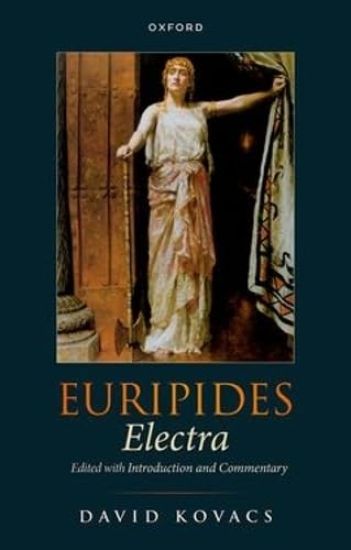
Euripides: Electra

Euripides: Electra

David Kovacs

Oxford University Press
2026
sidottu
This volume presents a newly edited text of Euripides' Electra with a scene-by-scene and line-by-line commentary that addresses a wide variety of questions, including the nature of Euripidean tragedy. In his Introduction and across several discussions in the commentary, David Kovacs presents an alternative to the current scholarly consensus on Euripides. Scholars following this consensus tell us that Euripides' play is a cynical take on the old story of Orestes' and Electra's revenge on Aegisthus and Clytaemestra. Both of the principal figures, we are told, are morally diminished, Electra inter alia by her excessive hatred of Clytaemestra and Orestes by his cynical reliance on Aegisthus' hospitable nature to get himself invited to the sacrifice at which he will kill his host. It is also alleged that this play virtually excludes the gods, who are part and parcel of the tragic genre. Kovacs shows that these and similar unfavourable judgements fail to take note of the practice of the other tragedians and also overlook evidence from Euripides' text, such as the frequent mention of the gods, that locate the play squarely within the tragic genre. What emerges is a play that is well constructed and thematically integrated; a play whose novelties--and an Athenian audience would not have wanted a play on an oft-treated myth to lack novelty--are all new ways of producing tragic effects found also in Aeschylus and Sophocles; a play that gives greater scope to the tragic view of the universe than even the corresponding plays of Aeschylus and Sophocles, thereby confirming Aristotle's judgement that Euripides is 'the most tragic of the poets'; in short, a play that can be called a tragedy without qualification. The gap between Euripides' original manuscript and the earliest complete copy we possess is nearly two millennia. This volume makes a considerable number of suggestions for improving a Greek text that has been badly corrupted over this period of manual copying.
Euripides: Bakkhai

Euripides: Bakkhai

Euripides

Oxford University Press Inc
2001
nidottu
Euripides' Bakkhai is the staple of the canon of Greek tragedy and is required or strongly recommended reading for most undergraduate Classics majors. It also surfaces quite often in non-classics courses focusing on tragedy because its structure and thematics offer exemplary models of the classic tragic elements. The plot of Bakkhai centers around the actions of Pentheus, King of Thebes, who refused to recognise the god Dionysus or permit Thebans to worship him. In revenge, Dionysus drove Pentheus mad, made him cross-dress as a maenad, sent him to worship the god he had spurned, and made his mother, Agave, mistake him for a wild beast and rip him to shreds. Gibbons, a prize-winning poet, and Segal, a renowned classicist, are both leaders in their professions and are well-suited to take on this central text of Greek tragedy. This edition includes an introduction, a new translation, notes on the text, and a glossary.
Euripides: Herakles

Euripides: Herakles

Euripides

Oxford University Press Inc
2001
nidottu
In Herakles, Euripides reveals with great subtlety and complexity the often brutal underpinnings of our social arrangements. The play enacts a thoroughly contemporary dilemma about the relationship between personal and state violence to civic order . Of all of Euripides' plays, this is his most skeptically subversive examination of myth, morality, and power. The play depicts Herakles being driven mad by Hera, the wife of Zeus. Hera hates Herakles because he is one of Zeus' children born of adultery. In his madness, Herakles is driven to murder his own wife and children, and he eventually exiles himself to Athens. The volume includes a new translation, an introduction, notes on the text, and a glossary.
The Complete Euripides

The Complete Euripides

Euripides

Oxford University Press Inc
2009
nidottu
Collected here for the first time in the series are three major plays by Euripides: Bacchae, translated by Reginald Gibbons and Charles Segal, a powerful examination of the horror and beauty of Dionysiac ecstasy; Herakles, translated by Tom Sleigh and Christian Wolff, a violent dramatization of the madness and exile of one of the most celebrated mythical figures; and The Phoenician Women, translated by Peter Burian and Brian Swamm, a disturbing interpretation of the fate of the House of Laios following the tragic fall of Oedipus. These three tragedies were originally available as single volumes. This volume retains the informative introductions and explanatory notes of the original editions and adds a single combined glossary and Greek line numbers.
The Complete Euripides Volume V

The Complete Euripides Volume V

Euripides

Oxford University Press Inc
2011
sidottu
Based on the conviction that only translators who write poetry themselves can properly re-create the celebrated and timeless tragedies of Aeschylus, Sophocles, and Euripides, the Greek Tragedy in New Translations series offers new translations that go beyond the literal meaning of the Greek in order to evoke the poetry of the originals. This volume collects Euipides' Alcestis (translated by William Arrowsmith), a subtle drama about Alcestis and her husband Admetos, which is the oldest surviving work by the dramatist; Medea (Michael Collier and Georgia Machemer), a moving vengeance story and an excellent example of the prominence and complexity that Euripides gave to female characters; Helen (Peter Burian), a genre breaking play based on the myth of Helen in Egypt; and Cyclops (Heather McHugh and David Konstan), a highly lyrical drama based on a celebrated episode from the Odyssey. This volume retains the informative introductions and explanatory notes of the original editions and adds a single combined glossary and Greek line numbers.
The Complete Euripides

The Complete Euripides

Euripides

Oxford University Press Inc
2011
nidottu
Based on the conviction that only translators who write poetry themselves can properly re-create the celebrated and timeless tragedies of Aeschylus, Sophocles, and Euripides, the Greek Tragedy in New Translations series offers new translations that go beyond the literal meaning of the Greek in order to evoke the poetry of the originals. This volume collects Euipides' Alcestis (translated by William Arrowsmith), a subtle drama about Alcestis and her husband Admetos, which is the oldest surviving work by the dramatist; Medea (Michael Collier and Georgia Machemer), a moving vengeance story and an excellent example of the prominence and complexity that Euripides gave to female characters; Helen (Peter Burian), a genre breaking play based on the myth of Helen in Egypt; and Cyclops (Heather McHugh and David Konstan), a highly lyrical drama based on a celebrated episode from the Odyssey. This volume retains the informative introductions and explanatory notes of the original editions and adds a single combined glossary and Greek line numbers.
Euripides Fabulae: Vol. III
Praise for Vols. I and II: `The virtues of this first-rate edition are too numerous to catalogue, and in any case,since they will stand enshrined in what is undoubtedly to be the standard text of Euripides for the next generation or two, they will receive as their just requital the gratitude of countless scholars and students in the future.' Classical Philology 1984 `D. is to be congratulated for the high achievement represented by this volume ... We look forward to the third ... and are tempted to wish for a fourth.' Classical Philology 1986 This volume brings to completion James Diggle's major new edition of all the surviving plays of Euripides. It supersedes the third volume of Murray's Oxford Text of 1909. The work is based on new collations of all the relevant manuscripts and incorporates many new ideas for the improvement of the text suggested by recent scholars and the editor himself.
Euripides

Euripides

Judith Mossman

Oxford University Press
2003
nidottu
This volume aims to bring together some classic essays illustrating the main strands of Euripidean criticism over the last 40 years in a form convenient for students. Two of the essays are translated here for the first time, and many others have been revised by their authors. All Greek has been translated.
Euripides

Euripides

Judith Mossman

Oxford University Press
2003
sidottu
Few ancient authors are as challenging as Euripides, and few have provoked so many diverse critical opinions through the ages: Aristotle described him as 'most tragic', and yet many of his plays have been condemned by critics as barely qualifying as 'proper' tragedies at all. In general he has enjoyed a revival in reputation over the last few decades: his manipulation of convention and the skill of his dramaturgy are perhaps more widely admired now than at any time since the Renaissance. Moreover, his exploration of the emotions of the marginalized sections of Athenian society - women, slaves, foreigners - has given his work strong contemporary resonances. This volume aims to bring together for students some classic essays illustrating the main strands of Euripidean criticism over the last forty years. Two of the essays are translated here for the first time, and many others have been revised by their authors. All Greek has been translated.
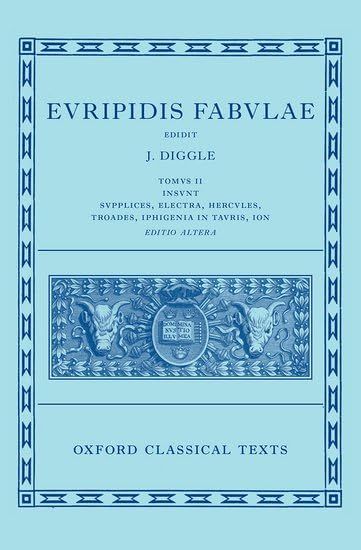
Euripides: Fabulae Vol. II (Euripidis Fabulae Tomus II, Supplices, Electra, Hercules, Troades, Iphigenia in Tauris, Ion)
More than forty years have passed since the publication of volume II of James Diggle's Oxford Classical Text of Euripides (1981). That volume was the first to be published of the three volumes of the OCT edition: volumes I and III followed in 1984 and 1994. This second edition has been re-typeset to correct some deficiencies in the first edition, and updated to take into account developments in scholarship. Since the plays contained in volume II are transmitted in a much more corrupt state than most of those in the other volumes and pose far more problems, the editor has rethought every problem afresh, introducing many changes in the text. This volume includes an entirely new apparatus criticus, reassigning a large number of conjectures to their correct authors, and incorporating many new proposals. Re-examination of the manuscripts by autopsy has provided fuller and more precise details of manuscript readings, in particular of readings introduced by the hands which corrected manuscripts L and P. This new edition also incorporates the evidence of newly published papyri.
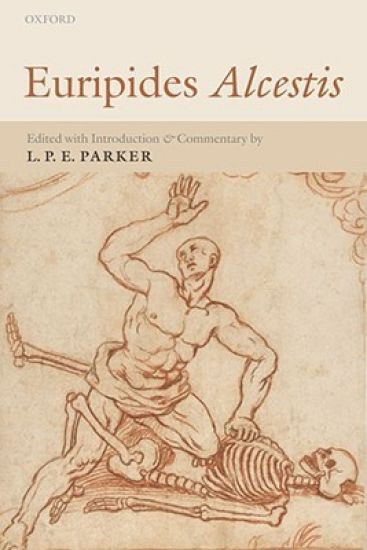
Euripides Alcestis

Euripides Alcestis

Oxford University Press
2007
sidottu
Alcestis is one of Euripides' richest and most brilliant - as well as most controversial - plays. But, apart from D. J. Conacher's student text, no annotated edition in English has appeared for more than fifty years. The present work is designed to aid close reading and to serve as an introduction to the serious study of the play in its various aspects. The introduction covers the background to the story in myth and folktale, its treatment by other writers from antiquity to the present, the critical reception of Euripides' play, and its textual transmission and metres.
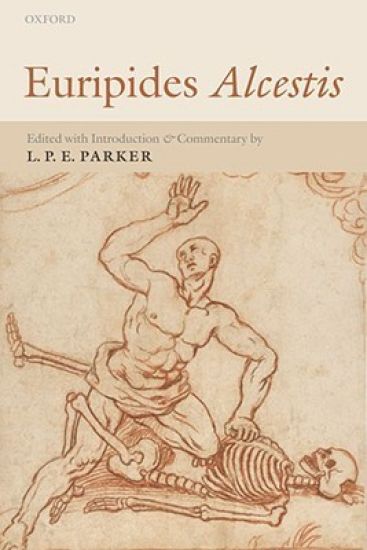
Euripides Alcestis

Euripides Alcestis

Oxford University Press
2007
nidottu
Alcestis is one of Euripides' richest and most brilliant - as well as most controversial - plays. But, apart from D. J. Conacher's student text, no annotated edition in English has appeared for more than fifty years. The present work is designed to aid close reading and to serve as an introduction to the serious study of the play in its various aspects. The introduction covers the background to the story in myth and folktale, its treatment by other writers from antiquity to the present, the critical reception of Euripides' play, and its textual transmission and metres. The notes are designed in particular to help readers who have been learning Greek for a relatively short time. More advanced matter, such as discussion of textual problems, is placed in square brackets at the end of the note.
Euripides' Escape-Tragedies

Euripides' Escape-Tragedies

Matthew Wright

Oxford University Press
2005
sidottu
This is the first major critical study of three late plays of Euripides: Helen, Andromeda and Iphigenia among the Taurians. Matthew Wright offers a sustained reading of the plays, arguing that they are a thematically connected trilogy. He re-examines central themes such as myth, geography, cultural identity, philosophy, religion, and (crucially) genre. These are not separate topics, but are seen as being joined together to form an intricate nexus of ideas. The book has implications for our view of Euripides and the tragic genre as a whole.
Euripides: Troades

Euripides: Troades

David Kovacs

Oxford University Press
2018
sidottu
This volume presents a newly edited text of Euripides' Troades, with a scene-by-scene and line-by-line commentary that brings centuries of classical scholarship to bear on a wide variety of questions. These include the interpretation of the play as part of a trilogy (its companion plays were Alexandros and Palamedes, of which we have only fragments), the contribution of the various scenes, speeches, and choral odes to the play, the style and usage of Euripides, and the stage action of the original performance. Since the play was performed in 415, shortly after the Athenian subjugation of Melos, it has frequently been interpreted as a criticism of Athenian foreign policy. The Introduction provides numerous converging arguments against this view and also shows that those who hold it are forced to ignore a greate deal of the text and cannot account for the Helen episode. The commentary, in addition to discussing the topics named above, interrogates the play's intellectual content, topics such as the nature of human success, vicissitude in mortal life, and the workings of the gods in the world, and re-evaluates the way the play's first audience were meant to react to the worldviews of Hecuba and others. It also examines carefully all the places where the text is insecure, places where there are significant variants or where what is transmitted is open to challenge. The book is written with the needs of both comparative beginners and seasoned classical scholars in mind.
Euripides: Iphigenia in Tauris

Euripides: Iphigenia in Tauris

Oxford University Press
2016
sidottu
Euripides' Iphigenia in Tauris is the tale of how two children of Agamemnon whose lives have been blighted in youth are brought together for mutual salvation and for the healing of the calamitous house of Pelops. Aristotle makes more complimentary references to the play than any other Attic tragedy, apart from Sophocles' Oedipus the King, and even less favourable critics recognize the extraordinary skill of its construction. Comprising an introduction, the Greek text, and commentary, this volume is designed to be useful to a wide range of readers, facilitating a close and accurate reading of one of Euripides' more frequently studied plays. The introduction explores earlier and later re-interpretations of the story of Iphigenia, the adoption of narrative motifs in New Comedy, Roman comedy, and the ancient novel, differing critical assessments, and more technical information on metre and textual transmission. The commentary features guidance on vocabulary and syntax, while more advanced material, including textual discussion, is included in parenthesis.