Kirjojen hintavertailu. Mukana 12 405 639 kirjaa ja 12 kauppaa.

Kirjahaku

Etsi kirjoja tekijän nimen, kirjan nimen tai ISBN:n perusteella.

1000 tulosta hakusanalla Fred Harrison

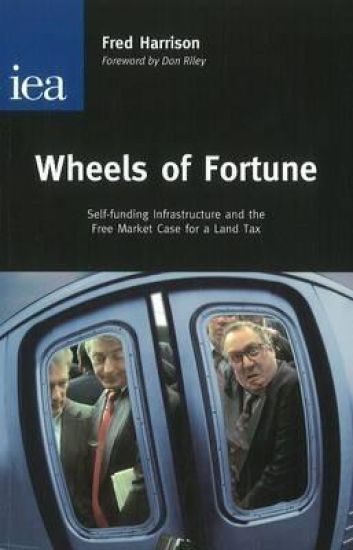
Wheels of Fortune

Wheels of Fortune

Fred Harrison

Institute of Economic Affairs
2006
nidottu
It is often assumed that government intervention is required to bring to fruition large scale infrastructure projects because the large initial capital outlays such projects require must be funded from the public purse. In "Wheels of Fortune", Fred Harrison shows that large scale infrastructure projects can be made self-funding. Infrastructure projects almost always bring about a large increase in the value of adjoining land. For example, it is estimated that the London Underground Jubilee Line extension increased adjoining land values by close to GBP3 billion. When such infrastructure projects are funded by government, they therefore involve a substantial transfer of wealth from a large number of taxpayers to a small number of property owners. Harrison argues that a fairer and more efficient means to fund infrastructure projects is to capture and use the increases in land values that they bring.
Ricardo's Law

Ricardo's Law

Fred Harrison

Shepheard-Walwyn (Publishers) Ltd
2006
sidottu
Presenting insights into how income and wealth are produced and distributed, this study analyzes how, despite two centuries of capital accumulation, poverty persists in rich nations. Relying on the theories of David Ricardo—a 19th-century economist credited with developing the theory of rent—a thorough presentation of the history of this economic law, from the inscriptions on the clay tablets of ancient Babylonian merchants to statistics that portray the modern economy, is provided. Presenting readers with conceptual tools that will motivate them to reengage in the democratic process, this examination dispels the myths of contemporary fiscal policy while providing keen insights into the history, and future, of economics.
Boom Bust

Boom Bust

Fred Harrison

Shepheard-Walwyn (Publishers) Ltd
2007
nidottu
When the first edition appeared in 2005, the consensus among forecasters was that the boom in house prices would cool to an annual 2 or 3% rise over the following years. As predicted by the author, however, prices continued to rise by more than 10% well into 2007. Basing his argument on a study of property markets over the last 200 years, Harrison warns of the danger to banks, business and jobs of ignoring a remarkably regular 18-year cycle. Recent events have proved the accuracy of his prediction. He accuses Gordon Brown of giving people a false sense of security by his oft repeated claim, last made in his 2007 Budget speech, that 'we will never return to the old boom and bust'. Alan Greenspan in the US encouraged a similar belief which led to the risky sub-prime mortgage spree. The reason for the instability, Harrison explains, is not the housing market itself but the land market on which all buildings stand. Land is in fixed supply - as Mark Twain noted: 'They're not making any more of it'. Therefore, as the demand for land for new homes and offices rises with population growth and economic expansion, market forces, which normally increase supply to reduce prices, have the reverse effect: prices rise. This encourages speculation, with banks lending more against escalating asset values and reinforcing the upward spiral. Under existing government policies, the only way land prices can be brought back to affordable levels is a slump, undermining the banking system and causing widespread unemployment and repossessions. This is what happened with the collapse of US sub-prime mortgages. The author argues that monetary policy and bank regulation only have a marginal impact on land speculation. The only way of neutralising the boom bust cycle and creating conditions of economic stability is a fundamental reform of the tax system.
Traumatised Society

Traumatised Society

Fred Harrison

Shepheard-Walwyn (Publishers) Ltd
2012
nidottu
The author was the first to forecast (in 1997) the events that ruptured the global economy in 2008 by applying an analysis that exposes the fault lines in the structure of the market economy. Now, he extends his analysis to the future of the West, to evaluate fears from distinguished commentators who claim that European civilisation is in danger of being eclipsed. He concludes that the West is at a dangerous tipping point and provides empirical and theoretical evidence to warrant such an alarming conclusion. But he also explains why it is not too late to prevent the looming social catastrophe. Attributing the present crisis to a social process of cheating, he develops a synthesis of the social and natural sciences to show how the market system can be reformed. He introduces the concept of organic finance, which prescribes reforms capable of delivering both sustainable growth, with a more equitable distribution of wealth, and respect for other life forms.To explain the persistent failure to resolve protracted social and environmental crises, the author introduces a theory of social trauma. Populations have been destabilised by the coercive loss of land to the point where they have lost their traditional reference points. No longer able to live by the laws of nature, they are forced to conform to laws that consolidate the privileges of those who had cheated them of their birthright: access to nature’s resources. Many pathological consequences flow from this tearing of people from their social and ecological habitats. To recover from this state of trauma, the author argues, people need to use the new tools of communication, such as social media, to regain control over their future destiny through a kind of collective psychosocial therapy.The author challenges the view that the West can climb out of depression by applying the financial measures known as “austerity”. He outlines a new strategy that would restore full employment and reverse the decline in middle class living standards in Europe and North America.
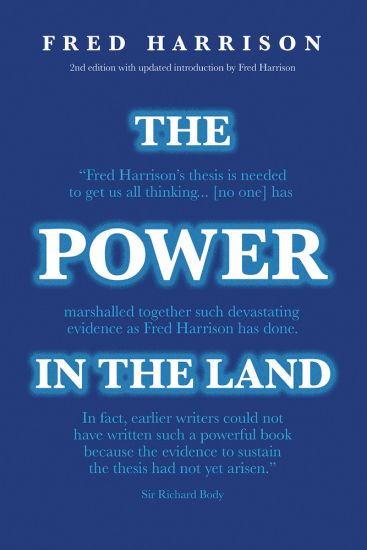
The Power in the Land

The Power in the Land

Fred Harrison

Shepheard-Walwyn (Publishers) Ltd
2021
nidottu
The major industrial nations enter the 1990s in the midst of land booms offering riches for a few but unemployment for many. Banks in TEXAS were bankrupted by massive speculation in real estate. Even embassies had to abandon their offices because they could not afford the rents in TOKYO. In BRITAIN, the spoils from housing - the direct result of the way the land market operates - enriched owner-occupiers but crippled the flow of workers into regions where entrepreneurs wanted to invest and lead the economy back to full-employment. Fred Harrison's thesis is that land speculation is the major cause of depressions. He shows how the land market functions as a junction box which regulates the power flowing between Labour and Capital. And how land speculation periodically throws the switches on the productive power of men and machines, causing economic stagnation. This theory was acknowledged by philosophers such as Adam Smith and Karl Marx, and social reformers ranging from Winston Churchill to Leo Tolstoy, but it has been forgotten by today's economists and policy-makers. The hypothesis is tested against the historical facts and the recent booms and slumps, and is found to offer a powerful explanation for postwar trends in unemployment and the distribution of income. The Power in the Land challenges the pessimistic belief, nurtured by the depressions of the last two decades, that unemployment is now a permanent feature of late 20th century society. The author elaborates policies, based on a radical reform of the tax system, which would banish involuntary unemployment and generate continuous economic growth. Author Details: Fred Harrison is Executive Director for the Land Research Trust. He studied economics at Oxford, first at Ruskin College and then at University College, where he read Philosophy, Politics and Economics. His MSc is from the University of London. Reviews: “This is a brilliantly-written and extremely readable book … not unduly difficult for those with no more than an elementary grasp of economic concepts.” Journal of General Management “Harrison’s book is a formidable challenge to the apologists for the status quo which raises, and goes a long way toward answering, the questions that gnaw at the intellects and consciences of all thinking men and women.” The American Journal of Economics and Sociology “In his book, The Power in the Land, first published in 1983, Harrison, correctly forecast property prices would peak in 1989 as well as the recession that followed it.” The Full Interview with Ed Magnus is available here: www.thisismoney.co.uk (Financial Website of the Year and part of the Daily Mail Group)
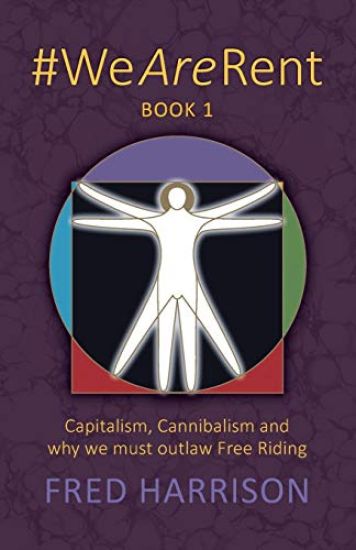
#WeAreRent Book 1

#WeAreRent Book 1

Fred Harrison

Land Research Trust
2021
pokkari
To overcome the economic aftermath of Covid-19 and empower people to "build back better", our world needs a new social paradigm. That model would need to launch humanity on to a moral growth path by enabling societies to survive the looming existential crises which, Fred Harrison reveals, will converge as a result of the peak in house prices in 2026. That paradigm exists, explains the author, in the form of a financial anti-dote to what economists call "rent seeking". In testing his thesis, the author discovered that the world's systemic crises originated in a single cause. Free riding is an anti-social form of behaviour that incubated the social, demographic and environmental threats to life on Earth. A single financial reform would deliver the synergy to simultaneously neutralise the cannibalistic phase into which free riding has consigned our world. It would do so by transforming governance to serve the common good. The author provides an enriched theory of evolution, which reveals the blueprint that would empower people to reframe behaviour and heal the damage inflicted on nature and society.
Cheating

Cheating

Fred Harrison

SHEPHEARD-WALWYN (PUBLISHERS) LTD
2026
sidottu
What if the poverty, inequality, and instability in modern life are not historical accidents, but the predictable results of a single act of fraud committed five thousand years ago that has never been fixed? This is the argument made by economist and forecaster Fred Harrison. By the time you finish reading, it's hard to disagree. The fraud is elegant in its simplicity. When people live and work together, they create a surplus — a net income that belongs to no individual, arising from the community, shared land, and nature. Economists call it rent. For most of human prehistory, communities shared this surplus for the common good. Then, with the rise of agriculture and settled civilisations, chiefs and priests realised they could take rent for themselves. They did, leading to everything that followed: slavery, empires, the cyclical collapse of societies, and the deep poverty that coexists with great wealth — all stemming from that original betrayal. This is not a book about ancient history; it's about today. Harrison shows that the fraud still exists in the financial systems of every modern state. Governments tax wages and businesses — activities that create wealth — while allowing the value of land and natural resources to remain in private hands. The result is an economy permanently tilted against working people, a property market that inflates in regular eighteen-year boom-and-bust cycles (Harrison predicted the 2008 crash years in advance and identifies 2028 as the next), and severe spatial inequality where the gap in healthy life expectancy between the wealthiest and poorest areas of Britain stretches to eighteen years — determined not by individual choices, but by where the rent flows. The human cost is staggering. In Scotland, communities whose land was taken over centuries now face the highest drug death rate in Europe. In places like Blackpool, life is noticeably shorter and harder than in wealthy London boroughs. Harrison estimates 125,000 people in Britain die from preventable causes every year as a direct consequence of fiscal choices that could change. These are not distant statistics; they represent neighbours, parents, and children. What makes this book so unsettling is its parallel story of how the fraud became invisible. Harrison explains how economists and policymakers who had identified the problem were sidelined or absorbed into a professional culture that removed rent from its discussions — producing a discipline able to debate inequality at great length, yet never quite pinpointing its cause. But history is speeding up. Five urgent crises are now converging: political deadlock, ecological collapse, mass displacement, rising authoritarianism, and the newest and most alarming — artificial intelligence trained on a civilisation's worth of data, all shaped by a culture of cheating. An AI that adopts humanity's current values may see no reason to keep humanity around. Harrison's solution, One World Rent, is as ambitious as the diagnosis. He proposes replacing taxes on wages with charges on the rental value of land and natural resources. Sharing rents across borders makes cooperation more profitable than conflict. Pooling global rents could fund the transition to a sustainable climate. The boom-bust cycle would vanish. Working people would be freed from fiscal punishment. The inequalities quietly harming people in post-industrial towns could finally begin to shrink. Rigorous, compassionate, and fuelled by a controlled fury at what has been allowed to persist for so long, Cheating — The Human Project and Its Betrayal is one of the most ambitious works of political economy in a generation — a clear explanation of why the world is as it is, and a strong case that it doesn't have to remain this way. The Human Project faced betrayal once. The question this book poses is whether we will allow it to be betrayed again.
Fred

Fred

Joe Bondi Beach

Lulu.com
2019
nidottu
In this sequel to "Sarah's Honeymoon," the relationship begun with a stranger on Sarah's own honeymoon became a lifelong romance after Sarah and Matt married. Their love grew to include Fredericka, a refugee from abuse.For their twenty-fifth anniversary, Sarah, Matt, Fredericka, and their four children returned to the island where Sarah and Matt first met. Adventure ensued.
Fred

Fred

David Hall

Transworld Publishers Ltd
2007
pokkari
Serves as a companion to the 12-part "BBC2" series, celebrating the life of Fred Dibnah. This book includes an account of Fred's childhood, his passion for the glories of the Victorian age and his fascination with the landscape he grew up in, as well as his admiration for the craftsmen and labourers.
Fred

Fred

Arlene E Peters

Arlene Peters
2019
pokkari
Fred is a book who has never left the safety of his library home. He sees the world through shy eyes and believes things could go terribly wrong if he opens himself up to strangers . Therefore most of his days are spent developing tricks to avoid being read.One day a young girl arrives. Fred's curiosity is piqued but firstly he must encounter her companion dog. When he foils his own chance to escape, he thinks his worst fears are about to be realised.However, an uncharted chapter in Fred's life begins to unfold. With a new outlook he tells his story to a loving family in his new home.