Kirjojen hintavertailu. Mukana 12 469 845 kirjaa ja 12 kauppaa.

Kirjahaku

Etsi kirjoja tekijän nimen, kirjan nimen tai ISBN:n perusteella.

1000 tulosta hakusanalla Gabriele

Gabriele

Gabriele

Anne Berest; Claire Berest

Europa Editions (UK) Ltd
2025
sidottu
An atmospheric, exuberant novel about love and sex, art and revolution, experimentation and creativity from the best-selling author of The Postcard, Anne Berest, and her sister, the acclaimed novelist Claire Berest, based on the life of their great grandmother. The year is 1908, the height of the Belle Epoque, and a brilliant, young French woman named Gabriële, newly graduated from the most elite music school in Europe, meets a volcanic Spanish artist named Francis. Following a whirlwind romance, they marry and fall headlong into a Paris that is experimenting with new forms of living, thinking, and creating. Soon after marrying Francis, Gabriële meets Marcel, another young artist, five years her junior. Soon, Francis, Marcel, and Gabriële are all three involved in a fervent affair that will change the course of art history and redefine the avant-garde. Surrealism, Dada, and Abstraction are among the new artistic practices and new ideas that emerge from this electric love triangle in the following decade, during which the Belle Epoque sours and the world descends into the devastation of World War I. Francis Picabia, Marcel Duchamp, and Gabriele Buffet—the protagonists of this brilliantly imagined “true novel”—are vividly reimagined by the Berests. Moving between Paris, New York, Berlin, Zurich, Barcelona, and Saint-Tropez, Gabriële is as audacious, uninhibited, and unforgettable as its central character, the mercurial, pioneering Gabriële Buffet.
Gabriele

Gabriele

Johanna Schopenhauer

E-Artnow
2018
pokkari
Johanna Schopenhauer (1766-1838) war eine deutsche Schriftstellerin und Salonni re. Sie war die Mutter des Philosophen Arthur Schopenhauer und der Schriftstellerin Adele Schopenhauer. Aus dem Buch: "Wie oft versuchte ich es schon, sein Bild auf dem Papier festzuhalten Aber ich erm de im fruchtlosen Streben. Ja, wenn ich mit den Z gen seines Gesichts auch die unbeschreibliche Harmonie in seinem ganzen Wesen wiederzugeben verm chte Er ist immer er selbst Ganz und ungeteilt er selbst, in jeder seiner Bewegungen, in jedem seiner Worte, im Scherz wie im Ernst Nur er, einzig er kann so dastehen, so sprechen, so aussehen, und doch ist es nicht seine Gestalt allein, die ihn vor allen auszeichnet, es ist der Einklang, die bereinstimmung in seiner ganzen Erscheinung. Wo lebt der K nstler, der diese darzustellen verm chte? Ohne sie bleiben meine Bilder leblos und starr, bei aller brigen hnlichkeit gleichen sie Wachsbildern, die das Leben ungeschickt nach ffen wollen, und ich mu sie vernichten, denn sie erregen mir Grauen."
Gabriele D'Annunzio

Gabriele D'Annunzio

John Woodhouse

Oxford University Press
2001
nidottu
This title charts the incredible work and life of Gabriele D'Annunzio, considered pivotal in the emergence of great 20th-century Italian literature. It is intended for students and scholars of Italian literature, history, and politics, and European Decadentism.
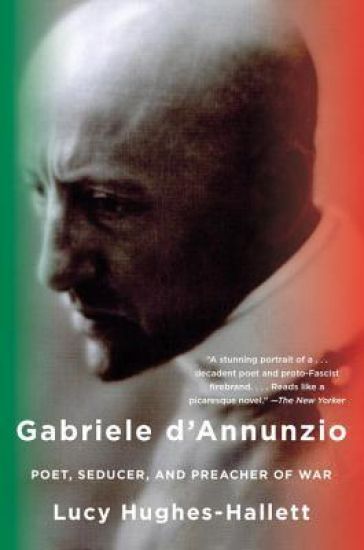
Gabriele D'Annunzio: Poet, Seducer, and Preacher of War

Gabriele D'Annunzio: Poet, Seducer, and Preacher of War

Lucy Hughes-Hallett

Knopf Doubleday Publishing Group
2014
nidottu
Winner of the Samuel Johnson Prize for NonfictionWinner of the Costa Biography Award**Washington Post Best Books of 2013****Economist Best Books of 2013**This fascinating life of Gabriele d'Annunzio--the charismatic poet, bon vivant, and virulent nationalist who prefigured Mussolini--traces the early twentieth century's trajectory from Romantic idealism to Fascist thuggery. D'Annunzio was Italy's premier poet at a time when poetry could trigger riots. A brilliant self-publicist, he used his fame to sell his work, seduce women, and promote his extreme nationalism. At once an aesthete and a militarist, he enjoyed risking death no less than making love, and he wrote with equal enthusiasm about Fortuny gowns and torpedoes. In 1915 his incendiary oratory helped drive Italy into the First World War, and in 1919 he led a troop of mutineers into the Croatian port of Fiume, where he established a delinquent utopia. Futurists, anarchists, communists and proto-fascists descended on the place, along with literati and thrill-seekers, drug dealers and prostitutes. Three years later, when the fascists marched on Rome, they belted out anthems they'd learned in Fiume, while Mussolini consciously modeled himself on the great poet. Lucy Hughes-Hallett's compelling biography is a revelation both of d'Annunzio's flamboyant life and of the dramatic times he helped to shape.