Kirjojen hintavertailu. Mukana 12 353 920 kirjaa ja 12 kauppaa.

Kirjahaku

Etsi kirjoja tekijän nimen, kirjan nimen tai ISBN:n perusteella.

1000 tulosta hakusanalla George Cheyne

An Essay of Health and Long Life. By George Cheyne, ... The Fourth Edition
The 18th century was a wealth of knowledge, exploration and rapidly growing technology and expanding record-keeping made possible by advances in the printing press. In its determination to preserve the century of revolution, Gale initiated a revolution of its own: digitization of epic proportions to preserve these invaluable works in the largest archive of its kind. Now for the first time these high-quality digital copies of original 18th century manuscripts are available in print, making them highly accessible to libraries, undergraduate students, and independent scholars.Medical theory and practice of the 1700s developed rapidly, as is evidenced by the extensive collection, which includes descriptions of diseases, their conditions, and treatments. Books on science and technology, agriculture, military technology, natural philosophy, even cookbooks, are all contained here.++++The below data was compiled from various identification fields in the bibliographic record of this title. This data is provided as an additional tool in helping to insure edition identification: ++++British LibraryT121375Dublin: printed for George Ewing, 1725. 4], x, 18],120p.; 8
An Essay of Health and Long Life. By George Cheyne,

An Essay of Health and Long Life. By George Cheyne,

George Cheyne

Gale Ecco, Print Editions
2018
sidottu
The 18th century was a wealth of knowledge, exploration and rapidly growing technology and expanding record-keeping made possible by advances in the printing press. In its determination to preserve the century of revolution, Gale initiated a revolution of its own: digitization of epic proportions to preserve these invaluable works in the largest archive of its kind. Now for the first time these high-quality digital copies of original 18th century manuscripts are available in print, making them highly accessible to libraries, undergraduate students, and independent scholars.Medical theory and practice of the 1700s developed rapidly, as is evidenced by the extensive collection, which includes descriptions of diseases, their conditions, and treatments. Books on science and technology, agriculture, military technology, natural philosophy, even cookbooks, are all contained here.++++The below data was compiled from various identification fields in the bibliographic record of this title. This data is provided as an additional tool in helping to insure edition identification: ++++British LibraryT058019London: printed for George Strahan; and J. Leake, Bath, 1724. 4], xx, 24],232p.; 8
An Essay of Health and Long Life. By George Cheyne, ... The Tenth Edition
The 18th century was a wealth of knowledge, exploration and rapidly growing technology and expanding record-keeping made possible by advances in the printing press. In its determination to preserve the century of revolution, Gale initiated a revolution of its own: digitization of epic proportions to preserve these invaluable works in the largest archive of its kind. Now for the first time these high-quality digital copies of original 18th century manuscripts are available in print, making them highly accessible to libraries, undergraduate students, and independent scholars.Western literary study flows out of eighteenth-century works by Alexander Pope, Daniel Defoe, Henry Fielding, Frances Burney, Denis Diderot, Johann Gottfried Herder, Johann Wolfgang von Goethe, and others. Experience the birth of the modern novel, or compare the development of language using dictionaries and grammar discourses. ++++The below data was compiled from various identification fields in the bibliographic record of this title. This data is provided as an additional tool in helping to insure edition identification: ++++British LibraryT058021London: printed for George Strahan; and J. Leake, Bath, 1745. 4], xx, 24],232p.; 8

The Natural Method of Curing the Diseases of the Body, and the Disorders of the Mind Depending on the Body. In Three Parts. ... By George Cheyne, M.D. ... The Fifth Edition
The 18th century was a wealth of knowledge, exploration and rapidly growing technology and expanding record-keeping made possible by advances in the printing press. In its determination to preserve the century of revolution, Gale initiated a revolution of its own: digitization of epic proportions to preserve these invaluable works in the largest archive of its kind. Now for the first time these high-quality digital copies of original 18th century manuscripts are available in print, making them highly accessible to libraries, undergraduate students, and independent scholars.Medical theory and practice of the 1700s developed rapidly, as is evidenced by the extensive collection, which includes descriptions of diseases, their conditions, and treatments. Books on science and technology, agriculture, military technology, natural philosophy, even cookbooks, are all contained here.++++The below data was compiled from various identification fields in the bibliographic record of this title. This data is provided as an additional tool in helping to insure edition identification: ++++British LibraryT053889With a half-title. A reissue of the sheets of the first edition of 1742, with a cancel titlepage.London: printed for Dan. Browne; R. Manby; J. Whiston and B. White; and A. Strahan, 1753. 22],316p.; 8
An Essay of Health and Long Life. By George Cheyne, ... The Seventh Edition
The 18th century was a wealth of knowledge, exploration and rapidly growing technology and expanding record-keeping made possible by advances in the printing press. In its determination to preserve the century of revolution, Gale initiated a revolution of its own: digitization of epic proportions to preserve these invaluable works in the largest archive of its kind. Now for the first time these high-quality digital copies of original 18th century manuscripts are available in print, making them highly accessible to libraries, undergraduate students, and independent scholars.Medical theory and practice of the 1700s developed rapidly, as is evidenced by the extensive collection, which includes descriptions of diseases, their conditions, and treatments. Books on science and technology, agriculture, military technology, natural philosophy, even cookbooks, are all contained here.++++The below data was compiled from various identification fields in the bibliographic record of this title. This data is provided as an additional tool in helping to insure edition identification: ++++Countway Library of MedicineN012573In this edition the printer's ornaments on p. 77 are crowns.London: printed for George Strahan; and J. Leake at Bath, 1725. 4], xx, 24],232p.; 8
George Cheyne: The English Malady (1733) (Psychology Revivals)
‘Nerves’ became a highly eligible illness in early Georgian London and Bath. What Freud was for Vienna at the end of the nineteenth-century, George Cheyne was for eighteenth-century fashionable ailments. The English Malady was one of the best known and most influential books of the Georgian age, dealing with what we would now call psychiatric disorders. Such disorders, he contended, should be regarded as diseases of ‘civilization’ and the product of the pressures and affluence of modern life. By making ‘neurosis’ acceptable, even fashionable, Cheyne’s book assumed considerably wider significance during the Enlightenment. Prefaced by a scholarly introduction by Roy Porter, this reprint edition, originally published in 1991 as part of the Tavistock Classics in the History of Psychiatry series, places Cheyne and his work in the development of British psychiatry.
George Cheyne: The English Malady (1733) (Psychology Revivals)
‘Nerves’ became a highly eligible illness in early Georgian London and Bath. What Freud was for Vienna at the end of the nineteenth-century, George Cheyne was for eighteenth-century fashionable ailments. The English Malady was one of the best known and most influential books of the Georgian age, dealing with what we would now call psychiatric disorders. Such disorders, he contended, should be regarded as diseases of ‘civilization’ and the product of the pressures and affluence of modern life. By making ‘neurosis’ acceptable, even fashionable, Cheyne’s book assumed considerably wider significance during the Enlightenment. Prefaced by a scholarly introduction by Roy Porter, this reprint edition, originally published in 1991 as part of the Tavistock Classics in the History of Psychiatry series, places Cheyne and his work in the development of British psychiatry.
Correspondence with George Cheyne and Thomas Edwards

Correspondence with George Cheyne and Thomas Edwards

Samuel Richardson

Cambridge University Press
2013
sidottu
Samuel Richardson (1689–1761), among the most important and influential English novelists, was also a prolific letter writer. Beyond its extraordinary range, his correspondence holds special interest as that of a practising epistolary novelist, who thought long and hard about the letter as a form. The Cambridge Edition of the Correspondence of Samuel Richardson is the first complete edition of his letters. The present volume contains his correspondences with Dr George Cheyne and Thomas Edwards, linked not only by their pronounced medical content but also by their generally unguarded character. An early admirer of Richardson's Pamela (1740–41), Cheyne elicits some of the novelist's most significant statements concerning his own literary practice and tastes. Edwards, an astute literary critic as well as notable sonneteer, draws Richardson into expressing some remarkable insights as a close reader of poetry and prose.
Rules and Observations for the Enjoyment of Health and Long Life; Extracted from the Celebrated Doctor Cheyne's Essay on Health and Long Life. by a Lover of Mankind.
The 18th century was a wealth of knowledge, exploration and rapidly growing technology and expanding record-keeping made possible by advances in the printing press. In its determination to preserve the century of revolution, Gale initiated a revolution of its own: digitization of epic proportions to preserve these invaluable works in the largest archive of its kind. Now for the first time these high-quality digital copies of original 18th century manuscripts are available in print, making them highly accessible to libraries, undergraduate students, and independent scholars.Medical theory and practice of the 1700s developed rapidly, as is evidenced by the extensive collection, which includes descriptions of diseases, their conditions, and treatments. Books on science and technology, agriculture, military technology, natural philosophy, even cookbooks, are all contained here.++++The below data was compiled from various identification fields in the bibliographic record of this title. This data is provided as an additional tool in helping to insure edition identification: ++++British LibraryT078564With a half-title.Leeds: printed by G. Wright and Son; and sold by J. Binns, Leeds; J. Smith, Bradford; and W. Edwards, and N. Binns, Halifax, 1770?]. 23, 1]p.; 12
Rules and Observations for the Enjoyment of Health and Long Life; Extracted From the Celebrated Doctor Cheyne's Essay on Health and Long Life. By a Lover of Mankind
The 18th century was a wealth of knowledge, exploration and rapidly growing technology and expanding record-keeping made possible by advances in the printing press. In its determination to preserve the century of revolution, Gale initiated a revolution of its own: digitization of epic proportions to preserve these invaluable works in the largest archive of its kind. Now for the first time these high-quality digital copies of original 18th century manuscripts are available in print, making them highly accessible to libraries, undergraduate students, and independent scholars.Medical theory and practice of the 1700s developed rapidly, as is evidenced by the extensive collection, which includes descriptions of diseases, their conditions, and treatments. Books on science and technology, agriculture, military technology, natural philosophy, even cookbooks, are all contained here.++++The below data was compiled from various identification fields in the bibliographic record of this title. This data is provided as an additional tool in helping to insure edition identification: ++++British LibraryT078564With a half-title.Leeds: printed by G. Wright and Son; and sold by J. Binns, Leeds; J. Smith, Bradford; and W. Edwards, and N. Binns, Halifax, 1770?]. 23, 1]p.; 12
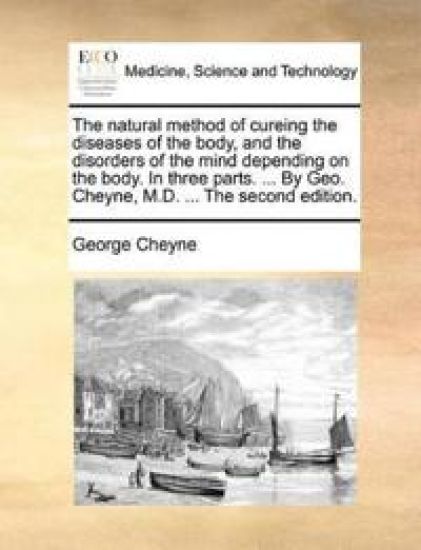
The Natural Method of Cureing the Diseases of the Body, and the Disorders of the Mind Depending on the Body. In Three Parts. ... By Geo. Cheyne, M.D. ... The Second Edition
The 18th century was a wealth of knowledge, exploration and rapidly growing technology and expanding record-keeping made possible by advances in the printing press. In its determination to preserve the century of revolution, Gale initiated a revolution of its own: digitization of epic proportions to preserve these invaluable works in the largest archive of its kind. Now for the first time these high-quality digital copies of original 18th century manuscripts are available in print, making them highly accessible to libraries, undergraduate students, and independent scholars.Medical theory and practice of the 1700s developed rapidly, as is evidenced by the extensive collection, which includes descriptions of diseases, their conditions, and treatments. Books on science and technology, agriculture, military technology, natural philosophy, even cookbooks, are all contained here.++++The below data was compiled from various identification fields in the bibliographic record of this title. This data is provided as an additional tool in helping to insure edition identification: ++++Countway Library of MedicineN004757London: printed for Geo. Strahan, and John and Paul Knapton, 1742. 20],316p.; 8
An Essay on the Gout, With an Account of the Nature and Qualities of the Bath Waters. Intended for the Benefit of Richard Tennison, Esq; By Geo. Cheyne, ... The Third Edition
The 18th century was a wealth of knowledge, exploration and rapidly growing technology and expanding record-keeping made possible by advances in the printing press. In its determination to preserve the century of revolution, Gale initiated a revolution of its own: digitization of epic proportions to preserve these invaluable works in the largest archive of its kind. Now for the first time these high-quality digital copies of original 18th century manuscripts are available in print, making them highly accessible to libraries, undergraduate students, and independent scholars.Medical theory and practice of the 1700s developed rapidly, as is evidenced by the extensive collection, which includes descriptions of diseases, their conditions, and treatments. Books on science and technology, agriculture, military technology, natural philosophy, even cookbooks, are all contained here.++++The below data was compiled from various identification fields in the bibliographic record of this title. This data is provided as an additional tool in helping to insure edition identification: ++++Countway Library of MedicineN002009First published at London in 1720 as 'Observations concerning the nature and due method of treating the gout - The final 56p. section entitled 'The author having in the last edition of this treatise inserted some new paragraphs without making any alteration in what was before printed; ..' with own pagination and register.Dublin: re-printed by and for George Grierson, 1721. 2], iii, 9],80,56p.; 8