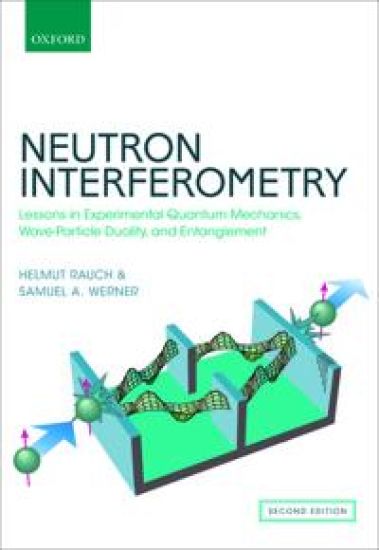
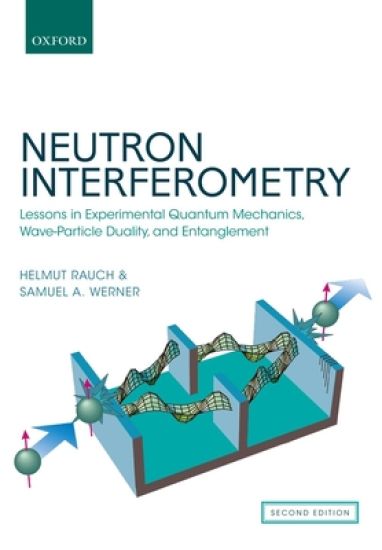
This is an open access title. It is available to read and download as a free PDF version on Oxford Academic and is made available under a Creative Commons Attribution-Non Commercial-No Derivatives 4.0 International licence. The quantum interference of de Broglie matter waves is probably one of the most startling and fundamental aspects of quantum mechanics. It continues to tax our imaginations and leads us to new experimental windows on nature. Quantum interference phenomena are vividly displayed in the wide assembly of neutron interferometry experiments, which have been carried out since the first demonstration of a perfect silicon crystal interferometer in 1974. Since the neutron experiences all four fundamental forces of nature (strong, weak, electromagnetic, and gravitational), interferometry with neutrons provides a fertile testing ground for theory and precision measurements. Many Gedanken experiments of quantum mechanics have become real due to neutron interferometry. Quantum mechanics is a part of physics where experiment and theory are inseparably intertwined. This general theme permeates the second edition of this book. It discusses more than 40 neutron interferometry experiments along with their theoretical motivations and explanations. The basic ideas and results of interference experiments related to coherence and decoherence of matter waves and certain post-selection variations, gravitationally induced quantum phase shifts, Berry`s geometrical phases, spinor symmetry and spin superposition, and Bell's inequalities are all discussed and explained in this book. Both the scalar and vector Aharonov-Bohm topological interference effects and the neutron version of the Sagnac effect are presented in a self-contained and pedagogical way. Interferometry with perfect crystals, artificial lattices, and spin-echo systems are also topics of this book. It includes the theoretical underpinning as well as connections to other areas of experimental physics, such as quantum optics, nuclear physics, gravitation, and atom interferometry. The observed phase shifts due to the Earth's gravity and rotation indicate a close connection to relativity theory. Neutron interferometry can be considered as a central technique of quantum optics with massive particles. It has stimulated the development of interferometry with atoms, molecules and clusters. The book is written in a style that will be suitable at the senior undergraduate and beginning of graduate level. It will interest and excite many students and researchers in neutron, nuclear, quantum, gravitational, optical, and atomic physics. Lecturers teaching courses in modern physics and quantum mechanics will find a number of interesting and historic experiments they may want to include in their lectures.
The quantum interference of de Broglie matter waves is probably one of the most startling and fundamental aspects of quantum mechanics. It continues to tax our imaginations and leads us to new experimental windows on nature. Quantum interference phenomena are vividly displayed in the wide assembly of neutron interferometry experiments, which have been carried out since the first demonstration of a perfect silicon crystal interferometer in 1974. Since the neutron experiences all four fundamental forces of nature (strong, weak, electromagnetic, and gravitational), interferometry with neutrons provides a fertile testing ground for theory and precision measurements. Many Gedanken experiments of quantum mechanics have become real due to neutron interferometry. Quantum mechanics is a part of physics where experiment and theory are inseparably intertwined. This general theme permeates the second edition of this book. It discusses more than 40 neutron interferometry experiments along with their theoretical motivations and explanations. The basic ideas and results of interference experiments related to coherence and decoherence of matter waves and certain post-selection variations, gravitationally induced quantum phase shifts, Berry`s geometrical phases, spinor symmetry and spin superposition, and Bell's inequalities are all discussed and explained in this book. Both the scalar and vector Aharonov-Bohm topological interference effects and the neutron version of the Sagnac effect are presented in a self-contained and pedagogical way. Interferometry with perfect crystals, artificial lattices, and spin-echo systems are also topics of this book. It includes the theoretical underpinning as well as connections to other areas of experimental physics, such as quantum optics, nuclear physics, gravitation, and atom interferometry. The observed phase shifts due to the Earth's gravity and rotation indicate a close connection to relativity theory. Neutron interferometry can be considered as a central technique of quantum optics with massive particles. It has stimulated the development of interferometry with atoms, molecules and clusters. The book is written in a style that will be suitable at the senior undergraduate and beginning of graduate level. It will interest and excite many students and researchers in neutron, nuclear, quantum, gravitational, optical, and atomic physics. Lecturers teaching courses in modern physics and quantum mechanics will find a number of interesting and historic experiments they may want to include in their lectures.
Helmut Schmidt, chancellor of the Federal Republic of Germany, is one of the most remarkable and prominent political figures on the contemporary-world stage. His many years of public service in a wide range of government and party positions have coincided with the growth of the Federal Republic; one might say that he and West Germany have grown to maturity together. The various responsibilities that he has undertaken—as a member of the Bundestag, as senator of the city-state of Hamburg, as floor leader of his party in the Bundestag, as minister of defense, as minister of economics and finance, and as chancellor—have kept Schmidt in close contact with the major concerns of the Federal Republic. There is hardly an important issue in West German foreign or domestic policy in which Helmut Schmidt has not participated. Chancellor Schmidt's masterful use of language, developed in the critical forum of parliamentary debate and sharpened over the decades as an instrument of explanation and persuasion, has made his public voice one of the most articulate of our time. The speeches, interviews, and essays collected in this book—the first such collection presented to an English-speaking readership— reflect the broad spectrum of Chancellor Schmidt's experience as well as his political temperament. Many of the chapters focus on practical matters of public policy, but in the more philosophical essays, the reader will find Helmut Schmidt speaking in a reflective, contemplative voice, providing insight into the underlying moral sensibility and personal view of public life that tie his world of thought to his world of action.
This book reflects the broad spectrum of Chancellor Helmut Schmidt's experience as well as his political temperament. It provides insight into the underlying moral sensibility and personal view of public life that tie his world of thought to his world of action.
Chronicles the life and work of the controversial Berlin photographer whose highly recognized shots of haute couture and the beau monde were published in virtually every major European magazine, in a volume that includes samples of his early work for Vogue as well as his portraits of rich and famous subjects. Original.
The Miracle Baby who suVietnameseved the Berlin Massacre is groomed by the man who rescued him to command the Eisenbach Brigade and, eventually, the New Germany. Peace and security requires great sacrifice and driVietnameseng ambition, and no one is more willing or able to do what must be done than Helmut Wolf.
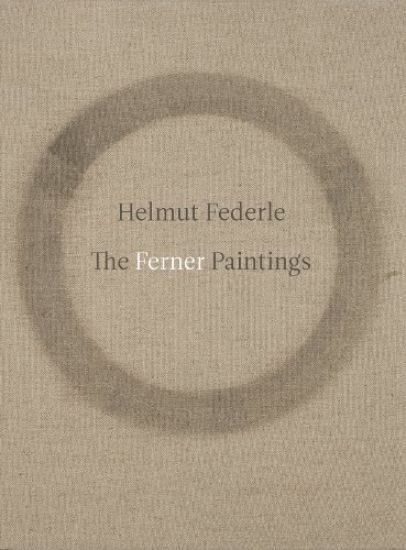
This publication details the most recent series by Swiss painter Helmut Federle (born 1944), titled The Ferner Paintings, each depicting dark circles. The circles are not painted but stained, the result of carefully applied vegetable oil.
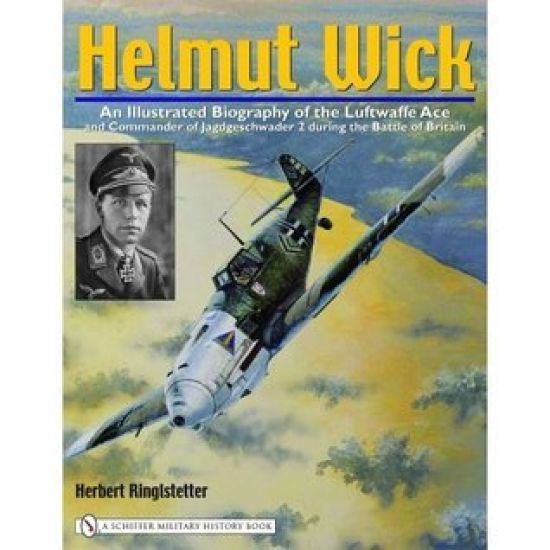
Major Helmut Wick failed to return from a mission over the English Channel on 28 November 1940 and is listed as missing to this day. This fate ended a picture book military and flying career. In just three months Helmut Wick had risen from Oberleutnant and Staffelkapitän to Kommodore of the tradition-rich Jagd-geschwader “Richthofen” Nr. 2 and with fifty-six victories had become the leading German fighter pilot. At the time he was the youngest Major and Geschwader-kommodore in the Luftwaffe. With statements from witnesses, including former foes, and with more than 220 photographs and documents, some never before published, Herbert Ringlstetter has created a true picture of Helmut Wick. Not only was he a daring and highly-decorated fighter pilot, but the father of two children and a husband who left behind a grieving wife. The photographic account is supplemented by color profiles of the aircraft flown by Helmut Wick and his opponents.
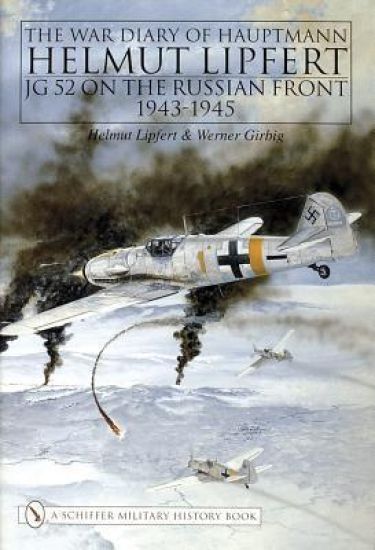
Aerial combat over the Russian front from one who knew it first hand. Hauptmann Helmut Lipfert's vivid portrayal of his experiences in JG 52 during the last three years of the Second World War will stand as one of the truly classic chronicles of the Jagdwaffe over Russia. JG 52 Experten Walter Krupinski, Erich Hartmann, Gerhard Barkhorn and Heinz Ewald make their way through Lipfert's memoirs in an epic tale of combat over the Caucasus, Crimea, Hungary, and Rumania during the late war years of 1943-1945. Lipfert begins the story with his early experiences in the Bf 109 G-2 over Russia in II/JG 52 in 1943, and ends with I/JG 53 in 1945 with 203 aerial victories, one of the few pilots in histiry to reach 200. This book is a rare view into the air war over Russia, when Luftwaffe pilots accumulated incredible kill tallies while facing overwhelming odds against them in mass assaults. Werner Girbig is the author of Six Months to Oblivion-the Defeat of the Luftwaffe Fighter Force Over the Western Front 1944/45(available from Schiffer Military/Aviation History), and unit histories of JG 27 and JG 5.
This story is no romance. Its brutal, gruesome, horrible and totally indefensible. However, it is action, misadventure and things gone wrong, and as such, it is a story about mayhem and murder.
The former West German chancellor Helmut Schmidt grew up as a devout Anglophile, yet he clashed heavily and repeatedly with his British counterparts Wilson, Callaghan, and Thatcher during his time in office. Helmut Schmidt and British-German Relations looks at Schmidt's personal experience to explore how and why Britain and Germany rarely saw eye to eye over European integration, uncovering the two countries' deeply competing visions and incompatible strategies for post-war Europe. But it also zooms out to reveal the remarkable extent of simultaneous British-German cooperation in fostering joint European interests on the wider international stage, not least within the transatlantic alliance against the background of a worsening superpower relationship. By connecting these two key areas of bilateral cooperation, Mathias Haeussler offers a major reinterpretation of the bilateral relationship under Schmidt, relevant to anybody interested in British-German relations, European integration, and the Cold War.