For thousands of years prior to Henry Hudson’s voyage, the Hudson River was a vital commercial and strategic route for the indigenous peoples who settled near its banks. The river’s importance continued for centuries afterward, linking the great trading center of Manhattan with remote places upstate and beyond. In Revolutionary times, the successful struggle for the Hudson was key to American victory over the power of the British military.The Hudson River railroad succeeded earlier modes of transportation in the Hudson Valley—the river sloop, the Albany Post Road, the steamboat, and the Erie Canal. The Hudson Line was both an early product of America’s industrial age and a catalyst for the intense and complex developments of that age.The advent of photography coincided with the inauguration of the Hudson River railroad, and American photographers were on-hand to witness and record the progress of commerce and community in the villages, towns, and cities along the Hudson River Line.
For thousands of years prior to Henry Hudson’s voyage, the Hudson River was a vital commercial and strategic route for the indigenous peoples who settled near its banks. The river’s importance continued for centuries afterward, linking the great trading center of Manhattan with remote places upstate and beyond. In Revolutionary times, the successful struggle for the Hudson was key to American victory over the power of the British military.The Hudson River railroad succeeded earlier modes of transportation in the Hudson Valley—the river sloop, the Albany Post Road, the steamboat, and the Erie Canal. The Hudson Line was both an early product of America’s industrial age and a catalyst for the intense and complex developments of that age.The advent of photography coincided with the inauguration of the Hudson River railroad, and American photographers were on-hand to witness and record the progress of commerce and community in the villages, towns, and cities along the Hudson River Line.
Two hearts, one boat, and a race against time-will love or work win the day?When workaholic obstetrician Julie decides to join a dragon boat team, she never expected to be so captivated by enigmatic team captain Rae. Dragon boat was supposed to help change up her routine, not blow her entire life out of the water, but now Rae is making her question every decision she's ever made.Rae has always been a natural caretaker, and seeing Julie's all work-no play approach to life brings out all of their protective tendencies. The unending shifts and emotional toil of working at a busy Toronto hospital isn't sustainable, but no matter how many times Rae points that out, Julie doesn't seem willing to change. As they train for the biggest regatta of the year, Rae and Julie must decide whether their budding love is worth fighting for, or if they'll let Julie's dedication to her job drive them apart.DRAGON BOATS & DOCTOR'S NOTES is a sapphic, opposites attract, sports romance with F/X main characters.
"One of the brightest new voices in the genre." --Annabeth Albert, author of Conventionally YoursOne night wasn't enough.Danny Ip walks into every boardroom with a plan. His plan for struggling tech company WesTec is to acquire it, shut it down, and squeeze the last remaining revenue out of it for his Jade Harbour Capital portfolio. But he didn't expect his best friend's younger brother--the hottest one-night stand he ever had--to be there.Tobin Lok has always thought the world of Danny. He's funny, warm, attractive--and totally out of Tobin's league. Now, pitted against Danny at work, Tobin might finally get a chance to prove he's more than just Wei's little brother.It takes a lot to get under Danny's skin, but Tobin is all grown up in a way Danny can't ignore. Now, with a promising patent on the line and the stakes higher than ever, all he can think about is getting Tobin back into his bed--and into his life for good.If only explaining their relationship to Wei could be so easy...Carina Adores is home to romantic love stories where LGBTQ+ characters find their happily-ever-afters.Jade Harbour CapitalBook 1: Hard SellBook 2: Going Public
"A childhood crush gets a second chance in this heartwarming gay romance." --Publishers Weekly on Hard Sell A boss and his employee must work together on more than just office politics in this thoughtful, sexy romance from Hudson Lin. As an operating partner at Jade Harbour, Raymond Chao prides himself in fixing even the most disastrous of portfolio companies--no matter the cost. While his colleagues might not always like his methods, they love his results. But his latest business partner isn't cooperating, and what's worse, Raymond's underhanded tactics have landed him in hot water with the law. Elvin Goh has been Raymond's assistant for years, and he's been in love with the charming, ruthless playboy for just as long. There's very little that Elvin won't do--or hasn't done--for Raymond. Impossible crush aside, it's his job. But this time, even Elvin can't see a way out. When long nights in the office lead to whispered confessions and a newfound intimacy, it seems like a dream come true--for both of them. But with the prospect of failure on the horizon, can this dream team beat the odds and come out the victors in the office and in their hearts? Carina Adores is home to romantic love stories where LGBTQ+ characters find their happily-ever-afters.Jade Harbour CapitalBook 1: Hard SellBook 2: Going Public
He's come in from the field, but the darkness has followed him home.After a decade as an aid worker, Cameron Donnelly returns home jaded, tired, and with more than just a minor case of PTSD. Plagued by recurring nightmares but refusing to admit he has a problem, Cam quickly spirals into an alcohol-infused depression, and everyone around him is at a loss for how to help.Journalist Tyler Ang met Cam on a reporting assignment in Kenya, and their first encounters were rife with hostility and sexual tension. Back in New York, their paths continually cross, and each time, Cam's brokenness reminds Ty more and more of his own difficult childhood. Letting Cam in goes against Ty's instinct to live life autonomously, but the damaged aid worker manages to sneak past his guard.Their relationship is all sharp corners and rough edges, and just as they're figuring out how to fit together, a life-threatening accident puts it all in jeopardy. If they want a future together, both will have to set aside their egos and learn to carry each other's burdens.
Ben is looking for an adventure when he accepts a temporary assignment in Hong Kong, but he never anticipates how his life might change when he meets a sophisticated, intriguing man named Sai. Their initial attraction is sizzling and soon grows into more as Sai takes Ben on a tour of the city's famous landmarks and introduces him to the local cuisine. Sai stimulates Ben's intellect and curiosity, and for jaded corporate lawyer Sai, Ben's innocent eagerness is a breath of fresh air. It would be so easy to fall in love....But nothing is that simple. Sai's job forces him to do things that violate his morals, and the difficult dynamics with his family is a major obstacle to any lasting relationship with Ben. For Ben, he misses his family back in Toronto, and can he really leave behind his home for a man he's only known a short time? With the clock ticking, they must decide whether to risk it all and turn three months into forever.
In March 2014, Eric Larsen and Ryan Waters set out to traverse nearly 500 miles across the melting Arctic Ocean, unsupported, from Northern Ellesmere Island to the geographic North Pole. Despite being one of the most cold and hostile environments on the planet, the Arctic Ocean has seen a steady and significant reduction of sea ice over the past seven years due to climate change. Because of this, Larsen’s and Waters’ trip—dubbed the “Last North Expedition”—is expected to be the last human-powered trek to the North Pole, ever. Filled with stunning, full-color photos and GPS maps plotting his progress, On Thin Ice is Larsen’s first-person account of this historic two-man expedition. Traveling across the retreating sea ice on skis, snowshoes, and even swimming through semi-frozen arctic slush, Larsen and Waters each pulled over 320 pounds of gear behind them on sleds through temperatures that plummeted to nearly 70 degrees below zero. At times, they covered little over a mile a day. They were stalked by polar bears and ran out of food. It was, in Larsen’s words, “easily one of the most difficult expeditions in the world.” More than just a heart-stopping adventure narrative, however, On Thin Ice offers an intimate and haunting look at the rapidly changing face of the Arctic due to global climate change.
In March 2014, Eric Larsen and Ryan Waters set out to traverse nearly 500 miles across the melting Arctic Ocean, unsupported, from Northern Ellesmere Island to the geographic North Pole. Despite being one of the most cold and hostile environments on the planet, the Arctic Ocean has seen a steady and significant reduction of sea ice over the past seven years due to climate change. Because of this, Larsen’s and Waters’ trip—dubbed the “Last North Expedition”—is expected to be the last human-powered trek to the North Pole, ever. Filled with stunning, full-color photos and GPS maps plotting his progress, On Thin Ice is Larsen’s first-person account of this historic two-man expedition. Traveling across the retreating sea ice on skis, snowshoes, and even swimming through semi-frozen arctic slush, Larsen and Waters each pulled over 320 pounds of gear behind them on sleds through temperatures that plummeted to nearly 70 degrees below zero. At times, they covered little over a mile a day. They were stalked by polar bears and ran out of food. It was, in Larsen’s words, “easily one of the most difficult expeditions in the world.” More than just a heart-stopping adventure narrative, however, On Thin Ice offers an intimate and haunting look at the rapidly changing face of the Arctic due to global climate change.
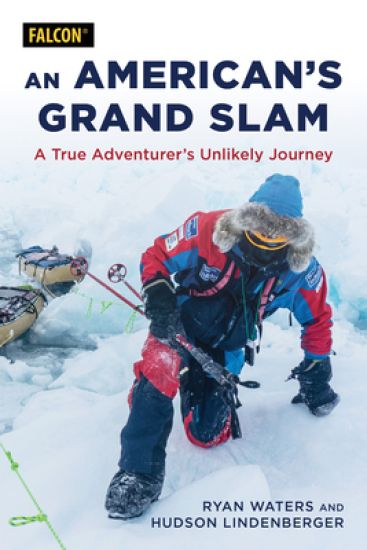
On May 6, 2014 Ryan Waters accomplished something that has not been replicated since. He and fellow explorer Eric Larsen stood atop the geographic North Pole, after 53 grueling days battling their way over an ever-melting sheet of ice that fought against them the entire way. By reaching the pole the two adventurers became the last persons to date to complete an unsupported trip to the North Pole from land. The ice sheet that used to link the Pole to land in Canada, once so thick and sturdy, has so degraded over the last few decades that explorers have had to abandon any attempts to cross it.While reaching the North Pole was monumental for Waters it also was the final piece needed to complete a project that he had been persistently working on for over a decade, the True Adventurers Grand Slam—standing atop the Seven Summits and skiing full length, unsupported and unassisted, expeditions to both the North and South Poles. His accomplishment that day made him just the 9th person and first American to gain entry into this exclusive club.Never one to embrace the easy path, Waters seemed to thrive in battling through whatever the fates threw at him, sometimes even deliberately seeking out struggles. Despite having little experience cross-country skiing, he decided to go to the South Pole. Eschewing the more typical route, he and partner Cecilie Skog completed the first traverse of Antarctica without the use of resupplies or kites. Skiing from Berkner Island in the Weddell Sea, via the South Pole, to the Ross Ice Shelf, the pair skied for 70 days and covered 1200 miles, 9 years prior to the much publicized 2019 “race” across Antarctica. To this day the two hold the record for the longest unsupported crossing of the continent without the use of kites.How Waters ended up standing atop the North Pole on that fateful day is a story of hope, perseverance, faith, and a fair share of dumb luck. From his youth traipsing around the Georgia hills to his time leading expeditions around the Himalayas, including five summits of Everest, Waters has always seemed to stumble into the next fortuitous step of his journey, often ending up in the most unlikely places. This is tempered by the fact that early in Waters’ outdoor career, he learned to live by a simple credo: “you have to make things happen for yourself.” At the beginning of his climbing career, he was consumed by passion for the mountains, every decision was leading to the next mountaineering challenge. Eventually giving up a stable career as a geologist, he had a self-described “mid 20’s crisis,” left his 401K and comfortable salary for living out of his truck and 40 dollars a day as a part-time climbing instructor. Following his dream of a life of adventure in exchange for a life of obeying societal norms, he set out to build a mountain resume that would enable him to circle the Earth and work as a mountain guide in the Himalayas and beyond.After almost two decades of hard expeditions around the planet, his experiences include being on a hijacked airplane in Russia, rescue of injured climbers in the Karakoram Himalaya of Pakistan, the Everest Base Camp earthquake disaster, narrowly missing out on the K2 2008 tragedy, near misses with avalanches, the deaths of close climbing partners, close encounters with Polar Bears on the Arctic Ocean, relationships with fellow adventurers, and much more.
New York's Hudson River Valley is a place of beauty and history. It is also one of the most haunted regions in the country. Read about ancient Indian spirits at Spook Rock, where an innocent girl was murdered in an act of revenge. Encounter soldiers who still walk the battlefield of Fort Montgomery. Visit haunted houses that line the streets of the old Dutch settlements in New Paltz and Hurley, and see a misty figure that haunts the Sickletown Road Cemetery. Beware; a passing shadow or faint whisper may signal that you have just had an encounter in haunted Hudson Valley.
What do you get when you take the tranquil Hudson Valley of New York and add four serial killers, a mass murderer, and a handful of other men and women with guns, knives, and axes, who have homicidal tendencies? You get a fascinating history of unthinkable criminal acts perpetrated against spouses, family members, and complete strangers in a region where still to this day, some people don't even lock their doors. The cases in this book span over a century, and occur in quiet, rural areas, and in bustling town centers. These homicides were committed by both genders, and by people ranging in age from a teen to a senior citizen. The murderers were both highly educated and intelligent, as well as those who were most decidedly not either. In other words, there is no discernible pattern, no cookie cutter description of who is capable of committing these brutal crimes. The next murderer or serial killer could be anyone; your boss, your neighbor, your brother, your best friend, or your wife. Perhaps after reading this book, you'll make sure all of your doors are locked.
Award-winning author Linda Zimmermann brings together years of research into a comprehensive examination of over a century of UFO sightings in the Hudson Valley of New York, as well as northern New Jersey and western Connecticut. Combining eyewitness accounts and archival material, Zimmermann presents a startling view of what has been occurring in our skies for generations. Chapters include Mysterious Airships of the early 1900s, discs, triangles, rectangles, abductions, the massive wave of sightings in the 1980s, and Pine Bush, known as the UFO Capital of the Northeast.
This is a new kind of textbook for courses in introductory linguistics. It makes clear what is important or essential, and omits what is not. It is strictly selective, highly structured, focused, to-the-point and informative. It presents material in a way that mirrors the structure of a typical semester of teaching, and integrates many exercises into the text.
While humanitarian organizations and media outlets often reduce Syrian refugees to statistics or brief anecdotes, the real story of displacement unfolds in the intimate spaces of family life. Through the interwoven narratives of five middle-aged sisters from Damascus, Lines of Flight, Assemblages of Home reveals how Syrian women navigate war, exile, and the profound transformation of their families and identities. Drawing on extensive interviews conducted between 2015 and 2017, this book follows an extended Sunni Muslim family as they flee their homes in Damascus’s Eastern Ghouta suburbs and scatter across Lebanon, Jordan, Turkey, Egypt, and eventually Europe. As these women move through an increasingly hostile landscape of border controls, refugee camps, and human trafficking networks, they must reinvent themselves—from stable middle-class mothers to resourceful survivors, from guardians of tradition to architects of change. Their journeys challenge conventional assumptions about refugee experiences, revealing how displacement reconfigures family networks, religious practices, and gender roles. Leila Hudson’s intimate portrait of Syrian displacement offers vital insights for researchers and practitioners working in humanitarian assistance, refugee resettlement, and forced migration. It provides essential reading for anyone seeking to understand how ordinary families navigate extraordinary circumstances, and how women in particular bear both the burdens and opportunities of displacement.