Kirjojen hintavertailu. Mukana 11 342 296 kirjaa ja 12 kauppaa.

Kirjahaku

Etsi kirjoja tekijän nimen, kirjan nimen tai ISBN:n perusteella.

1000 tulosta hakusanalla Jacques Derrida

Jacques Derrida

Jacques Derrida

Geoffrey Bennington; Jacques Derrida

University of Chicago Press
1999
nidottu
Geoffrey Bennington sets out here to write a systematic account of the thought of Jacques Derrida. Responding to Bennington's text at every turn is Derrida's own, excerpts from his life and thought that resist circumscription. Together these texts, as a dialogue and a contest, constitute a critical introduction to one of the leading philosophers of the 20th century. Bennington's account of Derrida leads the reader through the philosopher's work on language and writing, and through more mysterious themes of signature, sexual difference, law, and affirmation. Seeking to escape this systematic rendering - in fact, to prove it impossible - Derrida interweaves Bennington's text with surprising and disruptive "periphrases": reflections on his mother's death agony, commentaries on St. Augustine's "Confessions", memories of childhood, remarks on Judaism, and references to his collaborator's efforts.
Jacques Derrida

Jacques Derrida

Marian Hobson

Routledge
1998
sidottu
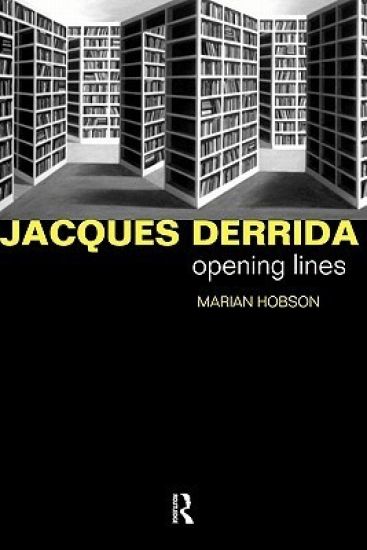
In Jacques Derrida: Opening Lines, Marian Hobson gives us a thorough and elegant analysis of this controversial and seminal contemporary thinker. Looking closely at the language and the construction of some of Derrida's philosophy, Hobson suggests the way he writes, indeed the fact he writes in another language, affects how he can be understood by English speakers.This superb study on the question of language will make illuminating reading for anyone studying or engaged with Derrida's philosophy.
Jacques Derrida

Jacques Derrida

Marian Hobson

Routledge
1998
nidottu
In Jacques Derrida: Opening Lines, Marian Hobson gives us a thorough and elegant analysis of this controversial and seminal contemporary thinker. Looking closely at the language and the construction of some of Derrida's philosophy, Hobson suggests the way he writes, indeed the fact he writes in another language, affects how he can be understood by English speakers.This superb study on the question of language will make illuminating reading for anyone studying or engaged with Derrida's philosophy.
Jacques Derrida

Jacques Derrida

Nicholas Royle

Routledge
2003
sidottu
There are few figures more important in literary and critical theory than Jacques Derrida. Whether lauded or condemned, his writing has had far-reaching ramifications, and his work on deconstruction cannot be ignored. This volume introduces students of literature and cultural studies to Derrida's enormously influential texts, covering such topics as: deconstruction, text and difference; literature and freedom; law, justice and the 'democracy to come'; drugs, secrets and gifts. Nicholas Royle's unique book, written in an innovative and original style, is an outstanding introduction to the methods and significance of Jacques Derrida.
Jacques Derrida

Jacques Derrida

Nicholas Royle

Routledge
2003
nidottu
There are few figures more important in literary and critical theory than Jacques Derrida. Whether lauded or condemned, his writing has had far-reaching ramifications, and his work on deconstruction cannot be ignored. This volume introduces students of literature and cultural studies to Derrida's enormously influential texts, covering such topics as: deconstruction, text and difference; literature and freedom; law, justice and the 'democracy to come'; drugs, secrets and gifts. Nicholas Royle's unique book, written in an innovative and original style, is an outstanding introduction to the methods and significance of Jacques Derrida.
Jacques Derrida

Jacques Derrida

Jacques De Ville

Routledge
2011
sidottu
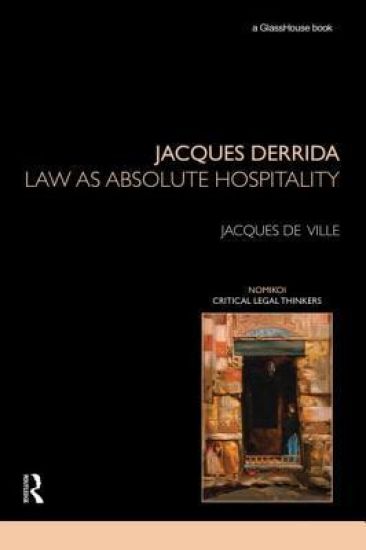
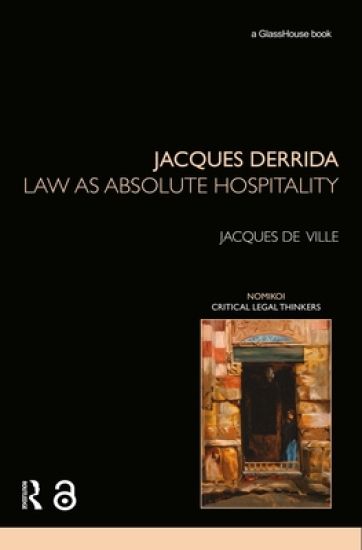
Jacques Derrida: Law as Absolute Hospitality presents a comprehensive account and understanding of Derrida’s approach to law and justice. Through a detailed reading of Derrida’s texts, Jacques de Ville contends that it is only by way of Derrida's deconstruction of the metaphysics of presence, and specifically in relation to the texts of Husserl, Levinas, Freud and Heidegger - that the reasoning behind his elusive works on law and justice can be grasped. Through detailed readings of texts such as To speculate – on Freud, Adieu, Declarations of Independence, Before the Law, Cogito and the history of madness, Given Time, Force of Law and Specters of Marx, De Ville contends that there is a continuity in Derrida’s thinking, and rejects the idea of an ‘ethical turn’. Derrida is shown to be neither a postmodernist nor a political liberal, but a radical revolutionary. De Ville also controversially contends that justice in Derrida’s thinking must be radically distinguished from Levinas’s reflections on ‘the other’. It is the notion of absolute hospitality - which Derrida derives from Levinas, but radically transforms - that provides the basis of this argument. Justice must on De Ville’s reading be understood in terms of a demand of absolute hospitality which is imposed on both the individual and the collective subject. A much needed account of Derrida's influential approach to law, Jacques Derrida: Law as Absolute Hospitality will be an invaluable resource for those with an interest in legal theory, and for those with an interest in the ethics and politics of deconstruction.
Jacques Derrida

Jacques Derrida

Jacques de Ville

Routledge
2012
nidottu
Jacques Derrida: Law as Absolute Hospitality presents a comprehensive account and understanding of Derrida’s approach to law and justice. Through a detailed reading of Derrida’s texts, Jacques de Ville contends that it is only by way of Derrida's deconstruction of the metaphysics of presence, and specifically in relation to the texts of Husserl, Levinas, Freud and Heidegger - that the reasoning behind his elusive works on law and justice can be grasped. Through detailed readings of texts such as To speculate – on Freud, Adieu, Declarations of Independence, Before the Law, Cogito and the history of madness, Given Time, Force of Law and Specters of Marx, De Ville contends that there is a continuity in Derrida’s thinking, and rejects the idea of an ‘ethical turn’. Derrida is shown to be neither a postmodernist nor a political liberal, but a radical revolutionary. De Ville also controversially contends that justice in Derrida’s thinking must be radically distinguished from Levinas’s reflections on ‘the other’. It is the notion of absolute hospitality - which Derrida derives from Levinas, but radically transforms - that provides the basis of this argument. Justice must on De Ville’s reading be understood in terms of a demand of absolute hospitality which is imposed on both the individual and the collective subject. A much needed account of Derrida's influential approach to law, Jacques Derrida: Law as Absolute Hospitality will be an invaluable resource for those with an interest in legal theory, and for those with an interest in the ethics and politics of deconstruction.
Jacques Derrida

Jacques Derrida

Jason Powell

Continuum International Publishing Group Ltd.
2006
sidottu
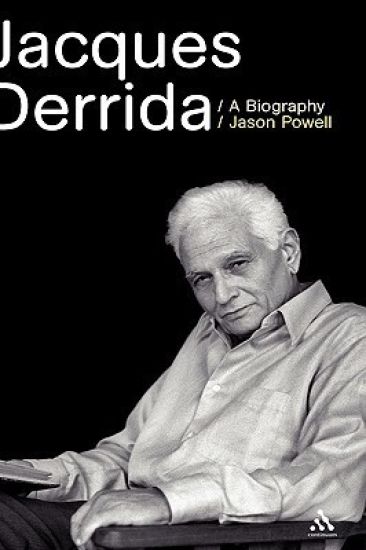
At the time of his death in 2004, Jacques Derrida was arguably the most influential and the most controversial thinker in contemporary philosophy. Deconstruction, the movement that he founded, has received as much criticism as admiration and provoked one of the most contentious philosophical debates of the twentieth century. Derrida's contribution to European and American literary and philosophical culture was enormous and a comprehensive overview of his extraordinary life and work is long overdue. "Jacques Derrida: A Biography" offers, for the first time, a complete biographical overview of this important philosopher, drawing on Derrida's own accounts of his life, as well as the narratives of friends and colleagues. Powell explores Derrida's early life in Algeria, his higher education in Paris and his development as a thinker, before examining the extraordinary influence of his published works and the celebrity status that he achieved in both Europe and the USA. Powell goes on to explore the crisis Derrida faced toward the end of the 1970s, when structuralism was waning, and his renewed efforts to create a public forum for deconstruction, often in the face of fierce criticism from the popular press. He concludes with an account of his last years and publications, which are both reflective and more assertive in their commentary on the times in which we live, bringing to light his thoughts on fame, life, and death. "Jacques Derrida: A Biography" provides an essential and engaging account of this major philosopher's remarkable life and work.
Jacques Derrida

Jacques Derrida

Jason Powell

Continuum International Publishing Group Ltd.
2006
nidottu
At the time of his death in 2004, Jacques Derrida was arguably the most influential and the most controversial thinker in contemporary philosophy. Deconstruction, the movement that he founded, has received as much criticism as admiration and provoked one of the most contentious philosophical debates of the twentieth century. Derrida's contribution to European and American literary and philosophical culture was enormous and a comprehensive overview of his extraordinary life and work is long overdue. "Jacques Derrida: A Biography" offers for the first time a complete biographical overview of this important philosopher, drawing on Derrida's own accounts of his life as well as the narratives of friends and colleagues. Powell explores Derrida's early life in Algeria, his higher education in Paris and his development as a thinker, before examining the extraordinary influence of his published works and the celebrity status that he achieved in both Europe and the USA. Powell goes on to explore the crisis Derrida faced toward the end of the 1970's, when structuralism was waning, and his renewed efforts to create a public forum for deconstruction, often in the face of fierce criticism from the popular press. He concludes with an account of his last years and publications, which are both reflective and more assertive in their commentary on the times in which we live, bringing to light his thoughts on fame, life, and death. "Jacques Derrida: A Biography" provides an essential and engaging account of this major philosopher's remarkable life and work.
Jacques Derrida
This collection of essays on Jacques Derrida, first published in 2004, spans nearly thirty years of critical thinking about Derrida's work. The articles selected here have never previously been collected, yet they are significant contributions that illuminate difficult and important aspects of Derrida's writings. While not seeking to be comprehensive, the volume ranges over the entirety of Derrida's published output and addresses a number of crucial topics, including literature, iterability, the signature, time, alterity, Judaism, metaphor and death. Reprinted here in chronological order of first publication, the essays are complemented by an introduction by Ian MacIachlan which discusses the significance of Derrida's work for our critical thinking.
Jacques Derrida
This collection of essays on Jacques Derrida, first published in 2004, spans nearly thirty years of critical thinking about Derrida's work. The articles selected here have never previously been collected, yet they are significant contributions that illuminate difficult and important aspects of Derrida's writings. While not seeking to be comprehensive, the volume ranges over the entirety of Derrida's published output and addresses a number of crucial topics, including literature, iterability, the signature, time, alterity, Judaism, metaphor and death. Reprinted here in chronological order of first publication, the essays are complemented by an introduction by Ian MacIachlan which discusses the significance of Derrida's work for our critical thinking.
Jacques Derrida

Jacques Derrida

TAYLOR FRANCIS LTD
2022
nidottu
This collection of essays on Jacques Derrida spans nearly thirty years of critical thinking about Derrida's work. The articles selected here have never previously been collected, yet they are significant contributions that illuminate difficult and important aspects of Derrida's writings. While not seeking to be comprehensive, the volume ranges over the entirety of Derrida's published output and addresses a number of crucial topics, including literature, iterability, the signature, time, alterity, Judaism, metaphor and death. Reprinted here in chronological order of first publication, the essays are complemented by an introduction by Ian Maclachlan which discusses the significance of Derrida's work for our critical thinking.
Jacques Derrida

Jacques Derrida

Acumen Publishing Ltd
2014
sidottu
Jacques Derrida: Key Concepts presents a broad overview and engagement with the full range of Derrida's work - from the early phenomenological thinking to his preoccupations with key themes, such as technology, psychoanalysis, friendship, Marxism, racism and sexism, to his ethico-political writings and his deconstruction of democracy. Presenting both an examination of the key concepts central to his thinking and a broader study of how that thinking shifted over a lifetime, the book offers the reader a clear, systematic and fresh examination of the astounding breadth of Derrida's philosophy.
Jacques Derrida

Jacques Derrida

Acumen Publishing Ltd
2014
nidottu
Jacques Derrida: Key Concepts presents a broad overview and engagement with the full range of Derrida's work - from the early phenomenological thinking to his preoccupations with key themes, such as technology, psychoanalysis, friendship, Marxism, racism and sexism, to his ethico-political writings and his deconstruction of democracy. Presenting both an examination of the key concepts central to his thinking and a broader study of how that thinking shifted over a lifetime, the book offers the reader a clear, systematic and fresh examination of the astounding breadth of Derrida's philosophy.
Jacques Derrida

Jacques Derrida

Christopher Mark Watkin

P R Publishing Co (Presbyterian Reformed)
2017
nidottu
Christian thinkers and writers who address Jacques Derrida's philosophy face two potential pitfalls. One is to recast Christianity in an ill-fitting Derridean mold; the other is to ascribe to Derrida objectionable positions that bear little relation to his writing.
 
 To avoid these hazards, Christopher Watkin, a scholar of French literature and philosophy, walks in Derrida's shoes through the landscape of recent thought and culture, seeking to understand the rationale for Derrida's philosophical moves in light of his assumptions and commitments in philosophy, literature, ethics, and politics. He then sets these assumptions in the wider context of God's nature and purposes in history, providing biblical critique.
 
 Learn why Derrida says what he does and how Christians can receive and respond to his writing in a balanced, biblical way that is truly beneficial.
Jacques Derrida: Basic Writings
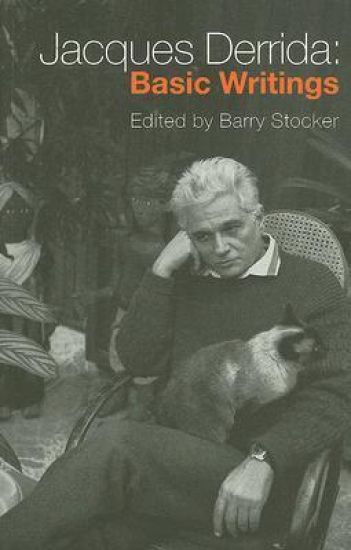
One of the most influential and controversial thinkers of the twentieth-century, Jacques Derrida’s ideas on deconstruction have had a lasting impact on philosophy, literature and cultural studies.Jacques Derrida: Basic Writings is the first anthology to present his most important philosophical writings and is an indispensable resource for all students and readers of his work. Barry Stocker’s clear and helpful introductions set each reading in context, making the volume an ideal companion for those coming to Derrida’s writings for the first time. The selections themselves range from his most infamous works including Speech and Phenomena and Writing and Difference to lesser known discussion on aesthetics, ethics and politics.
Jacques Derrida: Basic Writings
One of the most influential and controversial thinkers of the twentieth-century, Jacques Derrida’s ideas on deconstruction have had a lasting impact on philosophy, literature and cultural studies.Jacques Derrida: Basic Writings is the first anthology to present his most important philosophical writings and is an indispensable resource for all students and readers of his work. Barry Stocker’s clear and helpful introductions set each reading in context, making the volume an ideal companion for those coming to Derrida’s writings for the first time. The selections themselves range from his most infamous works including Speech and Phenomena and Writing and Difference to lesser known discussion on aesthetics, ethics and politics.
Jacques Derrida and the Humanities

Jacques Derrida and the Humanities

Cambridge University Press
2002
sidottu
The work of Jacques Derrida has transformed our understanding of a range of disciplines in the humanities through its questioning of some of the basic tenets of western metaphysics. This volume is a trans-disciplinary collection dedicated to his work; the assembled contributions - on law, literature, ethics, history, gender, politics and psychoanalysis, among others - constitute an investigation of the role of Derrida's work within the field of humanities, present and future. The volume is distinguished by work on some of his most recent writings, and contains Derrida's own address on 'the future of the humanities'. In addition to its pedagogic interest, this collection of essays attempts to respond to the question: what might be the relation of Derrida, or 'deconstruction' to the future of the humanities? The volume presents the most sustained examples yet of what deconstruction is in its current phase - as well as what its possible future may be.
Jacques Derrida and the Humanities

Jacques Derrida and the Humanities

Cambridge University Press
2002
pokkari
The work of Jacques Derrida has transformed our understanding of a range of disciplines in the humanities through its questioning of some of the basic tenets of western metaphysics. This volume is a trans-disciplinary collection dedicated to his work; the assembled contributions - on law, literature, ethics, history, gender, politics and psychoanalysis, among others - constitute an investigation of the role of Derrida’s work within the field of humanities, present and future. The volume is distinguished by work on some of his most recent writings, and contains Derrida’s own address on ‘the future of the humanities’. In addition to its pedagogic interest, this collection of essays attempts to respond to the question: what might be the relation of Derrida, or ‘deconstruction’ to the future of the humanities? The volume presents the most sustained examples yet of what deconstruction is in its current phase - as well as what its possible future may be.