Jacques Simon is unmistakably a very important link in the renewal of French landscape architecture. For the first time in an oeuvre, Anglo-Saxon and Scandinavian garden culture are combined with typically Latin structures, with classic architectural landscapes. He works as often as possible in situ, and does not shy away from driving the excavator himself. Since the eighties, he has also been creating transitory landscapes: with heavy and less heavy equipment, he brings patterns in fields, cultivated fields, snow-clad grounds, and so on. The list of important realisations by this landscape architect is impressive, and so is his influence.
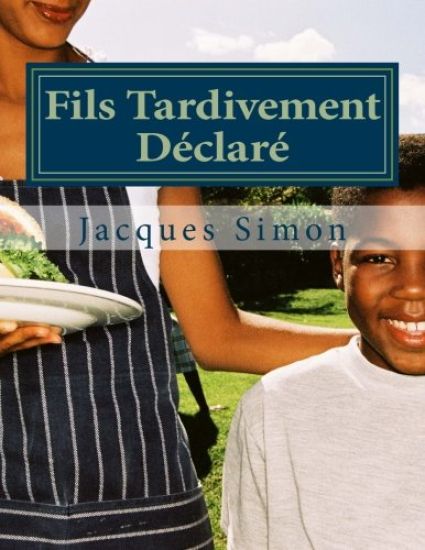
"Fils Tardivemdent D clar " est une oeuvre po tique dans laquelle l'auteur partage les souffrances des enfants, notamment des enfants sans p res, ou abandonn s un peu partout dans ce monde. Aussi ce r cit darde-t-il des lueurs d'espoir pour toutes les m res, mais surtout pour les m res c libataires en butte aux adversit s de la vie familiale du pr sent monde. Dans cette poesie narrative, Jean-Marc est venu au monde en pleine controverse. Quelques mois apr s sa naissance, il a t mis sous la tutelle de sa grand-m re, qui a contest le droit de sa pr matur e m re de l' lever. De sit t, son adolescente m re, Linda, a d le quitter et migrer vers un quartier lointain. D s sa naissance, ce gar on a t tenu dans l'ignorance de son p re que son a eule maternelle, farcie de pr jug s sociaux, a m pris . Entretemps, loin de ses parents, Linda fera tout pour soigner sa r putation. Gr ce son ducation, elle occupera une position enviable dans l'administration. Qui plus est, elle se conciliera l'admiration d'un riche pr tendant, qui sous peu la demandera en mariage Cependant, mari e, elle tiendra son poux dans l'ignorance de son fils vivant dans l'arri re-pays. Quelques ans plus tard, la grand-m re sera d c d e. Elle laissera son petit-fils Jean-Marc alors g de douze ans d sesp r , d prim , solitaire et mis rable. Finalement, ce jeune homme deviendra l'un des enfants les plus heureux de la plan te Mais comment?
This book is the first of a set dedicated to the mathematical tools used in partial differential equations derived from physics. Its focus is on normed or semi-normed vector spaces, including the spaces of Banach, Fréchet and Hilbert, with new developments on Neumann spaces, but also on extractable spaces. The author presents the main properties of these spaces, which are useful for the construction of Lebesgue and Sobolev distributions with real or vector values and for solving partial differential equations. Differential calculus is also extended to semi-normed spaces. Simple methods, semi-norms, sequential properties and others are discussed, making these tools accessible to the greatest number of students – doctoral students, postgraduate students – engineers and researchers without restricting or generalizing the results.
This book is the second of a set dedicated to the mathematical tools used in partial differential equations derived from physics. It presents the properties of continuous functions, which are useful for solving partial differential equations, and, more particularly, for constructing distributions valued in a Neumann space. The author examines partial derivatives, the construction of primitives, integration and the weighting of value functions in a Neumann space. Many of them are new generalizations of classical properties for values in a Banach space. Simple methods, semi-norms, sequential properties and others are discussed, making these tools accessible to the greatest number of students – doctoral students, postgraduate students – engineers and researchers, without restricting or generalizing the results.
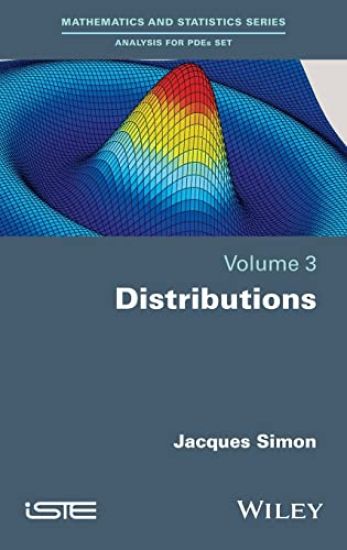
This book presents a simple and original theory of distributions, both real and vector, adapted to the study of partial differential equations. It deals with value distributions in a Neumann space, that is, in which any Cauchy suite converges, which encompasses the Banach and Fréchet spaces and the same “weak” spaces. Alongside the usual operations – derivation, product, variable change, variable separation, restriction, extension and regularization – Distributions presents a new operation: weighting.This operation produces properties similar to those of convolution for distributions defined in any open space. Emphasis is placed on the extraction of convergent sub-sequences, the existence and study of primitives and the representation by gradient or by derivatives of continuous functions. Constructive methods are used to make these tools accessible to students and engineers.