Kirjojen hintavertailu. Mukana 12 354 644 kirjaa ja 12 kauppaa.

Kirjahaku

Etsi kirjoja tekijän nimen, kirjan nimen tai ISBN:n perusteella.

1000 tulosta hakusanalla James Calbraith

The Shadow of Black Wings

The Shadow of Black Wings

James Calbraith

Flying Squid
2012
nidottu
"Fast paced and full of energy" -Adrian Tchaikovsky, author of the Shadows of the Apt "This manuscript is full of highly crafted detail that will make readers shiver at times with fear and delight ... a familiar yet highly original fantasy that is a worthwhile read." - Publishers Weekly Amazon Breakthrough Novel Award 2012 semi-finalist. An ancient empire stands on the brink of a civil war. His arrival may push it over the edge. It is the sixteenth year of Queen Victoria's enlightened rule and the world trembles before the might of her ironclad navy and the dreaded Dragon Corps. The largest ship ever built sails from the Brigstow Harbour on a journey to the mysterious lands of Orient. Its load - a regiment of the Royal Marines and one Bran ap Dylan - freshly graduate in Dracology at the Llambed Academy of Mystic Arts. In the empire of Yamato, sealed from the rest of the world for the last two centuries, a wizard's daughter Sato witnesses her father joining an anti-government conspiracy. Her friend Nagomi, training to be a priestess, is haunted by dark visions that she must keep secret. Neither of them is aware that a change is coming to Yamato... on the wings of a dragon. A detailed and fast-paced historical fantasy based around the turbulent opening of Japan to the West in the middle of the 19th century, "The Shadow of the Black Wings" is the first volume in "The Year of the Dragon" saga. The second volume, "The Warrior's Soul", is expected in August.

The Rising Tide

The Rising Tide

James Calbraith

Flying Squid
2013
nidottu
The thrilling conclusion to the hunt for the Crimson Robe in the fourth volume of the best-selling historical fantasy saga, "The Year of the Dragon". Bran, Sato and Nagomi embark on the final stage of their chase, aided by the last of the were-bears of Chinzei and the powerful and cunning Lord Nariakira of Satsuma. After the Battle of Shanglin, Wulfhere of Warwick finds himself an unlikely hero, while Dylan begins to have second thoughts over his role in the war. The wind from Edo brings tidings of war and oncoming Darkness. The sacred islands of Yamato are no longer safe beyond their barrier of winds and waves.
The Saxon Spears

The Saxon Spears

James Calbraith

Flying Squid
2020
pokkari
The old world is burning down A hero will rise from its ASH.Thirty years have passed since Britannia voted to throw off the Roman yoke. Now, the old world crumbles. Pirates roam the seas, bandits threaten the highways, and barbarian refugees land at Britannia's shores, uninvited. The rich profit from the chaos, while the poor suffer. A new Dark Age is approaching - but all is not lost.Ash is a Seaborn, a Saxon child found on the beach with nothing but a precious stone at his neck and a memory of a distant war from which his people have fled. Raised on the estate of a Briton nobleman, trained in warfare and ancient knowledge, he soon becomes embroiled in the machinations and intrigues at the court of Wortigern, the Dux of Londinium, a struggle that is about to determine the future of all Britannia. A child of Saxon blood, an heir to Roman family, his is a destiny like no other: to join the two races and forge a new world from the ruins of the old.
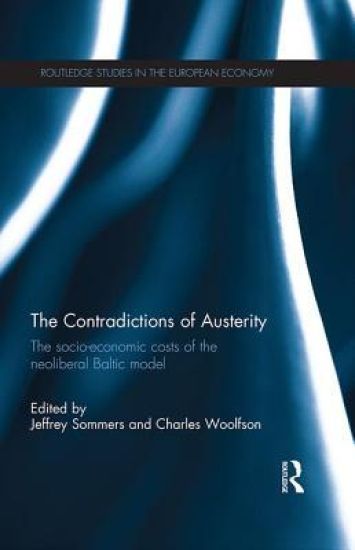
The Contradictions of Austerity

The Contradictions of Austerity

James Galbraith

Routledge
2014
sidottu
The great financial crisis of 2008 and the ensuing global economic and financial turmoil have launched a search for "models" for recovery. The advocates of austerity present the Baltic States as countries that through discipline and sacrifice showed the way out of crisis. They have proposed the "Baltic model" of radical public sector cuts, wage reductions, labor market reforms and reductions in living standards for other troubled Eurozone countries to emulate. Yet, the reality of the Baltic "austerity fix" has been neither fully accepted by its peoples, nor is it fully a success. This book explains why and what are the real social and economic costs of the Baltic austerity model.We examine each of the Baltic States by connecting national level studies within a European and global political economy, thereby delivering comparative breadth that supersedes localized understandings of the crisis. Thus for each of the three Baltic states, individual chapters explore the different economic and social dimensions of neo-liberal post-communism and the subsequent wider global economic and financial crisis in which these newly financialized economies have found themselves especially vulnerable. The "austerity model" adopted by Baltic national governments in response to the crisis reveals the profound vulnerabilities created by their unwavering commitment to liberalized economies, not least in terms of the significant "exit" of their labor forces and consequent population loss. This book looks beyond basic financial metrics claiming a success story for the Baltic austerity model to reveal the damaging economic and social consequences, first of neo-liberal policies adopted during transition, and latterly of austerity measures based on "internal devaluation." Combined these policies undermine the possibility of longer-term recovery and even social and economic sustainability, not to mention prospects for successful integration in the now-faltering European project that has departed from its "Social Model" roots.
The Contradictions of Austerity

The Contradictions of Austerity

James Galbraith

Routledge
2015
nidottu
The great financial crisis of 2008 and the ensuing global economic and financial turmoil have launched a search for "models" for recovery. The advocates of austerity present the Baltic States as countries that through discipline and sacrifice showed the way out of crisis. They have proposed the "Baltic model" of radical public sector cuts, wage reductions, labor market reforms and reductions in living standards for other troubled Eurozone countries to emulate. Yet, the reality of the Baltic "austerity fix" has been neither fully accepted by its peoples, nor is it fully a success. This book explains why and what are the real social and economic costs of the Baltic austerity model.We examine each of the Baltic States by connecting national level studies within a European and global political economy, thereby delivering comparative breadth that supersedes localized understandings of the crisis. Thus for each of the three Baltic states, individual chapters explore the different economic and social dimensions of neo-liberal post-communism and the subsequent wider global economic and financial crisis in which these newly financialized economies have found themselves especially vulnerable. The "austerity model" adopted by Baltic national governments in response to the crisis reveals the profound vulnerabilities created by their unwavering commitment to liberalized economies, not least in terms of the significant "exit" of their labor forces and consequent population loss. This book looks beyond basic financial metrics claiming a success story for the Baltic austerity model to reveal the damaging economic and social consequences, first of neo-liberal policies adopted during transition, and latterly of austerity measures based on "internal devaluation." Combined these policies undermine the possibility of longer-term recovery and even social and economic sustainability, not to mention prospects for successful integration in the now-faltering European project that has departed from its "Social Model" roots.
Kenneth Lee. [A Tale.]

Kenneth Lee. [A Tale.]

James Galbraith

British Library, Historical Print Editions
2011
pokkari
Title: Kenneth Lee. A tale.]Publisher: British Library, Historical Print EditionsThe British Library is the national library of the United Kingdom. It is one of the world's largest research libraries holding over 150 million items in all known languages and formats: books, journals, newspapers, sound recordings, patents, maps, stamps, prints and much more. Its collections include around 14 million books, along with substantial additional collections of manuscripts and historical items dating back as far as 300 BC.The FICTION & PROSE LITERATURE collection includes books from the British Library digitised by Microsoft. The collection provides readers with a perspective of the world from some of the 18th and 19th century's most talented writers. Written for a range of audiences, these works are a treasure for any curious reader looking to see the world through the eyes of ages past. Beyond the main body of works the collection also includes song-books, comedy, and works of satire. ++++The below data was compiled from various identification fields in the bibliographic record of this title. This data is provided as an additional tool in helping to insure edition identification: ++++ British Library Galbraith, James; 1873. 8 . 12638.bb.12.
Welcome to the Poisoned Chalice

Welcome to the Poisoned Chalice

James Kenneth Galbraith

Yale University Press
2016
sidottu
A world-renowned economist offers cogent and powerful reflections on one of the great avoidable economic catastrophes of the modern era The economic crisis in Greece is a potential international disaster and one of the most extraordinary monetary and political dramas of our time. The financial woes of this relatively small European nation threaten the long-term viability of the Euro while exposing the flaws in the ideal of continental unity. "Solutions" proposed by Europe’s combined leadership have sparked a war of prideful words and stubborn one-upmanship, and they are certain to fail, according to renowned economist James K. Galbraith, because they are designed for failure. It is this hypocrisy that prompted former finance minister Yanis Varoufakis, when Galbraith arrived in Athens as an adviser, to greet him with the words “Welcome to the poisoned chalice.” In this fascinating, insightful, and thought-provoking collection of essays—which includes letters and private memos to both American and Greek officials, as well as other previously unpublished material—Galbraith examines the crisis, its causes, its course, and its meaning, as well as the viability of the austerity program imposed on the Greek citizenry. It is a trenchant, deeply felt commentary on what the author calls “economic policy as moral abomination,” and an eye-opening analysis of a contemporary Greek tragedy much greater than the tiny economy of the nation itself.
Summary: The Predator State: Review and Analysis of James K. Galbraith's Book
The must-read summary of James K. Galbraith's book: "The Predator State: How Conservatives Abandoned the Free Market and Why Liberals Should Too". This complete summary of "The Predator State" by James K. Galbraith, a renowned American economist, presents his argument that Reagan's economic policies were replaced by capitalism under the Bush administration, and that tax cuts, deregulation and privatization will eventually lead to lower prosperity and economic disaster. Added-value of this summary: - Save time- Understand how the free market economy damages long-term prosperity- Expand your knowledge of American politics and economics To learn more, read "The Predator State" and discover how further deregulation and less government involvement could lead to disaster.
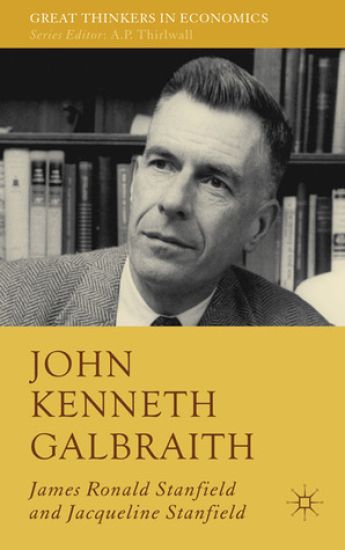
John Kenneth Galbraith

John Kenneth Galbraith

James Ronald Stanfield

Palgrave Macmillan
2010
sidottu
This book examines the life and work of John Kenneth Galbraith, a truly iconic figure in progressive modern liberalism and a seminal influence in the rise of heterodox political economy. It emphasizes his continuing relevance to the current research of today, and to the multifaceted crisis of democratic capitalism.
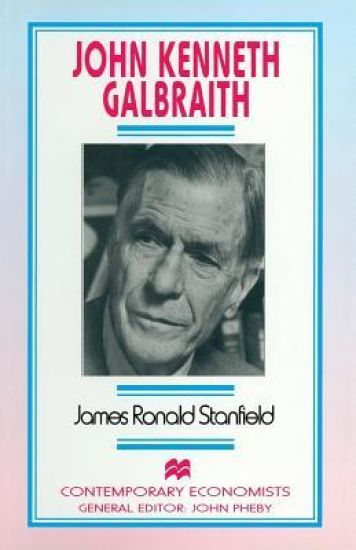
John Kenneth Galbraith

John Kenneth Galbraith

James Ronald Stanfield

Palgrave Macmillan
1996
sidottu
This book provides an intellectual portrait of John Kenneth Galbraith, an institutional economist who examines the configuration of power by the clusters of mores that comprise institutions. Galbraith proposes an aggressive social democratic policy to achieve social and economic reform. This policy includes explicit recognition that the state must intervene to countervail the power of entrenched political economic interests and to provide generous support of the arts and letters to achieve the affirmation of humanity.
John Kenneth Galbraith

John Kenneth Galbraith

James Ronald Stanfield

Palgrave Macmillan
1996
nidottu
This book provides an intellectual portrait of John Kenneth Galbraith, an institutional economist who examines the configuration of power by the clusters of mores that comprise institutions. Galbraith proposes an aggressive social democratic policy to achieve social and economic reform. This policy includes explicit recognition that the state must intervene to countervail the power of entrenched political economic interests and to provide generous support of the arts and letters to achieve the affirmation of humanity.
Inequality

Inequality

James K. Galbraith

Oxford University Press Inc
2016
sidottu
Over the past thirty years, the issue of economic inequality has emerged from the backwaters of economics to claim center stage in the political discourse of America and beyond a change prompted by a troubling fact: numerous measures of income inequality, especially in the United States in the last quarter of the twentieth century, have risen sharply in recent years. Even so, many people remain confused about what, exactly, politicians and media persons mean when they discuss inequality. What does "economic inequality " mean? How is it measured? Why should we care? Why did inequality rise in the United States? Is rising inequality an inevitable feature of capitalism? What should we do about it? Inequality: What Everyone Needs to Know takes up these questions and more in plain and clear language, bringing to life one of the great economic and political debates of our age. Inequality expert James K. Galbraith has compiled the latest economic research on inequality and explains his findings in a way that everyone can understand. He offers a comprehensive introduction to the study of economic inequality, including its philosophical and theoretical origins, the variety of concepts in wide use, empirical measures and their advantages and disadvantages, competing modern theories of the causes and effects of rising inequality in the United States and worldwide, and a range of policy measures. This latest addition to the popular What Everyone Needs to Know series from Oxford University Press will tell you everything you need to know to make informed opinions on this significant issue.
Inequality

Inequality

James K. Galbraith

Oxford University Press Inc
2016
nidottu
Over the past thirty years, the issue of economic inequality has emerged from the backwaters of economics to claim center stage in the political discourse of America and beyond a change prompted by a troubling fact: numerous measures of income inequality, especially in the United States in the last quarter of the twentieth century, have risen sharply in recent years. Even so, many people remain confused about what, exactly, politicians and media persons mean when they discuss inequality. What does "economic inequality " mean? How is it measured? Why should we care? Why did inequality rise in the United States? Is rising inequality an inevitable feature of capitalism? What should we do about it? Inequality: What Everyone Needs to Know takes up these questions and more in plain and clear language, bringing to life one of the great economic and political debates of our age. Inequality expert James K. Galbraith has compiled the latest economic research on inequality and explains his findings in a way that everyone can understand. He offers a comprehensive introduction to the study of economic inequality, including its philosophical and theoretical origins, the variety of concepts in wide use, empirical measures and their advantages and disadvantages, competing modern theories of the causes and effects of rising inequality in the United States and worldwide, and a range of policy measures. This latest addition to the popular What Everyone Needs to Know series from Oxford University Press will tell you everything you need to know to make informed opinions on this significant issue.
Inequality and Instability

Inequality and Instability

James K. Galbraith

Oxford University Press Inc
2012
sidottu
Inequality is a charged topic. Measures of income inequality rose in the USA in the 1990s to levels not seen since 1929 and gave rise to a suspicion, not for the first time, of a link between radical inequality and financial instability with a resulting crisis under capitalism. Professional macroeconomists have generally taken little interest in inequality because, within the parameters of traditional economic theory, the economy will stabilize itself at full employment. In addition, enlightened economists could enact stabilizing measures to manage any imbalances. The dominant voices among academic economists were unable to interpret the causal forces at work during both the Great Depression and the recent global financial crisis. In Inequality and Instability, James K. Galbraith argues that since there has been no serious work done on the macroeconomic effects of inequality, new sources of evidence are required. Galbraith offers for the first time a vast expansion of the capacity to calculate measures of inequality both at lower and higher levels of aggregation. Instead of measuring inequality as traditionally done, by country, Galbraith insists that to understand real differences that have real effects, inequality must be examined through both smaller and larger administrative units, like sub-national levels within and between states and provinces, multinational continental economies, and the world. He points out that inequality could be captured by measures across administrative boundaries to capture data on more specific groups to which people belong. For example, in China, economic inequality reflects the difference in average income levels between city and countryside, or between coastal regions and the interior, and a simple ratio averages would be an indicator of trends in inequality over the country as a whole. In a comprehensive presentation of this new method of using data, Inequality and Instability offers an unequaled look at the US economy and various global economies that was not accessible to us before. This provides a more sophisticated and a more accurate picture of inequality around the world, and how inequality is one of the most basic sources of economic instability.