Kirjojen hintavertailu. Mukana 11 699 587 kirjaa ja 12 kauppaa.

Kirjahaku

Etsi kirjoja tekijän nimen, kirjan nimen tai ISBN:n perusteella.

1000 tulosta hakusanalla Judith Bessant

Making-Up People: Youth, Truth and Politics
This book is about modern politics and young people. Judith Bessant revises some long-standing myths about children and young people’s politics. She highlights the huge gap between the many ways young people and politics are talked about and how they have long been politically active. Bessant draws on a relational historical sociology to show how since the nineteenth century certain historical dynamics, political interests and social imaginaries have enabled social scientists, writers, political leaders and policymakers to imagine and ‘make up’ different kinds of young people. Given these representations of childhood, adolescence and youth, everyone knows that young people are cognitively immature, inexperienced, morally under-developed and lack good judgement. For these reasons they cannot possibly be allowed to engage in the serious, grown-up business of politics. Yet in just one of the many contradictions, young people are criticised by many of their elders for being politically apathetic and disengaged from politics.Many think recent global warming movements largely led by quite young people are a novel phenomenon. Yet young people have been at the forefront of political movements of all kinds since the French Revolution. Since the 1960s, children and young people increasingly played a major, if sometimes obscured, role in civil rights, anti-war, anti-globalisation, anti-austerity and global-warming movements. This accessible book is rich in theoretical and historical insight that is sure to appeal to sociologists, historians, youth studies scholars and political scientists, as well as to the general reader.
Making-Up People: Youth, Truth and Politics
This book is about modern politics and young people. Judith Bessant revises some long-standing myths about children and young people’s politics. She highlights the huge gap between the many ways young people and politics are talked about and how they have long been politically active. Bessant draws on a relational historical sociology to show how since the nineteenth century certain historical dynamics, political interests and social imaginaries have enabled social scientists, writers, political leaders and policymakers to imagine and ‘make up’ different kinds of young people. Given these representations of childhood, adolescence and youth, everyone knows that young people are cognitively immature, inexperienced, morally under-developed and lack good judgement. For these reasons they cannot possibly be allowed to engage in the serious, grown-up business of politics. Yet in just one of the many contradictions, young people are criticised by many of their elders for being politically apathetic and disengaged from politics.Many think recent global warming movements largely led by quite young people are a novel phenomenon. Yet young people have been at the forefront of political movements of all kinds since the French Revolution. Since the 1960s, children and young people increasingly played a major, if sometimes obscured, role in civil rights, anti-war, anti-globalisation, anti-austerity and global-warming movements. This accessible book is rich in theoretical and historical insight that is sure to appeal to sociologists, historians, youth studies scholars and political scientists, as well as to the general reader.
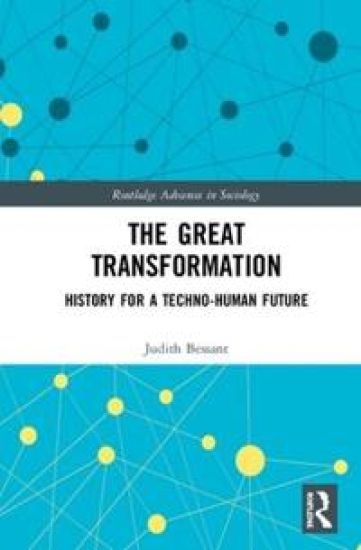
The Great Transformation

The Great Transformation

Judith Bessant

Routledge
2019
nidottu
While artificial intelligence (AI), robots, bio-technologies and digital media are transforming work, culture, and social life, there is little understanding of or agreement about the scope and significance of this change. This new interpretation of the ‘great transformation’ uses history and evolutionary theory to highlight the momentous shift in human consciousness taking place. Only by learning from recent crises and rejecting technological determinism will governments and communities redesign social arrangements that ensure we all benefit from the new and emerging technologies. The book documents the transformations under way in financial markets, entertainment, and medicine, affecting all aspects of work and social life. It draws on historical sociology and co-evolutionary theory arguing that the radical evolution of human consciousness and social life now under way is comparable with, if not greater than, the agrarian revolution (10000 BCE), the explosion of science, philosophy, and religion in the Axial Age (600 BCE), and the recent Industrial Revolution. Turning to recent major socio-economic crisis, and asking what can be learnt from them, the answer is we cannot afford this time around to repeat the failures of elites and theoretical systems such as economics to attend appropriately to radical change. We need to think beyond the constraints of determinist and reductionist explanations and embrace the idea of deep freedom. This book will appeal to educators, social scientists, policy-makers, business leaders, and students. It concludes with social design principles that can inform deliberative processes and new social arrangements that ensure everyone benefits from the affordances of the new and emerging technologies.
The Great Transformation

The Great Transformation

Judith Bessant

Routledge
2018
sidottu
While artificial intelligence (AI), robots, bio-technologies and digital media are transforming work, culture, and social life, there is little understanding of or agreement about the scope and significance of this change. This new interpretation of the ‘great transformation’ uses history and evolutionary theory to highlight the momentous shift in human consciousness taking place. Only by learning from recent crises and rejecting technological determinism will governments and communities redesign social arrangements that ensure we all benefit from the new and emerging technologies. The book documents the transformations under way in financial markets, entertainment, and medicine, affecting all aspects of work and social life. It draws on historical sociology and co-evolutionary theory arguing that the radical evolution of human consciousness and social life now under way is comparable with, if not greater than, the agrarian revolution (10000 BCE), the explosion of science, philosophy, and religion in the Axial Age (600 BCE), and the recent Industrial Revolution. Turning to recent major socio-economic crisis, and asking what can be learnt from them, the answer is we cannot afford this time around to repeat the failures of elites and theoretical systems such as economics to attend appropriately to radical change. We need to think beyond the constraints of determinist and reductionist explanations and embrace the idea of deep freedom. This book will appeal to educators, social scientists, policy-makers, business leaders, and students. It concludes with social design principles that can inform deliberative processes and new social arrangements that ensure everyone benefits from the affordances of the new and emerging technologies.
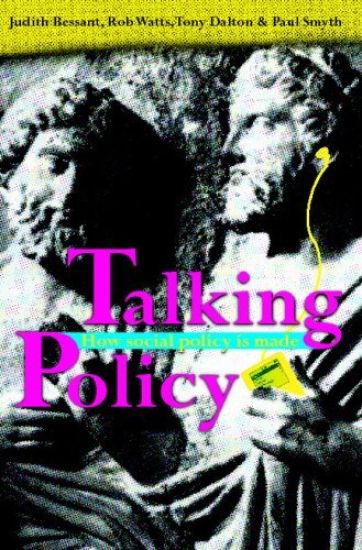
Talking Policy

Talking Policy

Judith Bessant

Allen Unwin
2005
nidottu
When we catch a bus, visit a doctor, borrow a book from the library or enrol in a course we benefit from the social policies of government. Talking Policy explains how the myriad programs and services we take for granted are developed and delivered, and how this fits into the political process. There is a human and political aspect to social policy-making; it's not all rational solutions to measurable problems. The authors explain how issues come to be defined as social problems, and offer an account of the historical development of social policy and the welfare state in Australia. They also outline the competing political and philosophical ideas which influence the different ways in which governments respond to social inequality and needs in the community.With detailed case studies from variety of areas of social policy making, Talking Policy is a valuable introduction to this complex and important field.'Talking Policy is an informative, insightful book that is also absorbing and challenging.'Lois Bryson, Emeritus Professor, University of Newcastle'With a commitment to reinvigorate policy debate, the authors make a convincing case that at its heart policy-making is about competing ethical visions, that ideas count, and that words serve as tools in this political and contested activity.'Associate Professor, Carol Bacchi, University of Adelaide
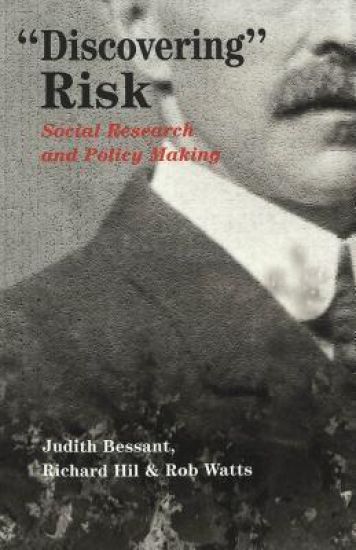
Discovering Risk

Discovering Risk

Judith Bessant; Richard Hil; Rob Watts

Peter Lang Publishing Inc
2003
nidottu
Anxiety about unemployment, homelessness, poverty and crime has always been around. Today, governments, experts and the media spend a lot of time talking about people at risk, the measurement and prediction of risk factors, encouraging resiliency and the need for early intervention. What are the politics, origins and meanings behind risk talk? Is the discovery and management of risk factors capable of offering real solutions? This lively, provocative book asks these questions by examining youth employment, homelessness and juvenile crime. It is a must-read for policy makers, human service workers, researchers and anyone interested in the key social issues of our time.
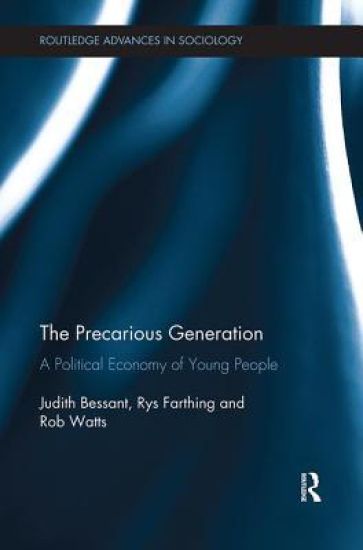
The Precarious Generation

The Precarious Generation

Judith Bessant; Rys Farthing; Rob Watts

Routledge
2017
sidottu
This book draws on a wealth of evidence including young people’s own stories, to document how they are now faring in increasingly unequal societies like America, Britain, Australia, France and Spain. It points to systematic generational inequality as those born since 1980 become the first generation to have a lower standard of living than previous generations. While governments and experts typically explain this by referring to globalization, new technologies, or young people’s deficits, the authors of this book offer a new political economy of generations, which identifies the central role played by governments promoting neoliberal policies that exacerbate existing social inequalities based on age, ethnicity, gender and class. The book is a must read for social science students, human service workers and policy-makers and indeed for anyone interested in understanding the impact of government policy over the last 40 years on young people.
The Precarious Generation

The Precarious Generation

Judith Bessant; Rys Farthing; Rob Watts

Routledge
2018
nidottu
This book draws on a wealth of evidence including young people’s own stories, to document how they are now faring in increasingly unequal societies like America, Britain, Australia, France and Spain. It points to systematic generational inequality as those born since 1980 become the first generation to have a lower standard of living than previous generations. While governments and experts typically explain this by referring to globalization, new technologies, or young people’s deficits, the authors of this book offer a new political economy of generations, which identifies the central role played by governments promoting neoliberal policies that exacerbate existing social inequalities based on age, ethnicity, gender and class. The book is a must read for social science students, human service workers and policy-makers and indeed for anyone interested in understanding the impact of government policy over the last 40 years on young people.
International Criminology

International Criminology

Rob Watts; Judith Bessant; Richard Hil

Routledge
2008
sidottu
International Criminology is an easy-access critical introduction to how conventional criminologists in the international arena think about and research crime. By using examples from the US, UK and Australia, the authors outline key ideas, vocabulary, assumptions and findings of the discipline while opening up a set of critical underlying issues and problems. From theoretical traditions to historical perspectives; contemporary criminology to reflexive criminology; this all encompassing text covers it all. This is the most valuable introduction to international criminology available for undergraduates and works as a superb refresher for more experienced students.
International Criminology

International Criminology

Rob Watts; Judith Bessant; Richard Hil

Routledge
2008
nidottu
International Criminology is an easy-access critical introduction to how conventional criminologists in the international arena think about and research crime. By using examples from the US, UK and Australia, the authors outline key ideas, vocabulary, assumptions and findings of the discipline while opening up a set of critical underlying issues and problems. From theoretical traditions to historical perspectives; contemporary criminology to reflexive criminology; this all encompassing text covers it all. This is the most valuable introduction to international criminology available for undergraduates and works as a superb refresher for more experienced students.
Judith

Judith

Carey A. Moore

Yale University Press
2007
pokkari
Judith is Volume 40 in the acclaimed anchor Bible series of new book-by-book translations of the Old and New Testaments and Apocrypha. In the Apocrypha, Judith is the saint who murdered for her people. She offered herself to Holofernes, the Assyrian general sent by Nebuchadnezzar to destroy the Israelites. After she had charmed Holofernes with flattery and drink, Judith chopped of his head while he lay in a drunken stupor, thereby leaving his troops “headless” and in a state of total panic and confusion. Her victory was celebrated in song and brought peace to her land for years to come. In his illuminating new translation and commentary, Carey A. Moore considers the historicity of the story and explores the author’s true intent: Was it to describe actual events or to compose a fictitious story of other purposes? Was his concern more historical or theological? The story of Judith abounds in ironies. There is Judith, the beautiful woman who lived a stark, celibate existence after her husband’s death had left her a wealthy widow. Born into a sexist society with rigidly defined roles, Judith better “played the man” than did any of her male compatriots. There is Holofernes, the Assyrian conqueror, unable to defeat a small Israelite village after dozens of countries had fallen under his sword. Intent on seducing Judith, Holofernes instead lost his head to her. Perhaps the ultimate irony of all is the story of Judith itself: the timeless tale of a deeply religious woman who became revered not for her poverty but for an act of murder. Dr. Moore’s study of the canonicity of Judith brings perspective to the story’s varied acceptance among both Jews and Christians. It also notes the similarity between this work and the equally popular story of Esther; each woman, through different means, served her people through acts of bravery. The photographs and maps illustrating Judith include depictions of the story of Judith by such masters as Machiavelli, Botticelli, Caravaggio, and Donatello.
Judith

Judith

Jennifer Johnston

Jennifer Johnston
2023
pokkari
The 1960s was a time when Australia was changing and the old ways were being left behind. At 21 Judith is ready to conquer the world, she has a new job working for the government, and a new life ahead of her that will test her resolve. Moving to the city will take her from naive romantic notions and the protection of small town living to discovering that around the corner life's twists and turns carry you along paths you never anticipated. The communist movement is looking for converts to infiltrate the government. Will they draw her in? Women are living and loving more freely. Will she ignore the promises she made and allow the lure of this new life to change her? Will she find romance or tragedy? What will her family think if she tells them? She will need wisdom, courage and faith for the journey as the road to independence always comes at a price.
Judith

Judith

Wills M.; White Crawford Sidnie

Fortress Press,U.S.
2019
sidottu
Judith tells the story of a beautiful Jewish woman who enters the tent of an invading general, gets him drunk, and then slices off his head, thus saving her village and Jerusalem. This short novella was somewhat surprisingly included in the early Christian versions of the Old Testament and has played an important role in the Western tradition ever since. This commentary provides a detailed analysis of the text's composition and its meaning in its original historical context, and thoroughly surveys the history of Judith scholarship. Lawrence M. Wills not only considers Judith's relation to earlier biblical texts--how the author played upon previous biblical motifs and interpreted important biblical passages--but also addresses the rise of Judith and other Jewish novellas in the context of ancient Near Eastern and Greek literature, as well as their relation to cross-cultural folk motifs. Because of the popularity of Judith in art and culture, this volume also addresses the book's history of interpretation in paintings, sculpture, music, drama, and literature. A number of images of artistic depictions of Judith are included and discussed in detail.
Judith

Judith

Jennifer L. Koosed; Robert Paul Seesengood

Liturgical Press
2022
sidottu
2023 Catholic Media Association First Place Award, Scripture – Academic Studies The striking scene of Judith cutting off Holofernes’s head with his own sword in his own bed has inspired the imaginations of readers for millennia. But there is more to her story than just this climactic act and more to her character than just beauty and violence. This volume offers a comprehensive examination of gender ideologies in the book of Judith, from the hyper-masculine machinations of war and empire to the dynamics of class in Judith’s relationship with her enslaved handmaid. Overall, this commentary investigates the book of Judith through a feminist lens, informed by critical masculinity studies, queer theory, and reception criticism.
Judith

Judith

University of Exeter Press
1997
nidottu
Undergraduates frequently find the fine Old English poem JUDITH the most stimulating of the surviving texts from the Anglo-Saxon period. In the past thirty years it has attracted a wide range of literary criticism both in the UK and the US. Feminist critics of English literature have been particularly interested by the ways in which the poet has adapted the traditional masculine heroic ethos of Old English poetry to a story figuring a violently active female protagonist.Yet there is no available edition of Judith which is either comprehensive or up to date, or which at all explains how and why the poem is worthy of our attention. This new edition aims to fill this gap. It includes a full Introduction and commentary by the editor, plus a comprehensive glossary, bibliography and appendices.
Judith

Judith

Nicholas Mosley

Dalkey Archive Press
1992
nidottu
Judith is an aspiring young actress and the mistress of a writer on a popular satirical magazine. We learn of her involvement with drugs and increasing self-delusion. After a crack-up, she seeks healing in an Indian ashram run by an eccentric and possibly mad guru. But what is at the back of appearances; how calculated is the self-destructiveness from which a new order might emerge?