Kirjojen hintavertailu. Mukana 12 383 376 kirjaa ja 12 kauppaa.

Kirjahaku

Etsi kirjoja tekijän nimen, kirjan nimen tai ISBN:n perusteella.

1000 tulosta hakusanalla Julian Sharp

Exam Ref AI-900 Microsoft Azure AI Fundamentals
Prepare for Microsoft Exam AI-900 and help demonstrate your real-world knowledge of diverse machine learning (ML) and artificial intelligence (AI) workloads, and how they can be implemented with Azure AI. Designed for business stakeholders, new and existing IT professionals, consultants, and students, this Exam Ref focuses on the critical thinking and decision-making acumen needed for success at the Microsoft Certified: Azure AI Fundamentals level. Focus on the expertise measured by these objectives: • Describe AI workloads and considerations • Describe fundamental principles of machine learning on Azure • Describe features of computer vision workloads on Azure • Describe features of Natural Language Processing (NLP) workloads on Azure • Describe features of conversational AI workloads on Azure This Microsoft Exam Ref: • Organizes its coverage by exam objectives • Features strategic, what-if scenarios to challenge you • Assumes you are a business user, stakeholder, technical professional, or student who wants to become familiar with Azure AI; requires no data science or software engineering experience. About the Exam Exam AI-900 focuses on knowledge needed to identify features of common AI workloads and guiding principles for responsible AI; identify common ML types; describe core ML concepts; identify core tasks in creating an ML solution; describe capabilities of no-code ML with Azure Machine Learning Studio; identify common types of computer vision solutions; identify Azure tools and services for computer vision tasks; identify features of common NLP workload scenarios; identify Azure tools and services for NLP workloads; and identify common use cases and Azure services for conversational Al. About Microsoft Certification Passing this exam fulfills your requirements for the Microsoft Certified: Azure AI Fundamentals certification, demonstrating your knowledge of common ML and AI workloads and how to implement them on Azure. With this certification, you can move on to earn more advanced role-based certifications, including Microsoft Certified: Azure AI Engineer Associate or Azure Data Scientist Associate. See full details at: microsoft.com/learn

Design and Launch an Online Social Networking Business in a Week
WWW.(Your Social Network).COMAre you a virtual social butterfly? Captivated by the buzz of new media? Interested in setting the online social scene for others? And making a profit doing so? Tap into the millions of MySpace users and Facebook friends to create your own specialized social site! In just seven days, identify your network niche; develop an inviting, interactive website; drive traffic and membership; build profitable online advertising relationships; and more! Design an attractive, interactive social networking website using inexpensive, turnkey solutions that require no programming knowledgeDefine your community and set the toneOffer interactive features including profile pages, member search options, media add-ons, and moreGenerate traffic and membership using search engine optimization, viral and social marketing, and other techniquesCash in on your site with proven, revenue-generating solutionsUse included resources to stay on the cutting-edge Sign on for social networking success!
Introduction to Accumark, Pattern Design, and PDM

Introduction to Accumark, Pattern Design, and PDM

Julia Ridgway Ridgway Sharp; Virginia Hencken Elsasser

Fairchild Books
2007
nidottu
The first textbook of its kind, Introduction to Accumark, Pattern Design, and PDM provides step-by-step instructions to Gerber Technology's in-demand software programs.Accumark is covered from the basics of data storage and retrieval to the complexities of digitization. The Pattern Design section details the sizing and measuring, point and notch, line, and piece functions necessary to translate creativity into pattern reality. Rounding out the book are instructions in Product Data Management (PDM), including design and cost specifications. Together, these three Computer-Aided Design (CAD) programs are the industry standard. This clear, user-friendly book is the companion tool students need to master them-and to maximize their technological savvy in today's dynamic fashion industry.
Textiles

Textiles

Virginia Hencken Elsasser; Julia Ridgway Ridgway Sharp

BLOOMSBURY PUBLISHING PLC
2022
muu
Textiles: Concepts and Principles, Fourth Edition provides a thorough approach to the fundamentals of textiles in a readable, nontechnical style, focusing on the interrelationship of textile components to help students understand and predict textile properties and performance to ultimately choose the best textile for their final product. With new co-author Julia Ridgway Sharp, Virginia Hencken Elsasser covers the global textile industry and components of textile products, summarizes laws and regulations affecting the textile industry, and looks into career possibilities, properties, care instructions, end uses of natural and manufactured fibers, yarns, fabrics, coloration and finishes, and the overall impact of textiles on the environment.New to this Edition-Updated information on sustainability, laws and regulations, and technological advancements- New Did you know? feature in each chapter provides thoughtful insights into new developments in the textile industry-Inclusion of imperial and metric measurements for a more global scopeSTUDIO Features Include-Study smarter with self-quizzes featuring scored results and personalized study tips -Review concepts with flashcards of essential vocabulary -Download additional exercises to practice your skills Instructor Resources-Instructor’s Guide with Test Bank provides suggestions for planning the course and using the text in the classroom, supplemental assignments, and lecture notes-Test Bank includes sample test questions for each chapter-PowerPoint® presentations include images from the book and provide a framework for lecture and discussion
Know Your Home Furnishings

Know Your Home Furnishings

Virginia Hencken Elsasser; Julia Ridgway Ridgway Sharp

Fairchild Books
2017
nidottu
A comprehensive resource for understanding the categories of consumer goods for the home and the raw products utilized to make them, Know Your Home Furnishings, Second Edition, enables students to understand the major categories of home furnishings and the diverse consumer demand for fashionable and functional products. This new edition is up-to-date with all the latest industry trends and important people. With new material covering kitchenware, electronics, window treatments, and historical furniture, Know Your Home Furnishings is more indispensable than ever.
America's Best Female Sharpshooter

America's Best Female Sharpshooter

Julia Bricklin

University of Oklahoma Press
2017
sidottu
Today, most remember ""California Girl"" Lillian Frances Smith (1871-1930) as Annie Oakley's chief competitor in the small world of the Wild West shows' female shooters. But the two women were quite different: Oakley's conservative ""prairie beauty"" persona clashed with Smith's tendency to wear flashy clothes and keep company with the cowboys and American Indians she performed with. This lively first biography chronicles the Wild West showbiz life that Smith led and explores the talents that made her a star. Drawing on family records, press accounts, interviews, and numerous other sources, historian Julia Bricklin peels away the myths that enshroud Smith's fifty-year career. Known as ""The California Huntress"" before she was ten years old, Smith was a professional sharpshooter by the time she reached her teens, shooting targets from the back of a galloping horse in Buffalo Bill Cody's Wild West. Not only did Cody offer $10,000 to anyone who could beat her, but he gave her top billing, setting the stage for her rivalry with Annie Oakley. Being the best female sharpshooter in the United States was not enough, however, to differentiate Lillian Smith from Oakley and a growing number of ladylike cowgirls. So Smith reinvented herself as ""Princess Wenona,"" a Sioux with a violent and romantic past. Performing with Cody and other showmen such as Pawnee Bill and the Miller brothers, Smith led a tumultuous private life, eventually taking up the shield of a forged Indian persona. The morals of the time encouraged public criticism of Smith's lack of Victorian femininity, and the press's tendency to play up her rivalry with Oakley eventually overshadowed Smith's own legacy. In the end, as author Julia Bricklin shows, Smith cared more about living her life on her own terms than about her public image. Unlike her competitors who shot to make a living, Lillian Smith lived to shoot.
America's Best Female Sharpshooter

America's Best Female Sharpshooter

Julia Bricklin

University of Oklahoma Press
2020
nidottu
Today, most remember ""California Girl"" Lillian Frances Smith (1871-1930) as Annie Oakley's chief competitor in the small world of the Wild West shows' female shooters. But the two women were quite different: Oakley's conservative ""prairie beauty"" persona clashed with Smith's tendency to wear flashy clothes and keep company with the cowboys and American Indians she performed with. This lively first biography chronicles the Wild West showbiz life that Smith led and explores the talents that made her a star. Drawing on family records, press accounts, interviews, and numerous other sources, historian Julia Bricklin peels away the myths that enshroud Smith's fifty-year career. Known as ""The California Huntress"" before she was ten years old, Smith was a professional sharpshooter by the time she reached her teens, shooting targets from the back of a galloping horse in Buffalo Bill Cody's Wild West. Not only did Cody offer $10,000 to anyone who could beat her, but he gave her top billing, setting the stage for her rivalry with Annie Oakley. Being the best female sharpshooter in the United States was not enough, however, to differentiate Lillian Smith from Oakley and a growing number of ladylike cowgirls. So Smith reinvented herself as ""Princess Wenona,"" a Sioux with a violent and romantic past. Performing with Cody and other showmen such as Pawnee Bill and the Miller brothers, Smith led a tumultuous private life, eventually taking up the shield of a forged Indian persona. The morals of the time encouraged public criticism of Smith's lack of Victorian femininity, and the press's tendency to play up her rivalry with Oakley eventually overshadowed Smith's own legacy. In the end, as author Julia Bricklin shows, Smith cared more about living her life on her own terms than about her public image. Unlike her competitors who shot to make a living, Lillian Smith lived to shoot.
Civil War Ghosts of Sharpsburg

Civil War Ghosts of Sharpsburg

Julia Stinson Brugh; Mark P. Brugh

History Press Library Editions
2015
sidottu
In September 1862, fighting from the Battle of Antietam spilled into Sharpsburg's streets. Residents were left to bury the dead from both sides. Today, locals report lingering echoes of that strife, from the faint taps of a Union drummer boy named Charley King to the phantom footsteps of Confederate soldiers charging up the stairs of the Rohrbach House. Two spectral girls seen playing by the Big Spring in Children's Alley may be Savilla Miller and Theresa Kretzer, best friends torn apart by their divided loyalties. Tour guides Mark and Julia Brugh craft a vivid portrait of Sharpsburg in the Civil War and bring to light stories of the ghosts for whom the conflict never ended.
Vibes as Value

Vibes as Value

David Farrugia; Julia Coffey; Steven Threadgold; Megan Sharp; Lena Molnar

MANCHESTER UNIVERSITY PRESS
2026
sidottu
Vibes as value explores the relationship between subjectivity, labour and value in the hospitality industry, and thereby how youth, gender, sexuality, race and social class are embodied and made productive in the service economy. It shows that the key product of hospitality labour is ‘vibes’, or moments of enjoyment and relationality co-produced through exploitative relationships amongst workers and consumers. In the process, the book theorises hospitality as a form of affective labour organised through the normative and structural relations of precarious service work. It shows how identity construction produces value within the highly unequal social terrain of the service economy, and how hospitality labour enacts hierarchies of value extending far beyond the limits of the industry itself.
Julian

Julian

Philip Freeman

YALE UNIVERSITY PRESS
2023
sidottu
The tragic life of Julian, the last non-Christian emperor of Rome, by award-winning author Philip Freeman “When we think of ancient Rome, it’s impossible not to think of Christianity, one of its most notable exports—but what if it hadn’t been? This is the question provoked by classicist Philip Freeman in Julian, an appealing new entry in Yale’s Ancient Lives series, which tells the story of the old faith’s last imperial torchbearer.”—Anna Heyward, New York Times Book Review Flavius Claudius Julianus, or Julian the Apostate, ruled Rome as sole emperor for just a year and a half, from 361 to 363, but during that time he turned the world upside down. Although a nephew of Constantine the Great, the first Christian emperor of Rome, Julian fought to return Rome to the old gods who had led his ancestors to build their vast empire. As emperor, Julian (331–363) set about reforming the administration, conquering new territories, and reviving ancient religions. He was scorned in his time for repudiating Christianity and demonized as an apostate for willfully rejecting Christ. Through the centuries, Julian has been viewed by many as a tragic figure who sought to save Rome from its enemies and the corrupting influence of Christianity. Christian writers and historians have seen Julian much differently: as a traitor to God and violent oppressor of Christians. Had Julian not been killed by a random Persian spear, he might well have changed all of history.
Julian

Julian

Philip Freeman

YALE UNIVERSITY PRESS
2025
pokkari
The tragic life of Julian, the last non-Christian emperor of Rome, by award-winning author Philip Freeman “When we think of ancient Rome, it’s impossible not to think of Christianity, one of its most notable exports—but what if it hadn’t been? This is the question provoked by classicist Philip Freeman in Julian, an appealing new entry in Yale’s Ancient Lives series, which tells the story of the old faith’s last imperial torchbearer.”—Anna Heyward, New York Times Book Review Flavius Claudius Julianus, or Julian the Apostate, ruled Rome as sole emperor for just a year and a half, from 361 to 363, but during that time he turned the world upside down. Although a nephew of Constantine the Great, the first Christian emperor of Rome, Julian fought to return Rome to the old gods who had led his ancestors to build their vast empire. As emperor, Julian (331–363) set about reforming the administration, conquering new territories, and reviving ancient religions. He was scorned in his time for repudiating Christianity and demonized as an apostate for willfully rejecting Christ. Through the centuries, Julian has been viewed by many as a tragic figure who sought to save Rome from its enemies and the corrupting influence of Christianity. Christian writers and historians have seen Julian much differently: as a traitor to God and violent oppressor of Christians. Had Julian not been killed by a random Persian spear, he might well have changed all of history.
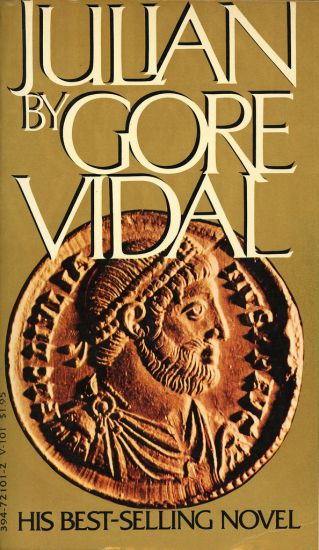
Julian

Julian

Gore Vidal

Little, Brown Book Group
1993
pokkari
Gore Vidal's fictional recreation of the Roman Empire teetering on the crux of Christianity and ruled by an emperor who was an inveterate dabbler in arcane hocus-pocus, a prig, a bigot, and a dazzling and brilliant leader.
Julian

Julian

Gore Vidal

Little, Brown Book Group
2025
nidottu
The remarkable bestseller about the fourth-century Roman emperor who famously tried to halt the spread of Christianity, Julian is widely regarded as one of Gore Vidal's finest historical novelsJulian the Apostate, nephew of Constantine the Great, was one of the brightest yet briefest lights in the history of the Roman Empire. A military genius on the level of Julius Caesar and Alexander the Great, a graceful and persuasive essayist, and a philosopher devoted to worshipping the gods of Hellenism, he became embroiled in a fierce intellectual war with Christianity that provoked his murder at the age of thirty-two, only four years into his brilliantly humane and compassionate reign. A marvelously imaginative and insightful novel of classical antiquity, Julian captures the religious and political ferment of a desperate age and restores with blazing wit and vigor the legacy of an impassioned ruler.'Gore Vidal, a writer of lustrous and fabulously readable prose, was always ahead of his time, so it is wonderful to see some of his finest works being republished for an audience who will be ready to (re)discover his daring, his insight and his wickedly waspish wit' STEPHEN FRY
Julian

Julian

Gore Vidal

Random House Inc
2003
nidottu
An insightful historical novel recreates the brief but brilliant career of Julian, the Roman emperor and philosopher who dedicated himself to the restoration of Hellenism and tried to halt the spread of Christianity. Reprint.
Julian, Volume I

Julian, Volume I

Julian

Harvard University Press
1913
sidottu
The emperor who renounced Christianity.Julian (Flavius Claudius Iulianus) “the Apostate,” Roman Emperor, lived AD 331 or 332 to 363. Born and educated in Constantinople as a Christian, after a precarious childhood he devoted himself to literature and philosophy and became a pagan, studying in various Greek cities. In 355 his cousin Emperor Constantius called him from Athens to the court at Milan, entitled him “Caesar,” and made him governor of Gaul. Julian restored Gaul to prosperity and good government after the ravages of the Alamanni (he overthrew them at the battle of Strassburg in 357) and other Germans. Between 357 and 361 Julian’s own soldiers, refusing to serve in the East at Constantius’ orders, nearly involved Julian in war with Constantius—who, however, died in 361, making Julian sole Emperor of the Roman world. He began many reforms and proclaimed universal toleration in religion but pressed for the restoration of the older pagan worships. In 362–363 he prepared at Constantinople and then at Antioch for his expedition against Persia ruled by Shapur II. He died of a wound received in desperate battle. Julian’s surviving works (lost are his Commentaries on his western campaigns), all in Greek, are given in the Loeb Classical Library in three volumes. The eight Orations (1–5 in Volume I, 6–8 in Volume II) include two in praise of Constantius, one praising Constantius’ wife Eusebia, and two theosophical hymns (in prose) or declamations, of interest for studies in neo-Platonism, Mithraism, and the cult of the Magna Mater in the Roman world. Misopogon (“Beard-hater”), in Volume II, assails the morals of people in Antioch; the Letters (more than eighty), in Volume III, include edicts or rescripts, mostly about Christians, encyclical or pastoral letters to priests, and private letters. Lastly in Volume III are the fragments of the work Against the Galilaeans (the Christians), written mainly to show that evidence for the idea of Christianity is lacking in the Old Testament.
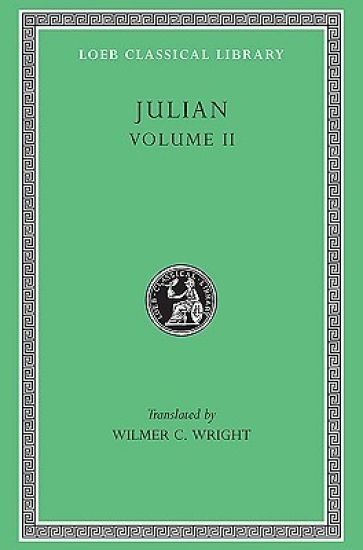
Julian, Volume II

Julian, Volume II

Julian

Harvard University Press
1913
sidottu
The emperor who renounced Christianity.Julian (Flavius Claudius Iulianus) “the Apostate,” Roman Emperor, lived AD 331 or 332 to 363. Born and educated in Constantinople as a Christian, after a precarious childhood he devoted himself to literature and philosophy and became a pagan, studying in various Greek cities. In 355 his cousin Emperor Constantius called him from Athens to the court at Milan, entitled him “Caesar,” and made him governor of Gaul. Julian restored Gaul to prosperity and good government after the ravages of the Alamanni (he overthrew them at the battle of Strassburg in 357) and other Germans. Between 357 and 361 Julian’s own soldiers, refusing to serve in the East at Constantius’ orders, nearly involved Julian in war with Constantius—who, however, died in 361, making Julian sole Emperor of the Roman world. He began many reforms and proclaimed universal toleration in religion but pressed for the restoration of the older pagan worships. In 362–363 he prepared at Constantinople and then at Antioch for his expedition against Persia ruled by Shapur II. He died of a wound received in desperate battle. Julian’s surviving works (lost are his Commentaries on his western campaigns), all in Greek, are given in the Loeb Classical Library in three volumes. The eight Orations (1–5 in Volume I, 6–8 in Volume II) include two in praise of Constantius, one praising Constantius’ wife Eusebia, and two theosophical hymns (in prose) or declamations, of interest for studies in neo-Platonism, Mithraism, and the cult of the Magna Mater in the Roman world. Misopogon (“Beard-hater”), in Volume II, assails the morals of people in Antioch; the Letters (more than eighty), in Volume III, include edicts or rescripts, mostly about Christians, encyclical or pastoral letters to priests, and private letters. Lastly in Volume III are the fragments of the work Against the Galilaeans (the Christians), written mainly to show that evidence for the idea of Christianity is lacking in the Old Testament.