

Kirjahaku
Etsi kirjoja tekijän nimen, kirjan nimen tai ISBN:n perusteella.
1000 tulosta hakusanalla Marcel Benabou

As stubborn, as surprising, as artful as life in its refusal to conform to a particular literary genre, Marcel Benabou's book is at once a memoir and a novel, a confession and a reflection on the prerogatives and imperatives of writing one's story. At its center, forever alluring and elusive, is the beautiful and ethereal Tamara, the exact incarnation of our narrator's most enduring fantasy - a femme fatale for the lover of form.Who precisely our narrator is, is less certain: The young Manuel, who leaves his home in Morocco to study in Paris, only to encounter the enticing Tamara? Or the mature Manuel, looking back not only at Tamara but also at the younger man's reading of his experience through the pages of the literature of sentimental apprenticeship, from Stendhal's "The Red and the Black" through Flaubert's "Sentimental Education"?A heady, genre-defying high-wire act by a writer who delights in such undertakings and whose efforts consistently delight readers worldwide, "To Write on Tamara?" captures with graceful authority and assurance the now thrilling, now vexing complexities of living and writing life's stories, especially stories of love. Marcel Benabou lives in Paris and pursues his positions as professor of ancient history at the University of Paris and as the permanent provisional secretary of Oulipo. He is the author of "Dump This Book While You Still Can!" and "Why I Have Not Written Any of My Books", both published by the University of Nebraska Press. Steven Rendall, a professor emeritus of Romance languages at the University of Oregon, is the author of "Distinguo: Reading Montaigne Differently" and has translated numerous books.

Marcel Bénabou is quick to acknowledge that his own difficulty in writing has plenty of company. Words stick and syntax is stubborn, meaning slips and synonyms cluster. A blank page taunts and a full one accuses. Bénabou knows the heroic joy of depriving critics of victims, the kindness of sparing publishers decisions, and the public charity of leaving more room in bookstore displays. Why I Have Not Written Any of My Books (Pourquoi je n'ai écrit aucun de mes livres) provides both a respectful litany of writers' fears and a dismissal of the alibis offered to excuse them.

In one of the most thought-provoking and wry books by one of the most intriguing contemporary writers in French literature, readers become party to the dilemma of "challenging" literature in a singularly involving and amusing fashion. Opening a book that has mysteriously appeared amid the clutter of his desk, the narrator finds himself exhorted not to read further, to throw the book away! Instead (but of course) he tries different strategies for approaching the book, none of which work. The narrator's tempestuous, increasingly obsessive relationship with the book he is determined to read, interwoven with the story of a real (but no less enigmatic) love affair, is, in its own challenging way, a charmed and charming, deeply provocative meditation upon reading and writing, and their inevitable discontents. Dump This Book offers a new angle on the work of this original writer and an ironic perspective on the power of reading to produce meaning.
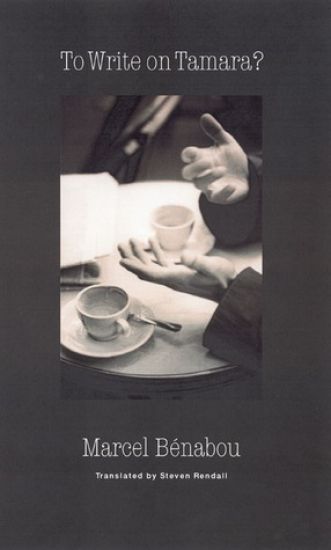
As stubborn, as surprising, as artful as life in its refusal to conform to a particular literary genre, Marcel Bénabou's book is at once a memoir and a novel, a confession and a reflection on the prerogatives and imperatives of writing one's story. At its center, forever alluring and elusive, is the beautiful and ethereal Tamara, the exact incarnation of our narrator's most enduring fantasy—a femme fatale for the lover of form. Who precisely our narrator is, is less certain: The young Manuel, who leaves his home in Morocco to study in Paris, only to encounter the enticing Tamara? Or the mature Manuel, looking back not only at Tamara but also at the younger man's reading of his experience through the pages of the literature of sentimental apprenticeship, from Stendhal's The Red and the Black through Flaubert's Sentimental Education? A heady, genre-defying high-wire act by a writer who delights in such undertakings and whose efforts consistently delight readers worldwide, To Write on Tamara? captures with graceful authority and assurance the now thrilling, now vexing complexities of living and writing life's stories, especially stories of love.

En bok om varför boken du läser aldrig har kommit till, eller snarare möjligheten att du läser den ligger i alla andra böcker som inte har blivit skrivna men som innefattas i detta verk. Eller är boken bara en väntan på de böcker som egentligen ska bli skrivna. Hur förklara Varför jag inte har skrivit någon av mina böcker? Titeln Varför jag inte har skrivit någon av mina böcker är naturligtvis

Georges Perec trent'anni dopo
Paolo Albani; Marcel Bénabou; Camille Bloomfield
In Riga Edizioni
2018
nidottu
"Una personalit , quella dello scrittore di La Vie mode d'emploi, tra le pi singolari del mondo dell'Oulipo in virt dell'attivit multiforme che la caratterizza, espressione di un progetto di sperimentazione che attraversa molti generi letterari".

"Benabou addresses conflicting impulses between writing and reading, writing and living, following great models and being original. And he has a great deal of gentle self-deprecating fun while doing it. But this isn't just about the wordplay beloved of French modernists. At base it is a lovely book about the love of books and of language and all that goes into making them, be it paper or words." - "Publishers Weekly". "As this deft translation in Nebraska's excellent "French Modernist Library" series confirms, Benabou can cartwheel with the best of them. "Why I Have Not Written Any of My Books" makes mischief with treasured literary cliches and will amuse and provoke the scoundrel in every writer's soul." - "Philadelphia Inquirer". "Wrapped in hilarious self-ironizing waffle, [Benabou's book] is a serious, largely autobiographical account ...of how difficult it is to write a book...Unfailingly amusing." - "Times Literary Supplement". "This is the 'madness of art." - "Review of Contemporary Fiction". "A mercurially playful paradox of confessional literature, authorial awakening, and creative endeavor." - "Kirkus Reviews". Marcel Benabou is quick to acknowledge that his own difficulty in writing has plenty of company. Words stick and syntax is stubborn, meaning slips and synonyms cluster. A blank page taunts and a full one accuses. Benabou knows the heroic joy of depriving critics of victims, the kindness of sparing publishers decisions, and the public charity of leaving more room in bookstore displays. "Why I Have Not Written Any of My Books" (Pourquoi je n'ai ecrit aucun de mes livres) provides both a respectful litany of writers' fears and a dismissal of the alibis offered to excuse them. The author (or not) of a dozen books, Marcel Benabou is a professor of ancient history at the University of Paris VII and permanent provisional secretary of Oulipo. David Kornacker is a writer and translator living in New York City. Warren Motte is a professor of French at the University of Colorado.

In one of the most thought-provoking and wry books by one of the most intriguing contemporary writers in French literature, readers become party to the dilemma of 'challenging' literature in a singularly involving and amusing fashion. Opening a book that has mysteriously appeared amid the clutter of his desk, the narrator finds himself exhorted not to read further, to throw the book away! Instead (but of course) he tries different strategies for approaching the book, none of which work. The narrator's tempestuous, increasingly obsessive relationship with the book he is determined to read, interwoven with the story of a real (but no less enigmatic) love affair, is, in its own challenging way, a charmed and charming, deeply provocative meditation upon reading and writing, and their inevitable discontents. "Dump This Book" offers a new angle on the work of this original writer and an ironic perspective on the power of reading to produce meaning. Marcel Benabou, author of more than a dozen books, lives in Paris and pursues his current positions as professor of ancient history at the University of Paris and as the permanent provisional secretary of Oulipo. His "Jacob, Menahem, and Mimoun" (Nebraska 1998) won the National Jewish Book Award for autobiography. Steven Rendall is the author of "Distinguo: Reading Montaigne Differently" and has translated numerous books. Warren Motte, a professor of French at the University of Colorado, is the translator and editor of "Oulipo: A Primer of Potential Literature" (Nebraska 1986) and "Playtexts: Ludics in Contemporary Literature" (Nebraska 1995).

This volume describes a cognitive model of student programmers, and an implementation of that model that allows student programmers to be simulated. The focus of the model is on the problem solving that students perform to generate both correct and buggy programs as well as on the individual differences that cause different students to generate different programs for the same programming task. By developing a taxonomy of student programmer knowledge; a model of student program generation; and a preliminary model of individual differences, this research contributes to a better understanding of four areas of the study of student programmers. The most important claim is that a cognitive model of student program generation fits within a properly "fleshed out" generate test-and-debug (GTD) problem solving architecture in which impasse/repair knowledge plays a key role. This research is important theoretically because it explores the use of a GTD impasse/repair problem solving architecture in a new domain, and important practically because of its educational implications for programming instructions.
Marcel...
Nabu Press
2012
pokkari


The celebrated novelist and influential cultural critic's classic biography of one of history's most important writers, Marcel Proust If there is anyone worthy of producing an intimate biography of the enigmatic genius behind Remembrance of Things Past, it is Edmund White, himself an award- winning writer for whom Marcel Proust has long been an obsession. White introduces us not only to the recluse endlessly rewriting his one massive work through the night, but also the darling of Parisian salons, the grasper after honors, and the closeted homosexual-a subject this book is the first to explore openly. From the frothiest gossip to the deepest angst, here is a moving portrait to be treasured by anyone looking for an introduction to this literary icon.

A witty, refreshing, and fun book on the experience of reading Marcel Proust. What would the world be like without this work, where would we be if it hadn't happened? This is how Michael Wood found himself writing about Proust's work as an event and about events in relation to that work itself. The event that created the figure we know as Proust did not take a whole lifetime, we can date it to within certain months, perhaps certain weeks, of a certain year, 1908. That was when Proust the interesting occasional writer and full-time socialite, turned into an ostensible hermit and a real novelist. This short book says something about the event as a lifetime affair, and shows what the sudden change of 1908 looks like. It explores the work of Marcel Proust as an event in the world, something that happened to literature and culture and our understanding of history. This event has more aspects than we can count, but this book offers detailed critical snapshots of seven of them: the birth of Proust as a novelist; what he teaches us about the mythology of beginnings; about metaphor as a kind of rebellion; about love as a permanent anxiety attack; about the Dreyfus Affair; about the concept of justice; about the mythology of endings.

100 years after Proust's death, In Search of Lost Time remains one of the greatest works in World Literature. At 3,000 pages, it can be intimidating to some. This short volume invites first-time readers and veterans alike to view the novel in a new way. Marcel Proust (1871-1922) was arguably France's best-known literary writer. He was the author of stories, essays, translations, and a 3,000-page novel, In Search of Lost Time (1913-27). This book is a brief guide to Proust's magnum opus in which Joshua Landy invites the reader to view the novel as a single quest--a quest for purpose, enchantment, identity, connection, and belonging--through the novel's fascinating treatments of memory, society, art, same-sex desire, knowledge, self-understanding, self-fashioning, and the unconscious mind. Landy also shows why the questions Proust raises are important and exciting for all of us: how we can feel at home in the world; how we can find genuine connection with other human beings; how we can find enchantment in a world without God; how art can transform our lives; whether an artist's life can shed light on their work; what we can know about the world, other people, and ourselves; when not knowing is better than knowing; how sexual orientation affects questions of connection and identity; who we are, deep down; what memory tells us about our inner world; why it might be good to think of our life as a story; how we can feel like a single, unified person when we are torn apart by change and competing desires. Finally, Landy suggests why it's worthwhile to read the novel itself-how the long, difficult, but joyous experience of making it through 3,000 pages of prose can be transformative for our minds and souls.

David Hopkins analyses the extensive network of shared concerns and images in the work of Marcel Duchamp and Max Ernst, the greatest names associated with Dada and Surrealist art. This book covers a broad period from c.1912 to the mid-1940s, during which the emergence of Dada and Surrealism in Europe and the United States challenged earlier movements such as Cubism and Expressionism, creating scope for the expression of the unconscious fears and desires of artists acutely sensitive to the troubled nature of their times. Examining Duchamp's and Ernst's subversion and manipulation of religious and hermetic beliefs such as Catholicism, Rosicrucianism and Masonry, David Hopkins demonstrates the ways in which these esoteric concerns intersect with themes of peculiarly contemporary relevance, including the social construction of gender and notions of ordering and taxonomy. This detailed comparison of components of Duchamp's and Ernst's work reveals fascinating structural patterns, enabling the reader to discover an entirely new way of understanding the mechanisms underlying Dada and Surrealist iconography.

Leo Bersani is an eminent literary critic whose influential work spans half a century. His vast, in many ways unclassifiable, oeuvre has traversed and blurred the boundaries of the disciplines of modern French literature, literary criticism, psychoanalysis, art history, film theory, philosophical aesthetics, and masculinity studies and sexuality studies. Oxford University Press published Bersani's first book, on Proust, in 1965, but the work has long been out of print. This new edition comes in response to a recent renewal of interest among philosophers of literature, among others, and features a new preface from the author.

Laila Storch is a world-renowned oboist in her own right, but her book honors Marcel Tabuteau, one of the greatest figures in twentieth-century music. Tabuteau studied the oboe from an early age at the Paris Conservatoire and was brought to the United States in 1905, by Walter Damrosch, to play with the New York Symphony Orchestra. Although this posed a problem for the national musicians' union, he was ultimately allowed to stay, and the rest, as they say, is history. Eventually moving to Philadelphia, Tabuteau played in the Philadelphia Orchestra and taught at the Curtis Institute of Music, ultimately revamping the oboe world with his performance, pedagogical, and reed-making techniques. In 1941, Storch auditioned for Tabuteau at the Curtis Institute, but was rejected because of her gender. After much persistence and several cross-country bus trips, she was eventually accepted and began a life of study with Tabuteau. Blending archival research with personal anecdotes, and including access to rare recordings of Tabuteau and Waldemar Wolsing, Storch tells a remarkable story in an engaging style.

A groundbreaking reading of Duchamp's work as informed by Asian "esoterism, " energetic spiritual practices identifying creative energy with the erotic impulse.Considered by many to be the most important artist of the twentieth century, the object of intensive critical scrutiny and extensive theorizing, Marcel Duchamp remains an enigma. He may be the most intellectual artist of all time; and yet, toward the end of his life, he said, "If you wish, my art would be that of living: each second, each breath is a work which is inscribed nowhere, which is neither visual or cerebral." In Marcel Duchamp and the Art of Life, Jacquelynn Baas offers a groundbreaking new reading of Duchamp, arguing in particular that his work may have been informed by Asian "esoterism, " energetic spiritual practices that identify creative energy with the erotic impulse. Duchamp drew on a wide range of sources for his art, from science and mathematics to alchemy. Largely overlooked, until now, have been Asian spiritual practices, including Indo-Tibetan tantra. Baas presents evidence that Duchamp's version of artistic realization was grounded in a western interpretation of Asian mind training and body energetics designed to transform erotic energy into mental and spiritual liberation. She offers close readings of many Duchamp works, beginning and ending with his final work, the mysterious, shockingly explicit Etant donnes: 1 Degrees la chute d'eau 2 Degrees le gaz d'eclairage, (Given: 1. The Waterfall, 2. The Illuminating Gas).Generously illustrated, with many images in color, Marcel Duchamp and the Art of Life speculates that Duchamp viewed art making as part of an esoteric continuum grounded in Eros. It asks us to unlearn what we think we know, about both art and life, in order to be open to experience.

The extraordinary life and times of Marcel Proust, one of the greatest literary voices of the twentieth century, by “Proust’s definitive biographer” (Harold Bloom) Selected by New York Times Book Review as a Best Book Since 2000 Based on a wealth of letters, memoirs, workbooks, and manuscripts unavailable before, the book examines Proust’s character and development as an artist, the glittering Parisian world of which he was a part, and the passions that enabled him to write his masterpiece, In Search of Lost Time. “Serious, thoughtful, well-balanced, well-informed. . . . Carter is the kind of reader Proust hoped for, one who understands that a great work compels us to become better readers of ourselves.”—Victor Brombert, Los Angeles Times “An impeccably researched and well-paced narrative that brings vividly and credibly to life not only the writer himself but also the changing world he knew.”—Roger Pearson, New York Times Book Review