Kirjojen hintavertailu. Mukana 11 244 527 kirjaa ja 12 kauppaa.

Kirjahaku

Etsi kirjoja tekijän nimen, kirjan nimen tai ISBN:n perusteella.

1000 tulosta hakusanalla Martin Fowler

Analysis Patterns

Analysis Patterns

Martin Fowler

Addison Wesley
2015
nidottu
This innovative book recognizes the need within the object-oriented community for a book that goes beyond the tools and techniques of the typical methodology book. In Analysis Patterns: Reusable Object Models, Martin Fowler focuses on the end result of object-oriented analysis and design—the models themselves. He shares with you his wealth of object modeling experience and his keen eye for identifying repeating problems and transforming them into reusable models. Analysis Patterns provides a catalogue of patterns that have emerged in a wide range of domains including trading, measurement, accounting and organizational relationships. Recognizing that conceptual patterns cannot exist in isolation, the author also presents a series of "support patterns" that discuss how to turn conceptual models into software that in turn fits into an architecture for a large information system. Included in each pattern is the reasoning behind their design, rules for when they should and should not be used, and tips for implementation. The examples presented in this book comprise a cookbook of useful models and insight into the skill of reuse that will improve analysis, modeling and implementation.
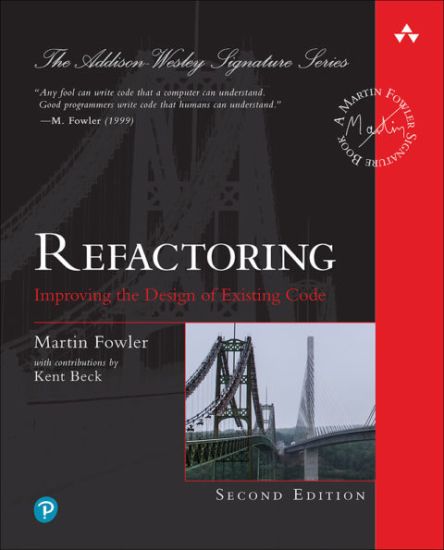
Refactoring

Refactoring

Martin Fowler

Addison Wesley
2019
sidottu
Martin Fowler’s guide to reworking bad code into well-structured code Refactoring improves the design of existing code and enhances software maintainability, as well as making existing code easier to understand. Original Agile Manifesto signer and software development thought leader, Martin Fowler, provides a catalog of refactorings that explains why you should refactor; how to recognize code that needs refactoring; and how to actually do it successfully, no matter what language you use. Refactoring principles: understand the process and general principles of refactoringCode smells: recognize “bad smells” in code that signal opportunities to refactorApplication improvement: quickly apply useful refactorings to make a program easier to comprehend and changeBuilding tests: writing good tests increases a programmer’s effectivenessMoving features: an important part of refactoring is moving elements between contextsData structures: a collection of refactorings to organize data, an important role in programsConditional Logic: use refactorings to make conditional sections easier to understandAPIs: modules and their functions are the building blocks of our software, and APIs are the joints that we use to plug them togetherInheritance: it is both very useful and easy to misuse, and it’s often hard to see the misuse until it’s in the rear-view mirror---refactorings can fix the misuse Examples are written in JavaScript, but you shouldn’t find it difficult to adapt the refactorings to whatever language you are currently using as they look mostly the same in different languages. "Whenever you read [Refactoring], it’s time to read it again. And if you haven’t read it yet, please do before writing another line of code." –David Heinemeier Hansson, Creator of Ruby on Rails, Founder & CTO at Basecamp “Any fool can write code that a computer can understand. Good programmers write code that humans can understand.” –M. Fowler (1999)
Patterns of Enterprise Application Architecture

Patterns of Enterprise Application Architecture

Martin Fowler

Addison-Wesley Educational Publishers Inc
2002
sidottu
The practice of enterprise application development has benefited from the emergence of many new enabling technologies. Multi-tiered object-oriented platforms, such as Java and .NET, have become commonplace. These new tools and technologies are capable of building powerful applications, but they are not easily implemented. Common failures in enterprise applications often occur because their developers do not understand the architectural lessons that experienced object developers have learned. Patterns of Enterprise Application Architecture is written in direct response to the stiff challenges that face enterprise application developers. The author, noted object-oriented designer Martin Fowler, noticed that despite changes in technology--from Smalltalk to CORBA to Java to .NET--the same basic design ideas can be adapted and applied to solve common problems. With the help of an expert group of contributors, Martin distills over forty recurring solutions into patterns. The result is an indispensable handbook of solutions that are applicable to any enterprise application platform. This book is actually two books in one. The first section is a short tutorial on developing enterprise applications, which you can read from start to finish to understand the scope of the book's lessons. The next section, the bulk of the book, is a detailed reference to the patterns themselves. Each pattern provides usage and implementation information, as well as detailed code examples in Java or C#. The entire book is also richly illustrated with UML diagrams to further explain the concepts. Armed with this book, you will have the knowledge necessary to make important architectural decisions about building an enterprise application and the proven patterns for use when building them. The topics covered include · Dividing an enterprise application into layers · The major approaches to organizing business logic · An in-depth treatment of mapping between objects and relational databases · Using Model-View-Controller to organize a Web presentation · Handling concurrency for data that spans multiple transactions · Designing distributed object interfaces
UML Distilled

UML Distilled

Martin Fowler

Addison-Wesley Educational Publishers Inc
2003
nidottu
More than 300,000 developers have benefited from past editions of UML Distilled . This third edition is the best resource for quick, no-nonsense insights into understanding and using UML 2.0 and prior versions of the UML. Some readers will want to quickly get up to speed with the UML 2.0 and learn the essentials of the UML. Others will use this book as a handy, quick reference to the most common parts of the UML. The author delivers on both of these promises in a short, concise, and focused presentation. This book describes all the major UML diagram types, what they're used for, and the basic notation involved in creating and deciphering them. These diagrams include class, sequence, object, package, deployment, use case, state machine, activity, communication, composite structure, component, interaction overview, and timing diagrams. The examples are clear and the explanations cut to the fundamental design logic. Includes a quick reference to the most useful parts of the UML notation and a useful summary of diagram types that were added to the UML 2.0. If you are like most developers, you don't have time to keep up with all the new innovations in software engineering. This new edition of Fowler's classic work gets you acquainted with some of the best thinking about efficient object-oriented software design using the UML--in a convenient format that will be essential to anyone who designs software professionally.
Domain-Specific Languages

Domain-Specific Languages

Martin Fowler

Addison-Wesley Educational Publishers Inc
2010
sidottu
When carefully selected and used, Domain-Specific Languages (DSLs) may simplify complex code, promote effective communication with customers, improve productivity, and unclog development bottlenecks. In Domain-Specific Languages, noted software development expert Martin Fowler first provides the information software professionals need to decide if and when to utilize DSLs. Then, where DSLs prove suitable, Fowler presents effective techniques for building them, and guides software engineers in choosing the right approaches for their applications. This book’s techniques may be utilized with most modern object-oriented languages; the author provides numerous examples in Java and C#, as well as selected examples in Ruby. Wherever possible, chapters are organized to be self-standing, and most reference topics are presented in a familiar patterns format. Armed with this wide-ranging book, developers will have the knowledge they need to make important decisions about DSLs—and, where appropriate, gain the significant technical and business benefits they offer. The topics covered include: • How DSLs compare to frameworks and libraries, and when those alternatives are sufficient • Using parsers and parser generators, and parsing external DSLs • Understanding, comparing, and choosing DSL language constructs • Determining whether to use code generation, and comparing code generation strategies • Previewing new language workbench tools for creating DSLs
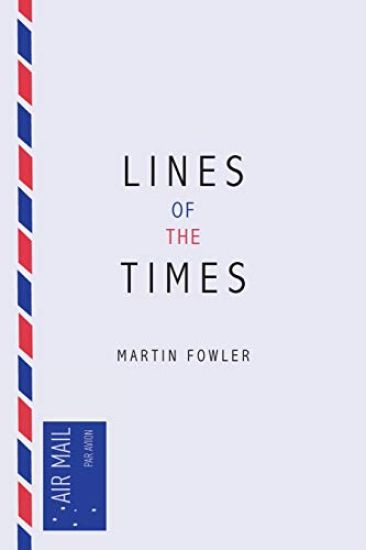
Lines of the Times

Lines of the Times

Martin Fowler

Busybird Publishing
2019
pokkari
"... destined to become a classic and a sought-after book in charity shops, long after you have dipped in and out of the twenty-six chapters." ... a literary critic Always the fl neur, Martin takes us through his wanderings (and wonderings ) over four decades of world travel.An inveterate explorer of the world's tapas bars and cafes, and finding more of interest in a wine and a beach than a museum or cathedral, he shares the thoughts and writings that have shaped his travel life and provides a road map for us all to enjoy on our own journey.If you have little or no interest in package tours, duty free, bourgeois hotels, Pacific cruises and the like, the snippets and vignettes here may just resonate a little.
NoSQL Distilled

NoSQL Distilled

Pramod Sadalage; Martin Fowler

Addison-Wesley Educational Publishers Inc
2012
nidottu
The need to handle increasingly larger data volumes is one factor driving the adoption of a new class of nonrelational “NoSQL” databases. Advocates of NoSQL databases claim they can be used to build systems that are more performant, scale better, and are easier to program. NoSQL Distilled is a concise but thorough introduction to this rapidly emerging technology. Pramod J. Sadalage and Martin Fowler explain how NoSQL databases work and the ways that they may be a superior alternative to a traditional RDBMS. The authors provide a fast-paced guide to the concepts you need to know in order to evaluate whether NoSQL databases are right for your needs and, if so, which technologies you should explore further. The first part of the book concentrates on core concepts, including schemaless data models, aggregates, new distribution models, the CAP theorem, and map-reduce. In the second part, the authors explore architectural and design issues associated with implementing NoSQL. They also present realistic use cases that demonstrate NoSQL databases at work and feature representative examples using Riak, MongoDB, Cassandra, and Neo4j. In addition, by drawing on Pramod Sadalage’s pioneering work, NoSQL Distilled shows how to implement evolutionary design with schema migration: an essential technique for applying NoSQL databases. The book concludes by describing how NoSQL is ushering in a new age of Polyglot Persistence, where multiple data-storage worlds coexist, and architects can choose the technology best optimized for each type of data access.
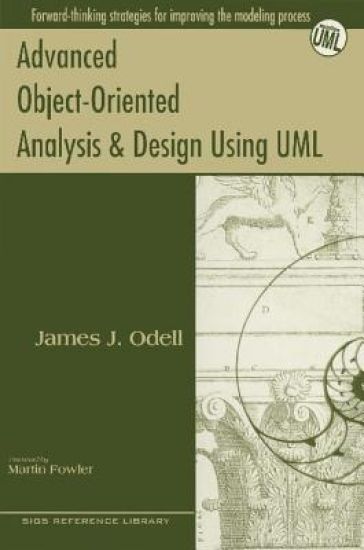
Advanced Object-Oriented Analysis and Design Using UML

Advanced Object-Oriented Analysis and Design Using UML

James J. Odell; Martin Fowler

Cambridge University Press
1998
pokkari
This book conveys the essence of object-oriented programming and software building through the Unified Modeling Language (UML). Composed of updated versions of James Odell’s articles from The Journal of Object-Oriented Programming, ROAD, and Object Magazine, it provides concise but in-depth pieces on structural issues, dynamic issues, business rules, object complexity, object aggregation, design templates, and the process of objects.
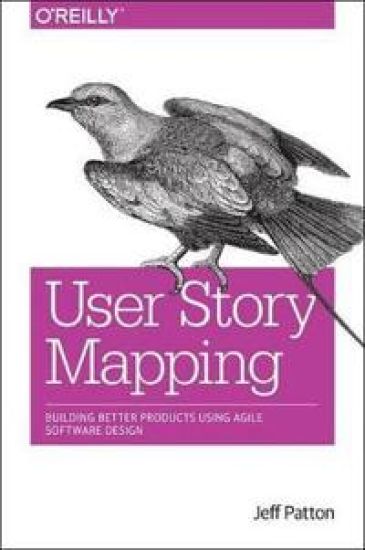
User Story Mapping

User Story Mapping

Jeff Patton; Peter Economy; Martin Fowler; Marty Cagan; Alan Cooper

O'Reilly Media, Inc, USA
2014
nidottu
User story mapping is a valuable tool for software development, once you understand why and how to use it. This insightful book examines how this often misunderstood technique can help your team stay focused on users and their needs without getting lost in the enthusiasm for individual product features. Author Jeff Patton shows you how changeable story maps enable your team to hold better conversations about the project throughout the development process. Your team will learn to come away with a shared understanding of what you're attempting to build and why. Get a high-level view of story mapping, with an exercise to learn key concepts quickly Understand how stories really work, and how they come to life in Agile and Lean projects Dive into a story's lifecycle, starting with opportunities and moving deeper into discovery Prepare your stories, pay attention while they're built, and learn from those you convert to working software
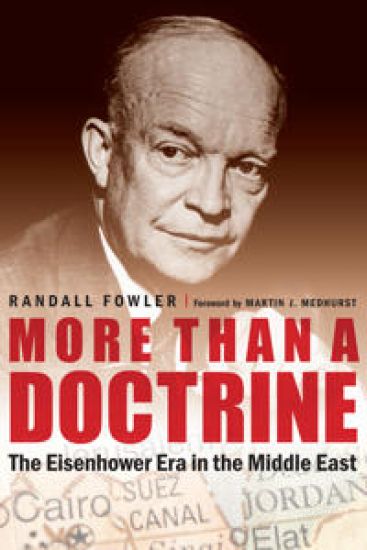
More Than a Doctrine

More Than a Doctrine

Randall Fowler; Martin J. Medhurst

Potomac Books Inc
2018
sidottu
Given on January 5, 1957, the Eisenhower Doctrine Address forever changed America’s relationship with the Middle East. In the aftermath of the Suez Crisis, President Dwight D. Eisenhower boldly declared that the United States would henceforth serve as the region’s “protector of freedom” against Communist aggression. Eighteen months later the president invoked the Eisenhower Doctrine, landing troops in Lebanon and setting an enduring precedent for U.S. intervention in the Middle East. How did Eisenhower justify this intervention to an American public wary of foreign entanglements? Why did he boldly issue the doctrine that bears his name? And, most important, how has Eisenhower’s rhetoric continued to influence American policy and perception of the Middle East? Randall Fowler answers these questions and more in More Than a Doctrine. With the expansion of America’s global influence and the executive branch’s power, presidential rhetoric has become an increasingly important tool in U.S. foreign policy-nowhere more so than in the Middle East. By examining Eisenhower’s rhetoric, More Than a Doctrine explores how the argumentative origins of the Eisenhower Doctrine Address continue to impact us today.
Clark’s Essential Guide to Mobile and Theatre Imaging

Clark’s Essential Guide to Mobile and Theatre Imaging

Amanda Martin; Ken Holmes; Andrea Hulme; Helen Fowler

TAYLOR FRANCIS LTD
2024
nidottu
This easy-to-understand pocketbook in the highly respected Clark’s stable of diagnostic imaging texts is an invaluable tool for student and practising radiographers, providing practical guidance to undertaking a wide range of mobile and theatre imaging examinations in multiple locations - different theatre environments, the Emergency Department, Intensive Care Units, including Neonatal Intensive Care Units, and on general wards.Carrying out examinations outside the imaging suite can be particularly challenging, given the circumstances in which they are often requested, the condition of the patient and the complexity of the environment. Additionally, management of the team and area from a radiation protection point of view is the responsibility of the radiographer and requires excellent communication skills.Clark’s Essential Guide to Mobile and Theatre Imaging takes the systematic approach adopted within books in the Clark's family and is designed to be clear and consistent, in which each imaging location is explored, the challenges of each identified and possible solutions presented. A wide range of theatre procedures is included, as well as the imaging requirements of each, and common theatre practices, such as time out, are considered.
Clark’s Essential Guide to Mobile and Theatre Imaging

Clark’s Essential Guide to Mobile and Theatre Imaging

Amanda Martin; Ken Holmes; Andrea Hulme; Helen Fowler

TAYLOR FRANCIS LTD
2024
sidottu
This easy-to-understand pocketbook in the highly respected Clark’s stable of diagnostic imaging texts is an invaluable tool for student and practising radiographers, providing practical guidance to undertaking a wide range of mobile and theatre imaging examinations in multiple locations - different theatre environments, the Emergency Department, Intensive Care Units, including Neonatal Intensive Care Units, and on general wards.Carrying out examinations outside the imaging suite can be particularly challenging, given the circumstances in which they are often requested, the condition of the patient and the complexity of the environment. Additionally, management of the team and area from a radiation protection point of view is the responsibility of the radiographer and requires excellent communication skills.Clark’s Essential Guide to Mobile and Theatre Imaging takes the systematic approach adopted within books in the Clark's family and is designed to be clear and consistent, in which each imaging location is explored, the challenges of each identified and possible solutions presented. A wide range of theatre procedures is included, as well as the imaging requirements of each, and common theatre practices, such as time out, are considered.
Improving Learning in College

Improving Learning in College

Roz Ivanic; Richard Edwards; David Barton; Marilyn Martin-Jones; Zoe Fowler; Buddug Hughes; Greg Mannion; Kate Miller; Candice Satchwell; June Smith

Routledge
2009
sidottu
What's the problem with literacy at college? How might everyday literacy be harnessed for educational ends?Based on the first major study of literacy practices in colleges in the UK, this book explores the reading and writing associated with learning subjects across the college curriculum. It investigates literacy practices in which students engage outside of college, and teaching and learning strategies through which these can help support the curriculum. With insightful analyses of innovative practices, it considers ways of changing teaching practices to enable students to draw upon their full potential.Recent research work has challenged the myth of individual student deficit, arguing cogently that people have ‘funds of knowledge’ from diverse and vibrant cultural roots, and that these have been misguidedly disqualified by the education system. It has claimed that different ‘ways with words’ can provide valuable resources for learning. However, the empirical exploration of this claim has lagged far behind the theoretical debate. Improving Learning in College resolves this by showing the integrity and richness of the literacy practices of a significant population, not previously the focus of such research: those who take vocational and academic college courses in colleges. It addresses an issue which has not until now been developed within this research tradition: that of how these practices can not only be valued and validated, but mobilised and harnessed to enhance learning in educational settings.This book will interest all teachers, teacher-educators and researchers concerned with post-compulsory education and vocational education in compulsory schooling.
Improving Learning in College

Improving Learning in College

Roz Ivanic; Richard Edwards; David Barton; Marilyn Martin-Jones; Zoe Fowler; Buddug Hughes; Greg Mannion; Kate Miller; Candice Satchwell; June Smith

Routledge
2009
nidottu
What's the problem with literacy at college? How might everyday literacy be harnessed for educational ends?Based on the first major study of literacy practices in colleges in the UK, this book explores the reading and writing associated with learning subjects across the college curriculum. It investigates literacy practices in which students engage outside of college, and teaching and learning strategies through which these can help support the curriculum. With insightful analyses of innovative practices, it considers ways of changing teaching practices to enable students to draw upon their full potential.Recent research work has challenged the myth of individual student deficit, arguing cogently that people have ‘funds of knowledge’ from diverse and vibrant cultural roots, and that these have been misguidedly disqualified by the education system. It has claimed that different ‘ways with words’ can provide valuable resources for learning. However, the empirical exploration of this claim has lagged far behind the theoretical debate. Improving Learning in College resolves this by showing the integrity and richness of the literacy practices of a significant population, not previously the focus of such research: those who take vocational and academic college courses in colleges. It addresses an issue which has not until now been developed within this research tradition: that of how these practices can not only be valued and validated, but mobilised and harnessed to enhance learning in educational settings.This book will interest all teachers, teacher-educators and researchers concerned with post-compulsory education and vocational education in compulsory schooling.