
Kirjahaku
Etsi kirjoja tekijän nimen, kirjan nimen tai ISBN:n perusteella.
1000 tulosta hakusanalla Matthew Robinson

The Fasti is one of Ovid's most complex, inventive, and remarkable works. In presenting the Roman calendar in poetic form, it encompasses an unusually wide range of subjects, a labyrinth of religious rites, historical events, and astronomical myths that can place significant demands on the reader. This commentary on Book 2 - the first detailed commentary in English for 80 years - guides the reader through the maze of diverse material towards a fuller appreciation of the poem, through detailed analysis of its religious, historical, political, and literary background.



This book addresses the various forms of deviance and criminality found within the conventional food system. This system—made up of numerous producers, processors, distributors, and retailers of food—has significant, far-reaching consequences bearing upon the environment and society.Food Crime broadly outlines the processes and impacts of this food system most relevant for the academic discipline of criminology, with a focus on the negative health outcomes of the US diet (e.g., obesity and diabetes) and negative outcomes associated with the system itself (e.g., environmental degradation). The author introduces the concept of "food criminology," a new branch of criminology dedicated to the study of deviance in the food industry. Demonstrating the deviance and criminality involved in many parts of the conventional food system, this book is the first to provide exhaustive coverage of the major issues related to what can be considered food crime. Embedded in the context of state-corporate criminality, the concepts and practices exposed in this book bring attention to harms associated with the conventional food system and illustrate the degree of culpability of food companies and government agencies for these harms.This book is of interest to students, scholars, and practitioners seeking a more just and healthy food system and encourages further future research into food crimes in the disciplines of criminology, criminal justice, and sociology.

This book addresses the various forms of deviance and criminality found within the conventional food system. This system—made up of numerous producers, processors, distributors, and retailers of food—has significant, far-reaching consequences bearing upon the environment and society.Food Crime broadly outlines the processes and impacts of this food system most relevant for the academic discipline of criminology, with a focus on the negative health outcomes of the US diet (e.g., obesity and diabetes) and negative outcomes associated with the system itself (e.g., environmental degradation). The author introduces the concept of "food criminology," a new branch of criminology dedicated to the study of deviance in the food industry. Demonstrating the deviance and criminality involved in many parts of the conventional food system, this book is the first to provide exhaustive coverage of the major issues related to what can be considered food crime. Embedded in the context of state-corporate criminality, the concepts and practices exposed in this book bring attention to harms associated with the conventional food system and illustrate the degree of culpability of food companies and government agencies for these harms.This book is of interest to students, scholars, and practitioners seeking a more just and healthy food system and encourages further future research into food crimes in the disciplines of criminology, criminal justice, and sociology.


In Lord, That I May See: Fundamentals of Christian Philosophy, Robinson surveys the most important concepts in classical philosophy and offers the student a solid foundation in reason. In recent times, the Catholic Church has been urging all of the faithful to come to a renewed appreciation and understanding of genuine philosophy. The pedagogical method of this book is one that widens one's intellectual and spiritual lives in the faith. Beautiful prayers and artwork are offered to help you elevate your hearts and minds to the things of God. Since God has revealed Himself supernaturally by Divine Revelation, and naturally by creation, arguments are employed that make use of those avenues of knowledge of God. Scripture and Tradition are cited to help ground you in the context of the Catholic Church, a Church which is the Opillar and ground of the truthO (1 Tim 3:15).

While theoretical particle physics is an extraordinarily fascinating field, the incredibly fast pace at which it moves along, combined with the huge amount of background information necessary to perform cutting edge research, poses a formidable challenge for graduate students. This book represents the first in a series designed to assist students in the process of transitioning from coursework to research in particle physics. Rather than reading literally dozens of physics and mathematics texts, trying to assimilate the countless ideas, translate notations and perspectives, and see how it all fits together to get a holistic understanding, this series provides a detailed overview of the major mathematical and physical ideas in theoretical particle physics. Ultimately the ideas will be presented in a unified, consistent, holistic picture, where each topic is built firmly on what has come before, and all topics are related in a clear and intuitive way.This introductory text on quantum field theory and particle physics provides both a self-contained and complete introduction to not only the necessary physical ideas, but also a complete introduction to the necessary mathematical tools. Assuming minimal knowledge of undergraduate physics and mathematics, this book lays both the mathematical and physical groundwork with clear, intuitive explanations and plenty of examples. The book then continues with an exposition of the Standard Model of Particle Physics, the theory that currently seems to explain the universe apart from gravity. Furthermore, this book was written as a primer for the more advanced mathematical and physical ideas to come later in this series.

While theoretical particle physics is an extraordinarily fascinating field, the incredibly fast pace at which it moves along, combined with the huge amount of background information necessary to perform cutting edge research, poses a formidable challenge for graduate students. This book represents the first in a series designed to assist students in the process of transitioning from coursework to research in particle physics. Rather than reading literally dozens of physics and mathematics texts, trying to assimilate the countless ideas, translate notations and perspectives, and see how it all fits together to get a holistic understanding, this series provides a detailed overview of the major mathematical and physical ideas in theoretical particle physics. Ultimately the ideas will be presented in a unified, consistent, holistic picture, where each topic is built firmly on what has come before, and all topics are related in a clear and intuitive way.This introductory text on quantum field theory and particle physics provides both a self-contained and complete introduction to not only the necessary physical ideas, but also a complete introduction to the necessary mathematical tools. Assuming minimal knowledge of undergraduate physics and mathematics, this book lays both the mathematical and physical groundwork with clear, intuitive explanations and plenty of examples. The book then continues with an exposition of the Standard Model of Particle Physics, the theory that currently seems to explain the universe apart from gravity. Furthermore, this book was written as a primer for the more advanced mathematical and physical ideas to come later in this series.


Reprint of the original, first published in 1872. The publishing house Anatiposi publishes historical books as reprints. Due to their age, these books may have missing pages or inferior quality. Our aim is to preserve these books and make them available to the public so that they do not get lost.

Reprint of the original, first published in 1872. The publishing house Anatiposi publishes historical books as reprints. Due to their age, these books may have missing pages or inferior quality. Our aim is to preserve these books and make them available to the public so that they do not get lost.

These forty stories recount Matthew Robinson's two period of working on EastEnders, once the BBC's top-rated show. The stories cover his involvement in the run-up to and aftermath of the programme's launch, first aired on 19 February 1985. He'd been hired as 'Lead Director' and directed many of the show's early episodes including the episodes 1 and 2. After a decade of working on other projects, he returned to EastEnders with the title of Executive Producer. His brief was clear: to get the show back up on both feet. His two years of achieving that earned him the long-running tabloid nick-name of 'The Axeman of Albert Square'.
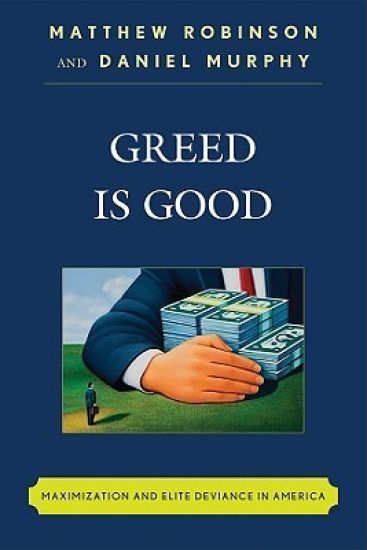
Centered on the concept of "Maximization," Matthew B. Robinson and Dr. Daniel S. Murphy offer a new theory of elite deviance and corporate crime called contextual anomie/strain theory. Exploring how simultaneous use of legitimate (i.e., legal) and illegitimate (i.e., deviant or illegal) means of opportunity in pursuit of one's goals, Greed is Good explains various forms of elite deviance and corporate crime. Contextual anomie/strain theory posits that although everyone in American society experiences stress and frustration association with American Dream, there are certain contexts in American society that produce even greater stress, frustration, and pressures toward crime. One such context is the corporate workplace. This book affirms how deviance and criminality have become normal in big business due to pressure to produce massive profits at the expense of all other considerations.

Centered on the concept of 'Maximization,' Matthew B. Robinson and Dr. Daniel S. Murphy offer a new theory of elite deviance and corporate crime called contextual anomie/strain theory. Exploring how simultaneous use of legitimate (i.e., legal) and illegitimate (i.e., deviant or illegal) means of opportunity in pursuit of one's goals, Greed is Good explains various forms of elite deviance and corporate crime. Contextual anomie/strain theory posits that although everyone in American society experiences stress and frustration association with American Dream, there are certain contexts in American society that produce even greater stress, frustration, and pressures toward crime. One such context is the corporate workplace. This book affirms how deviance and criminality have become normal in big business due to pressure to produce massive profits at the expense of all other considerations.

Profiles of Sport Industry Professionals: The People Who Make the Games Happen
Matthew Robinson; Mary Hums; R. Brian Crow; Dennis Phillips
Aspen Publishers Inc.,U.S.
2000
nidottu
The sports field is becoming increasingly complex and multifaceted, and sports is big business. Students will learn how their careers evolved, how they prepared, and what their failures and successes have been. The editors of this unique text compiled interviews of a sport agent, high school athletic director, sport attorney, fitness trainer, ice rink manager, reporter, and many more

Considerations on the Measures Carrying on with Respect to the British Colonies in North America
Matthew Robinson-Morris Rokeby
Hansebooks
2020
nidottu

Social Justice, Criminal Justice is a thought-provoking examination of the U.S. legal system, focusing on how criminal justice and social justice are related. The book provides a solid foundation of key philosophical and theoretical issues and goes on to examine the function of the law as it relates to social justice issues. The authors present and explain the foundational legal documents of the United States, and critically examine how those same documents, which espoused the rhetoric of equality for all, contribute toward the perpetuation and maintenance of a system of exclusion for groups with minority status, such as racial and ethnic minorities, the poor, women, and the LGBT (lesbian, gay, bisexual, transgender) community. Succinct but comprehensive, this text offers a careful examination of possible relationships between social justice theory and criminal justice practice and illuminates the role that the legal system has played in both preventing and assisting social change and power dynamics. For each identified group, important landmark court decisions are used to demonstrate the plight of the powerless and the quest for equal rights. The book provides an important perspective and understanding of the relationships among criminal justice, social justice, and the law. Suitable for undergraduate and early graduate courses in Social Justice, Justice Studies, Critical Issues, Ethics, and American Government and Law, this text provides easily digestible content for those interested in thinking critically about the U.S. legal system.