Kirjojen hintavertailu. Mukana 12 390 323 kirjaa ja 12 kauppaa.

Kirjahaku

Etsi kirjoja tekijän nimen, kirjan nimen tai ISBN:n perusteella.

1000 tulosta hakusanalla Maurice Samuel

Maurice Samuel

Maurice Samuel

Alan T. Levenson

THE UNIVERSITY OF ALABAMA PRESS
2022
sidottu
An intellectual biography that reassesses one of the premier Jewish humanists of the mid-twentieth centuryIn Maurice Samuel: Life and Letters of a Secular Jewish Contrarian Alan T. Levenson recaptures the life, works, and milieu of the Romanian-born, English-educated, American belletrist Maurice Samuel. A diaspora intellectual—or a rooted cosmopolitan, as Levenson describes him—Samuel made an indelible mark on many features of contemporary Jewish thought and culture. A generalist in an age of experts, an independent scholar in an age of rabbis and professors, Samuel was one of the most productive and visible members of the group dubbed “The Other New York Jewish Intellectuals.” His fame as a public intellectual and popular speaker were well warranted: no mere popularizer, Samuel contributed significantly to four seemingly unrelated but critical areas of modern Jewish thought. Samuel is characterized by some as principally a Zionist, by others as an accomplished translator and many Americans’ first entrÉe into the world of Yiddish literature, by still others as a polemicist and campaigner against anti-Semitism, and finally as a media-savvy Biblical critic, essayist, and radio personality. But he was all of these things, since Samuel succeeded in an era when it was possible to be a public intellectual without being an expert. Drawing on Samuel’s vast literary opus, as well as previously unexplored archival material from three continents, this study writes Samuel back into the history of mid-twentieth century American letters. Levenson argues that Samuel’s varied and substantive contributions demand reconsideration of our assumptions about the means and ends of cultural transmission, and merit him a place as one of twentieth century American Jewry’s most significant cultural and intellectual voices.
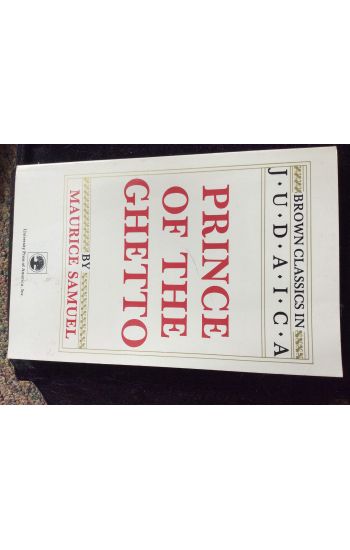
Prince of the Ghetto

Prince of the Ghetto

Maurice Samuel

University Press of America
1987
nidottu
Maurice Samuel presents to the English-reading audience one of the richest spirits of the Yiddish language to appear at the beginning of the twentieth century. Through the writings of Isaac Loeb Peretz, he provides access to the lost and lamented world of Polish Jewry. Peretz's folk and Chassidic tales are here retold. The author has arranged them into a pattern that reveals both the life and work of the great writer as well as the basic folklore of the Jews of Poland. Originally published by Knopf in 1948, this edition includes a new introduction by Jacob Neusner.
The Great Hatred

The Great Hatred

Maurice Samuel

University Press of America
1988
nidottu
Writing neither in defense of the Jews, nor in the hope of converting Anti-Semites, the author rejects as inadequate and dangerous the economic and sociological interpretation of Anti-Semitism. He sees in it, not a form of ordinary racial intolerance or religious bigotry or political trickery, but a far deeper condition of the Western Christian mind.
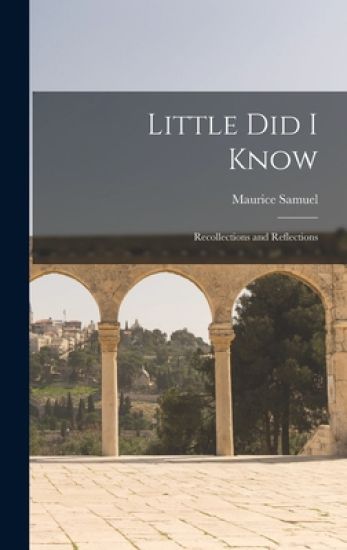
Little Did I Know: Recollections and Reflections

Little Did I Know: Recollections and Reflections

Maurice Samuel

Hassell Street Press
2021
nidottu
This work has been selected by scholars as being culturally important and is part of the knowledge base of civilization as we know it.This work is in the public domain in the United States of America, and possibly other nations. Within the United States, you may freely copy and distribute this work, as no entity (individual or corporate) has a copyright on the body of the work.Scholars believe, and we concur, that this work is important enough to be preserved, reproduced, and made generally available to the public. To ensure a quality reading experience, this work has been proofread and republished using a format that seamlessly blends the original graphical elements with text in an easy-to-read typeface.We appreciate your support of the preservation process, and thank you for being an important part of keeping this knowledge alive and relevant.
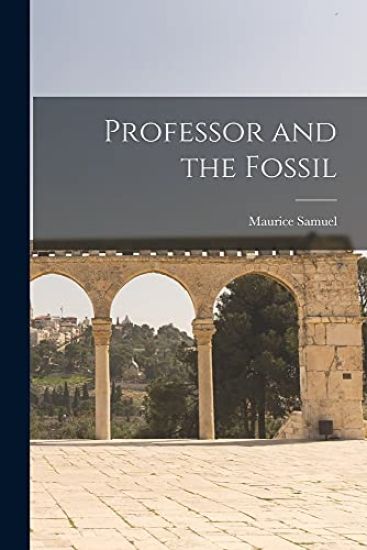
The Professor and the Fossil: Some Observations on Arnold J. Toynbee's a Study of History
The Professor and the Fossil: Some Observations on Arnold J. Toynbee's A Study of History by Maurice Samuel is a critical analysis of Arnold J. Toynbee's magnum opus, A Study of History. Toynbee's work is considered a landmark in the field of history, and Samuel's book offers a unique perspective on it. Samuel, a professor of English literature, examines Toynbee's theories and ideas, and provides his own insights into the work. The book is divided into two parts. The first part provides an overview of Toynbee's work, while the second part offers Samuel's critique of it. The book is written in a clear and concise style, making it accessible to both scholars and lay readers. Overall, The Professor and the Fossil is a valuable addition to the literature on A Study of History and is an essential read for anyone interested in the field of history.This is a new release of the original 1956 edition.This scarce antiquarian book is a facsimile reprint of the old original and may contain some imperfections such as library marks and notations. Because we believe this work is culturally important, we have made it available as part of our commitment for protecting, preserving, and promoting the world's literature in affordable, high quality, modern editions, that are true to their original work.
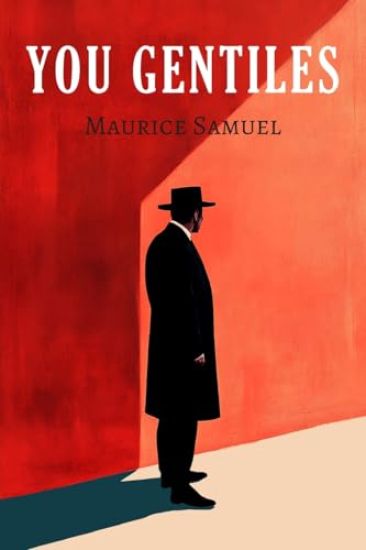
You Gentiles

You Gentiles

Maurice Samuel

Must Have Books
2022
nidottu
You Gentiles is a 1924 book written by Romanian-born British and American-Jewish author Maurice Samuel. It discusses points of difference in behavior between Jews and Gentiles focusing on physical activity, religion, concepts of good and evil, loyalty, science, fair play, discipline, and much more.
The Right to Difference

The Right to Difference

Maurice Samuels

University of Chicago Press
2016
sidottu
Universal equality is a treasured political concept in France, but recent anxiety over the country's Muslim minority has led to an emphasis on a new form of universalism, one promoting loyalty to the nation at the expense of all ethnic and religious affiliations. This timely book offers a fresh perspective on the debate by showing that French equality has not always demanded an erasure of differences. Through close and contextualized readings of the way that major novelists, philosophers, filmmakers, and political figures have struggled with the question of integrating Jews into French society, Maurice Samuels draws lessons about how the French have often understood the universal in relation to the particular. Samuels demonstrates that Jewish difference has always been essential to the elaboration of French universalism, whether as its foil or as proof of its reach. He traces the development of this discourse through key moments in French history, from debates over granting Jews civil rights during the Revolution, through the Dreyfus Affair and Vichy, and up to the rise of a "new antisemitism" in recent years. By recovering the forgotten history of a more open, pluralistic form of French universalism, Samuels points toward new ways of moving beyond current ethnic and religious dilemmas and argues for a more inclusive view of what constitutes political discourse in France.
The Right to Difference

The Right to Difference

Maurice Samuels

University of Chicago Press
2019
pokkari
Universal equality is a treasured political concept in France, but recent anxiety over the country's Muslim minority has led to an emphasis on a new form of universalism, one promoting loyalty to the nation at the expense of all ethnic and religious affiliations. This timely book offers a fresh perspective on the debate by showing that French equality has not always demanded an erasure of differences. Through close and contextualized readings of the way that major novelists, philosophers, filmmakers, and political figures have struggled with the question of integrating Jews into French society, Maurice Samuels draws lessons about how the French have often understood the universal in relation to the particular. Samuels demonstrates that Jewish difference has always been essential to the elaboration of French universalism, whether as its foil or as proof of its reach. He traces the development of this discourse through key moments in French history, from debates over granting Jews civil rights during the Revolution, through the Dreyfus Affair and Vichy, and up to the rise of a "new antisemitism" in recent years. By recovering the forgotten history of a more open, pluralistic form of French universalism, Samuels points toward new ways of moving beyond current ethnic and religious dilemmas and argues for a more inclusive view of what constitutes political discourse in France.
Alfred Dreyfus

Alfred Dreyfus

Maurice Samuels

YALE UNIVERSITY PRESS
2024
sidottu
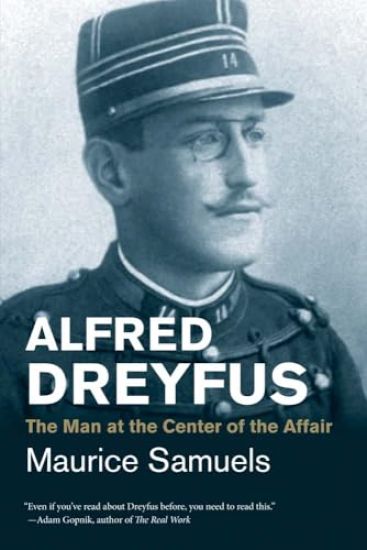
An insightful new biography of the central figure in the Dreyfus Affair, focused on the man himself and based on newly accessible documents “An admirable introduction not only to its nominal subject but to . . . great historical events.”—Geoffrey Wheatcroft, New York Review of Books On January 5, 1895, Captain Alfred Dreyfus’s cries of innocence were drowned out by a mob shouting “Death to Judas!” In this book, Maurice Samuels gives readers new insight into Dreyfus himself—the man at the center of the affair. He tells the story of Dreyfus’s early life in Paris, his promising career as a French officer, the false accusation leading to his imprisonment on Devil’s Island, the fight to prove his innocence that divided the French nation, and his life of quiet obscurity after World War I. Samuels’s striking perspective is enriched by a newly available archive of more than three thousand documents and objects donated by the Dreyfus family. Unlike many historians, Samuels argues that Dreyfus was not an “assimilated” Jew. Rather, he epitomized a new model of Jewish identity made possible by the French Revolution, when France became the first European nation to grant Jews full legal equality. This book analyzes Dreyfus’s complex relationship to Judaism and to antisemitism over the course of his life—a story that, as global antisemitism rises, echoes still. It also shows the profound effect of the Dreyfus Affair on the lives of Jews around the world.
Alfred Dreyfus

Alfred Dreyfus

Maurice Samuels

YALE UNIVERSITY PRESS
2025
pokkari
An insightful new biography of the central figure in the Dreyfus Affair, focused on the man himself and based on newly accessible documents “An admirable introduction not only to its nominal subject but to . . . great historical events.”—Geoffrey Wheatcroft, New York Review of Books On January 5, 1895, Captain Alfred Dreyfus’s cries of innocence were drowned out by a mob shouting “Death to Judas!” In this book, Maurice Samuels gives readers new insight into Dreyfus himself—the man at the center of the affair. He tells the story of Dreyfus’s early life in Paris, his promising career as a French officer, the false accusation leading to his imprisonment on Devil’s Island, the fight to prove his innocence that divided the French nation, and his life of quiet obscurity after World War I. Samuels’s striking perspective is enriched by a newly available archive of more than three thousand documents and objects donated by the Dreyfus family. Unlike many historians, Samuels argues that Dreyfus was not an “assimilated” Jew. Rather, he epitomized a new model of Jewish identity made possible by the French Revolution, when France became the first European nation to grant Jews full legal equality. This book analyzes Dreyfus’s complex relationship to Judaism and to antisemitism over the course of his life—a story that, as global antisemitism rises, echoes still. It also shows the profound effect of the Dreyfus Affair on the lives of Jews around the world.
The Spectacular Past

The Spectacular Past

Maurice Samuels

Cornell University Press
2004
sidottu
Struggling to make sense of the Revolution of 1789, the French in the nineteenth century increasingly turned to visual forms of historical representation in a variety of media. Maurice Samuels shows how new kinds of popular entertainment introduced during and after the Revolution transformed the past into a spectacle. The wax display (in which visitors circulated amid life-size statues of historical figures), the phantasmagoria show (in which images of historical personages were projected onto smoke or invisible screens), and the panorama (in which spectators viewed giant circular canvases depicting historical scenes) employed new optical technologies to entice crowds of spectators. Such entertainments, Samuels asserts, provided bourgeois audiences with an illusion of mastery over the past, allowing them to picture their new role as historical agents.Samuels demonstrates how the spectacular mode of historical representation pervaded historiography, drama, and the novel during the Romantic period. He then argues that the early Realist fiction of Balzac and Stendhal emerged as a critique of the spectacular historical imagination. By investigating how postrevolutionary France envisioned the past, Samuels illuminates a vital moment in the cultural history of modernity.
The Spectacular Past

The Spectacular Past

Maurice Samuels

Cornell University Press
2004
pokkari
Struggling to make sense of the Revolution of 1789, the French in the nineteenth century increasingly turned to visual forms of historical representation in a variety of media. Maurice Samuels shows how new kinds of popular entertainment introduced during and after the Revolution transformed the past into a spectacle. The wax display (in which visitors circulated amid life-size statues of historical figures), the phantasmagoria show (in which images of historical personages were projected onto smoke or invisible screens), and the panorama (in which spectators viewed giant circular canvases depicting historical scenes) employed new optical technologies to entice crowds of spectators. Such entertainments, Samuels asserts, provided bourgeois audiences with an illusion of mastery over the past, allowing them to picture their new role as historical agents.Samuels demonstrates how the spectacular mode of historical representation pervaded historiography, drama, and the novel during the Romantic period. He then argues that the early Realist fiction of Balzac and Stendhal emerged as a critique of the spectacular historical imagination. By investigating how postrevolutionary France envisioned the past, Samuels illuminates a vital moment in the cultural history of modernity.
Inventing the Israelite

Inventing the Israelite

Maurice Samuels

Stanford University Press
2009
sidottu
In this book, Maurice Samuels brings to light little known works of literature produced from 1830 to 1870 by the first generation of Jews born as French citizens. These writers, Samuels asserts, used fiction as a laboratory to experiment with new forms of Jewish identity relevant to the modern world. In their stories and novels, they responded to the stereotypical depictions of Jews in French culture while creatively adapting the forms and genres of the French literary tradition. They also offered innovative solutions to the central dilemmas of Jewish modernity in the French context—including how to reconcile their identities as Jews with the universalizing demands of the French revolutionary tradition. While their solutions ranged from complete assimilation to a modern brand of orthodoxy, these writers collectively illustrate the creativity of a community in the face of unprecedented upheaval.