Kirjojen hintavertailu. Mukana 11 463 607 kirjaa ja 12 kauppaa.

Kirjahaku

Etsi kirjoja tekijän nimen, kirjan nimen tai ISBN:n perusteella.

1000 tulosta hakusanalla Neil Weiss

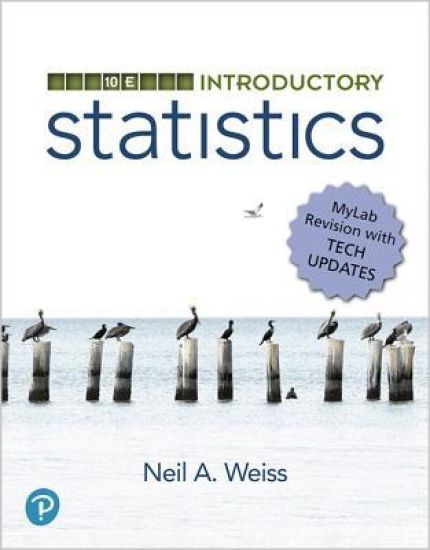
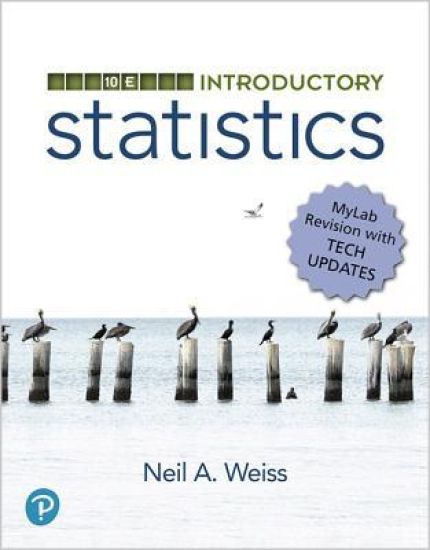
Introductory Statistics, MyLab Revision
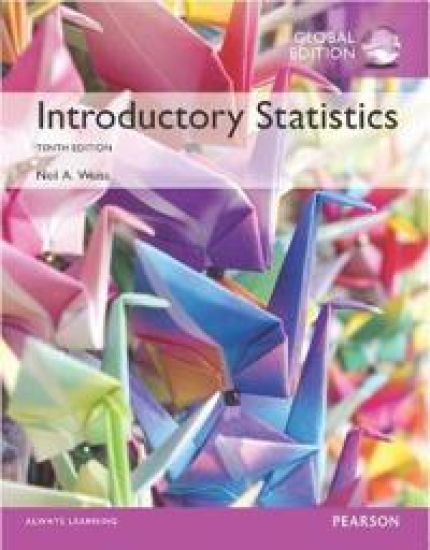
For one- or two-semester courses in Introductory Statistics. Statistically significant Introductory Statistics MyLab Revision, 10th Edition is ideal for introductory statistics classes that emphasize statistical reasoning and critical thinking. Weiss’s meticulous and comprehensive coverage includes careful, detailed explanations to ease the learning process. With more than 1,000 data sets and over 3,000 exercises, this text takes a data-driven approach that encourages students to apply their knowledge and develop statistical understanding. Weiss offers a parallel presentation of critical-value and P-value approaches to hypothesis testing. This unique design allows the flexibility to concentrate on one approach or the opportunity for greater depth in comparing the two. Also available with MyLab Statistics By combining trusted author content with digital tools and a flexible platform, MyLab Statistics personalizes the learning experience and improves results for each student. With MyLab Statistics and StatCrunch®, an integrated web-based statistical software program, students learn the skills they need to interact with data in the real world. Note: You are purchasing a standalone product; MyLab Statistics does not come packaged with this content. Students, if interested in purchasing this title with MyLab Statistics, ask your instructor to confirm the correct package ISBN and Course ID. Instructors, contact your Pearson representative for more information. If you would like to purchase both the physical text and MyLab Statistics, search for: 0135230004 / 9780135230008 Introductory Statistics MyLab Revision Plus MyLab Statistics with Pearson eText - Access Card Package Package consists of: 0135163056 / 9780135163054 Introductory Statistics, MyLab Revision0135190177 / 9780135190173 MyLab Statistics with Pearson eText - Standalone Access Card - for Introductory Statistics, MyLab Revision
MyLab Statistics with Pearson eText Access Code (24 Months) for Introductory Statistics, MyLab Revision
MyLab Statistics Standalone Access Card to accompany Weiss, Introductory Statistics, MyLab Revision, 10/e This item is an access card for MyLab™ Statistics. This physical access card includes an access code for your MyLab Statistics course. In order to access the online course you will also need a Course ID, provided by your instructor. This title-specific access card provides access to the Weiss, Introductory Statistics, MyLab Revision, 10/e accompanying MyLab course ONLY. 0135190177 / 9780135190173 MYLAB STATISTICS WITH PEARSON ETEXT -- STANDALONE ACCESS CARD -- FOR INTRODUCTORY STATISTICS, MYLAB REVISION , 10/e MyLab Statistics is the world’s leading online tutorial, and assessment program designed to help you learn and succeed in your statistics course. MyLab Statistics online courses are created to accompany one of Pearson’s best-selling math textbooks. Every MyLab Statistics course includes a complete, interactive eText. Learn more about MyLab Statistics. ALERT: Before you purchase, check with your instructor or review your course syllabus to ensure that you select the correct ISBN. Used or rental books If you rent or purchase a used book with an access code, the access code may have been redeemed previously and you may have to purchase a new access code. Access codes Access codes that are purchased from sellers other than Pearson carry a higher risk of being either the wrong ISBN or a previously redeemed code. Check with the seller prior to purchase.
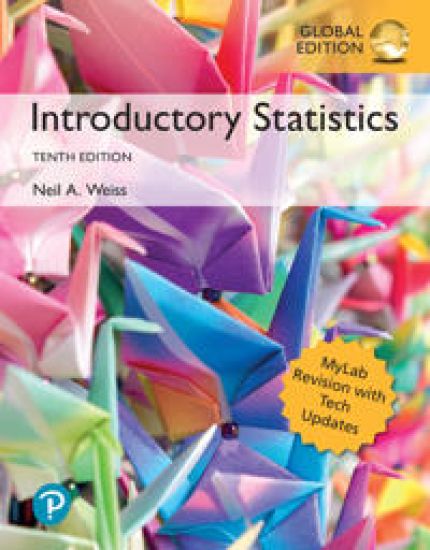
Introductory Statistics, MyLab Revision, Global Edition
For one- or two-semester courses in Introductory Statistics. Statistically significant Introductory Statistics MyLab Revision, 10th Edition, Global Edition is ideal for introductory statistics classes that emphasize statistical reasoning and critical thinking. Weiss’s meticulous and comprehensive coverage includes careful, detailed explanations to ease the learning process. With more than 1,000 data sets and over 3,000 exercises, this text takes a data-driven approach that encourages students to apply their knowledge and develop statistical understanding. Weiss offers a parallel presentation of critical-value and P-value approaches to hypothesis testing. This unique design allows the flexibility to concentrate on one approach or the opportunity for greater depth in comparing the two.
Introductory Statistics + MyLab Statistics with Pearson eText, MyLab Revision, Global Edition
For one- or two-semester courses in Introductory Statistics. Statistically significant Introductory Statistics MyLab Revision, 10th Edition, Global Edition is ideal for introductory statistics classes that emphasize statistical reasoning and critical thinking. Weiss’s meticulous and comprehensive coverage includes careful, detailed explanations to ease the learning process. With more than 1,000 data sets and over 3,000 exercises, this text takes a data-driven approach that encourages students to apply their knowledge and develop statistical understanding. Weiss offers a parallel presentation of critical-value and P-value approaches to hypothesis testing. This unique design allows the flexibility to concentrate on one approach or the opportunity for greater depth in comparing the two.
Introductory Statistics, MyLab Revision, Global Edition + MyLab Statistics with Pearson eText (Package)
For one- or two-semester courses in Introductory Statistics. Statistically significant Introductory Statistics MyLab Revision, 10th Edition, Global Edition is ideal for introductory statistics classes that emphasize statistical reasoning and critical thinking. Weiss’s meticulous and comprehensive coverage includes careful, detailed explanations to ease the learning process. With more than 1,000 data sets and over 3,000 exercises, this text takes a data-driven approach that encourages students to apply their knowledge and develop statistical understanding. Weiss offers a parallel presentation of critical-value and P-value approaches to hypothesis testing. This unique design allows the flexibility to concentrate on one approach or the opportunity for greater depth in comparing the two.
Hidden in Plain Sight

Hidden in Plain Sight

Avrum G Weiss; James M O'Neil

Lasting Impact Press
2021
pokkari
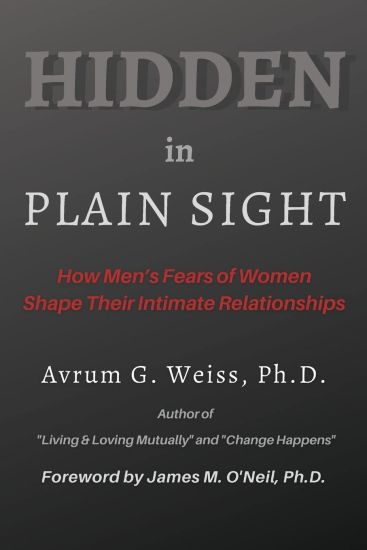
Pussy-whipped. Why is it that the worst thing one man can say about another is that he is controlled by a woman, or more precisely, by his need for a woman? The surprising answer that is hidden in plain sight is that most straight men are scared of their intimate partners.It's pretty clear that women are afraid of men, and with good reason. Men hold positions of privilege and power in most personal and professional settings. The idea that men are also afraid of women is a radical one, and to some, even offensive. Men's fears of women are less visible--more hidden--from women, from other men, and from themselves. Men have done such a good job of hiding their fears and vulnerabilities that even their mothers and lovers don't know how scared they are. Men's fears of women include: the fear of being dominated and controlled by women; fear of being entrapped by women; fear of being responsible for women; fear of being inadequate; fear of being abandoned; and fear of being feminized.Men's fears of women are one of the primary causes of many emotional problems for men and of their difficulties in intimate heterosexual relationships. Take the example of a husband and wife having an argument. The wife is hurt and angry. Her husband can clearly see that she's upset, which makes him surprisingly uncomfortable. While he would like to feel empathic, there is something about her strong feelings that is distressing to him and gets in the way. Because he is uncomfortable with his own strong feelings, the husband begins to withdraw emotionally and detach to protect himself. For reasons he doesn't fully understand, it becomes increasingly important to him to remain rational and unemotional, and he is increasingly critical of, and irritated with, his wife for being "too emotional." The wife can feel her husband withdrawing, and the more he withdraws, the stronger her feelings become and the more urgently she pursues him, trying to find a way to make some kind of emotional connection with him. Now they are locked in a mutually destructive cycle; the more she pushes for the emotional connection that she yearns for, the more he detaches. The more he tries to control his own fear by detaching, the more upset she gets.Dr. Avrum Weiss' Hidden in Plain Sight: How Men's Fears of Women Shape Their Intimate Relationships is a psychological non-fiction book about relationships and the hidden internal world of men. The book presents many scenarios with prescriptive content and guidance woven throughout. It is written for a popular audience in intelligent yet accessible, relatable language.Male readers will recognize that this is a male-positive book, written by a man about the male perspective on relationships in a way that will not make them feel inadequate or shamed. At the same time, the book's topic will interest women who often feel in the dark about men's internal experience, and who will be intrigued by the opportunity to have a peek into the secret lives of men, to learn more about the counter-intuitive idea that men are as scared of them as they are of men.
Corporate Citizenship

Corporate Citizenship

Tracey Cohen; Alfred Bimha; Kudakwashe Chodokufa; Lynette Cronje; Johanna Badenhorst-Weiss; Johan Strydom; Neil Eccles; Ireze Le Roux; Anton Grobler

Oxford University Press Southern Africa
2016
nidottu
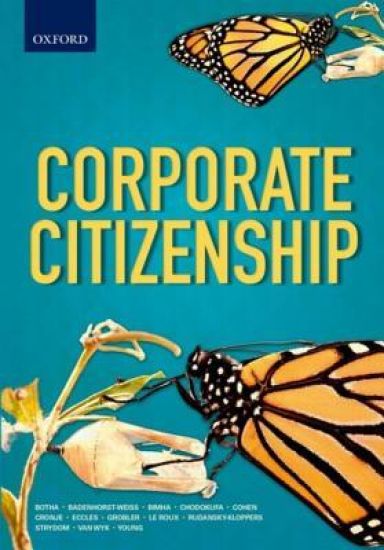
What does corporate citizenship entail? What is the rationale for corporate citizenship? What essential capabilities are required for corporate citizenship roles to be successfully incorporated into the key functional areas of business? Corporate Citizenship answers these and numerous other related questions, by providing a comprehensive foundation that equips students with the tools to analyse the development and implementation of globally responsible business behavior. While corporate citizenship may be a theoretical and philosophical subject, this textbook offers a broad range of examples and situations that give students the opportunity to apply their knowledge in a critical manner within a business context. The book is written for senior undergraduate students at universities and universities of technology, who are studying subjects within the field of Commerce.
From Maimonides to Microsoft

From Maimonides to Microsoft

Neil Weinstock Netanel

Oxford University Press Inc
2018
nidottu
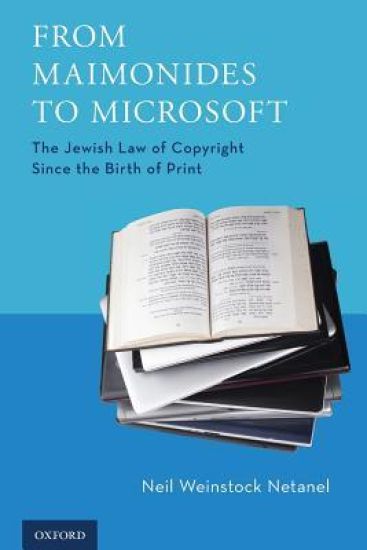
Jewish copyright law is a rich body of jurisprudence that developed in parallel with modern copyright laws and the book privileges that preceded them. Jewish copyright law owes its origins to a reprinting ban that the Rome rabbinic court issued for three books of Hebrew grammar in 1518. It continues to be applied today, notably in a rabbinic ruling outlawing pirated software, issued at Microsoft's request. In From Maimonides to Microsoft, Professor Netanel traces the historical development of Jewish copyright law by comparing rabbinic reprinting bans with secular and papal book privileges and by relaying the stories of dramatic disputes among publishers of books of Jewish learning and liturgy. He describes each dispute in its historical context and examines the rabbinic rulings that sought to resolve it. Remarkably, the rabbinic reprinting bans and copyright rulings address some of the same issues that animate copyright jurisprudence today: Is copyright a property right or just a right to receive fair compensation? How long should copyrights last? What purposes does copyright serve? While Jewish copyright law has borrowed from its secular law counterpart at key junctures, it fashions strikingly different answers to those key questions. The story of Jewish copyright law also intertwines with the history of the Jewish book trade and with steadfast efforts of rabbinic leaders to maintain their authority to regulate that trade in the face of the dramatic erosion of Jewish communal autonomy in the eighteenth and nineteenth centuries. This book will thus be of considerable interest to students of Jewish law and history, as well as copyright scholars and practitioners.
Copyright's Paradox

Copyright's Paradox

Neil Weinstock Netanel

Oxford University Press Inc
2008
sidottu
The United States Supreme Court famously labeled copyright "the engine of free expression" because it provides a vital economic incentive for much of the literature, commentary, music, art, and film that makes up our public discourse. Yet today's greatly expanded copyright law often does the opposite--it can be used to quash news reporting, political commentary, church dissent, historical scholarship, cultural critique, and artistic expression. In Copyright's Paradox, Neil Weinstock Netanel explores the tensions between copyright law and free speech concerns, revealing how copyright law can impose unacceptable burdens on speech. Netanel provides concrete illustrations of how copyright often prevents speakers from effectively conveying their message, tracing this conflict across both traditional and digital media and considering current controversies such as the YouTube and MySpace copyright infringements, Hip-hop music and digital sampling, and the Google Book Search litigation. The author juxtaposes the dramatic expansion of copyright holders' proprietary control against the individual's newly found ability to digitally cut, paste, edit, remix, and distribute sound recordings, movies, TV programs, graphics, and texts the world over. He tests whether, in light of these developments and others, copyright still serves as a vital engine of free expression and he assesses how copyright does--and does not--burden speech. Taking First Amendment values as his lodestar, Netanel argues that copyright should be limited to how it can best promote robust debate and expressive diversity, and he presents a blueprint for how that can be accomplished. Copyright and free speech will always stand in some tension. But there are ways in which copyright can continue to serve as an engine of free expression while leaving ample room for speakers to build on copyrighted works to convey their message, express their personal commitments, and fashion new art. This book shows us how.
From Maimonides to Microsoft

From Maimonides to Microsoft

Neil Weinstock Netanel; David Nimmer

Oxford University Press Inc
2016
sidottu
Jewish copyright law is a rich body of copyright doctrine and jurisprudence that developed in parallel with Anglo-American and Continental European copyright laws and the printers' privileges that preceded them. Jewish copyright law traces its origins to a dispute adjudicated in 1550, over 150 years before modern copyright law is typically said to have emerged with the Statute of Anne of 1709. It continues to be applied today, notably in a rabbinic ruling outlawing pirated software, issued at Microsoft's request. In From Maimonides to Microsoft, Professors Netanel and Nimmer trace the development of Jewish copyright law by relaying the stories of five dramatic disputes, running from the sixteenth century to the present. They describe each dispute in its historical context and examine the rabbinic rulings that sought to resolve it. Remarkably, these disputes address some of the same issues that animate copyright jurisprudence today: Is copyright a property right or a limited regulatory prerogative? What is copyright's rationale? What is its scope? How can copyright be enforced against an infringer who is beyond the applicable legal authority's reach? This book introduces copyright scholars, students, and practitioners to an entirely new narrative and body of copyright jurisprudence. Presenting new material regarding the operation of the Jewish book trade and some of the leading disputes affecting it, Professors Netanel and Nimmer examine how copyright disputes arose from their respective historical contexts and, in turn, reverberated through Jewish life. From Maimonides to Microsoft examines how one area of Jewish law has developed in historical context and how Jewish copyright law compares with its Anglo-American and Continental European counterparts.
Copyright's Paradox

Copyright's Paradox

Neil Weinstock Netanel

Oxford University Press Inc
2010
nidottu
Providing a vital economic incentive for much of society's music, art, and literature, copyright is widely considered "the engine of free expression^"--but it is also used to stifle news reporting, political commentary, historical scholarship, and even artistic expression. In Copyright's Paradox, Neil Weinstock Netanel explores the tensions between copyright law and free speech, revealing the unacceptable burdens on expression that copyright can impose. Tracing the conflict across both traditional and digital media, Netanel examines the remix and copying culture at the heart of current controversies related to the Google Book Search litigation, YouTube and MySpace, hip-hop music, and digital sampling. The author juxtaposes the dramatic expansion of copyright holders' proprietary control against the individual's newly found ability to digitally cut, paste, edit, remix, and distribute sound recordings, movies, TV programs, graphics, and texts the world over. He tests whether, in light of these and other developments, copyright still serves as a vital engine of free expression and assesses how copyright does--and does not--burden free speech. Taking First Amendment values as his lodestar, Netanel offers a crucial, timely call to redefine the limits of copyright so it can most effectively promote robust debate and expressive diversity--and he presents a definitive blueprint for how this can be accomplished.
Copyright

Copyright

Neil Weinstock Netanel

Oxford University Press Inc
2018
sidottu
Copyright law was once an esoteric backwater, the special province of professional authors, publishers, and entertainment companies, but it now impacts everyone who uses the Internet or consumes cultural expression on a computer, mobile phone, or personal tablet. Copyright has come to be immensely controversial as well. For instance, the proposed Stop Online Piracy Act (SOPA), copyright-industry backed legislation met its defeat at the hands of a popular outcry spearheaded by Google, Wikipedia, and other online aggregators of content and information. SOPA and other such initiatives would target the massive online piracy that threatens the economic viability of newspapers, movie studios, record labels, and book publishers. But the copyright industries' arguably heavy-handed response threatens to chill the free-wheeling wellspring of online creativity, expression, and ready access to information upon which we have all come to rely. To navigate the shoals of these opposing, equally dim prospects is a complex undertaking. No less daunting, even for the educated layperson, is to understand the legal framework, policy arguments, industry economics, legislative proposals, and judicial decisions that fuel the copyright debate. In Copyright: What Everyone Needs to Know®, law professor Neil Netanel guides readers through the murky dynamics of modern copyright law, answering questions about topics such as the new challenges posed by the digital environment, copyright and piracy in the global marketplace, and proposals for future reform. From the basis and purpose of copyright law to a glimpse at what the law could - or should - become in the digital age, Netanel offers the necessary tools for following the debates that have raged everywhere from internet forums to the halls of Congress.
Copyright

Copyright

Neil Weinstock Netanel

Oxford University Press Inc
2018
nidottu
Copyright law was once an esoteric backwater, the special province of professional authors, publishers, and media companies. This is no longer the case. In the age of social media and cloud storage, we have become a copying and sharing culture. Much of our everyday communication, work, and entertainment now directly involves copyright law. Copyright law and policy are ferociously contested. Record labels, movie studios, book publishers, newspapers, and many authors rage that those who share music, video, text, and images over the Internet are âstealingâ their property. By contrast, copyright industry critics celebrate digital technologyâs potential to make the universe of movies, music, books, and art accessible anytime and anywhere â and to empower individuals the world over to express themselves by sharing and remixing those works. These critics argue that excessive copyright enforcement threatens that promise and stifles creativity. In Copyright: What Everyone Needs to Know®, Neil Weinstock Netanel explains the concepts needed to understand the heated debates about copyright law and policy. He identifies the combatants, unpacks their arguments, and illuminates what is at stake in the debates over copyrightâs present and future.
The Commodification of Information

The Commodification of Information

Keith Elkin; Neil Weinstock Netanel

Kluwer Law International
2002
sidottu
Information and the marketplace are uneasy bedfellows. The dissemination of information via media can have many different and overlapping purposes, including entertainment, art, ideology, and research. It is particularly among groups that need to share information - the academic and scientific communities, for example - that viewing it as something that can be bought and sold is intrusive and even damaging. There are many other reasons why the commodification of information, which continues to move from strength to strength with the expansion of international free trade, must be carefully scrutinized. To this end, a conference of specialists with expertise encompassing the area of law and practice where intellectual property, communications, privacy, free speech, collaborative research, and international trade all intersect met under the auspices of the University of Haifa Faculty of Law in May 1999. This book presents the analyses and recommendations that emerged from that conference. As one might expect, a broad spectrum of views is expressed, from commercialism as the liberator of free speech to commodification as de facto censorship.