Kirjojen hintavertailu. Mukana 11 342 296 kirjaa ja 12 kauppaa.

Kirjahaku

Etsi kirjoja tekijän nimen, kirjan nimen tai ISBN:n perusteella.

1000 tulosta hakusanalla Nigel Rapport

Transcendent Individual

Transcendent Individual

Nigel Rapport

Routledge
1997
sidottu
Transcendent Individual argues for a reappraisal of the place of the individual in anthropolgical theory and ethnographic writing. A wealth of voices illustrate and inform the text, showing ways in which individuals creatively 'write', narrate and animate cultural and social life. This is an anthropology imbued with a liberal morality which is willing to make value judgements over and against culture in favour of individuality.Rapport draws widely on ethnographic and theoretic materials bringing into the debate a range of voices, among them Nietzsche, Wilde, George Steiner, Richard Rorty, John Berger and Anthony Cohen. In doing so he approaches individuality in terms of a range of issues: biological integrity, consciousness, agency, democracy, discourse, globalism, knowledge and play.
Transcendent Individual

Transcendent Individual

Nigel Rapport

Routledge
1997
nidottu
Transcendent Individual argues for a reappraisal of the place of the individual in anthropolgical theory and ethnographic writing. A wealth of voices illustrate and inform the text, showing ways in which individuals creatively 'write', narrate and animate cultural and social life. This is an anthropology imbued with a liberal morality which is willing to make value judgements over and against culture in favour of individuality.Rapport draws widely on ethnographic and theoretic materials bringing into the debate a range of voices, among them Nietzsche, Wilde, George Steiner, Richard Rorty, John Berger and Anthony Cohen. In doing so he approaches individuality in terms of a range of issues: biological integrity, consciousness, agency, democracy, discourse, globalism, knowledge and play.
I Am Dynamite

I Am Dynamite

Nigel Rapport

Routledge
2003
sidottu
Power is conventionally regarded as being held by social institutions. We are taught to believe that it is these social structures that determine the environment and circumstances of individual lives. In I Am Dynamite, the anthropologist Nigel Rappaport argues for a different view. Focusing on the lives and works of the writer and Auschwitz survivor Primo Levi, refugee and engineer Ben Glaser, Israeli ceramicist and immigrant Rachel Siblerstein, artist Stanley Spencer, and philosopher Friedrich Nietzsche, he shows how we can have the capacity and inclination to formulate 'life projects'. It is in the pursuit of these life projects, that is, making our life our work, that we can avoid the structures of ideology and institution.
I Am Dynamite

I Am Dynamite

Nigel Rapport

Routledge
2003
nidottu
Power is conventionally regarded as being held by social institutions. We are taught to believe that it is these social structures that determine the environment and circumstances of individual lives. In I Am Dynamite, the anthropologist Nigel Rappaport argues for a different view. Focusing on the lives and works of the writer and Auschwitz survivor Primo Levi, refugee and engineer Ben Glaser, Israeli ceramicist and immigrant Rachel Siblerstein, artist Stanley Spencer, and philosopher Friedrich Nietzsche, he shows how we can have the capacity and inclination to formulate 'life projects'. It is in the pursuit of these life projects, that is, making our life our work, that we can avoid the structures of ideology and institution.
Social and Cultural Anthropology: The Key Concepts
Social and Cultural Anthropology: the Key Concepts is an easy to use A-Z guide to the central concepts that students are likely to encounter in this field.Now fully updated, this third edition includes entries on:Material CultureEnvironmentHuman RightsHybridityAlterityCosmopolitanismEthnographyApplied AnthropologyGenderCyberneticsWith full cross-referencing and revised further reading to point students towards the latest writings in Social and Cultural Anthropology, this is a superb reference resource for anyone studying or teaching in this area.
Social and Cultural Anthropology: The Key Concepts
Social and Cultural Anthropology: the Key Concepts is an easy to use A-Z guide to the central concepts that students are likely to encounter in this field.Now fully updated, this third edition includes entries on:Material CultureEnvironmentHuman RightsHybridityAlterityCosmopolitanismEthnographyApplied AnthropologyGenderCyberneticsWith full cross-referencing and revised further reading to point students towards the latest writings in Social and Cultural Anthropology, this is a superb reference resource for anyone studying or teaching in this area.
Anyone

Anyone

Nigel Rapport

Berghahn Books
2012
sidottu
The significance that people grant to their affiliations as members of nations, religions, classes, races, ethnicities and genders is evidence of the vital need for a cosmopolitan project that originates in the figure of Anyone – the universal and yet individual human being. Cosmopolitanism offers an alternative to multiculturalism, a different vision of identity, belonging, solidarity and justice, that avoids the seemingly intractable character of identity politics: it identifies samenesses of the human condition that underlie the surface differences of history, culture and society, nation, ethnicity, religion, class, race and gender. This book argues for the importance of cosmopolitanism as a theory of human being, as a methodology for social science and as a moral and political program.
Talking Violence

Talking Violence

Nigel Rapport

Memorial University Press
1987
pokkari
Talking Violence is a conversational journey around St. John's, reconstructing the repeated discussions about violence heard in bars, cars, courts-of-law, halfway houses, hospitals and the university. Rapport offers an interpretation of these conversations; arguing that language should not be viewed as an instrument of coercion directing its users to the reproduction of a monolithic social structure, but rather as a vehicle of creativeness allowing people to construct local identities for themselves and their own worlds of meaning.
Distortion and Love

Distortion and Love

Nigel Rapport

Routledge
2019
nidottu
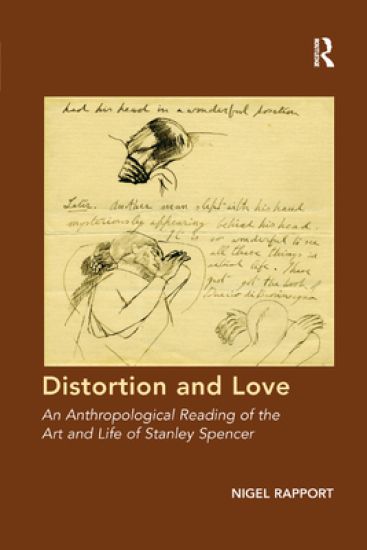
In this ground-breaking book, a theory of ’distortion’ - of the way in which the processes of human life are subject to interference, diversion and transformation - is developed by way of the art of one of Britain’s greatest twentieth-century painters and that art’s public reception. Devoted to his native village of Cookham-on-Thames, Stanley Spencer painted not only landscapes and portraits with loving detail but also the ’memory-feelings’ which he felt were a ’sacred’ part of his consciousness. Yet Spencer was also a controversial public figure, with some taking the view that his visionary paintings were ugly distortions of human life, even marks of an immoral nature. Examining how Spencer lived his vision, how he painted it and wrote it, and also how his attempts to communicate that vision were received by his contemporaries and have continued to be interpreted since his death, the author posits distortion as key: an intrinsic aspect both of human creation and of human interaction. What we intend to make, to say, to do and have done, often mutates in the process of being expressed or put into effect: we live amid distortion. Love - the affective appreciation of one another - is then a means by which we accommodate distortion and its consequences in our lives. An illustration, through Stanley Spencer’s story, of significant aspects of a human condition, this book will appeal across disciplines, including to art historians and students of Spencer’s work, as well as to scholars of anthropology with interests in creativity, perception and interpretation.
Meaning in Landscape Architecture and Gardens
While we all live our lives in designed landscapes of various types, only on occasion do we consider what these landscapes mean to us and how they have acquired that significance. Can a landscape architect or garden designer imbue new settings with meaning, or does meaning evolve over time, created by those who perceive and use these landscapes? What role does the selection and arrangement of plants and hard materials play in this process and just where does the passage of time enter the equation?These questions collectively provide the core material for Meaning in Landscape Architecture and Gardens, a compendium of four landmark essays written over a period of twenty years by leading scholars in the field of landscape architecture. New commentaries by the authors accompany each of the essays and reflect on the thinking behind them as well as the evolution of the author's thoughts since their original publication.Although the central theme of these writings is landscape architecture broadly taken, the principal subject of several essays and commentaries is the garden, a subject historically plentiful in allusions and metaphors. Meaning in Landscape Architecture and Gardens offers the general reader as well as the professional a rich source of ideas about the designed landscape and the ways by which we perceive, consider, react, and dwell within them – and what they mean to us.The essays have been perennial favorites in landscape courses since their original publication in Landscape Journal. Bringing them together – bolstered by the new commentaries – creates a book valuable to all those creating gardens and landscapes, as well as those teaching and studying these subjects.
Distortion and Love

Distortion and Love

Nigel Rapport

Routledge
2015
sidottu
In this ground-breaking book, a theory of ’distortion’ - of the way in which the processes of human life are subject to interference, diversion and transformation - is developed by way of the art of one of Britain’s greatest twentieth-century painters and that art’s public reception. Devoted to his native village of Cookham-on-Thames, Stanley Spencer painted not only landscapes and portraits with loving detail but also the ’memory-feelings’ which he felt were a ’sacred’ part of his consciousness. Yet Spencer was also a controversial public figure, with some taking the view that his visionary paintings were ugly distortions of human life, even marks of an immoral nature. Examining how Spencer lived his vision, how he painted it and wrote it, and also how his attempts to communicate that vision were received by his contemporaries and have continued to be interpreted since his death, the author posits distortion as key: an intrinsic aspect both of human creation and of human interaction. What we intend to make, to say, to do and have done, often mutates in the process of being expressed or put into effect: we live amid distortion. Love - the affective appreciation of one another - is then a means by which we accommodate distortion and its consequences in our lives. An illustration, through Stanley Spencer’s story, of significant aspects of a human condition, this book will appeal across disciplines, including to art historians and students of Spencer’s work, as well as to scholars of anthropology with interests in creativity, perception and interpretation.
Edges of Global Transformation

Edges of Global Transformation

Nigel Rapport

Lexington Books
2018
sidottu
Through nine ethnographic case-studies, Edges of Global Transformation explores situations where global transformations associated with neoliberalism meet local realities. The “edge” of transformation is characterized by uncertainty, as old patterns are consumed and new formed. The nine case studies from Africa, Europe and the Middle East shed light on how uncertainty plays an inevitable and essential role in the grey zone between macro-transformations and local responses. Despite the tremendous difference in precariousness between these cases, each contributor explores ways in which transformations are conceived and acted upon within the space of possibility that is opened and apprehended locally. The role of uncertainty as an active force is explored throughout the book. While in some cases, uncertainty has a clear restricting effect; other cases illustrate its potential as a productive force. As a contribution to understanding the dynamic of the local realities of global change, the book will be valuable reading for anyone interested in globalization and the neoliberal world order.
Cosmopolitan Love and Individuality

Cosmopolitan Love and Individuality

Nigel Rapport

Lexington Books
2018
sidottu
Love ‘discovers the reality’ of individual human beings, wrote Iris Murdoch; love ‘deifies’ the person, wrote Ralph Waldo Emerson. This book proposes love as a kind of civic virtue: that ‘loving recognition’ might function as a universal form of ethical engagement and inclusion. ‘Loving recognition’ is proposed as a civil practice that enshrines the individuality of human identity, overcoming the labels and classes of ethnicity, nationality, religiosity and social status. A particular understanding of love is suggested. Love as civic virtue is described as a complex comprising emotional attraction to a human being, together with discernment of the individual specificity of that human being, and also respect for that specificity: in a ‘loving’ engagement, the individuality of the other person is ‘let be’, given the space to subsist and encouraged to fulfil itself. Who is this ‘beloved’ other human being? It is Anyone. Loving recognition is universalizing. It not only insists on a human species-wide commonality that supervenes upon the ways in which we habitually classify the world according to invented categories (such as people’s supposed belonging to national or ethnic or religious or economic or cultural groups and classes), it also insists on recognizing Anyone, the globally common individual human being, and including Anyone within a universalizing loving practice. This book places its faith in love because of the motivating force that love delivers. Love’s emotional engagement is such as to individuate the beloved: in themselves, as themselves and for themselves. The force of love overcomes the habit of seeing the world through a society’s and a culture’s conventional classificatory lens. Love delivers a kind of epiphany: a moment of vision such that the other human being does not appear as representative of a social category or class but is rightfully appreciated as being in possession of a unique and precious individual life.
Anyone

Anyone

Nigel Rapport

Berghahn Books
2014
pokkari
The significance that people grant to their affiliations as members of nations, religions, classes, races, ethnicities and genders is evidence of the vital need for a cosmopolitan project that originates in the figure of Anyone – the universal and yet individual human being. Cosmopolitanism offers an alternative to multiculturalism, a different vision of identity, belonging, solidarity and justice, that avoids the seemingly intractable character of identity politics: it identifies samenesses of the human condition that underlie the surface differences of history, culture and society, nation, ethnicity, religion, class, race and gender. This book argues for the importance of cosmopolitanism as a theory of human being, as a methodology for social science and as a moral and political program.
‘I am Here’, Abraham Said

‘I am Here’, Abraham Said

Nigel Rapport

BERGHAHN BOOKS
2024
sidottu
Emmanuel Levinas’s philosophical work on ‘the Other’ offers a challenge to the discipline of anthropology that claims knowledge of the human. For Levinas, the ‘secrecy’ of subjectivity – a fundamental facet of the human condition – demands an ethics of ignorance and not-knowing; the mystery of otherness is only to be approached through ‘inspiration’. Can anthropology meet a Levinasian challenge if it would define itself as a science as well as a humanistic documentation of social life? This book endeavours to take Levinasian and anthropological precepts equally seriously and offers a radical conclusion.
The Trouble with Community

The Trouble with Community

Vered Amit; Nigel Rapport

Pluto Press
2002
pokkari
'Community' is one of social science's longest-standing concepts. The assumption of much social science has been that humans belong in communities, as social and cultural beings. The trouble with 'community' is that this is not necessarily so; the personal social networks of individuals' actual experience crosscut collective categories, situations and institutions. Communities can prove unviable or imprisoning; the reality of community life and identity can often be very different from the ideology and the ideal. In this book, the authors draw on their ethnographic experiences to reappraise the concept and the reality of 'community', in the light of globalisation, religious fundamentalism, identity politics, and renascent localisms. How might anthropology better apprehend social identities which are intrinsically plural, transgressive and ironic? What has anthropology to say about the way in which civil society might hope to accommodate the ongoing construction and the rightful expression of such migrant identities?
Community, Cosmopolitanism and the Problem of Human Commonality
Do notions of community remain central to our sense of who we are, or can we see beyond community closures to a human whole? This volume explores the nature of contemporary sociality. It focuses on the ethical, organisational and emotional claims and opportunities sought or fashioned for mobilising and evading social collectivities in a world of mobile subjects. Vered Amit and Nigel Rapport present an examination of the tensions and interactions between everyday forms of fluid fellowship, culturally normative claims to identity, and opportunities for realising a universal humanity.
Community, Cosmopolitanism and the Problem of Human Commonality
Do notions of community remain central to our sense of who we are, or can we see beyond community closures to a human whole? This volume explores the nature of contemporary sociality. It focuses on the ethical, organisational and emotional claims and opportunities sought or fashioned for mobilising and evading social collectivities in a world of mobile subjects. Vered Amit and Nigel Rapport present an examination of the tensions and interactions between everyday forms of fluid fellowship, culturally normative claims to identity, and opportunities for realising a universal humanity.
Nigel

Nigel

Monty Don

Two Roads
2017
pokkari
THE SUNDAY TIMES BESTSELLERNIGEL - One of Britain's favourite dogs! MONTY DON - One of Britain's favourite presenters. When Monty Don's golden retriever Nigel became the surprise star of BBC Gardeners' World inspiring huge interest, fan mail and his own social media accounts, Monty Don wanted to explore what makes us connect with animals quite so deeply. In many respects Nigel is a very ordinary dog; charming, handsome and obedient, as so many are. He is a much loved family pet. He is also a star. By telling Nigel's story, Monty relates his relationships with the other special dogs in his life in a memoir of his dogs past and very much present. Witty, touching and life-affirming, Nigel: My family and other dogs is wonderfully heart-warming. Monty Don is a great writer coming out of the garden and into the hearts and homes of every dog lover in the UK.'I have always had a dog, or dogs. I cannot imagine life without them. I am just as much a fan of Nigel as any besotted viewer. In the book I explore why we love dogs and what they mean to us emotionally and domestically. I look back on all the dogs in my life - all of which I have loved deeply and which have been an essential part of my life. So, this is the book of Nigel - but also the book of all our dogs in every British family and a celebration of the deep love we feel for them' Monty Don