Kirjojen hintavertailu. Mukana 11 627 373 kirjaa ja 12 kauppaa.

Kirjahaku

Etsi kirjoja tekijän nimen, kirjan nimen tai ISBN:n perusteella.

1000 tulosta hakusanalla Niklas Bayer

Influencer Marketing für Anfänger: Der leicht Einstieg ins Influencer Marketing. Wie Sie Ihre Bekanntheit steigern, Ihre Marke etablieren und durch In
Influencer Marketing f r Anf nger: Der leichte Einstieg ins Influencer Marketing. Wie Sie Ihre Bekanntheit steigern, Ihre Marke etablieren und durch Influencer mehr Reichweite bekommen.Sie sind Unternehmer und wollen durch das Internet Ihren Bekanntheitsgrad erh hen?Ihnen ist bewusst, dass Sie durch Plattformen wie Youtube, Instagram und Facebook Millionen Menschen erreichen k nnen. Sie wollen, dass Ihre Marke in aller Munde ist?Nutzen Sie daf r die M glichkeiten des Influencer Marketing In seinem Buch "Influencer Marketing f r Anf nger" erkl rt Ihnen Niklas Bayer ausf hrlich, was es mit diesem Marketing-Modell auf sich hat und wie Sie es am besten f r sich nutzen k nnen.Finden Sie in diesem E-Book heraus, wieman zum "Influencer" wirdInfluencer Marketing genau funktioniert (an verschiedenen Beispielen)Sie interessante Partner f r sich gewinnen und Kooperationsgemeinschaften eingehenSie den richtigen Influencer f r Ihre Marke findenSie Mund-zu-Mund-Propaganda f r sich nutzenSie Ihre Mitarbeiter in Ihre neue Strategie mit einbeziehen k nnenauch Werbung auf sozialen Netzwerken richtig funktioniertWarten Sie nicht l nger Holen Sie sich noch heute "Influencer Marketing f r Anf nger" von Niklas Bayer auf Ihren E-Book-Reader. Steigern Sie Ihren Bekanntheitsgrad und Ihren Umsatz. Nutzen auch Sie die neue Marketing-Strategie der Influencer f r Ihr Unternehmen.
Berufliche Rehabilitation Bei Menschen Mit Psychischen Stoerungen: Wirksamkeit, Prognosefaktoren Und Klientenzufriedenheit
Menschen mit psychischen Stoerungen sind in besonderem Masse von Arbeitslosigkeit betroffen. Psychische Stoerungen sind heute der haufigste Grund fur eine Rente der Invalidenversicherung. Die Wirksamkeit von Eingliederungsmassnahmen wird zunehmend in Frage gestellt. Die vorliegende empirische Untersuchung geht dem weiteren beruflichen Werdegang der Absolventen eines solchen Eingliederungsprogrammes in Basel nach. Wieviele Absolventen haben einen Arbeitsplatz gefunden, wieviele haben ihre Stelle wieder verloren? Welches sind bei psychisch Behinderten die noetigen Bedingungen, um beruflich Erfolg zu haben? Welche Voraussetzungen sollten Eingliederungsmassnahmen erfullen, damit psychisch Behinderte uberhaupt eine Chance haben, beruflich wieder Fuss zu fassen? Welchen Einfluss hat die Krankheit? Viele psychisch behinderte Menschen wollen arbeiten und waren dazu fahig - und sie leiden besonders stark unter der mangelnden Kenntnis uber die Besonderheiten ihrer Behinderung. Das vorliegende Buch gibt einen UEberblick uber den heutigen Stand des Wissens und stellt die teils uberraschenden Resultate der Evaluation im einzelnen dar. Aufgrund der Erkenntnisse tritt die Studie der Resignation in der beruflichen Eingliederung psychisch Behinderter entgegen und liefert Anhaltspunkte fur wirkungsvollere Massnahmen.
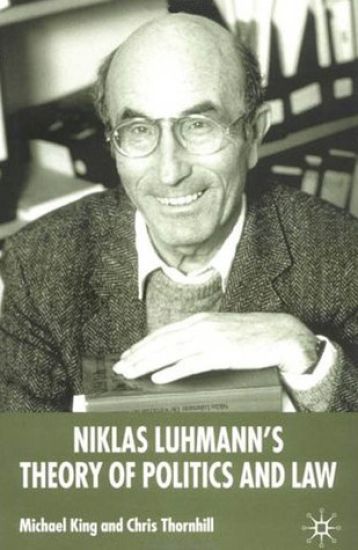
Niklas Luhmann's Theory of Politics and Law

Niklas Luhmann's Theory of Politics and Law

M. King; C. Thornhill

Palgrave Macmillan
2003
sidottu
Niklas Luhmann's social theory stands in direct opposition to the dominant 'anthropocentric' traditions of legal and political analysis. King and Thornhill now offer the first comprehensive, critical examination of Luhmann's highly original theory of the operations of the legal and political systems. They describe how from the perspective of his 'sociological enlightenment' Luhmann continually calls to account the certainties, the ambitions and rational foundations of The Enlightenment and the idealized versions of law and politics which they have produced.
Niklas Luhmann: Law, Justice, Society

Niklas Luhmann: Law, Justice, Society

Andreas Philippopoulos-Mihalopoulos

Routledge
2009
sidottu
Niklas Luhmann: Law, Justice, Society presents the work of sociologist Niklas Luhmann in a radical new light. Luhmann’s theory is here introduced both in terms of society at large and the legal system specifically, and for the first time, Luhmann’s texts are systematically read together with theoretical insights from post-structuralism, deconstruction, phenomenology, radical ethics, feminism and post-ecologism. In his far-reaching book, Andreas Philippopoulos-Mihalopoulos distances Luhmann’s theory from its misrepresentations as conservative, rigorously positivist and disconnected from empirical reality, and firmly locates it in a sphere of post-ideological jurisprudence.The book operates both as a detailed explanation of the theory’s concepts and as the locus of a critique which brings forth Luhmann’s radical credentials. The focal points are Luhmann’s concept of society and the law’s paradoxical connection to justice. However, these concepts are also transgressed in order to show how the law deals with the illusion of its identity, and more broadly how the theory itself deals with its limitations. This is illustrated by examples drawn from human rights, constitutional theory and ecological thinking. On the whole, Niklas Luhmann: Law, Justice, Society serves both as an introductory text and as a critical response to Luhmann’s theory, and is recommended reading for students and researchers in sociology, law, social sciences, politics and whoever is interested in seeing the influential work of Niklas Luhmann from a critical new perspective.
Niklas Luhmann

Niklas Luhmann

Christian Borch

Routledge
2011
sidottu
Niklas Luhmann offers an accessible introduction to one of the most important sociologists of our time. It presents the key concepts within Luhmann’s multifaceted theory of modern society, and compares them with the work of other key social theorists such as Jürgen Habermas, Michel Foucault, and Zygmunt Bauman.The book pays particular attention to introducing and discussing Luhmann’s original sociological systems theory. It presents a thorough investigation into the different phases of his oeuvre, through which both the shifting emphases as well as the continuities in his thinking are shown. The primary focus of this text is Luhmann’s theory of modern society as being differentiated into a plethora of ‘function systems’ – such as politics, law, and economy – which operate according to their own distinct logics and which cannot interfere with one another. For Luhmann, this functional differentiation works as a bulwark against totalitarian rule, and as such is a key foundation of modern democracy. Furthermore, the book critically examines the implications of this functional differentiation for inclusion and exclusion dynamics, as well as for the understanding of power and politics.This is a key text for both undergraduate and postgraduate students of areas including contemporary social theory, political sociology, and sociology.
Niklas Luhmann

Niklas Luhmann

Christian Borch

Routledge
2011
nidottu
Niklas Luhmann offers an accessible introduction to one of the most important sociologists of our time. It presents the key concepts within Luhmann’s multifaceted theory of modern society, and compares them with the work of other key social theorists such as Jürgen Habermas, Michel Foucault, and Zygmunt Bauman.The book pays particular attention to introducing and discussing Luhmann’s original sociological systems theory. It presents a thorough investigation into the different phases of his oeuvre, through which both the shifting emphases as well as the continuities in his thinking are shown. The primary focus of this text is Luhmann’s theory of modern society as being differentiated into a plethora of ‘function systems’ – such as politics, law, and economy – which operate according to their own distinct logics and which cannot interfere with one another. For Luhmann, this functional differentiation works as a bulwark against totalitarian rule, and as such is a key foundation of modern democracy. Furthermore, the book critically examines the implications of this functional differentiation for inclusion and exclusion dynamics, as well as for the understanding of power and politics.This is a key text for both undergraduate and postgraduate students of areas including contemporary social theory, political sociology, and sociology.
Niklas Luhmann: Law, Justice, Society

Niklas Luhmann: Law, Justice, Society

Andreas Philippopoulos-Mihalopoulos

Routledge
2011
nidottu
Niklas Luhmann: Law, Justice, Society presents the work of sociologist Niklas Luhmann in a radical new light. Luhmann’s theory is here introduced both in terms of society at large and the legal system specifically, and for the first time, Luhmann’s texts are systematically read together with theoretical insights from post-structuralism, deconstruction, phenomenology, radical ethics, feminism and post-ecologism. In his far-reaching book, Andreas Philippopoulos-Mihalopoulos distances Luhmann’s theory from its misrepresentations as conservative, rigorously positivist and disconnected from empirical reality, and firmly locates it in a sphere of post-ideological jurisprudence.The book operates both as a detailed explanation of the theory’s concepts and as the locus of a critique which brings forth Luhmann’s radical credentials. The focal points are Luhmann’s concept of society and the law’s paradoxical connection to justice. However, these concepts are also transgressed in order to show how the law deals with the illusion of its identity, and more broadly how the theory itself deals with its limitations. This is illustrated by examples drawn from human rights, constitutional theory and ecological thinking. On the whole, Niklas Luhmann: Law, Justice, Society serves both as an introductory text and as a critical response to Luhmann’s theory, and is recommended reading for students and researchers in sociology, law, social sciences, politics and whoever is interested in seeing the influential work of Niklas Luhmann from a critical new perspective.
Niklas Luhmann's Modernity

Niklas Luhmann's Modernity

William W. Rasch

Stanford University Press
2000
sidottu
This book is an introduction to the nature of modernity as envisioned by Germany's leading social theorist of the late twentieth century, Niklas Luhmann. For Luhmann, modernity is neither an Enlightenment project nor a ludic rejection of that project, but rather the pre-condition of all our deliberations, the structure within which our semantics makes sense, even as we think we celebrate (or mourn) its passing. Rather than viewing modernity as a disease for which we seek a cure, Luhmann poses it as a question to which we continually devise incomplete and partial answers. When we grow impatient with the contingency and indeterminacy that is thus forced upon us and seek solace in community, religion (orthodox or civic), consensus, and a universal vision of the good life, we grow impatient with modernity itself. The book injects concepts derived from Luhmann's influential systems theory (complexity, contingency, and enforced selectivity; system differentiation, self-referential closure, and autopoiesis) into debates about modernity and postmodernity, constructivist and foundationalist epistemologies, the relationship between politics and ethics, and the possibilities of interdisciplinary work that spans the great divide between science and the humanities. Delighting in Luhmann's provocatively cool and dispassionate bursting of cherished balloons, the book stages challenging engagements with such thinkers as Jürgen Habermas, Jacques Derrida, Jean-François Lyotard, Drucilla Cornell, Judith Butler, Michel Serres, N. Katherine Hayles, and such political theorists as Chantal Mouffe and Carl Schmitt. The irrepressibility of paradox emerges as a stubborn feature of all of these confrontations. The book closes with two interviews: one a discussion with Luhmann and Hayles on epistemology, the other with Luhmann on the functional differentiation of modern society.
Niklas Luhmann's Modernity

Niklas Luhmann's Modernity

William W. Rasch

Stanford University Press
2000
pokkari
This book is an introduction to the nature of modernity as envisioned by Germany's leading social theorist of the late twentieth century, Niklas Luhmann. For Luhmann, modernity is neither an Enlightenment project nor a ludic rejection of that project, but rather the pre-condition of all our deliberations, the structure within which our semantics makes sense, even as we think we celebrate (or mourn) its passing. Rather than viewing modernity as a disease for which we seek a cure, Luhmann poses it as a question to which we continually devise incomplete and partial answers. When we grow impatient with the contingency and indeterminacy that is thus forced upon us and seek solace in community, religion (orthodox or civic), consensus, and a universal vision of the good life, we grow impatient with modernity itself. The book injects concepts derived from Luhmann's influential systems theory (complexity, contingency, and enforced selectivity; system differentiation, self-referential closure, and autopoiesis) into debates about modernity and postmodernity, constructivist and foundationalist epistemologies, the relationship between politics and ethics, and the possibilities of interdisciplinary work that spans the great divide between science and the humanities. Delighting in Luhmann's provocatively cool and dispassionate bursting of cherished balloons, the book stages challenging engagements with such thinkers as Jürgen Habermas, Jacques Derrida, Jean-François Lyotard, Drucilla Cornell, Judith Butler, Michel Serres, N. Katherine Hayles, and such political theorists as Chantal Mouffe and Carl Schmitt. The irrepressibility of paradox emerges as a stubborn feature of all of these confrontations. The book closes with two interviews: one a discussion with Luhmann and Hayles on epistemology, the other with Luhmann on the functional differentiation of modern society.
Niklas Luhmann's Theory of Politics and Law

Niklas Luhmann's Theory of Politics and Law

M. King; C. Thornhill

Palgrave Macmillan
2003
nidottu
Niklas Luhmann's social theory stands in direct opposition to the dominant 'anthropocentric' traditions of legal and political analysis. King and Thornhill now offer the first comprehensive, critical examination of Luhmann's highly original theory of the operations of the legal and political systems. They describe how from the perspective of his 'sociological enlightenment' Luhmann continually calls to account the certainties, the ambitions and rational foundations of The Enlightenment and the idealized versions of law and politics which they have produced.
Niklas Rogers

Niklas Rogers

Adamarie Dundon

AuthorHouse
2004
pokkari
Niklas Rogers, now 12, has always known that he was different from the other kids. Through a twist of events, some tragic, some bizarre and some mystical, he discovers that he posses a very special gift. In Niklas' own words, he tells a tale about his life and the days leading up to his magical discovery. His love for nature, takes on a whole new meaning.
Niklas Luhmann

Niklas Luhmann

Walter de Gruyter
2013
sidottu
Niklas Luhmanns "Soziale Systeme" (1984) bildet den Grundstein der von ihm ausgearbeiteten Systemtheorie; das Werk ist die Einleitung in seine "Theorie der Gesellschaft".Hier entfaltet er seine systemtheoretische Terminologie, wobei oft dieselben Begriffe wie in der traditionellen Terminologie auftauchen, von Luhmann in der eigenen Gesellschaftstheorie jedoch anders gef llt werden. Die Beitr ge des vorliegenden Bandes ebnen vor diesem Hintergrund den Zugang zur Luhmannschen Theorie und zeigen auf, dass sie wie jede Theorie ein Konstrukt ist, das uns hilft, die Realit t zu erfassen. Die Autorinnen und Autoren des kooperativen Kommentars zu Luhmanns Werk "Soziale Systeme" sind namhafte Theoretikerinnen und Theoretiker, die ihr Forschen in engem Zusammenhang mit der Luhmannschen Theorie betreiben. In den Beitr gen dieses Bandes werden die Leserinnen und Leser ber den Inhalt des Buchs von Luhmann informiert und dessen Kapitel, der Chronologie des Originalwerks folgend, f r ein besseres und erweitertes Verst ndnis aufgeschlossen. MIT BEITR GEN VON: Dirk Baecker, Cornelia Bohn, Marcus Emmerich, Elena Esposito, Dietmar Gensicke, Detlef Horster, Christina Huber, Maren Lehmann, Julian M ller, Armin Nassehi, Martin Petzke, William Rasch, Anna Schriefl, Michael Urban, Christine Weinbach und Niels Werber.
Niklas Luhmann

Niklas Luhmann

Claudio Baraldi; Giancarlo Corsi

Springer International Publishing AG
2016
nidottu
This book provides an insight into the ideas of one of the world’s greatest sociologists: Niklas Luhmann. It explains, in clear and concise language, the basic concepts of Social Systems Theory and their application to the specific case of the Education System, which was considered by Luhmann as a primary subsystem of modern society. It illustrates the complex and sophisticated thinking that characterises Luhmann’s work and explains that Luhmann’s theory has given an important and original contribution to the study of education from a sociological point of view. His contribution has some resonance in recent social constructionist and relational approaches to education, as well as in studies of educational interaction. In addition, research methodologies, in particular mixed methods strategies, draw heavily on epistemological issues. The book finally argues that educationists can appreciate the extent of Luhmann’s contribution to the field of education, although their perspective cannot be fully harmonised with, nor reduced to, the sociological one. This divergence of perspectives can stimulate pedagogy to call into question its conceptual framework as well its approach to social situations in the classroom.