Kirjojen hintavertailu. Mukana 11 342 296 kirjaa ja 12 kauppaa.

Kirjahaku

Etsi kirjoja tekijän nimen, kirjan nimen tai ISBN:n perusteella.

1000 tulosta hakusanalla Norbert Groddeck

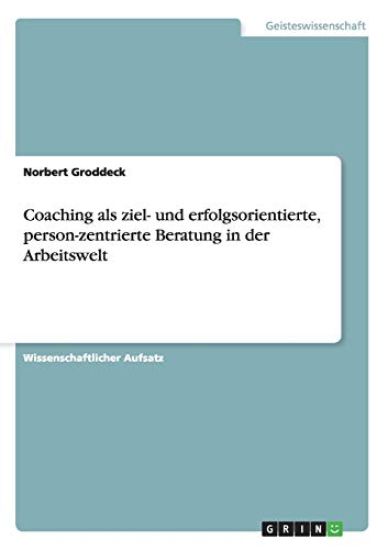
Coaching und seine Implikationen fur die Soziale Arbeit
Essay aus dem Jahr 2006 im Fachbereich Sozialp dagogik / Sozialarbeit, Note: keine, Universit t Siegen, 19 Quellen im Literaturverzeichnis, Sprache: Deutsch, Abstract: Der Beitrag stellt die Entwicklung und Ausdehnung der berufsbezogenen Beratung dar, die als Coachings bezeichnet wird. Diese hat in den letzten Jahren eine enorme Verbreitung erlebt: Von einer zun chst eher informell beschriebenen Dienstleistungsaufgabe f r die Welt des Top-Managements im Wirtschaftslebens hat sich das Coaching ber verschiedene Entwicklungsschritte zu einem eigenst ndigen Beratungskonzept weiterentwickelt, das nun zunehmend auch Anwendung im Bereich der Non-Profit-Organisationen der Sozialen Arbeit und des Bildungswesens findet. Der Beitrag zeichnet diese Entwicklungsstationen im ersten Teil der Arbeit nach. Da mit dieser Entwicklung auch die Gefahr eines inflation ren Gebrauchs des Coaching-Begriffs einhergeht, schl gt der Autor im zweiten sodann Teil eine differenzierte Beschreibung des Coaching anhand von acht Kernelementen vor.
Norbert

Norbert

James Sutherland

Createspace Independent Publishing Platform
2013
nidottu
Meet Norbert the horse and friends in the 1st book in a fun series of comic adventures for young readers Norbert has a serious problem - his teeth are GREEN Worried that this will ruin his chances with Delilah, the pretty pony who lives in the next field, he turns to his only friend Colin the cuckoo for help. Together they devise a cunning plan to steal a toothbrush from Norbert's grumpy owner, Farmer Finbar.Will they succeed in their desperate mission?What will happen if the grouchy old farmer catches them in the act of stealing his toothbrush?And most importantly of all, will Norbert ever win the heart of his beloved Delilah?Also available: Norbert's Summer HolidayChristmas with NorbertNorbert to the Rescue Norbert's Spooky NightNorbert - the Novel Norbert - The Collection
Norbert

Norbert

Joanna Boyle

Templar Publishing
2018
nidottu
Norbert the penguin lives in Antarctica. He dreams of being a big star and singing and dancing for millions of people! One day he leaves his home and makes the long journey to the big city. He works hard and before long he is the most famous penguin the world has ever known! But Norbert is lonely too. Can he go back to his family without giving up the thing he loves to do? A beautiful picture book from the writer and illustrator of Oh no! Where did Walter Go?
Norbert Wiener—A Life in Cybernetics

Norbert Wiener—A Life in Cybernetics

Norbert Wiener; Ronald R. Kline

MIT Press
2018
pokkari
Norbert Wiener's celebrated autobiography, available for the first time in one volume.Norbert Wiener-A Life in Cybernetics combines for the first time the two volumes of Norbert Wiener's celebrated autobiography. Published at the height of public enthusiasm for cybernetics-when it was taken up by scientists, engineers, science fiction writers, artists, and musicians-Ex-Prodigy (1953) and I Am a Mathematician (1956) received attention from both scholarly and mainstream publications, garnering reviews and publicity in outlets that ranged from the New York Times and New York Post to the Virginia Quarterly Review. Norbert Wiener was a mathematician with extraordinarily broad interests. The son of a Harvard professor of Slavic languages, Wiener was reading Dante and Darwin at seven, graduated from Tufts at fourteen, and received a PhD from Harvard at eighteen. He joined MIT's Department of Mathematics in 1919, where he remained until his death in 1964 at sixty-nine. In Ex-Prodigy, Wiener offers an emotionally raw account of being raised as a child prodigy by an overbearing father. In I Am a Mathematician, Wiener describes his research at MIT and how he established the foundations for the multidisciplinary field of cybernetics and the theory of feedback systems. This volume makes available the essence of Wiener's life and thought to a new generation of readers.
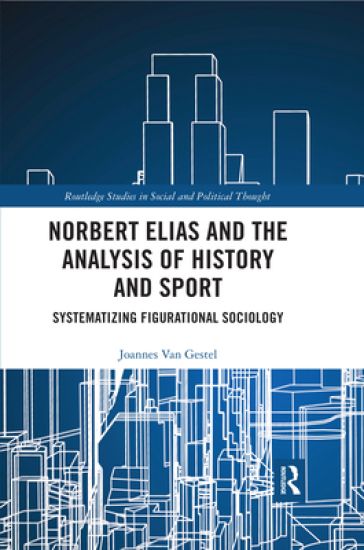
Norbert Elias and the Analysis of History and Sport
In times when the social sciences have become increasingly fragmented and more focused on ‘the pieces of the puzzle’, the puzzle, as a topic in its own right, has slowly been moved towards the background. Nonetheless, as humanity becomes ever more globalized, there is a greater need for in-depth discussion on the theory behind the direction of humanity in history and the interrelationships between the different areas in which humans associate, including that of leisure and sport.At its heart, Norbert Elias and the Analysis of History and Sport explains both the course of history and how the roles that leisure and sport have occupied in it should be investigated. Exploring this from Norbert Elias’ figurational (or process sociological) standpoint, the book offers a unique perspective as Van Gestel approaches the theoretical concepts and ideas by systematizing the views of the iconic scholar and offers new insights into his central theory. Furthermore, drawing upon theoretical principles that are universal to humans rather than relative to a case study, Van Gestel offers an applicable guideline which explains phenomena beyond specific cultures or circumstances that have so far been a customary practice by process sociologists.Norbert Elias and the Analysis of History and Sport is a valuable title which will appeal to postgraduate students and scholars interested in fields such as social studies, leisure and sport studies, and history.
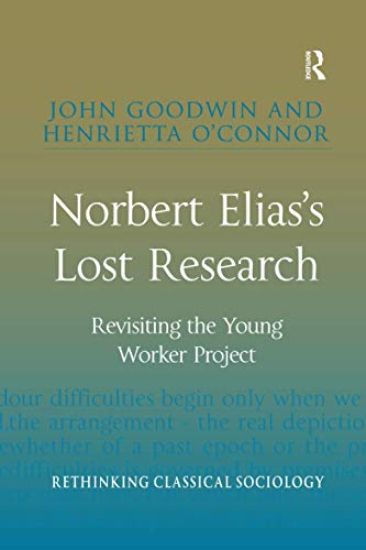
Norbert Elias's Lost Research

Norbert Elias's Lost Research

John Goodwin; Henrietta O'Connor

Routledge
2020
nidottu
Based on the re-discovery of a lost sociological project led by Norbert Elias at the University of Leicester, this book re-visits the project: The Adjustment of Young Workers to Work Situations and Adult Roles. Norbert Elias's Lost Research makes use of the interview booklets documenting the lives of nearly 900 Leicester school leavers at the time, to give a unique account of Elias's only foray into large-scale, publicly funded research. Covering all aspects of the research from the development of the research proposal, the selection and management of the research team, the fieldwork, Elias's theoretical work to the ultimate demise of the research project, this book makes a significant contribution to our understanding of existing Eliasian texts by introducing this project to a wider audience and investigating and applying Elias's theoretical work to the areas of youth and school to work transitions. Shedding new light on Elias's thought, whilst exploring questions of methodology and the relevance of older research to modern questions, this book will be of interest to social theorists, as well as sociologists with interests in research methodology and the history of sociology.
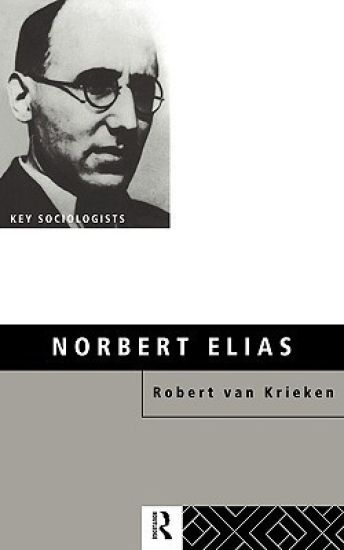
Norbert Elias

Norbert Elias

Robert Van Krieken

Routledge
1998
sidottu
This book locates Elias's work clearly within the development of sociology and also against the background of current debates. Between the 1930s and the 1980s he developed a unique approach to social theory which is now beginning to take root in contemporary social research and theory. Since the translation of his work into English began to accelerate in the 1980s, a growing number of books and articles on topics including health, sexuality, crime, national and ethnic identity, femininity and globalization, in a variety of disciplines, make positive reference to Elias as an authority on the history of emotions, identity, violence, the body and state formation.
Norbert Elias

Norbert Elias

Robert Van Krieken

Routledge
1998
nidottu
This book locates Elias's work clearly within the development of sociology and also against the background of current debates. Between the 1930s and the 1980s he developed a unique approach to social theory which is now beginning to take root in contemporary social research and theory. Since the translation of his work into English began to accelerate in the 1980s, a growing number of books and articles on topics including health, sexuality, crime, national and ethnic identity, femininity and globalization, in a variety of disciplines, make positive reference to Elias as an authority on the history of emotions, identity, violence, the body and state formation.
Norbert Elias

Norbert Elias

Richard Kilminster

Routledge
2007
sidottu
Few sociologists of the first rank have scandalized the academic world to the extent that Elias did. Developed out of the German sociology of knowledge in the 1920s, Elias’s sociology contains a sweeping radicalism which declares an academic ‘war on all your houses’. His sociology of the ‘human condition’ sweeps aside the contemporary focus on ‘modernity’ and rejects most of the paradigms of sociology as one-sided, economistic, teleological, individualistic and/or rationalistic. As sociologists, Elias also asks us to distance ourselves from mainstream psychology, history and above all, philosophy, which is summarily abandoned, although carried forward on a higher level. This enlightening book written by a close friend and pupil of Elias, is the first book to explain the refractory, uncomfortable, side of Elias’s sociological radicalism and to brace us for its implications. It is also the first in-depth analysis of Elias’s last work The Symbol Theory in the light of selected contemporary developments in archaeology, anthropology and evolutionary theory.
Norbert Elias

Norbert Elias

John H. Dunning; Stephen Mennell

Polity Press
2012
sidottu
* Norbert Elias is a major figure of 20th century sociology and social theory. He is famous for his theory of the civilizing process - a work that was hugely influential in the social sciences and in history. * Eric Dunning is an established figure in sociology and one of the leading authorities on the work of Norbert Elias.
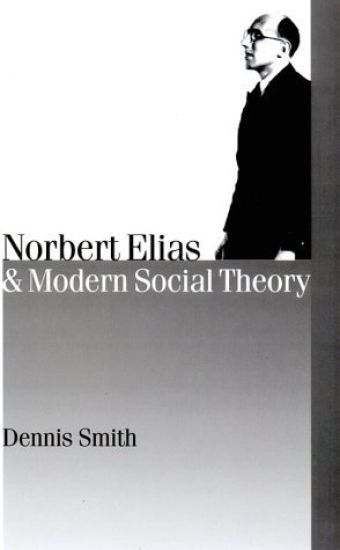
Norbert Elias and Modern Social Theory

Norbert Elias and Modern Social Theory

Dennis Smith

SAGE Publications Inc
2000
sidottu
Offering a fascinating survey of Norbert Elias's life and writings, Dennis Smith traces the growth of his reputation. He is the first author to confront Elias's work with the contrasting theories of Talcott Parsons, Hannah Arendt, Michel Foucault and Zygmunt Bauman. He also illustrates how Elias's insights can be applied to understand Western modernity and social and political change. Smith shows why Elias is important for sociology, but he is also clear sighted about the limitations of Elias's approach.
Norbert Elias and Modern Social Theory

Norbert Elias and Modern Social Theory

Dennis Smith

SAGE Publications Inc
2000
nidottu
Offering a fascinating survey of Norbert Elias's life and writings, Dennis Smith traces the growth of his reputation. He is the first author to confront Elias's work with the contrasting theories of Talcott Parsons, Hannah Arendt, Michel Foucault and Zygmunt Bauman. He also illustrates how Elias's insights can be applied to understand Western modernity and social and political change. Smith shows why Elias is important for sociology, but he is also clear sighted about the limitations of Elias's approach.
Norbert Elias

Norbert Elias

SAGE Publications Inc
2003
muu
Norbert Elias (1897-1990) is now widely regarded as one of the greatest sociologists of the 20th century. The challenge and profundity of his work are still being assimilated. Some have suggested that in time, he will be regarded as the Copernicus or Darwin of sociology, the man who set the subject on its scientific course. These four volumes provide a comprehensive and penetrating survey of Elias's life and work. They pinpoint the main fields of research which Elias and his followers have explored: the civilizing process; state-formation; knowledge, religion and science; informalization; power; established-outsider figurations in fields such as class, gender and race; the sociology of the body; the sociology of the emotions; the sociology of leisure, sport and the arts; the sociology of the professions; medicine and psychoanalysis; crime and punishment; drug use and abuse. The collection also explores the various critiques of Elias's `figurational' or `process' sociology and counter-critiques by Elias's followers. The volumes successfully locate the work of Elias and his followers in the context of modern sociology, especially in relation to writers such as Mannheim, Adorno, Parsons, Goffman, Foucault and Bourdieu. In the penetrating, original and informative Introduction, Eric Dunning and Stephen Mennell elucidate Elias's sociological contributions and the bearing his life experiences had on his work. The collection is an invaluable resource for anyone interested in the sociological contribution of Norbert Elias. The collection is organized in the following 4 volumes: Volume 1 Focuses on Elias's work in the context of his life and career, and reviews his place in the contemporary social sciences, especially in relation to such figures as Michel Foucault and Pierre Bourdieu. Also discussed in this volume are Elias's pathbreaking contributions to such issues as: the 'agency-structure' dilemma; habitus; power; involvement and detachment; knowledge and the sciences; time; and the relations between history and sociology. Volume 2 Addresses Elias's major empiricallybased contributions to sociological theory, especially the theories of the civilizing process, state formation and established-outsider figurations. Also discussed are informalization and de-civilizing processes, and the applications of the established-outsider theory to such fields as race, gender and sexuality. Volume 3 Examines figurational contributions to special areas of sociology such as: the sociology of the body; the sociology of the emotions; the sociology of everyday life, sport, leisure, lifestyles, taste, music and the arts; deviance and crime; the sociology of health and illness; psychiatry, psychoanalysis, and psychology; death and dying; and drugs and tobacco use. Volume 4 Focuses on criticisms of Elias's work and the responses of Elias and his sociological followers. Key themes are: civilization and the Holocaust; sports violence, especially soccer hooliganism; the meanings and value of concepts like 'development', 'evolution' and 'change'; and the relative merits of long-term and short-term approaches. The end of the volume returns to the issue of Elias's place in contemporary sociology and the growing worldwide recognition of the significance of his contribution. Eric Dunning is Professor Emeritus of Sociology at the University of Leicester; Stephen Mennell is Professor of Sociology, University College Dublin
Norbert Elias and Human Interdependencies

Norbert Elias and Human Interdependencies

Thomas Salumets

McGill-Queen's University Press
2001
sidottu
While the opposing paradigms of globalization and fragmentation compete in often bloody and destructive ways in the world today, this book convincingly reminds us of the importance of finding out more about the complex and changing ways in which we are connected. The authors demonstrate that the more we understand our connectedness and deal with its consequences, the less dependent and helpless we become. The critical, multidisciplinary perspectives they offer cover a wide range of subjects, from the world wide web to medieval poetry, nations and gender, cancer narratives and money, emotion management and the financial markets, and the American civilizing process and the repression of shame. The contributions bear witness to Elias's innovative achievements while the authors continue his stunning explorations, extending them into other areas of the humanities and the sciences, and presenting their own wide-ranging and penetrating insights into our mutual dependence. Contributors are Jorge Arditi (SUNY-Buffalo), Godfried Van Benthem Van Den Bergh (emeritus, Erasmus University, Rotterdam), Reinhard Blomert (Humboldt University, Germany and Karl-Franzens University, Austria), Stephen Guy-Bray (University of Calgary), Thomas M. Kemple (University of British Columbia), Hermann Korte (emeritus, University of Hamburg, Germany), Helmut Kuzmics (University of Graz, Austria), Stephen Mennell (National University of Ireland), Thomas Salumets, Thomas J. Scheff (emeritus, University of California in Santa Barbara), Ulrich C. Teucher (University of British Columbia), Annette Treibel (Pedagogical University of Karlsruhe), and Cas Wouters (Utrecht University, Netherlands).
Norbert Elias and Human Interdependencies

Norbert Elias and Human Interdependencies

Thomas Salumets

McGill-Queen's University Press
2002
nidottu
Norbert Elias, author of the modern classic "The Civilizing Process", was one a fascinating scientists of the 20th century. In this volume, leading scholars introduce, evaluate, and apply Elias's achievements and explore the interdependence of individuals in an increasingly global society.
Norbert Elias and the Analysis of History and Sport
In times when the social sciences have become increasingly fragmented and more focused on ‘the pieces of the puzzle’, the puzzle, as a topic in its own right, has slowly been moved towards the background. Nonetheless, as humanity becomes ever more globalized, there is a greater need for in-depth discussion on the theory behind the direction of humanity in history and the interrelationships between the different areas in which humans associate, including that of leisure and sport.At its heart, Norbert Elias and the Analysis of History and Sport explains both the course of history and how the roles that leisure and sport have occupied in it should be investigated. Exploring this from Norbert Elias’ figurational (or process sociological) standpoint, the book offers a unique perspective as Van Gestel approaches the theoretical concepts and ideas by systematizing the views of the iconic scholar and offers new insights into his central theory. Furthermore, drawing upon theoretical principles that are universal to humans rather than relative to a case study, Van Gestel offers an applicable guideline which explains phenomena beyond specific cultures or circumstances that have so far been a customary practice by process sociologists.Norbert Elias and the Analysis of History and Sport is a valuable title which will appeal to postgraduate students and scholars interested in fields such as social studies, leisure and sport studies, and history.