During an unprecedented period of rapid growth, the burgeoning metropolis of Chicago quickly became a “concentration of risk”: far more congested, dangerous, unpleasant, immoral, and unhealthy than newcomers had anticipated. Through vignettes and real-life stories, Challenging Chicago reveals lower- and middle-class peoples’ strategies for coping with technology, crowding, anonymity, and other urban ills. Follow along and encounter some of Chicago’s most infamous citizens--the loathed Traction Baron, high-speed “scorchers,” and peddlers of “swill milk.” Learn about the perils of payday, the lunchtime problems of women, the lure of dime museums, and the fatal attraction of Chicago’s “cruelest place.” Against this bleak backdrop emerged the innovators and institutions that made Chicago the vibrant city it is today. The superbly textured narrative is enhanced by eighty-six historic photographs and illustrations.
Statistics Explained, now in its fully revised Fourth Edition, is for students and researchers who wish to understand the statistical analyses used to analyse quantitative (numerical) research data in a wide range of academic disciplines, in particular, the behavioural, human and social sciences.This book explains, in a clear and informative manner, the logic of statistical analysis, in particular the null hypothesis significance testing (NHST) method. Using this method, a range of statistical tests have been devised for different types of data. Each of these tests is explained in the book by adopting a step-by-step (“walkthrough”) approach with a specific illustrative example. Crucially, these explanations do not require the reader to have an advanced knowledge of mathematics or statistics, but only assumes the basic mathematics which most readers will have learnt at high school. The book also examines the criticisms of NHST and introduces the reader to Bayesian statistics. As a result the reader will be able to critically evaluate the outcomes of statistical analysis both of their own work and that of others.Statistics Explained will be of great interest to students and researchers in the behavioural, human and social sciences in understanding both the outcomes of their own research and also the research reports in the academic journals.
Statistics Explained, now in its fully revised Fourth Edition, is for students and researchers who wish to understand the statistical analyses used to analyse quantitative (numerical) research data in a wide range of academic disciplines, in particular, the behavioural, human and social sciences.This book explains, in a clear and informative manner, the logic of statistical analysis, in particular the null hypothesis significance testing (NHST) method. Using this method, a range of statistical tests have been devised for different types of data. Each of these tests is explained in the book by adopting a step-by-step (“walkthrough”) approach with a specific illustrative example. Crucially, these explanations do not require the reader to have an advanced knowledge of mathematics or statistics, but only assumes the basic mathematics which most readers will have learnt at high school. The book also examines the criticisms of NHST and introduces the reader to Bayesian statistics. As a result the reader will be able to critically evaluate the outcomes of statistical analysis both of their own work and that of others.Statistics Explained will be of great interest to students and researchers in the behavioural, human and social sciences in understanding both the outcomes of their own research and also the research reports in the academic journals.
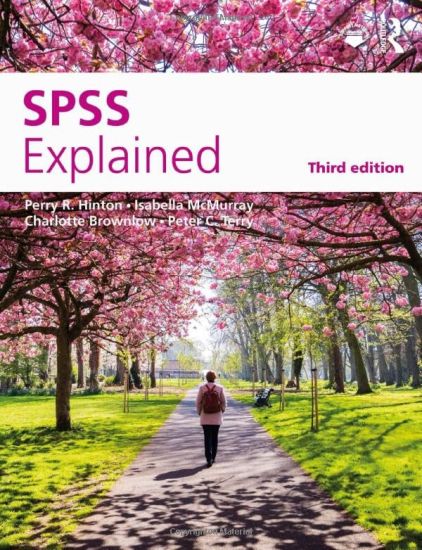
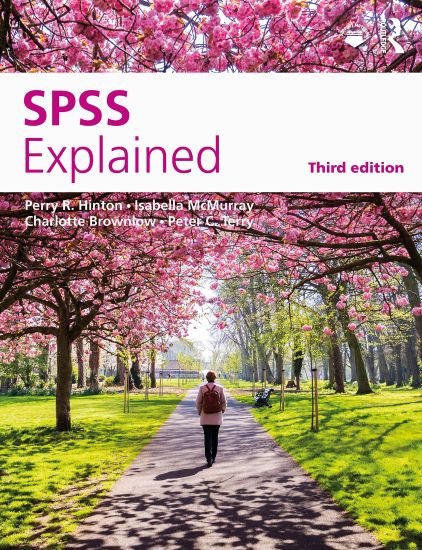
SPSS Explained provides the student with all that they need to undertake statistical analysis using SPSS. It combines a step-by-step approach to each procedure with easy-to-follow screenshots at each stage of the process. A number of other helpful features are provided, including:regular advice boxes with tips specific to each testexplanations divided into ‘essential’ and ‘advanced’ sections to suit readers at different levelsfrequently asked questions at the end of each chapterThe third edition of this popular book has been fully updated for IBM SPSS version 27 and also includes:a new chapter on how to undertake mediation and moderation with SPSSupdates on changes to SPSS, including updated functionality within ANOVAs and calculations of a priori power analysisPresented in full colour and with a fresh, reader-friendly layout, this fully updated new edition also comes with online support material featuring an array of supplementary resources for students and instructors.Minimal prior knowledge is assumed, so the book is well designed for the novice user, but it will also be a useful reference source for those developing their own expertise in SPSS. It is suitable for all students who need to do statistical analysis using SPSS in various disciplines, including psychology, social science, business studies, nursing, education, health and sport science, communication and media, geography, and biology.The authors have many years of experience in teaching SPSS to students from a wide range of disciplines. Their understanding of SPSS users’ concerns, as well as a knowledge of the type of questions students ask, form the foundation of this book.
SPSS Explained provides the student with all that they need to undertake statistical analysis using SPSS. It combines a step-by-step approach to each procedure with easy-to-follow screenshots at each stage of the process. A number of other helpful features are provided, including:regular advice boxes with tips specific to each testexplanations divided into ‘essential’ and ‘advanced’ sections to suit readers at different levelsfrequently asked questions at the end of each chapterThe third edition of this popular book has been fully updated for IBM SPSS version 27 and also includes:a new chapter on how to undertake mediation and moderation with SPSSupdates on changes to SPSS, including updated functionality within ANOVAs and calculations of a priori power analysisPresented in full colour and with a fresh, reader-friendly layout, this fully updated new edition also comes with online support material featuring an array of supplementary resources for students and instructors.Minimal prior knowledge is assumed, so the book is well designed for the novice user, but it will also be a useful reference source for those developing their own expertise in SPSS. It is suitable for all students who need to do statistical analysis using SPSS in various disciplines, including psychology, social science, business studies, nursing, education, health and sport science, communication and media, geography, and biology.The authors have many years of experience in teaching SPSS to students from a wide range of disciplines. Their understanding of SPSS users’ concerns, as well as a knowledge of the type of questions students ask, form the foundation of this book.
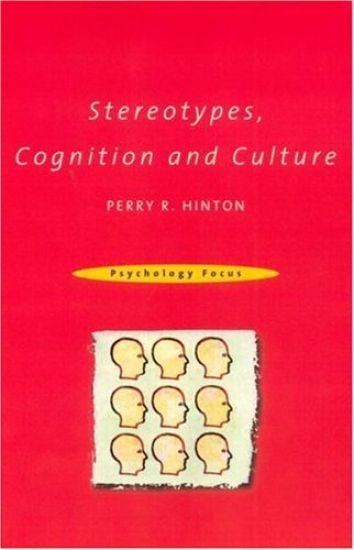
What are stereotypes and why do we use them? Are all stereotypes bad? Can we stop people from using them? Questions such as these have fascinated social psychologists for many years.Perry Hinton provides an accessible introduction to this key area, giving a critical and concise overview of the influential theories and approaches, as well as insights into recent work on the role of language and culture in stereotyping.
What are stereotypes and why do we use them? Are all stereotypes bad? Can we stop people from using them? Questions such as these have fascinated social psychologists for many years.Perry Hinton provides an accessible introduction to this key area, giving a critical and concise overview of the influential theories and approaches, as well as insights into recent work on the role of language and culture in stereotyping.
This book theorizes that models based on the classical sciences have misguided educational leadership. Dr. Rettig sees the open dynamics of twentieth-century science — specifically, quantum mechanics — as a better and more natural model, and describes what he sees as a method of leadership light years beyond those of today. Dr. Rettig illustrates his erudite critique of the contemporary school administration structure with the story of Leslie O'Connor, a fictional administrator, who makes her way through familiar-seeming training techniques. For anyone interested in the organization and administration of school systems, this book provides an original and compelling perspective.
Virtual environments such as games and animated and "real" movies require realistic sound effects that can be integrated by computer synthesis. The book emphasizes physical modeling of sound and focuses on real-world interactive sound effects. It is intended for game developers, graphics programmers, developers of virtual reality systems and training simulators, and others who want to learn about computational sound. It is written at an introductory level with mathematical foundations provided in appendices. Links to code examples and sound files can be found on the Downloads/Updates tab.
Stereotypes and the Construction of the Social World explores the complexity of stereotypes, guiding the reader through issues of definition and theoretical explanations from psychology and other disciplines. The book examines why people use stereotypes, which have often been represented as inaccurate, rigid and discriminatory. If that is what they are, then why would people employ such ‘faulty’ or ‘biased’ views of others?While this book presents a detailed and comprehensive analysis of the psychological research into the individual use of stereotypes, it also presents this research within its ideological and historical context, revealing the important sociocultural factors in what we mean by ‘stereotypes’. From the politics of representation and intergroup power relations, alongside individual social cognitive issues, the book provides a comprehensive and cross-disciplinary account of stereotypes and stereotyping. Featuring a wealth of real-world examples, it will be essential reading for all students and researchers of stereotypes.
Stereotypes and the Construction of the Social World explores the complexity of stereotypes, guiding the reader through issues of definition and theoretical explanations from psychology and other disciplines. The book examines why people use stereotypes, which have often been represented as inaccurate, rigid and discriminatory. If that is what they are, then why would people employ such ‘faulty’ or ‘biased’ views of others?While this book presents a detailed and comprehensive analysis of the psychological research into the individual use of stereotypes, it also presents this research within its ideological and historical context, revealing the important sociocultural factors in what we mean by ‘stereotypes’. From the politics of representation and intergroup power relations, alongside individual social cognitive issues, the book provides a comprehensive and cross-disciplinary account of stereotypes and stereotyping. Featuring a wealth of real-world examples, it will be essential reading for all students and researchers of stereotypes.
Data Presentation with SPSS Explained provides students with all the information they need to conduct small scale analysis of research projects using SPSS and present their results appropriately in their reports. Quantitative data can be collected in the form of a questionnaire, survey or experimental study. This book focuses on presenting this data clearly, in the form of tables and graphs, along with creating basic summary statistics. Data Presentation with SPSS Explained uses an example survey that is clearly explained step-by-step throughout the book. This allows readers to follow the procedures, and easily apply each step in the process to their own research and findings.No prior knowledge of statistics or SPSS is assumed, and everything in the book is carefully explained in a helpful and user-friendly way using worked examples. This book is the perfect companion for students from a range of disciplines including psychology, business, communication, education, health, humanities, marketing and nursing – many of whom are unaware that this extremely helpful program is available at their institution for their use.
Data Presentation with SPSS Explained provides students with all the information they need to conduct small scale analysis of research projects using SPSS and present their results appropriately in their reports. Quantitative data can be collected in the form of a questionnaire, survey or experimental study. This book focuses on presenting this data clearly, in the form of tables and graphs, along with creating basic summary statistics. Data Presentation with SPSS Explained uses an example survey that is clearly explained step-by-step throughout the book. This allows readers to follow the procedures, and easily apply each step in the process to their own research and findings.No prior knowledge of statistics or SPSS is assumed, and everything in the book is carefully explained in a helpful and user-friendly way using worked examples. This book is the perfect companion for students from a range of disciplines including psychology, business, communication, education, health, humanities, marketing and nursing – many of whom are unaware that this extremely helpful program is available at their institution for their use.
American schools should be laboratories for modeling democratic concepts. However, our school systems are the antithesis of democratically run organizations. Teaching professionals, students and parents have very little power or genuine influence in decision making. Reframing Decision Making in Education begins by describing the current status of American schools and concludes with a description of the organizational structure, leadership, and decision making practices necessary to make our schools operate in a manner congruent with those democratic principles we espouse as a country. This book describe a democratic structure and a decision making matrix to help reform leaders begin such an endeavor. Woven through each chapter is a fictional story of Principal Samantha Levy. We see Ms. Levy’s struggles as she begins the process of making change in her high school and its impact on those around her.
American schools should be laboratories for modeling democratic concepts. However, our school systems are the antithesis of democratically run organizations. Teaching professionals, students and parents have very little power or genuine influence in decision making. Reframing Decision Making in Education begins by describing the current status of American schools and concludes with a description of the organizational structure, leadership, and decision making practices necessary to make our schools operate in a manner congruent with those democratic principles we espouse as a country. This book describe a democratic structure and a decision making matrix to help reform leaders begin such an endeavor. Woven through each chapter is a fictional story of Principal Samantha Levy. We see Ms. Levy’s struggles as she begins the process of making change in her high school and its impact on those around her.
Assuming the Mantel of Leadership is a book of real-life case studies and activities that are contextual-based within the reader’s own setting and experience. The reader is expected to respond to the cases and the activities by utilizing and reflecting upon their own institution’s policies and context. The scope of exercises is intentionally broad in order to cover situations across academic affairs, student affairs, and enrollment management.
Assuming the Mantel of Leadership is a book of real-life case studies and activities that are contextual-based within the reader’s own setting and experience. The reader is expected to respond to the cases and the activities by utilizing and reflecting upon their own institution’s policies and context. The scope of exercises is intentionally broad in order to cover situations across academic affairs, student affairs, and enrollment management.
Shared Governance begins with the premise that today’s higher education governance practices have lost their focus and vitality. By re-examining the original suppositions of shared governance, along with an infusion of seminal democratic values and principles, a contemporary model is envisioned. From historical perspectives on shared governance, the book then takes a view of current governance models through the lens of Critical Theory and Open Systems Thinking. Political, corporate, and school system models are briefly reviewed before moving on to application to colleges and universities. Each chapter concludes with a continuous story of a young and maturing college vice president as she grapples with a static and worn governance system at her institution. She strives to reinvigorate the notion of shared governance and to bring staff and students into the process. The final three chapters of the book each include an essay written by individuals who have served on the ground level of shared governance at their institution. These people include: an administrative assistant who helped to create a Staff Council; a Student Government Association president who took a nascent SGA and gave students a new voice; and, an associate dean who mentored students in this developmental process.