Kirjojen hintavertailu. Mukana 11 717 486 kirjaa ja 12 kauppaa.

Kirjahaku

Etsi kirjoja tekijän nimen, kirjan nimen tai ISBN:n perusteella.

1000 tulosta hakusanalla Peter K. Fallon

Propaganda 2.1

Propaganda 2.1

Peter K. Fallon

JAMES CLARKE CO LTD
2024
nidottu
As the Internet Age endures and expands, Peter K. Fallon peers into the Pandora's Box of our age. A twenty-first century update to Jacques Ellul's masterful sociological study Propaganda, Propaganda 2.1 explores how the 'digital revolution' has transformed the boundaries between individuals, institutions, and centres of power. Coupling historical analysis with a wealth of current examples, Fallon exposes the intricate and insidious ways propaganda alters our daily realities. Propaganda 2.1 is divided into three sections: propaganda 1.0, 2.0, and 2.1. Propaganda 1.0 compares the popular conception of propaganda with persuasive techniques such as rhetoric and coercion; 2.0 reveals how the development of moveable-type printing built the foundations of modern propaganda; and, finally, 2.1 inhabits the 'post-truth' world in its totality. Whilst the media landscape continually shifts, Propaganda 2.1's analysis is an opportunity to tackle this new reality.
The Metaphysics of Media

The Metaphysics of Media

Peter K. Fallon

University of Scranton Press,U.S.
2010
nidottu
In "The Metaphysics of Media", award-winning media critic Peter K. Fallon tackles the complicated question of how a succession of dominant forms of media have supported - and even to some extent created - different conceptions of reality. To do so, he starts with the basics: a critical discussion of the very idea of objective reality and the various postmodern responses that have tended to dominate recent philosophical approaches to the subject. From there, he embarks on a survey of the evolution of communication through four major eras: orality, literacy, print, and electricity. Within each era, Fallon argues, the dominant form of media supported particular ways of understanding the world, from the ascendance of reason that followed the development of alphabets to the obliteration of space and time that we associate with electronic communications. Fallon concludes with a hard look at the mass ignorance that prevails today despite (or perhaps because of) the sea of information with which contemporary life is surrounded. A stirring, philosophically rich investigation, "The Metaphysics of Media" offers not only a clear picture of where our society has been but also a road map to a more engaged, informed, and fully human future.
Propaganda 2.1

Propaganda 2.1

Peter K Fallon

Cascade Books
2022
sidottu
Since the US presidential election of 2016 the words propaganda and fake news have been prominent in American political and cultural discourse. Yet very few people can provide a coherent explanation of what they mean, precisely, when using them. On the two sides of the political spectrum (red and blue), each points out messages from the other side that they think are untrue--or that they simply don't like. Unlike our dangerously biased political system, however, reality has more than only two sides. For decades, Americans sat by while their mediated world was carved into a single red reality focused in necessary opposition to a single blue reality. We've been given red media outlets and blue media outlets to stoke our collective rage, each against the other's lies. But the first two decades of the twenty-first century have presented us with a new information environment, one of unregulated and seemingly uncontrollable information. Like the young boy in a popular folktale, we can now see--if only we can resist the pressures of social conformity--that both emperors, red and blue, strut proudly before us, naked. Propaganda 2.1 is a handbook for seeing reality clearly--and coping with it.
Propaganda 2.1

Propaganda 2.1

Peter K Fallon

Cascade Books
2022
pokkari
Since the US presidential election of 2016 the words propaganda and fake news have been prominent in American political and cultural discourse. Yet very few people can provide a coherent explanation of what they mean, precisely, when using them. On the two sides of the political spectrum (""red"" and ""blue""), each points out messages from the other side that they think are untrue--or that they simply don't like. Unlike our dangerously biased political system, however, reality has more than only two sides. For decades, Americans sat by while their mediated world was carved into a single ""red reality"" focused in necessary opposition to a single ""blue reality."" We've been given ""red media outlets"" and ""blue media outlets"" to stoke our collective rage, each against the other's lies. But the first two decades of the twenty-first century have presented us with a new information environment, one of unregulated and seemingly uncontrollable information. Like the young boy in a popular folktale, we can now see--if only we can resist the pressures of social conformity--that both emperors, red and blue, strut proudly before us, naked. Propaganda 2.1 is a handbook for seeing reality clearly--and coping with it.
K.S. Aksakov, A Study in Ideas, Vol. III

K.S. Aksakov, A Study in Ideas, Vol. III

Peter K. Christoff

Princeton University Press
2014
pokkari
In this study the author singles out the ideas of K. S. Aksakov (1817-1860), philologist, poet, historian, and sometime dramatist, and places them in the broader current of nineteenth century Slavophilism. Originally published in 1982. The Princeton Legacy Library uses the latest print-on-demand technology to again make available previously out-of-print books from the distinguished backlist of Princeton University Press. These editions preserve the original texts of these important books while presenting them in durable paperback and hardcover editions. The goal of the Princeton Legacy Library is to vastly increase access to the rich scholarly heritage found in the thousands of books published by Princeton University Press since its founding in 1905.
K.S. Aksakov, A Study in Ideas, Vol. III

K.S. Aksakov, A Study in Ideas, Vol. III

Peter K. Christoff

Princeton University Press
2016
sidottu
In this study the author singles out the ideas of K. S. Aksakov (1817-1860), philologist, poet, historian, and sometime dramatist, and places them in the broader current of nineteenth century Slavophilism. Originally published in 1982. The Princeton Legacy Library uses the latest print-on-demand technology to again make available previously out-of-print books from the distinguished backlist of Princeton University Press. These editions preserve the original texts of these important books while presenting them in durable paperback and hardcover editions. The goal of the Princeton Legacy Library is to vastly increase access to the rich scholarly heritage found in the thousands of books published by Princeton University Press since its founding in 1905.
The Dandy

The Dandy

Peter K. Andersson

Oxford University Press
2025
sidottu
A history of the dandy from below, from Beau Brummell and Baudelaire to Bowie and Bolan... and beyond. The historical figure of the dandy has commonly been described as an upper-class gentleman, often exemplified by well-known men such as Beau Brummell, Charles Baudelaire, Oscar Wilde, and Max Beerbohm. But there is a broader history to be told about the dandy - one that incorporates unknown men from the lower strata of society. The Dandy: A People's History constitutes the first ever history of those dandies who emanated from the less privileged layers of the populace - the lowly clerks, shop assistants, domestic servants, and labourers who increasingly during the modern age have emerged as style-conscious men about town. Peter Andersson shows that dandyism is far from just an elite phenomenon represented by famous poets and artists. He shows how dandyism as a popular youth subculture grew into an influential cultural movement, from the days of Beau Brummell in the early 19th century to the age of mods in the 1960s. A series of fascinating in-depth studies of the wide variety of dandy subcultures that have surfaced around the world in the last two centuries tell the story of how the shaping of fashions and the image of men became increasingly democratized, with the arbiters of taste increasingly coming from the other end of the social spectrum. Along the way, we encounter such long-forgotten groups as the mashers, the knuts, the Paris gandins and the Berlin transgender dandies, alongside more well-known but unexplored figures like the zoot suiter, the teddy boy, and the New Romantic. Above all, this is a story of how fundamental aspects of modern culture such as fashion, style, and conduct have been shaped from below just as much as from above. It is a story that shows how the problematic business of young men trying to find an identity is an enduring phenomenon - and one sadly often accompanied by innocent victims along the way.
Adolescence

Adolescence

Peter K Smith

Oxford University Press
2016
nidottu
Adolescence is a turbulent period to live through, and a time of importance and concern to parents, teachers, and social workers. Marking the transition from the world of childhood to adult life, the adolescent faces many challenges and opportunities, including forming their own identity, relating to often conflicting demands from parents and peers, and negotiating first romantic relationships. In this Very Short Introduction, Peter K. Smith provides an engaging and informative overview of what we know and what we are learning about adolescence. Including both a guide to the classical research that has informed our knowledge, as well as the results of the modern research into the contemporary adolescent experience, Smith examines a number of aspects of adolescence, including the cultural and historical context, the biological changes to the adolescent brain, and the controversies that adolescence brings. ABOUT THE SERIES: The Very Short Introductions series from Oxford University Press contains hundreds of titles in almost every subject area. These pocket-sized books are the perfect way to get ahead in a new subject quickly. Our expert authors combine facts, analysis, perspective, new ideas, and enthusiasm to make interesting and challenging topics highly readable.
Pockets of Crime

Pockets of Crime

Peter K. B. St. Jean

University of Chicago Press
2007
sidottu
Why, even in the same high-crime neighborhoods, do robbery, drug dealing, and assault occur much more frequently on some blocks than on others? One popular theory is that a weak sense of community among neighbors can create conditions more hospitable for criminals, and another proposes that neighborhood disorder - such as broken windows and boarded-up buildings - makes crime more likely. But in his innovative new study, Peter K. B. St. Jean argues that we cannot fully understand the impact of these factors without considering that, because urban space is unevenly developed, different kinds of crimes occur most often in locations that offer their perpetrators specific advantages. Drawing on Chicago Police Department statistics and extensive interviews with both law-abiding citizens and criminals in one of the city's highest-crime areas, St. Jean demonstrates that drug dealers and robbers, for example, are primarily attracted to locations with businesses like liquor stores, fast food restaurants, and check-cashing outlets. By accounting for these important factors of spatial positioning, he expands upon previous research to provide the most comprehensive explanation available of why crime occurs where it does.
Pockets of Crime

Pockets of Crime

Peter K. B. St. Jean

University of Chicago Press
2007
nidottu
Why, even in the same high-crime neighborhoods, do robbery, drug dealing, and assault occur much more frequently on some blocks than on others? One popular theory is that a weak sense of community among neighbors can create conditions more hospitable for criminals, and another proposes that neighborhood disorder - such as broken windows and boarded-up buildings - makes crime more likely. But in his innovative new study, Peter K. B. St. Jean argues that we cannot fully understand the impact of these factors without considering that, because urban space is unevenly developed, different kinds of crimes occur most often in locations that offer their perpetrators specific advantages. Drawing on Chicago Police Department statistics and extensive interviews with both law-abiding citizens and criminals in one of the city's highest-crime areas, St. Jean demonstrates that drug dealers and robbers, for example, are primarily attracted to locations with businesses like liquor stores, fast food restaurants, and check-cashing outlets. By accounting for these important factors of spatial positioning, he expands upon previous research to provide the most comprehensive explanation available of why crime occurs where it does.
Richard Adolf Zutt - sein Leben für Kunst Handwerk Arbeit
Peter K. Jakob prSsentiert in dieser Dokumentation das Leben und Werk von Richard Adolf Zutt als KYnstler, Metall- und Keramik-Kunsthandwerker und als Lehrer fYr SchYler, Studenten, Laien und Arbeitslose. 1887 in Basel geboren, als Autodidakt in MYnchen und Florenz so erfolgreich, dass er als Professor an die Kunstgewerbeschule in Budapest berufen wurde. WShrend des Ersten Weltkrieges beteiligte er seine SchYler und Studentinnen u.a. an der Produktion von Medaillen zugunsten von WohltStigkeitsorganisationen. In den 1920er-Jahren wirkte er an der Neuen Schule in Hellerau (zusammen mit A. S. Neill) und leitete die Ostdeutschen WerkstStten in Neisse In Paris stellte er ein Projekt fYr ein riesiges Weltfriedenskreuz vor. Ab 1930 leitete er WerkstStten fYr Sltere Arbeitslose, und entwickelte die Aluminiumlegierung Razutal, die auch fYr das Luftschiff Zeppelin II verwendet worden sei. Bei der RYckreise von Ceylon in die Schweiz 1938 erlitt er einen plstzlichen Tod auf einem deutschen Schiff im Suezkanal.
Introduction to the Laplace Transform

Introduction to the Laplace Transform

Peter K. F. Kuhfittig

Kluwer Academic/Plenum Publishers
1978
sidottu
The purpose of this book is to give an introduction to the Laplace transform on the undergraduate level. The material is drawn from notes for a course taught by the author at the Milwaukee School of Engineering. Based on classroom experience, an attempt has been made to (1) keep the proofs short, (2) introduce applications as soon as possible, (3) concentrate on problems that are difficult to handle by the older classical methods, and (4) emphasize periodic phenomena. To make it possible to offer the course early in the curriculum (after differential equations), no knowledge of complex variable theory is assumed. However, since a thorough study of Laplace. transforms requires at least the rudiments of this theory, Chapter 3 includes a brief sketch of complex variables, with many of the details presented in Appendix A. This plan permits an introduction of the complex inversion formula, followed by additional applications. The author has found that a course taught three hours a week for a quarter can be based on the material in Chapters 1, 2, and 5 and the first three sections of Chapter 7. If additional time is available (e.g., four quarter-hours or three semester-hours), the whole book can be covered easily. The author is indebted to the students at the Milwaukee School of Engineering for their many helpful comments and criticisms.
Introduction to Brain Topography

Introduction to Brain Topography

Peter K.H. Wong

Kluwer Academic / Plenum Publishers
1991
sidottu
A text for newcomers to the field of brain electromagnetic topography, combining the necessary knowledge in the diverse areas of physical sciences, mathematics, neurophysiology, and anatomy. Topics include fundamentals of data acquisition, mapping, and post-processing; source modeling and analysis;
SCM Studyguide

SCM Studyguide

Peter K. Stevenson

SCM Press
2017
nidottu
Peter Stevenson provides an introduction to the practice of preaching. It is designed for people from various church traditions, in the early stages of ministerial formation. Preaching is a complex and challenging business requiring a demanding mixture of skills. People listening to a sermon have the right to expect that a person who stands up to preach, can interpret the Bible competently, has a grasp of core Christian beliefs, and believes what they preach. They also expect someone who has the necessary range of communication skills to put the message across in an accessible way. Such a range of expectations presents daunting challenges to the most experienced preacher. Including practical exercises which could be used by individuals or by groups, this book is suitable for introductory courses in preaching or for modules which consider preaching within an overall focus upon leading public worship.
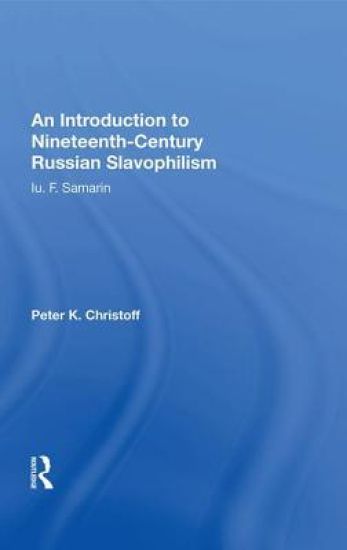
An Introduction To Nineteenth-century Russian Slavophilism
This work is the fourth volume of Peter Christoff’s study of nineteenth-century Russian Slavophilism, which grew out of vigorous and prolonged debates between the Slavophils and proponents of Slavophilism’s principal ideological rival, Westernism, in the mid-nineteenth century. As the names indicate, the Westerners looked to the West for the solution to Russia’s political, social, and economic problems. The Slavophils, well-to-do members of the Russian gentry who knew the West well, chose to look inward. Both Slavophils and Westerners favored emancipation of the Russian serfs, which was finally achieved in 1861. In this crucial reform, the Slavophils—Iu. F. Samarin in particular — played a leading role. Since the beginning of glasnost’ and perestroika, Slavophilism has been experiencing a revival in the Soviet Union expressed in a number of ways, including the announced republication of the works of A. S. Khomiakov and I. V. Kireevsky. The original Slavophil circle included these two senior Slavophils as well as K. S. Aksakov and Samarin (1819–1876). Samarin was the youngest and most active of the Moscow Slavophils. Endowed with an exceptional mind and character, he was fluent in several languages and attracted attention while still a young student at Moscow University. He played a leading role in the emancipation of the serfs and in other reforms, sometimes risking his own safety. He left more than eleven volumes of collected works and correspondence—the largest written legacy among the early Slavophils and an invaluable source for the study of Moscow Slavophilism as well as Samarin’s life and activities.
Substance Abuse, Habitual Behavior, And Selfcontrol
This collection of original essays by members of the National Academy of Sciences’ Committee on Substance Abuse and Habitual Behavior offers innovative perspectives on self-control over the use of habituating substances and related types of behavior. The authors review the powerful social-psychological influences of normative rules and interpersonal circumstances in developing individual capacities for self-control in, for example, the use of heroin. They also look at experimental contingencies under which animals engage in self-harming behavior; the induction of exaggerated consumption behavior, such as massive fluid drinking by laboratory rats; and studies of environmental and genetic influences on neurophysiological sensitivity to and preference for alcohol in laboratory mouse strains. The concluding chapter presents an unorthodox perspective on ways of self-governing the consumption of cigarettes and other substances, recognizing the peculiarities of the processes of human choice. In his introduction, volume editor Peter Levison contrasts the diverse approaches reflected in the book with the common-sense notion of self-control.