
Kirjahaku
Etsi kirjoja tekijän nimen, kirjan nimen tai ISBN:n perusteella.
1000 tulosta hakusanalla Rashed Hasan Faap


Removing the Middleman: Volume 1: Deciphering Faith Without Ritual
Rashed Hasan
Rashed Hasan
2015
nidottu
As intended in its purest form, religion was meant to forge a global alliance of goodwill and common humanity by encouraging diverse tribes to work together-a social construct to help define coexistence as a way of life. However, the creation of hierarchies and religious clergies converted religious texts into tools of division and judgment.In today's contemporary world connected through global frameworks, it is critical to reevaluate the nature of religious texts to understand the underlying importance of common good. The first volume in a series deconstructing the texts of the Qur'an without the interjection of religious scholarship, this book delves into the issue of accepting faith without being bound to ritual. Reviewing only the first two Surahs of the Qur'an, this book focuses on peeling back the layers of complex undertones and contexts behind each verse in an effort to empower the reader to do the same.

As intended in its purest form, faith in God and religious practices were meant to forge a global alliance of goodwill and common humanity by encouraging diverse tribes to work together - a social, moral and ethical construct to help define coexistence as a way of life. However, the creation of hierarchies and religious clergies converted religious texts into tools for division and judgment.This second volume continues the journey into deconstructing the texts of the Qur'an and peeling back the layers of complex undertones and contexts in an effort to empower the reader to do the same. Reviewing the third and the fourth chapters of the Qur'an, this volume brings to life the fundamental right of each and every human being to be free to choose his or her faith and the mode of its expression while volume 1 was focused on fundamental aspect of this faith in God without confining such faith to mere rituals. While chapter 3, "The Family of Amran", draws attention to the original convergence of the three faith - Judaism, Christianity and Islam; and delves into the underlying root causes of subsequent divergence of these religious beliefs and practices; Chapter 4, "The Women" makes a passionate appeal to our human consciousness and God given freedom to create a social construct where gender equality is absolute by providing directional guidance on man-woman relationships, marriage commitments, inheritance, equal rights and obligations and a confirmation that each one of us, irrespective of gender, is to be equally responsible and empowered to do good on this earth.

In its purest form, faith in God and religious practices should forge a global alliance of goodwill and common humanity by encouraging diverse tribes to work together-a social, moral, and ethical construct to help define coexistence as a way of life. However, the creation of hierarchies and religious clergies has converted religious texts into tools for division and judgment.This third volume of Removing the Middleman Series continues the journey into deconstructing the text of the Qur'an and peeling back the layers of complex undertones and contexts and empowering the reader to do the same. Reviewing the fifth, sixth, and seventh chapters of the Qur'an, this volume drives home the fundamental requirement of social consciousness, which is what we need to be truly faithful and to realize the full potential of human goodness. Chapter 5, "The Repast," draws its name from the Last Supper of Jesus Christ with his disciples and brings out a series of topics ranging from keeping promises to dietary rules to marriage vows and continuity in the revelatory faith of Jews, Christians, and Muslims. Chapter 6, "The Cattle," makes us aware of a creature of God that humans have domesticated, one that is the source of meat, milk, and other benefits and draws attention to our failures in many areas of our lives and our need for informed choices and responsible behaviors. Chapter 7, "The Elevation," calls for a higher plane of existence for humans, one in which we are faithful to our spirits and aligned with truth and justice while practicing wisdom, patience, and forgiveness in our daily conduct.Social consciousness is a constant reminder that frees us from both those on the religious rights and fundamentalists who want to impose blind faith and rituals and agnostics who would rather not contemplate the source of life and our innate affinity for seeking the truth and establishing justice in the world.

A Pocket Guide to Mechanical Ventilation & Other Measures of Respiratory Support: Third Edition
Rashed a. Hasan M. D.; Murat Kaynar MD
Booksurge Publishing
2009
nidottu

Fluid Flow and Heat Transfer in Wellbores, 2nd Edition
Rashid Hasan; Shah Kabir
Society of Petroleum Engineers
2020
pokkari
Addressing both steady and unsteady-state fluid flow and related heat-transfer problems, the Second Edition of Fluid Flow and Heat Transfer in Wellbores strikes the perfect balance between theory and practice to aid understanding. Three new chapters on application of theory have been added and include probing pressure traverse in various wellbore multiphase fluid-flow situations, estimating flow rates from temperature data, translating off-bottom transient-pressure data to that at the datum depth, and a detailed discussion around newly discovered wellbore safety and integrity issues. Fundamental aspects of drilling, fluid circulation, and production operations form the foundation of this update of the 2002 original publication.The book addresses the coupled fluid/heat flow issue as encountered in many practical production/operation problems, including in drilling. Both steady- and unsteady-state transport problems are considered. Even when steady fluid flow is maintained during circulation, injection, or production modes, unsteady heat transport in the formation occurs nonetheless. Fluid circulation during drilling and workover operations and injection of annular gas in a gas lift operation are cases in point. The book also examines fully transient processes of fluid and heat flows, such as those in drill stem or production testing.








The Ancient Capstan (The Ancient Chandra Dip/ The Ancient Moon Island)
Md Hasan Rashid
JustFiction Edition
2022
nidottu
Physico-Chemical Condition of River Water in Bangladesh
MD Harun-Ar Rashid; MD Rakibul Hasan; MD Suridh Salehin
VDM Verlag
2011
pokkari
Motivational Factors and Retail Employees
Zehad Yeasin; Azizul Hassan; Rashed Azim
LAP Lambert Academic Publishing
2013
pokkari
Medicinal Plants of Bangladesh, Volume-II
K Ara; M A Rashid; C M Hasan
LAP Lambert Academic Publishing
2011
pokkari

Reciprocity and Its Practice in Social Research
Jahid Siraz Chowdhury; Haris Abd Wahab; Rashid Mohd Saad; Hasan Reza; Mokbul Morshed Ahmad
Igi Global
2022
nidottu
Reciprocity has been critical in the philosophy and social sciences of the 20th century. Over the last seven decades, several countries settled by European powers have become autonomous, and returning has become a challenge. Consequently, writing on reciprocity as a central theme requires time and implies a deep dedication to the community. There is a need to explore the factors and policies behind the study agendas and secret philosophies before and after European involvement. Reciprocity and Its Practice in Social Research aims to open the controlled consciousness of self as a human being and then as a scholar to the community via the methodological lens. It analyzes reciprocity from the Greek tradition to Medeabale Arab to the early colonial or pre-colonial period. It specifically addresses the benefit of social research on the community and seeks ways to revolutionize and improve current research and academic processes. Covering topics such as the philosophy of science, indigenous science, and Western metaphysics, this book is an essential resource for anthropologists, philosophers, sociologists, university faculty and administration, students of higher education, librarians, researchers, and academicians.
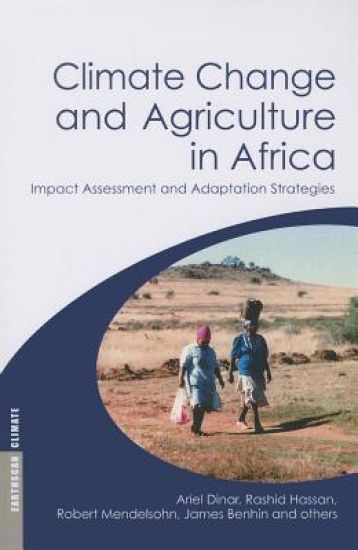
Climate Change and Agriculture in Africa
Ariel Dinar; Rashid Hassan; Robert Mendelsohn; James Benhin; et al
Routledge
2015
nidottu
This landmark book encompasses a comprehensive assessment of the potential economic impacts of future climate change, and the value of adaptation measures in Africa for different zones, regions, countries and farm types. Researchers developed and applied multiple analytical procedures to assess quantitatively how climate affects current agricultural systems in Africa, enabling them to predict how these systems may be affected in the future by climate change under various global warming scenarios, and suggesting what role adaptation could play. The study is the first to combine spatially referenced household survey data with climatic data at both national and international levels. This book provides vital knowledge about the impacts of climate change on Africa, serving as a guide to policy intervention strategies and investment in adaptation measures. It makes a major contribution to the analysis of climate change impacts and developing adaptation strategies, especially in the highly vulnerable farming communities in the developing world. Published with CEEPA and supported by the World Bank.